Poseidon’s Scribe has done it again and now presents another interview with a captivating author whose story appears in the anthology Avast, Ye Airships! Today I welcome 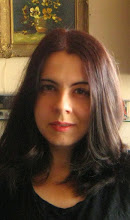 Diana Parparita, a Romanian author living in Bucharest who writes fantasy and steampunk.
Read on for the interview:
Poseidon’s Scribe: When and why did you begin writing fiction?
Diana Parparita: I started writing fiction when I was four or five years old. I hadn’t learned to write yet, back then, so I dictated my stories to my grandmother, but the intent to write speculative fiction was there, even at that age. The reason why I began writing, or, rather, dictating, was that I kept making stories in my head to entertain myself, and I liked them enough that I wanted to share them with others. And I kept forgetting them, so a big incentive for writing was to have a way to remember the best stories that I’d come up with.
P.S.: What are the easiest, and the most difficult, aspects of writing for you?
D.P.: The easiest part of writing for me is writing dialogues. My characters feel very much alive to me, and tend to act as if they had a mind of their own, so they talk naturally and I can always picture what they’d say and how they’d say it. The most difficult part for me is writing action scenes. I still haven’t been able to figure out a good pacing for writing action. When I read, I tend to skip through most of the fight scenes because I just want to know how it ends, and I haven’t been able to find a way to keep the reader’s attention on the action itself, at least not my attention.
P.S.: What is your favorite genre to write in?
D.P.: My favorite genre is fantasy, because it offers me complete freedom to create any type of world and society I choose. But I’m also fond of sci-fi, for the same reason, although I find it colder than fantasy.
P.S.: You live in Romania, right? Have you used Romania as a setting in any of your stories? If not, are there other ways that living in that country has influenced your fiction?
D.P.: Yes, I live in Romania. I haven’t used Romania per se as a setting, but the setting for the stories in my Huntsfee series is loosely based on Romania. There are, however, other ways I which living in Romania and being Romanian has influenced my writing. Romania is at the border between several cultures, and has seen a good number of invaders over the centuries, and as a result, Romanian writers tend to incorporate elements from different cultures into their writing. In that respect, my writing stories set in a fictional version of the Victorian age, as well as mixing that with elements from other cultures, is in perfect agreement with my Romanian heritage. To give an example, the story I wrote for Avast, Ye Airships! is influenced by the steampunk stories I’ve read and by Victorian England, but also by Jules Verne and an Italian 19th century writer of adventure novels, whose pirates have played an important part in my adolescence. This mixture of elements from three different cultures is all very natural to a Romanian writer and to Romanian culture.
P.S.: Your story “Miss Warlyss Meets the Black Buzzard” will appear in the anthology Avast, 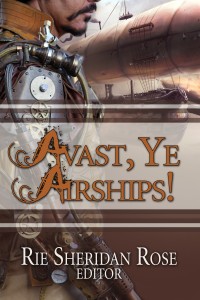 Ye Airships! Please tell us a little about Miss Warlyss.
D.P.: Miss Warlyss is the daughter of a governor, who grew up in a pensionnat, and she’s now being sent home to become the bride of one of her father’s political allies. Which, of course, is something she doesn’t quite fancy doing in the near future. But you’ll have to read the story to see just how she manages to avoid getting married.
P.S.: In your website and in social media, your sense of humor is evident. Do you include humor in all your stories, or are there some purely serious ones?
D.P.: I’ve written some stories that are meant to be purely serious, but I’m afraid my sense of humor does show even in those, though to a lesser degree. I tend to make fun of the worst parts of life, as a form of self-preservation, so the darker the story, the harder it is not to add a touch of humor to it.
P.S.: From your Facebook page, I gather that a cat figures prominently in your home life. Does the cat inspire any characteristics or features of any of the animals in your stories?
D.P.: Actually, the cat in question is a rather new addition to the household. We’ve only had her for a few months. I used to have a cat before her, but she never inspired any characters either. But whenever I write animals, they are indeed based on nature. I always pay close attention to animals when I have a chance, and I try to study them before I use any animals as characters. Except for the horse in the first story I’ve ever published, “Sir Joseph’s Choice,” which was heavily anthropomorphized from a psychological point of view.
P.S.: One of your published books is Doctor Edmund 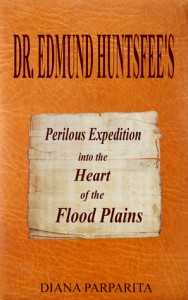 Huntsfee’s Perilous Expedition into the Heart of the Flood Plains. It appears this has inspired a series, with a second story published and a third being written. What do you find fascinating about the world or characters in this series?
D.P.: What I find most fascinating about the series is the continuous study of new and original species. Dr. Huntsfee is a sort of natural historian who specializes in the study of fantasy creatures, so each story enables me to create and present in detail a new personal species. But there’s one more thing that fascinates me about this series, and that’s the relationship between two of the characters in it, Miss Ophelia Dalton and Captain Joseph Marlin. They were both created to serve very specific roles within the story: Miss Ophelia is the chaperon of Dr. Huntsfee’s friend and love interest, while the captain was meant to be in charge of the boat the expedition is sailing on. They were never meant to be a couple, and that shows even in the age difference between them, with him being about ten years younger than her, but from their first scene together, they’ve developed a special chemistry that I hadn’t planned for them to have. So now I’m very curious to see where that’s going and I want to explore that budding relationship through many other stories.
P.S.: What is your current work in progress? Would you mind telling us a little about it?
D.P.: I’m always working on several things at the same time, so right now I’m working on the third installment in the Huntsfee series, a steampunk retelling of The Little Mermaid, and a young adult novel about a girl who finds out she’s part dryad and gathers an army to free her country of an evil dictator and the dragons under his command.
Poseidon’s Scribe: What advice can you offer aspiring writers?
Diana Parparita: I think the best advice I can offer is to read the best stories and novels in the genre they want to specialize in, as well as the very best that other genres have to offer. I’ve noticed that quality is something that tends to rub off, so the more good books you read the better. Also, there’s one piece of advice that I haven’t heard enough: live! Get as much life experience as you possibly can. I have a bad record of never staying in a job for longer than a year and a half, but, apart from it looking dreadful on my résumé, this has helped me meet all sorts of people and has placed me in all sorts of environments. The pirates in “Miss Warlyss Meets the Black Buzzard,” for instance, are based on some of my co-workers from a male-dominated workplace I landed in a couple of years ago. Having lived my entire life in a female-dominated environment, it was just as much of a shock to me as it was to Miss Warlyss, and that provided me both with an understanding of her experience and with a good reference for my pirates and for male-dominated environments in general. My pirates would have never seemed authentic if I’d found a comfortable job and stayed in it all my life. So I definitely advise experiencing things outside of your comfort zone.
Thank you, Diana! My many readers are urged to learn more about Diana Parparita on Facebook, on DeviantArt, and at her website.
Poseidon’s Scribe