At a writing panel event a few months ago, I met Susan Ayres. Some poets concentrate on one theme or subject, returning to it often. Not Susan. She’ll write a poem about anything and doesn’t limit herself. Also, her poems sometimes go beyond words, to include pictorial images, a medium called Visual Poetry. Unlike many poets, Susan also practiced law. If lawyer and poet sound incompatible to you, read on to see how Susan Ayres fits both into her life.
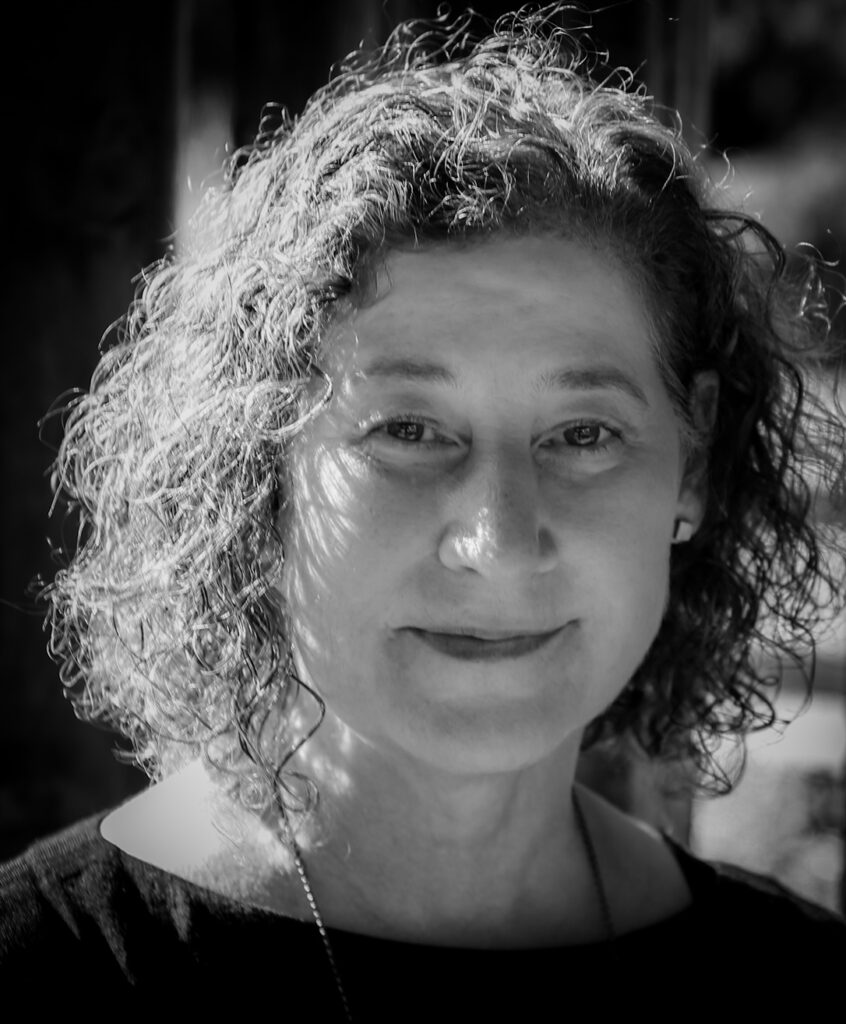
Bio
Susan Ayres is a poet, lawyer, and translator from the Spanish. Her work has been nominated for a Pushcart Prize, and has appeared in a variety of literary and scholarly journals. She has studied Spanish in Cuernavaca, Mexico, practiced karate for nine years with her son, and now spends time in Texas writing, collaging, teaching, and practicing tai chi. Her chapbooks are Walk Like the Bird Flies (Finishing Line, 2023) and Red Cardinal, White Snow (Main Street Rag, 2024). Visit www.psusanayres.com.
Interview
Poseidon’s Scribe: How did you get started writing? What prompted you?
Susan Ayres: My uncle, who was an artist, would pay me a nickel when I was a child to write a story. It was his way of keeping me entertained when we went out to dinner as a family, and he saw that I was bored. He’d say, “See the people at that table over there? Make up a story about them.”
P.S.: Who are some of your influences? What are a few of your favorite poems?
S.A.:There are so many poets I love, including Whitman, Dickinson, Stevens, Hopkins, and more recent poets like Adrienne Rich, Denise Levertov, WS Merwin, Sharon Olds, Ada Limón, Martín Espada, William Stafford, Ross Gay.
Some of my favorite poems are “Pied Beauty” by Hopkins, “A Noiseless Patient Spider” by Whitman, “For the Anniversary of My Death” by Merwin. I have a stack of poems on notecards that I like to take with me on walks to memorize (and re-memorize).
P.S.: You’ve translated several poems, notably some by Elsa Cross and some by David Anuar. How does translating poetry compare with translating prose? What is it about these two poets in particular that made you want to translate their poems into English?
S.A.:The famous literary translator, Edith Grossman, points out in her book Why Translation Matters that prose is easier to translate than poetry—she says, “most of the time it was possible to complete a page of prose in about the same time it took to revise and rework a line of poetry.” I have found poetry much more difficult to translate than prose because every word in a poem matters.
Elsa Cross is a wonderful poet and person—her poetry is complex and metaphysical. David Anuar is also a wonderful poet and person. His poetry is more personal and playful than Elsa’s. Both are award-winning poets. Elsa has been around longer and has many collections of poetry. Over the years, I have gotten to know both poets, and I especially enjoy and appreciate their willingness to provide feedback in the translation process. Recently, David and I worked together to translate poems by the late Mexican poet Ursus Sartoris.
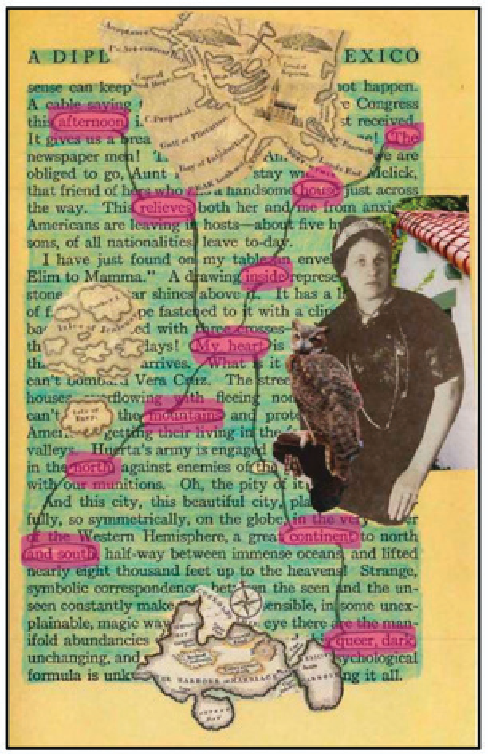
P.S.: Some of your poems, like “Luz, Map of Matrimony” and “Worlds Apart” are examples of visual poetry. What are visual poems and how do you create yours?
S.A.:Visual poetry is also categorized as hybrid literature or graphic art; it may take many forms, such as erasure, collage. For my visual poems in my project on the wives of Pancho Villa, I have used a page of a memoir of the Mexican Revolution by Edith O’Shaughnessy (A Diplomat’s Wife in Mexico), and have done both erasure and collage. I work the old-fashioned way—analogue, not digital—with paper and a glue stick.
P.S.: You’re both a poet and a lawyer. In addition, you used to teach law. Some may think of poetry and the law as opposites, with poets playing with fun-sounding words and expressing feelings about the human condition, while lawyers deal with dry texts and the dull legal minutiae of societal wrongs. Do you see the two endeavors as opposites, or do you see large overlaps in their Venn diagram circles?
S.A.:There is so much overlap between law and literature—it is a unique category of law, as a matter of fact. There are courses and workshops and journals devoted to the overlap between law and the humanities. My favorite course to teach was Law and Literature.
P.S.: Has your experience as a lawyer and teacher influenced your poetry? If so, how?
S.A.:I believe so. It is impossible to write outside of our experience. But it is also hard for me to see myself from the outside and describe how law has influenced my poetry.
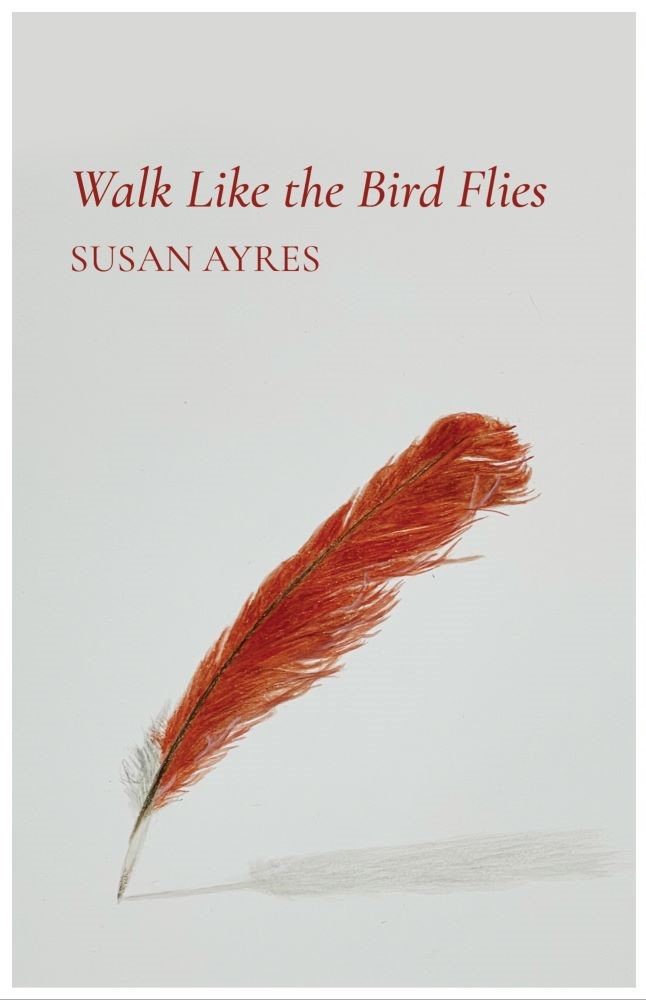
P.S.: Tell us about your chapbook, Walk Like the Bird Flies.
S.A.:Walk Like the Bird Flies was my first chapbook (Finishing Line Press 2023). It is a collection of poems set in different parts of the world, and contains prose poems, lyric poems, and one documentary poem at the end of the collection, “Trouvelot’s Crater,” which is about the French scientist and artist, Étienne Trouvelot, who unintentionally released the gypsy moth (now called spongy moth) into the United States from France.
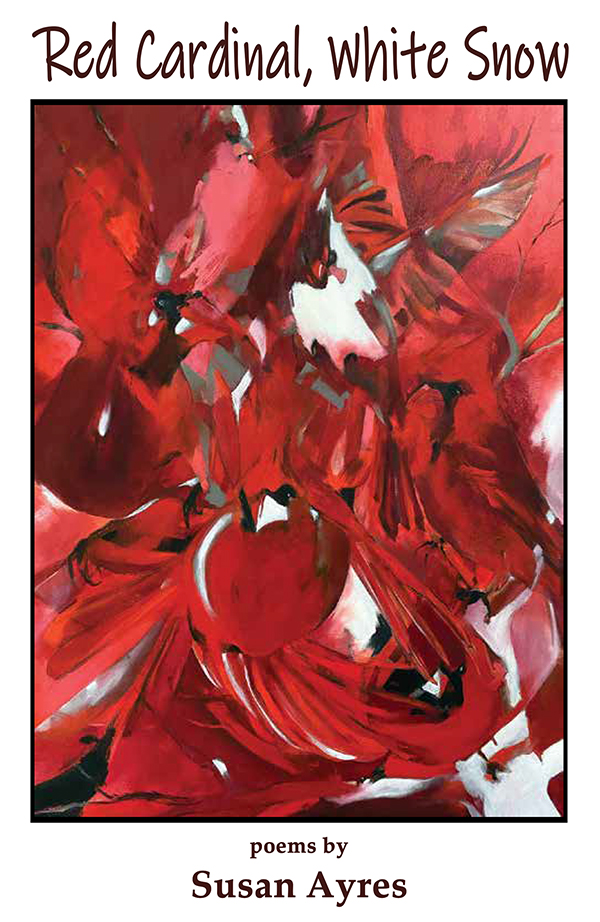
In 2024, Mainstreet Rag published my second chapbook, Red Cardinal, White Snow, which is a book about family secrets surrounding mental illness.
P.S.: Reading a sample of poems linked on your website shows a vast spectrum of topics and formats. What, if anything, ties your poetry together? Are there common themes or poetic structures to which you return more often?
S.A.:Thank you for this observation and question. Sometimes I work on a particular project, such as the wives of Pancho Villa, but nothing is really off-limits for my poetry, and I never know what might inspire me. That is one of the most amazing aspects of poetry. I might be inspired to write a poem about my husband or children, or about something I saw on my morning walk or on a vacation. Sometimes I write a poem that is based on a dream. The possibilities are endless.
P.S.: Describe your poetic process. Do you write a draft in one sitting? How many drafts does one of your poems require? Do you have several poems working at any particular time, or do you finish one before beginning another?
S.A.:I usually write first drafts by hand in my journal, and then type them into a word document for revision. Revision is a huge part of my work. I have learned the hard way to save revisions as separate documents—because sometimes a change is one for the worse, and I have go back to a previous version. I do work on several poems at once. Sometimes it seems very chaotic and disorganized—I remind myself to be comfortable with uncertainty, and I have lots of different colored folders.
P.S.: What is your current work in progress? Would you mind telling us a little about it?
S.A.:Thank you for asking this question. I am compiling a manuscript on the wives of Pancho Villa that contains poems and visual poetry. This project is different from others because it is based in history and is narrative poetry, as opposed to being more personal and lyric poetry. It is also a feminist project because history has little to say about the wives; my poems attempt to give voice to these forgotten women.
Poseidon’s Scribe: What advice can you offer beginning poets?
Susan Ayres: Some of the best advice I received was to read widely. I would also say don’t be discouraged by rejection. Keep writing, and if you are sending out your poems for publication, try to embrace rejection because it is inevitable. Also, try to find a community of poets—either a local poetry society or a group that meets online, because it is inspiring to be with other writers, and it is helpful to have readers who might offer critiques or encouragement.
Poseidon’s Scribe: Thank you, Susan.
Web Presence
Readers may discover more about Susan’s poetry at her website, on Instagram, and on Facebook.


Susan is as wonderful a person as she is a poet. Fine interview.
Thank you, Charles, for visiting my blog, and for the comment. I enjoyed meeting and interviewing Susan.