Author Interview – Ann Katagiri

Just before they closed, Leaves Book and Tea Shop held one last Afternoon with Authors event. That’s where I met Ann Katagiri. Just as Leaves combines books with food, so does Ann. Not only is she an author, but she’s soon to start her own cafe. Not only is her book a fun read, but it might inspire you to learn a new language, or two. As you’ll find out from the interview, Ann has specific dreams, and pursues them with determination and passion.

Bio

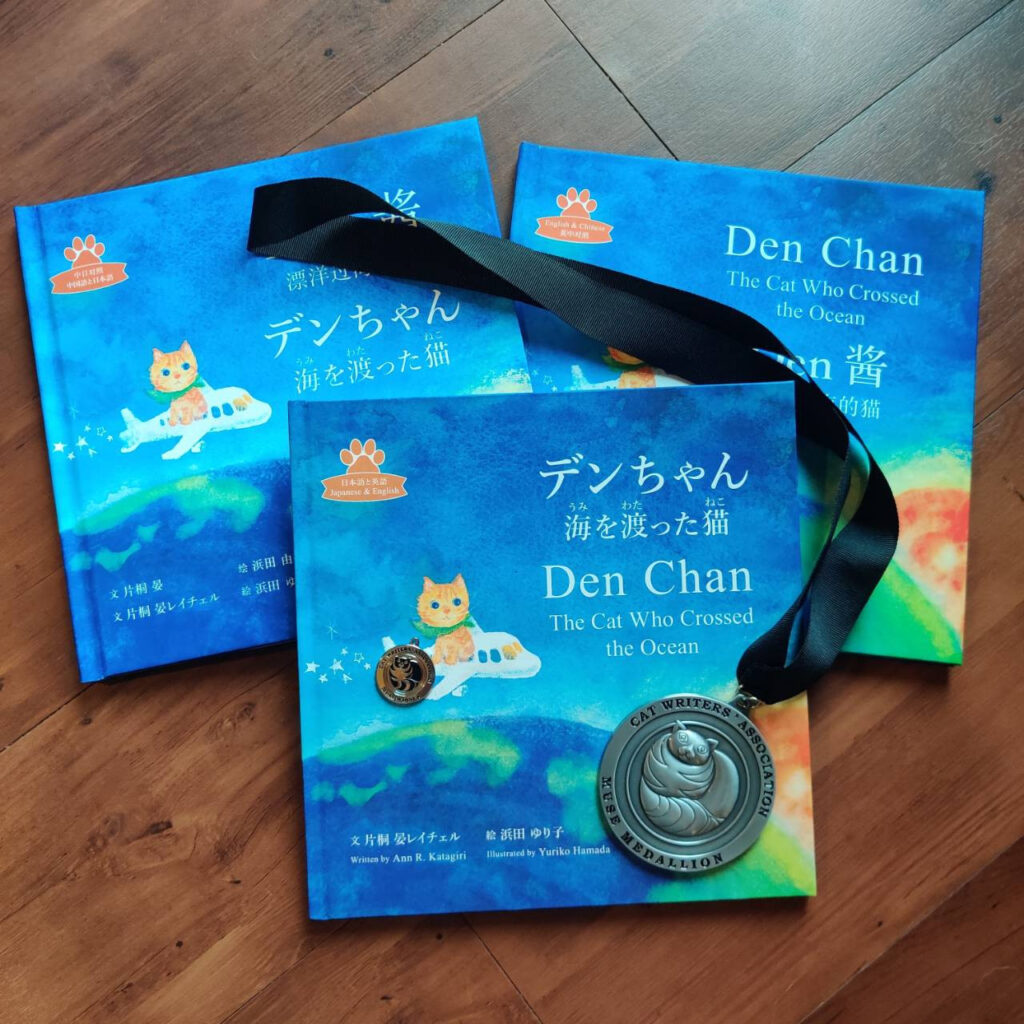
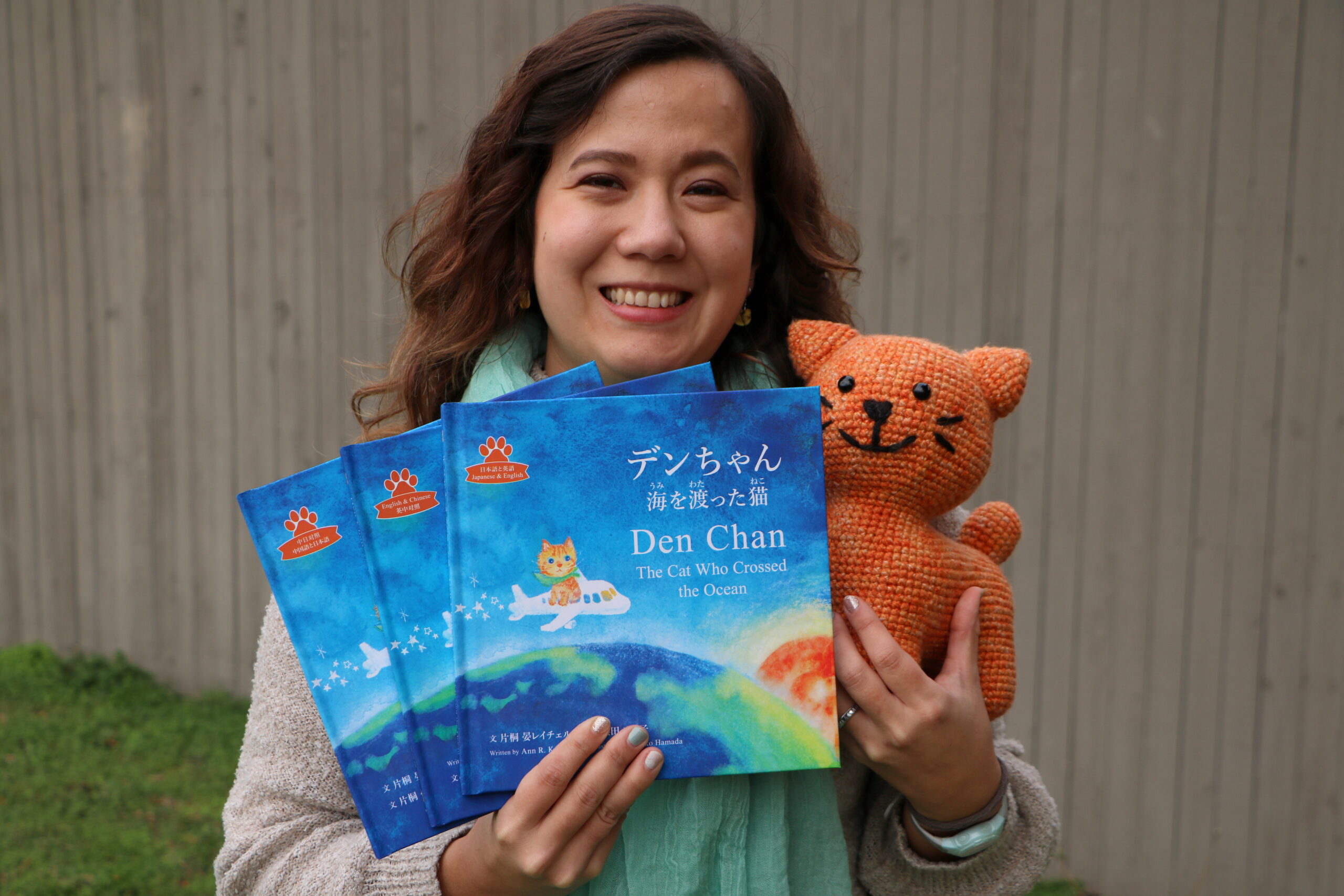
Ann Katagiri is a polyglot author who speaks English, Japanese, and Mandarin Chinese. Her three debut bilingual books, all titled Den Chan: The Cat Who Crossed the Ocean, were independently published in December 2023. Based on a true story, the books follow the adventures of an orange tabby cat who travels from Japan to Texas. The children’s books are written in bilingual pairs of Japanese & English, English & Mandarin Chinese, and Mandarin Chinese & Japanese. Proudly printed and bound in the Dallas-Fort Worth area, each book purchase supports five small businesses. The books are written in hope of inspiring language learning in everyone, regardless of age. She often does vendor events around the DFW area, selling her three books, t-shirts, and lots of different hand-made kitty merch. All of her items that she doesn’t craft are sourced from other creatives, supporting local small businesses 100%. Her next venture is one true to her heart, Den Chan Cafe, coming in September 2026.

Interview

Poseidon’s Scribe: How did you get started writing? What prompted you?

Ann Katagiri: Writing has always been important in my family, especially growing up with a father who is an academic and published author as well as a mother who is an English teacher. For me, writing started off as a place to put words to my feelings, morphed into four years of travel blogs, then my current trilingual blog, A Halfie’s Rambles, started in 2019.

P.S.: Who are some of your influences? What are a few of your favorite books?

A.K: My life has been influenced by so many people and things that it is a little hard to name specifics. Living a life growing up in both Japan and Texas, as well as living and working in China for over 3 years has shaped me in profound ways. One of my life-long dreams of traveling to 30 countries before I turned 30 definitely gave me a whole new perspective on how to view the world and its wonderful people.

My all-time favorite book is one from Japan, The 14 Forest Mice series!

P.S.: You’ve said Den Chan, the Cat Who Crossed the Ocean is based on a true story. In brief, what was that story?

A.K: Growing up in the outskirts of Tokyo, my siblings and I met Den Chan as a tiny orange ball of fur. We adopted him shortly before we moved to Texas to start high school and he was a treasured part of our family for years to come. My books capture the story of us moving and how that came about, written from Den Chan’s perspective, but embodying my family’s true story.

P.S.: You published Den Chan in three versions, each with two languages. Translation can often be tricky, with culture-specific idioms and connotations for various words. Did you encounter translation difficulties with the three versions of this book?  If so, how did you resolve them?

A.K: It was definitely a little frustrating at times, since I had many language experts helping me who only spoke two of the three languages. Whenever I edited one language, I made sure that the other two reflected that same change. However, the books are not so-called “direct translations” but specifically translated to reveal each language’s hidden nuances and meanings to make the most sense. I also wanted the books to be helpful to anyone trying to learn any of the three languages.

P.S.: You call your blog “A Halfie’s Rambles.” What is a halfie, and what are you rambling about?

A.K: I absolutely love this question! I call myself a halfie because in Japanese, “hafu” is a nickname for anyone who is of mixed blood, typically of two races. Halfie is more slang, but I wanted to proudly show that I straddle two different cultures and am proud to be fully both Japanese as well as Texan.  I love to especially ramble about any topic I’m passionate about, travel, recipes, cultures, and languages!

P.S.: In the “Who’s the Rambling For?” section of your blog, you mentioned the term “Third Culture Kid.” What does that mean, and how would you say your life blends two cultures to form a third?

A.K: Even though “Third Culture Kid” typically refers to kids who grew up in a third country that neither of their parents are from, I always felt like I belonged in this group because the culture my siblings and I created definitely became a “third” culture for us. When we talk to each other, it is typically a mix of both Japanese and English (honestly, whichever comes to mind first) and the food we make is usually a fun mix of both countries (think, Salisbury steak with rice and pickles instead of with mashed potatoes and green beans).

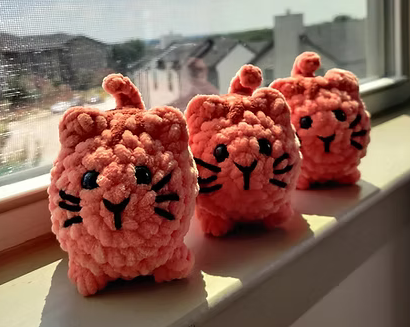
P.S.: You make and sell little plush stuffed animal versions of the orange cat, Den Chan, to supplement the book. What other non-writing hobbies or interests do you have? Do they complement your writing or are they a relief from writing?

A.K: I love visiting science museums and local coffee shops when I have free time or am traveling. For me, blog post drafts typically are inspired by something that happens throughout my life, so even if they don’t turn into a book, they definitely become part of my blog drafts that then get chosen to be published as part of my free monthly post in three languages!

P.S.: I’ve read that you attended culinary school, and taught others how to cook. Please tell us about that experience. Also, does your cooking expertise impact your writing in any way?

A.K: Attending culinary school had been a dream of mine since I was 15, but despite being accepted to the CIA in NY, I didn’t have the money to pay for tuition at 17. After living and working in Beijing for a few years and having the chance to teach kids baking and cooking classes, I realized that attending culinary school was a dream I simply couldn’t give up. In 2021, I successfully graduated from a Japanese and French culinary school in Japan, happily falling in love with making chocolates and baking breads. My cooking expertise is sometimes shared through recipes on my blog that I write in a simplified way so that readers can follow along easily.

Ann Katagiri and a Giant Panda

P.S.: In one blogpost, you casually mention hugging a giant panda. Did that really happen? If so, what was it like? They are bears—large, dangerous, wild animals—right?

A.K: YES and it was absolutely magical as well as the most expensive few minutes of my life. Due to conservation efforts to not let tourists hug baby pandas anymore, the one option I had to make this dream of mine come true was to visit the Chengdu Research Base of Giant Panda Breeding in China. You can make a donation in order to spend a few minutes sitting and taking pictures with a Giant Panda who is distracted eating bamboo! They also have a program where you can become “Panda Keepers” for the day and help out at the research base, which I would highly recommend!

P.S.: You’re one of the few authors I’ve interviewed who started her own publishing company. Why did you do that, and how is that decision working out?

A.K: I branched out on my own because there wasn’t a publishing house out there who would publish my books in the three languages I speak: English, Japanese, and Mandarin Chinese. I also have a passion for supporting local small business and not big monopolies, so rather than giving up on this dream of mine, I incorporated A Halfie’s Rambles to make it come true. This decision is something I will stand by for as long as I’m alive because it means the world to me to have the honor of printing and binding my three books with the help of 3 small businesses in DFW. Every Den Chan book purchase proudly supports them as well as myself and my illustrator.

P.S.: What is your current work in progress? Would you mind telling us a little about it?

A.K: I am actually currently working very hard to open Den Chan Cafe, which will be based on my three bilingual books, created for language and cat lovers. It will be fueled by the same passion to support local small businesses, this time, expanding with new artists. All sourcing will be done from local farms as well as a coffee roaster who sources direct from coffee farms in El Salvador. I do have a sequel I am writing that will cover Den Chan’s life in Texas, but it will come out after the cafe is up and running!

Poseidon’s Scribe: What advice can you offer aspiring authors?

Ann Katagiri: Know exactly what you want and how much you’re willing to work for it, that way, it won’t matter what others say. Creating your own publishing company isn’t everyone’s cup of tea, but I always like saying, “there’s always a way for what you believe in”. If you are going to be amazing, I hope you have the courage to stand out from the crowd.

Poseidon’s Scribe: Great advice. Thank you, Ann.

Web Presence

Readers can find out more about Ann Katagiri at her blog, A Halfie’s Rambles on Facebook. For information about her book, check out this Instagram page and this page of her website. She’s also got a personal Instagram page. You may subscribe to her free monthly trilingual blog and get emails straight to your inbox. Be sure to check out the Den Chan Online Store. Find out about the soon-to-open Den Chan Cafe on Instagram and on Facebook. It’s scheduled to open on September 28, 2026. You can find Ann on Goodreads as well. Read another interview of Ann here.

Catch Me on the “Miles Beyond the Page” Podcast

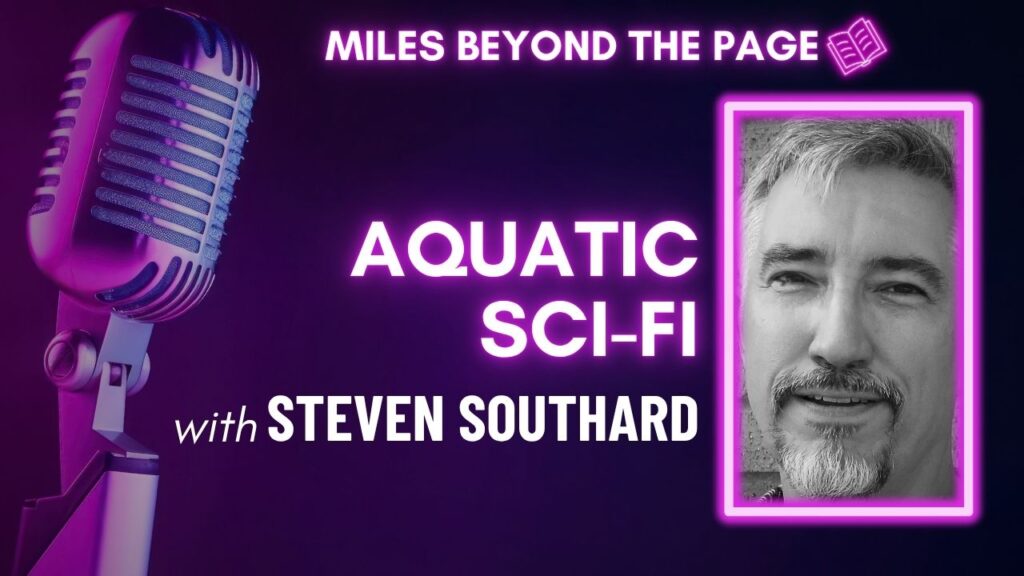
Author and podcaster Michelle Miles hosted me on her podcast, “Miles Beyond the Page.” You can watch and listen on YouTube here, or on Spotify, Apple Podcasts, Amazon MusiciHeartRadio, or GoodPods.

You know about Michelle from my blogpost interview of her. An author of fantasy, urban fantasy, and paranormal romance, she had no problem interviewing this science fiction author. She made me feel at ease during the podcast, an interview format I’ve had only limited experience with.

She’s done numerous podcasts and you can check them all out here.

I’m grateful to Michelle Miles for this opportunity. She did a wonderful job with her podcast interview of—

Poseidon’s Scribe

Poet Interview – Susan Ayres

At a writing panel event a few months ago, I met Susan Ayres. Some poets concentrate on one theme or subject, returning to it often. Not Susan. She’ll write a poem about anything and doesn’t limit herself. Also, her poems sometimes go beyond words, to include pictorial images, a medium called Visual Poetry. Unlike many poets, Susan also practiced law. If lawyer and poet sound incompatible to you, read on to see how Susan Ayres fits both into her life.

Bio

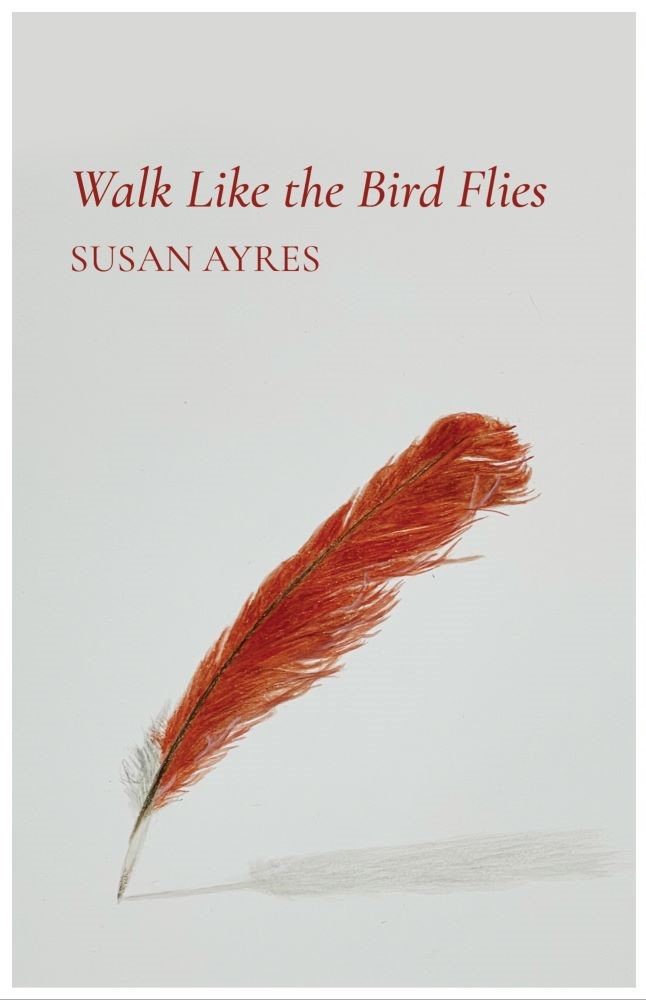
Susan Ayres is a poet, lawyer, and translator from the Spanish. Her work has been nominated for a Pushcart Prize, and has appeared in a variety of literary and scholarly journals. She has studied Spanish in Cuernavaca, Mexico, practiced karate for nine years with her son, and now spends time in Texas writing, collaging, teaching, and practicing tai chi. Her chapbooks are Walk Like the Bird Flies (Finishing Line, 2023) and Red Cardinal, White Snow (Main Street Rag, 2024). Visit www.psusanayres.com.

Interview

Poseidon’s Scribe: How did you get started writing? What prompted you? 

Susan Ayres: My uncle, who was an artist, would pay me a nickel when I was a child to write a story. It was his way of keeping me entertained when we went out to dinner as a family, and he saw that I was bored. He’d say, “See the people at that table over there? Make up a story about them.”

P.S.: Who are some of your influences? What are a few of your favorite poems?

S.A.:There are so many poets I love, including Whitman, Dickinson, Stevens, Hopkins, and more recent poets like Adrienne Rich, Denise Levertov, WS Merwin, Sharon Olds, Ada Limón, Martín Espada, William Stafford, Ross Gay.

Some of my favorite poems are “Pied Beauty” by Hopkins, “A Noiseless Patient Spider” by Whitman, “For the Anniversary of My Death” by Merwin. I have a stack of poems on notecards that I like to take with me on walks to memorize (and re-memorize).

P.S.: You’ve translated several poems, notably some by Elsa Cross and some by David Anuar. How does translating poetry compare with translating prose?  What is it about these two poets in particular that made you want to translate their poems into English?

S.A.:The famous literary translator, Edith Grossman, points out in her book Why Translation Matters that prose is easier to translate than poetry—she says, “most of the time it was possible to complete a page of prose in about the same time it took to revise and rework a line of poetry.” I have found poetry much more difficult to translate than prose because every word in a poem matters.

Elsa Cross is a wonderful poet and person—her poetry is complex and metaphysical. David Anuar is also a wonderful poet and person. His poetry is more personal and playful than Elsa’s. Both are award-winning poets. Elsa has been around longer and has many collections of poetry. Over the years, I have gotten to know both poets, and I especially enjoy and appreciate their willingness to provide feedback in the translation process. Recently, David and I worked together to translate poems by the late Mexican poet Ursus Sartoris.

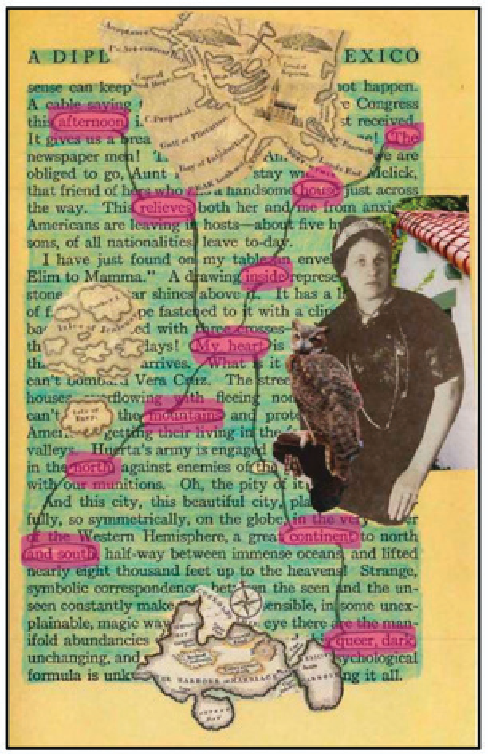
Luz, Map of Matrimony

P.S.: Some of your poems, like “Luz, Map of Matrimony” and “Worlds Apart” are examples of visual poetry. What are visual poems and how do you create yours?

S.A.:Visual poetry is also categorized as hybrid literature or graphic art; it may take many forms, such as erasure, collage. For my visual poems in my project on the wives of Pancho Villa, I have used a page of a memoir of the Mexican Revolution by Edith O’Shaughnessy (A Diplomat’s Wife in Mexico), and have done both erasure and collage. I work the old-fashioned way—analogue, not digital—with paper and a glue stick.

P.S.: You’re both a poet and a lawyer. In addition, you used to teach law. Some may think of poetry and the law as opposites, with poets playing with fun-sounding words and expressing feelings about the human condition, while lawyers deal with dry texts and the dull legal minutiae of societal wrongs. Do you see the two endeavors as opposites, or do you see large overlaps in their Venn diagram circles?

S.A.:There is so much overlap between law and literature—it is a unique category of law, as a matter of fact. There are courses and workshops and journals devoted to the overlap between law and the humanities. My favorite course to teach was Law and Literature.

P.S.: Has your experience as a lawyer and teacher influenced your poetry? If so, how?

S.A.:I believe so. It is impossible to write outside of our experience. But it is also hard for me to see myself from the outside and describe how law has influenced my poetry.

P.S.: Tell us about your chapbook, Walk Like the Bird Flies.

S.A.:Walk Like the Bird Flies was my first chapbook (Finishing Line Press 2023). It is a collection of poems set in different parts of the world, and contains prose poems, lyric poems, and one documentary poem at the end of the collection, “Trouvelot’s Crater,” which is about the French scientist and artist, Étienne Trouvelot, who unintentionally released the gypsy moth (now called spongy moth) into the United States from France.

In 2024, Mainstreet Rag published my second chapbook, Red Cardinal, White Snow, which is a book about family secrets surrounding mental illness.

P.S.: Reading a sample of poems linked on your website shows a vast spectrum of topics and formats. What, if anything, ties your poetry together? Are there common themes or poetic structures to which you return more often?

S.A.:Thank you for this observation and question. Sometimes I work on a particular project, such as the wives of Pancho Villa, but nothing is really off-limits for my poetry, and I never know what might inspire me. That is one of the most amazing aspects of poetry. I might be inspired to write a poem about my husband or children, or about something I saw on my morning walk or on a vacation. Sometimes I write a poem that is based on a dream. The possibilities are endless.

P.S.: Describe your poetic process. Do you write a draft in one sitting? How many drafts does one of your poems require? Do you have several poems working at any particular time, or do you finish one before beginning another?

S.A.:I usually write first drafts by hand in my journal, and then type them into a word document for revision. Revision is a huge part of my work. I have learned the hard way to save revisions as separate documents—because sometimes a change is one for the worse, and I have go back to a previous version. I do work on several poems at once. Sometimes it seems very chaotic and disorganized—I remind myself to be comfortable with uncertainty, and I have lots of different colored folders.

P.S.: What is your current work in progress? Would you mind telling us a little about it?

S.A.:Thank you for asking this question. I am compiling a manuscript on the wives of Pancho Villa that contains poems and visual poetry. This project is different from others because it is based in history and is narrative poetry, as opposed to being more personal and lyric poetry. It is also a feminist project because history has little to say about the wives; my poems attempt to give voice to these forgotten women.

Poseidon’s Scribe: What advice can you offer beginning poets?

Susan Ayres: Some of the best advice I received was to read widely. I would also say don’t be discouraged by rejection. Keep writing, and if you are sending out your poems for publication, try to embrace rejection because it is inevitable. Also, try to find a community of poets—either a local poetry society or a group that meets online, because it is inspiring to be with other writers, and it is helpful to have readers who might offer critiques or encouragement.

Poseidon’s Scribe: Thank you, Susan.

Web Presence

Readers may discover more about Susan’s poetry at her website, on Instagram, and on Facebook.

Author Interview – Frank Hood

At SoonerCon in June, I met science fiction author Frank Hood. Like me, he started as a kid in the Midwest reading scifi. Early on, he decided to write short stories, dreaming of huge success. As with me, he found out the world may not fall in love with your writing at first. In his case, it meant he had to put off his writing ambitions and get a job with more certain prospects. From the interview that follows, you’ll enjoy learning about his writing journey.

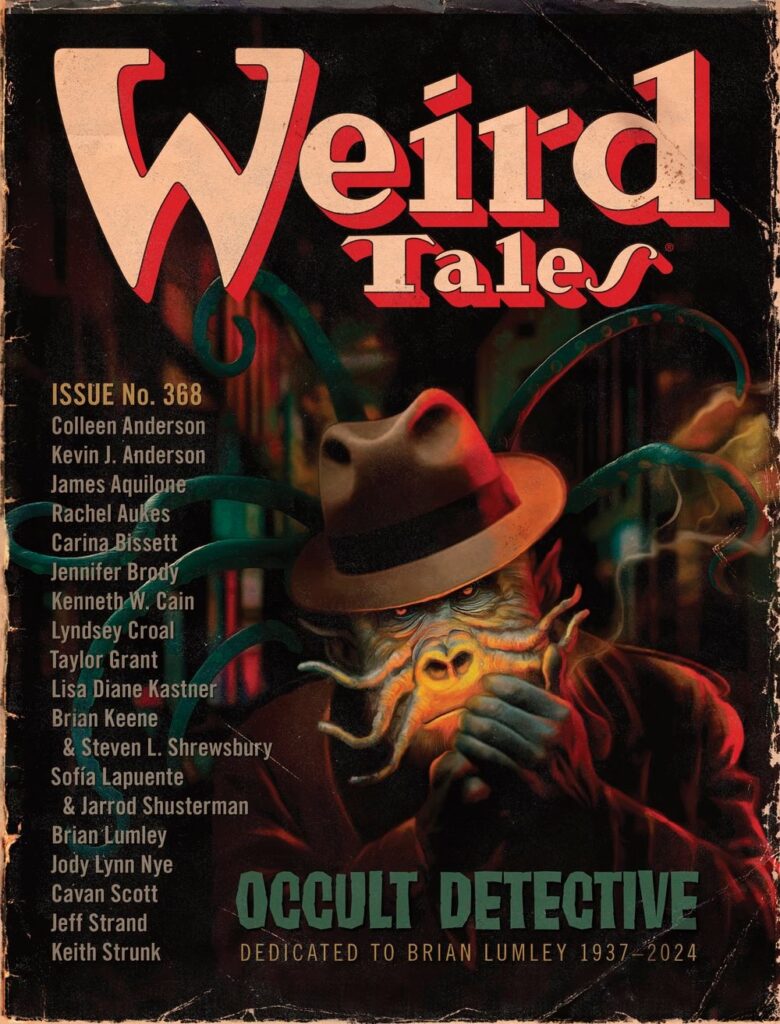
Note: Frank mentions Ray Bradbury’s 1950 story, “There Will Come Soft Rains” as one of his favorites. By a fitting coincidence, today, August 5, 2026, is the date repeated endlessly by the automated house in that story.

Bio

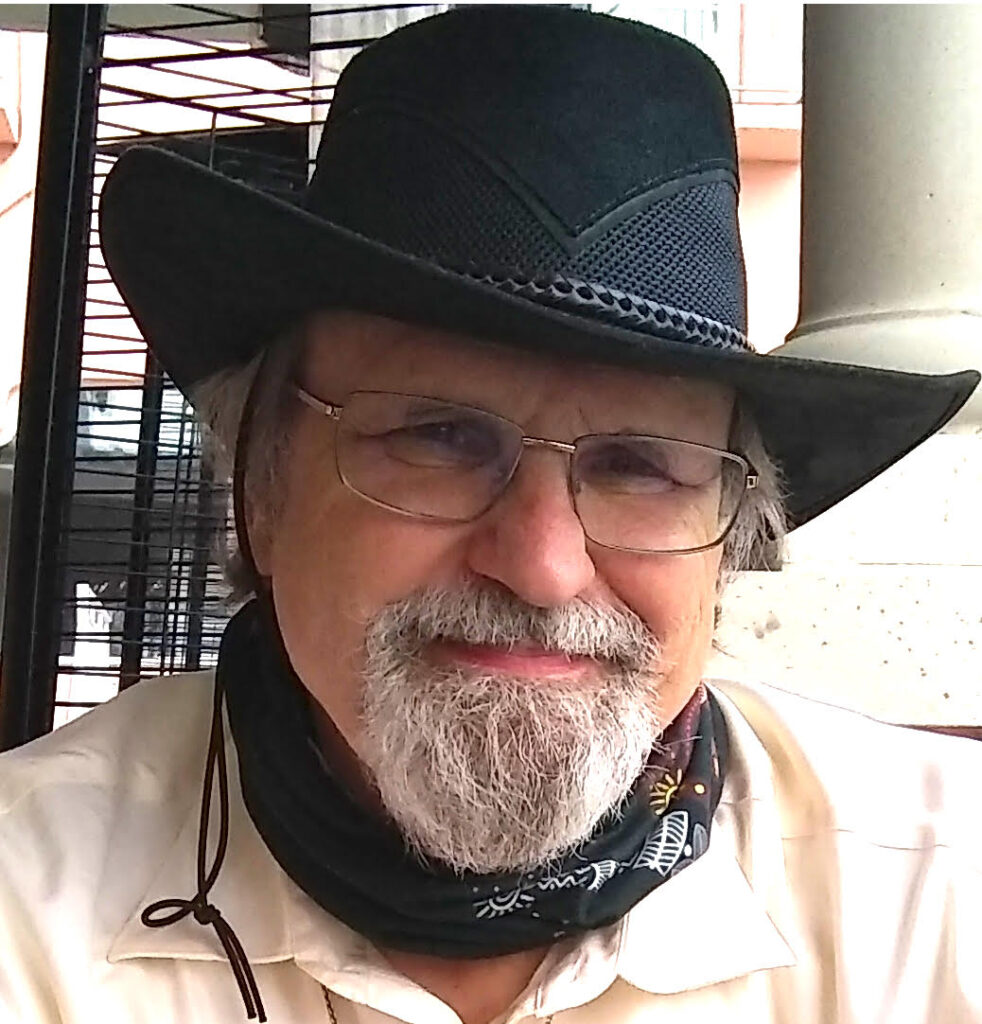
Frank Hood author photo

Frank Hood sold his first story at age 26 then spent 40 years as a software engineer from punch cards to AI. He documented that career in his first book A Geek’s Progress. Published his first novel Advance Guards in September 2025, and, along with his wife, a collection of horror/science fiction/fantasy/mystery stories, That Has Such Creatures in 2026. His second novel A Child’s Uneven Scrawl is expected in late 2026. Is well known for his ability to explain how AI really works to general audiences and for the depth of his fiction writing. He writes about whatever strikes his fancy from history, travel, science, humor, and social commentary at frank-hood.com.

Prefatory Remarks

I’m a storyteller, and, as Mick Jagger puts it, “I’ve been around a long, long time….” That is a lethal combination, so prepare yourself for a journey through the labyrinth that purports to be my mind, full of more digressions and dead ends than those of a mercury-addled mad hatter or ancient gold miner (I’ve met one of those. It was a trip.) There will be references and diversions such that you may never find your way out, so “Abandon all hope you who enter here.”

Interview

Poseidon’s Scribe: How did you get started writing? What prompted you? 

Frank Hood: I blame the accident of geography. Until I was 10, I was raised in an Irish Catholic neighborhood in north Detroit. It was a tight-knit community. We played baseball in the streets (not stickball, we had real bats). None of us even knew where the public school was. The Catholic high school was 2 blocks north. The Catholic hospital was 3 blocks east, and the church with its elementary school was about 8 blocks south. Basically you could live your whole life from baptism to funeral in that little neighborhood. Our playgrounds were the streets, backyards, and construction sites. Construction sites made great jungle gyms.

Then, when I was 10, we moved to San Diego where my dad switched from engineering cars to engineering airplanes and rockets. We rented a house on a 170-acre ranch that was a mile from the nearest neighbor and 10 miles from the nearest town that had only 19,000 people. You can see a picture of the ranch on the front page of my website.

That left 10-year-old me with only my 13-year-old and 4-year-old brothers for company. So, mostly I was on my own. On grocery trips to town with my mother, I skipped over to the drugstore where I could afford a couple of the 10 cent comics from the spinner rack. Those fed my imagination. Breakfast was informal, and usually the family didn’t talk much at that meal, so I read and re-read my comics while I consumed my cereal and toast. Dinner was for the formal interrogation and teasing of us boys by my father, but breakfast was my reading time.

My parents were readers, and we had Life Magazine and Readers’ Digest always lying around, so I read those too. I also had a subscription to Baseball Digest, which featured sportswriters’ columns from all over the country. Remember when a sports column was about poetic writing and dramatic moments rather than a bland listing of obscure statistics? No, well I feel sorry for you. It was fun.

In high school, I mostly wrote non-fiction, usually satires of everybody at the school to amuse my friends. I especially liked to satirize the administration and teachers. Our principal’s last name was Foucar (pronounced foo-kar). How could I resist writing about Mother Foucar? Or the just-this-far from senile Civics teacher? Or the brilliant but somewhat crazed German teacher? Or the 5’3” barrel-chested, ramrod straight WWII Marine veteran of Iwo Jima English teacher with the razor-sharp wit?

College was where I started to write fiction seriously. First, I concentrated on making entertaining plots that might make people shake their heads. An early one was two professors talking as they waited for a computer to output its solution on how to make a computer think, and ended with the computer typing out the scene they were in to the extent that it repeated the professors’ own conversation (albeit somewhat badly) until they tried to stop it before it took over the story—they weren’t fast enough. I guess I’ve been thinking about AI for a long time. Then I worked on creating characters for you to care about, but what the heck does an 18-year-old know about depth of character unless you’ve had a very traumatic childhood?

P.S.: Who are some of your influences? What are a few of your favorite books? 

F.H.: My biggest writing influence was probably Ray Bradbury. I love his way with words and the spooky stories he told, like “The Small Assassin,” “Skeleton,” and “There Will Come Soft Rains.” Boy, I wanted to be able to write like that!

After that, there’s Shakespeare. The depth and wisdom of his dialog as well as the breadth of his characters blow me away. Most of his plots were just borrowed from older works, but he gave voice to every piece of human instinct and desire. There is only one document that we can claim is what Shakespeare “said.” That is his last will and testament. He does not speak in any of his plays. There is no author’s voice proclaiming from a soapbox in Shakespeare. He writes conniving villains like Iago, brilliant and clever villains like Richard III, roguish young men who become heroes like Henry IV, and conflicted men who either yield to temptation like Macbeth or who finally claim the side of their better instincts like Hamlet. And all of his characters, including Shylock, the stereotypical greedy, conniving Jew, are given brilliant lines to express their views of life. None of those amazing speeches in all those plays are Shakespeare talking, rather they are his characters talking. Shakespeare encompassed all of life and expressed every point of view magnificently. “He summed it all up,” is the best, most insightful quote you will ever hear about Shakespeare. I try hard to be true to that method. There are no self-inserts in my fiction. I try to recreate real people with all their desires, motivations, and weaknesses.

Also in Catholic elementary school, we had a bookshelf at the back of the classroom with a dozen of Heinlein’s juveniles among other books, and I devoured them to feed my imagination. I’m trying to pay that debt back by donating books to my church’s new elementary school.

As an adult, I love the Horatio Hornblower books.

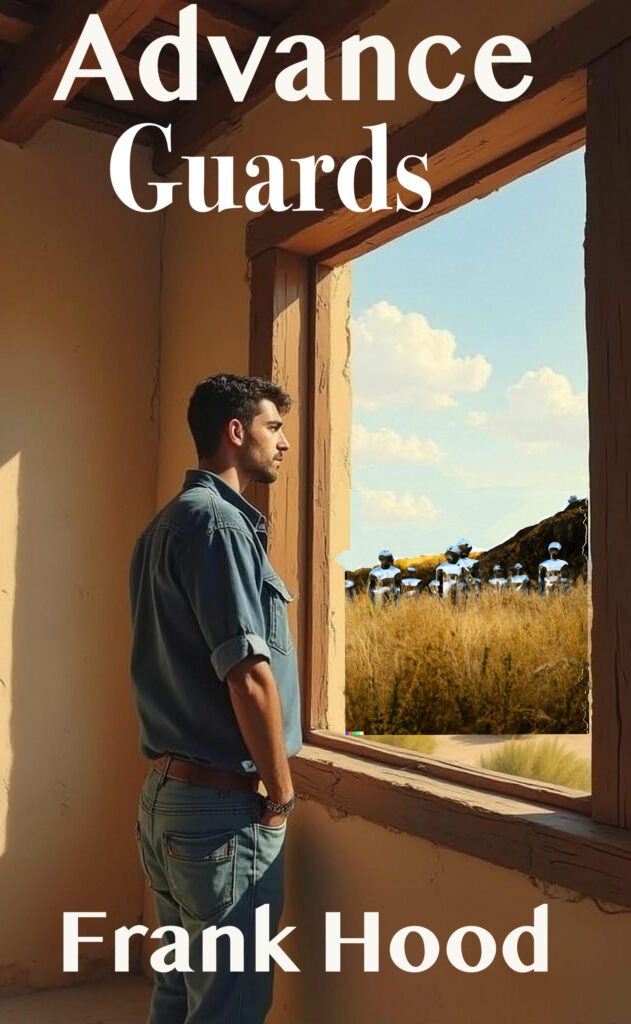
Advance Guards

P.S.: Your debut novel, Advance Guards, shows readers a future of plenty, with human wants satisfied. How does that world affect the main character, Thom? The cover shows a male—is it Thom?—looking out a window at a group of robots in a field. How does that cover image suggest the themes of the novel?

F.H.: Actually, that’s Thom’s youngest son Samuel on the cover. More on that later. The cover image is meant to show the contrast between the old adobe house without even glass for the windows and the shiny robots from the city.

One of the things about the novel is that it’s a family saga covering some 40 years, so I wrote it as 12 short (and some not so short) stories to accommodate time shifts and different points of view. The future Los Angeles I depict is dystopian, not because of any catastrophe, but because it’s simply a continuation of the way things are going. There’s no apocalypse, no plague, no totalitarian regime behind it all, just incremental improvements in technology until people have begun to lose human contact with each other.

Thom accidentally discovers a love interest in the first story. He begins to realize the bland life of isolation from both nature and humanity that lays ahead of him. Also he wants to rescue his love, Celia, who is going down a dark path of drugs and partying in her own form of rebellion against the city’s lifestyle when he meets her.

Thom finally asserts himself to find a different, less artificial way of life for himself and Celia. They end up raising a family of 7 kids in the wilderness 150 miles north of LA, learning, sometimes painfully, how to live off the land.

Then the kids grow up, and there’s still nobody out there beyond the family. When they notice one of the boys beginning to eye his older sister in a different way, they resolve to send each of their children back to the city when they turn 18. The second part of the novel explores the children’s individual and very different reactions to the city life their parents left and how they end up influencing the city for better or worse.

As a joke, I say the Hollywood pitch is, “Swiss Family Robinson meets The Jetsons, wrapped in a Shakespearean tragedy.”

The cover illustrates the opening scene from the last story where the youngest son, having returned to the family’s abandoned, hand-built adobe house to live in the country, sees a dozen robots that he helped design, coming to fetch him back to the city, doubtlessly at the behest of one or more of his siblings. 

The title, Advance Guards, is from an old Seals & Crofts song whose lyrics they claim were taken from a centuries’ old Middle-Eastern poem. I frequently use songs as inspiration for my stories.

P.S.: Does this first novel signal a shift to the longer form, or will you still write short stories? How different was it to write a novel?

F.H.: I will probably never abandon short stories, but they just don’t sell as well as novels and novellas. A lot of independent novels these days are about 60-80k words, which is short for what I remember growing up with, but makes it easier to put out a lot of work.

Advance Guards was not too different because I wrote it as a series of short stories with the same characters and one plotline, but the new novel is more traditional, so we’ll see how that goes.

P.S.: In your bio, you state you set out to be a great writer, but the expected large advances didn’t materialize. You chose a day job for steady income but dreamed about writing during that forty-year career. Were you able to write at all during that interval, or did the dream burn inside for those decades, awaiting the moment you had time to write?

F.H.: I never gave up on wanting to write. A lot of that was ameliorated with trying to help my wife’s writing career. More of it was satisfied by writing technical documents and proposals for novel approaches to applications for the DoD. At about 20 years into my career, I decided to sit down and write a story to see if I could still do it. The result was “The Gardener’s Wife” that is included in That Has Such Creatures as well as for sale individually as an ebook. That story convinced me that I hadn’t lost my fiction touch, but I waited until I retired to take up writing as a profession again.

A Geek's Progress

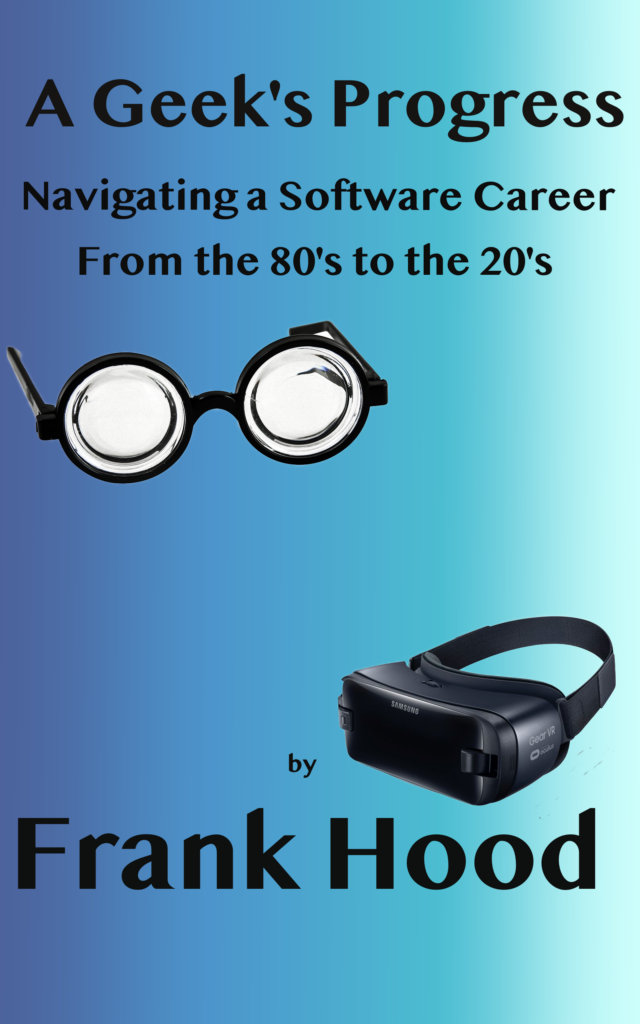
P.S.: You wrote A Geek’s Progress: Navigating a Software Career from the 80s to the 20s. The book discusses your career and your aim to live a good life, not necessarily to innovate your way to Silicon Valley billionaire status. Who is your intended audience for that book and what do you hope they get out of it?

F.H.: There are two groups I intend as an audience for A Geek’s Progress, grizzled software veterans like me, who, I hope, see themselves in my book and feel nostalgic about old times, and young people starting a career in the corporate world. I hope to give the latter a realistic idea of how to survive in the corporate world and make useful products for the end user even if management seems to prefer you didn’t. As I say, there are already a ton of books out there for the budding entrepreneur wanting to become the next Elon Musk or Steve Jobs, and A Geek’s Progress is not for them, it’s for the rest of us nerds who just want a satisfying career that enables us to have a family and a good life.

P.S.: What non-writing hobby or interest do you have? Does it complement your writing or is it a relief from writing?

F.H.: I write fiction. I write non-fiction. I dispense the wisdom of the ancients. I listen to my 10,000-song Pandora playlist. I donate platelets every 2 weeks or so because I have a talent for bleeding. I stream old TV series. I watch movies (and write reviews), and read books (and write reviews). I walk to the grocery store and back every other day, and, if I time it right, ogle the young ladies emerging from one of the many yoga studios in their stretchy leotards. I go out to lunch with former colleagues and friends. I go to SF Conventions, and each summer now I buy a 30-day Amtrak rail pass and take a cross-country train trip to LibertyCon in Chattanooga TN via Atlanta, with stops to play tourist along the way. One year it was DC, the next Cooperstown and the Baseball Hall of Fame, then Memphis (yes, I walked Beale St., but my feet didn’t leave the ground). The train gives me the opportunity to talk with quite an interesting mix of strangers (and write about it). This year SoonerCon was the week before LibertyCon, so I took that opportunity.

Oh right, you asked about non-writing. I’ve spent the last couple of years painfully learning art programs. (I have no coordination for real hand-drawing.) Someday I might actually get good at it, so I can make my own covers. I suppose I’m the definition of monomaniacal.

P.S.: What are the easiest, and the most difficult, aspects of writing for you?

F.H.: Easiest? I’d rather write about what I enjoy most about writing—just about everything. If I can make you laugh, if I can make you cry, then I feel I’ve done something wonderful and worthwhile. Writers and actors are manipulators (in a good way). We want to make our audience feel things they would normally suppress. The Greeks called it catharsis. Ray Bradbury said, when he found himself crying as he wrote something, he knew he’d written something good. J. Michael Straczynski wrote that, as a kid, he was reading a story where a little boy begged his grandfather for an ice cream cone. As soon as he left the store, the boy was distracted, tilted his hand, and the ice cream dropped on the pavement. Joe describes himself crying reading that. He read it a second time and cried again. He decided that if someone could make him care that much about somebody who wasn’t real, then he needed to learn how to do that. People have described my behavior upon seeing a good comedy in a movie theater as laughing so loudly that everybody looks my way.

What I like least is getting stuck because I’m so hung up on making the details consistent and plausible. Sometimes I just have to tell myself, “Pshaw, just say it happened, and they’ll figure it out.” A lot of times that’s the right answer. When Howard Hawks was directing The Big Sleep, he was doing the scene where the rich family’s dead chauffeur is pulled out of the bay in the limousine. Someone on the crew asked him why that scene was there, and he realized he didn’t know. It didn’t actually figure in the mystery. Finally he called up Raymond Chandler and asked.

“Why did the chauffeur drive off the pier?”

“Damned if I know,” Chandler replied.

China Harbor: Out of Time

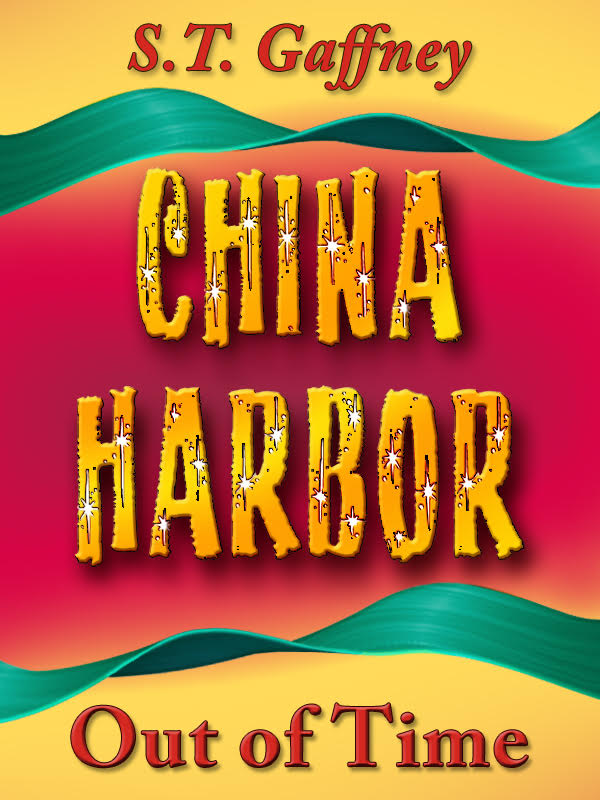
P.S.: Sorry to read about the death of your wife, Sharon. You wrote lovingly about her on your website. An author herself, she wrote under the name S.T. Gaffney. Tell us about her novel, China Harbor: Out of Time. How is it different from what you write?

F.H.: Pardon me for going on for a bit, but Sharon is probably my favorite subject. She was the most brilliant person I ever met. She taught herself to be an effortless storyteller. In third grade, she learned every cliché there was and deployed them at every appropriate opportunity to the annoyance of her friends. She then spent the next year changing every cliché into something non-cliched, so she never used a cliché again.

She devoured mysteries and read lots of Best Short Stories of [insert year here] collections and subconsciously absorbed what made good writing. When we left after seeing The Empire Strikes Back in the theater, I casually asked, “That scene where Luke leaves and Obi Wan says, ‘That was our last hope,’ to which Yoda replies, ‘No, there is another,’ I wonder what he was talking about?” She calmly replied, “It’s Princess Leia. She’s Luke’s sister,” as if it should be perfectly obvious. When we watched mystery movies, she always knew who the murderer was within the first 15 minutes, but she considerately wouldn’t spoil it for me.

China Harbor: Out of Time is a dramatic time-travel thriller, set in a small island off the coast of China after China has nuked America. The main character is a female physicist who invented a time travel machine and has spent the last 5 years living as an American refugee in an unfamiliar land where she barely speaks the language, and guts fish for a meager living, until events conspire to give her the precarious chance to rectify the war she feels she may have inadvertently caused while trying to prevent it.

Sharon was what they call a pantser (she preferred the term organic writer, nurturing and letting the story grow rather than pretending to make it up as she wrote it). China Harbor started as a vision of the first scene that came into her head as she stared into her tea cup at our favorite Chinese restaurant. She came home and started typing. Two weeks later, she said, “This story is getting kind of long. How long is a novella?”

I told her, and a month later, she asked, “How long is a novel?”

I told her about 80K to 120K words. A month later, she asked, “How long is War and Peace?”

It ended up being 180K words of very taut prose. There is no wasted space. As I saw it coming off the printer as she wrote it, I remember thinking about one passage, “Well, that’s kind of a diversion, but I’ll give her that for local color.” To my astonishment, two-hundred pages later that became an integral plot point.

She had a unique voice. When she was in 5th grade, her English teacher took her aside and told her, “Reading your stuff is like I’m sitting there listening to you. That’s a great voice for fiction. Don’t lose it, but it isn’t the right way to write a formal essay.” Thank God for that man. Blessings be upon him.

Also, despite our 41 years together, her life was very different from mine. She grew up in Beverly Hills (on the wrong side of the tracks, she always noted, as her family was far from rich) where 95% of her high school class went on to college vs. my small-town roots. She also suffered from fibromyalgia for 30 years because of childhood trauma from an abusive, alcoholic father and a mother who had what they today call a “borderline personality disorder,” in other words not quite crazy enough to be locked up, but you wouldn’t want to live with her.

Also she was a chemist who taught at the community college level for many years whereas I was just a bum, as her mother accurately described me when we got married. Modern medicine has no cure or even treatment for fibromyalgia, so she explored other avenues. When California legalized acupuncture, one of her students recommended an acupuncturist, so she tried that. A curious chemist who is given the diagnosis, “The wind and the damp have come into your shoulder,” does not just shrug it off when the treatments start to work. To understand this thing that made no sense, she became a Chinese scholar, reading dozens of books on acupuncture and the Chinese philosophy and culture that it grew from and was infused with. When she died, I donated her 300 books on the subject to the local Chinese Historical Society.

Also she taught a diverse set of students at the community college level. It was the time of the Vietnamese boat people who had fled the communist takeover, and she taught Chemistry to many refugees from Vietnam and Cambodia, who barely spoke English.

All that fed into her book. When I was reading it as it came off the printer, I realized it had an unusual power that was different from anything else I had read. That year, at Comic-Con as we watched the 4th of July fireworks, it hit me. America has taken in refugees from all over the world, but Americans have never been refugees. It was that perspective that was one of the things that gave her book such unusual power.

Sorry, but I could talk for days about the best woman who ever lived. My writing is not so instinctual or magical. I consider myself Robert Browning to her Elizabeth Barret Browning, an excellent writer but more restrained and intellectual, not the genius one that I married.

That Has Such Creatures

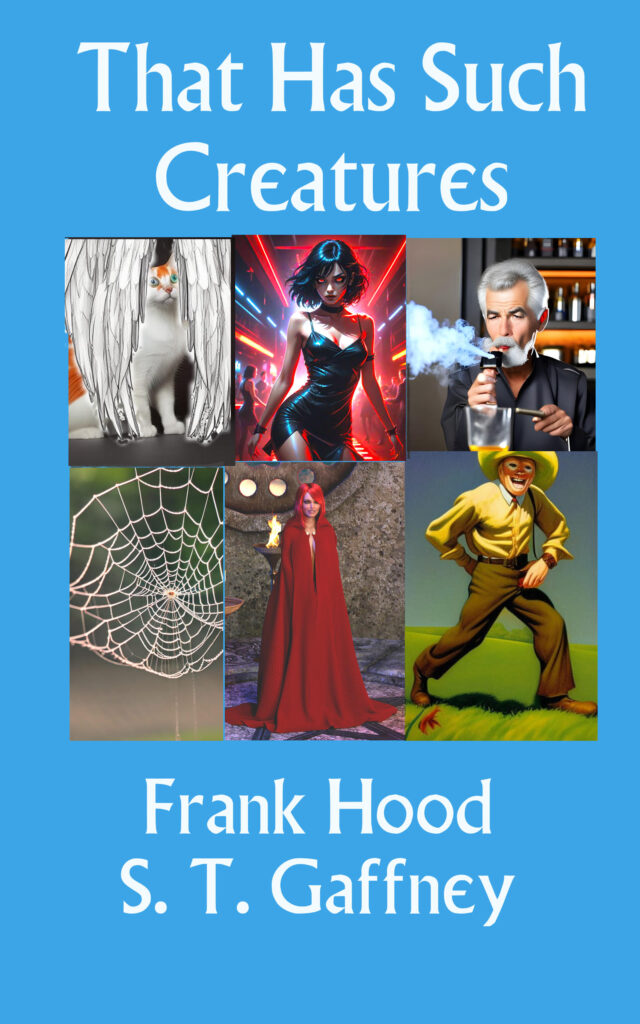
P.S.: Short stories by you and your wife appear in the book That Has Such Creatures. Aside from the marriage between the two authors, are there any traits connecting the stories? Common settings, themes, tone, etc.?

F.H.: Sharon and I wrote very different types of stories. I pulled a couple of her stories into the collection, partly because I wanted to tell the story of How Sharon and I “Met”, and the different type of stories we write figured into that. Many of her stories were darker, reflecting her background. That Has Such Creatures is 14 stories by me, 2 by Sharon, and 2 non-fiction stories that people have trouble believing aren’t fiction, so the connection is more tenuous rather than collaborative.

We tended to push each other and help refine our ideas rather than really co-write things. You can get a little flavor of that in the last stories and essays in That Has Such Creatures. I hope to finish and publish our real collaboration later this year. When she realized her lone novel wouldn’t sell very well on its own, she came up with the idea of a twelve issue Pogo-esque comic book with talking animals, called Hermit and Vulture about, “A man who is about to go over the edge—and a bird that’s ready to help.” It’s a satirical look at modern life set in the tiny, High Sierra hamlet of Another Fine Mess. We brainstormed a number of scenarios. She could never find an artist to collaborate with though, so she eventually settled on the idea of just publishing it as prose under the subtitle, “A comic book that isn’t”. Unfortunately her health deteriorated, and she never finished it, but she left elaborate notes. I hope to finish it and do it justice.

P.S.: What is your current work in progress? Would you mind telling us a little about it?

F.H.: I’ve got two works going on right now. The first is a traditional novel, A Child’s Uneven Scrawl, set in 1968-1969. Those were amazing and turbulent years to live through, and the period and culture is a heavy influence on the book. It involves a grad student studying the human brain who ends up apprenticing to a former Nazi scientist whose research has been continued by the Defense Department. (Think Werner von Braun, and it won’t seem so far-fetched.)

It also features his DoD boss, a retiring WW II Marine captain on his last tour of duty in San Diego, so he can leave the service and get his teaching credential at San Diego State to begin a high school teaching career.

Biology in the old days was a particularly cruel science to explore, where mice, cats, and sometimes even primates were experimented on, sometimes brutally, all in the name of science. Much of what we know now about the functioning of the brain stems from those early, gruesome experiments that happened before functional MRIs. Trust me, the history of biology is a scary place.

When the ex-Nazi dies, both the captain and the grad student are left with an experiment that poses both seemingly great opportunities and ethical dilemmas.

By the way, A Child’s Uneven Scrawl is another song lyric, this time from Simon and Garfunkel, that helped inspire the story.

The other work is the afore-mentioned Hermit and Vulture.

Poseidon’s Scribe: What advice can you offer aspiring authors?

Frank Hood: The best writing advice I ever got was from Ted Sturgeon. In 1976, I found myself sitting next to him at Tuscon IV. He found out I wanted to be a writer, and told me, “I have a guaranteed method to make you a published writer. Write 50 stories in a year. By the end of that year, I guarantee you’ll be a published writer.”

It took me two years, but I did sell my 32nd story. Learning to write is like learning to walk. You’re going to fall down a lot, but keep getting back up and persist. Just write, my friends!

Other advice I got from a veteran Hollywood screenwriter was, “Make ’em love. Make ’em hate. Make ’em wait.”

That’s my writing advice. My business advice is, “Stay away from so-called traditional publishers. That industry exists mostly as a money-laundering scheme for politicians. Write something people want to read, and publish a lot of it. It may take time for people to discover you, but don’t get discouraged, just keep putting it out there.”

Poseidon’s Scribe: Thank you, Frank.

Web Presence

Readers may find out more about Frank Hood at his Amazon author page, his website “Musings of a Restless Mind,” and his Goodreads author page. You can find his wife’s novel, China Harbor: Out of Time, here.
Author Interview—William Bernhardt

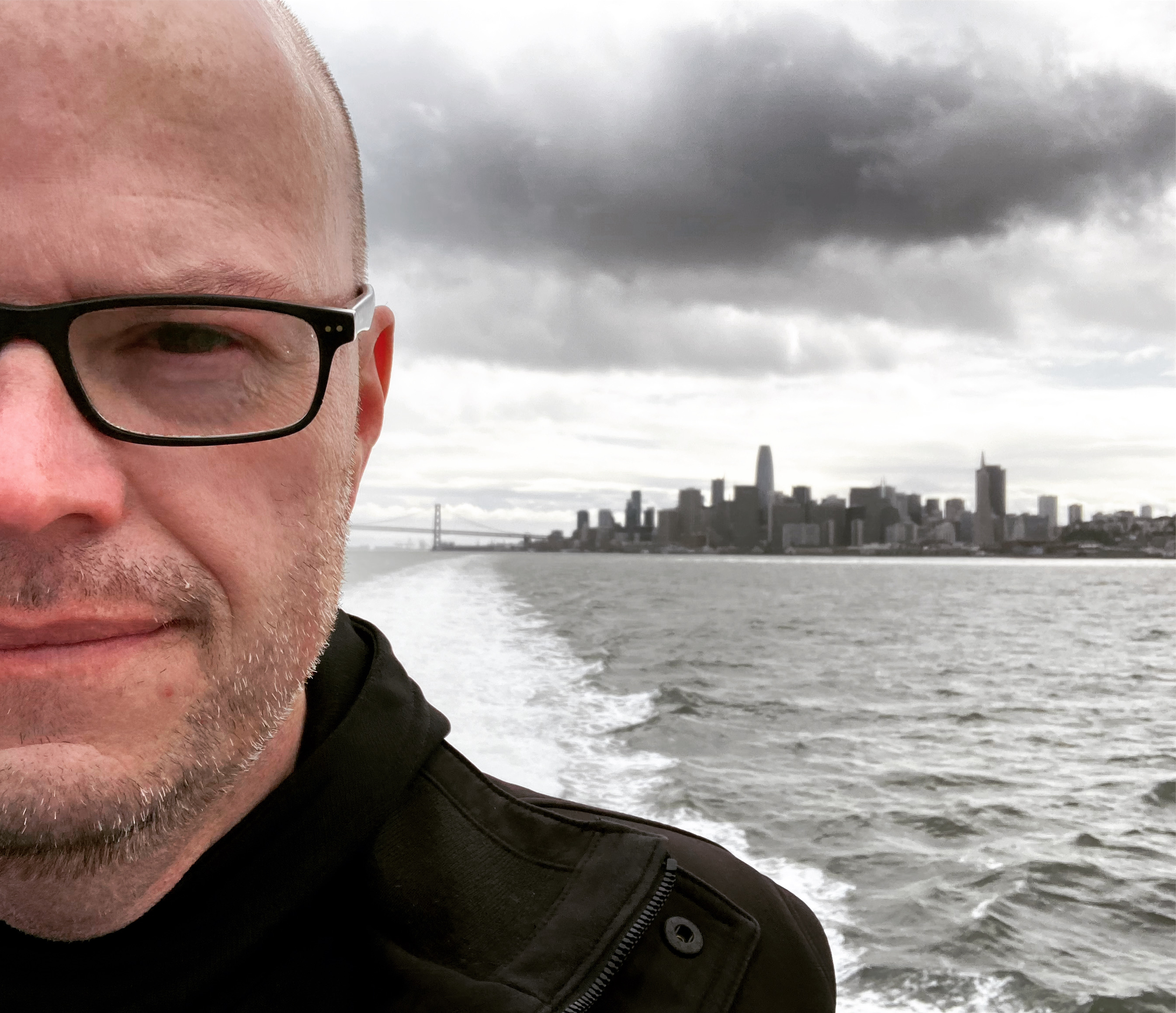
At Soonercon last month, I met many authors. One of them, William Bernhardt, has led a jam-packed life. I’d find it easier to list the things he hasn’t done. Reading his bio makes me want to get off the couch and swim the Atlantic just to say I’ve done something he hasn’t. (Note to self—check if he’s done that, too.) I’m guessing he has to update his bio every week just to keep it current. Here’s this week’s version:

Bio

William Bernhardt is the #1 bestselling author of over sixty books, including the nonfiction book The Superman Wars and the Daniel Pike legal thriller series (The Last Chance Lawyer). His previous works include the historical novels The Florentine Poet and Nemesis, The Final Case of Eliot Ness, three books of poetry, children’s and young adult books, and several books on fiction writing. In addition, Bernhardt hosts an annual writers conference (WriterCon), an annual writing cruise, small-group writing retreats, a magazine, plus a free e-newsletter and podcast. He is also the president of Bernhardt Books.

Bernhardt has received the Southern Writers Guild’s Gold Medal Award, the Royden B. Davis Distinguished Author Award (University of Pennsylvania) and the H. Louise Cobb Distinguished Author Award (Oklahoma State), which is given “in recognition of an outstanding body of work that has profoundly influenced the way in which we understand ourselves and American society at large.” He has been nominated for the Oklahoma Book Award over twenty times in four different categories and has won the award three times. In 2019, he received the Arrell Gibson Lifetime Achievement Award.

In addition to his novels and poetry, Bernhardt has written plays, a musical (book and score), humor, children stories, biography, and crossword puzzles for The New York Times. He is also a Jeopardy! champion (2013). He has edited two anthologies (Legal Briefs and Natural Suspect) as fundraisers for The Nature Conservancy and the Children’s Legal Defense Fund. In his spare time, he has enjoyed surfing, digging for dinosaurs, trekking through the Himalayas, paragliding, scuba diving, kayaking, caving, zip-lining over the canopy of the Costa Rican rain forest, and jumping out of an airplane at 10,000 feet.

OSU has called Bernhardt “Oklahoma’s Renaissance Man.” When Bernhardt delivered the keynote address at the San Francisco Writers Conference, chairman Michael Larsen noted that in addition to penning novels, Bernhardt can “write a sonnet, play a sonata, plant a garden, try a lawsuit, teach a class, cook a gourmet meal, beat you at Scrabble, and work the New York Times crossword in under five minutes.”

Interview

Poseidon’s Scribe: How did you get started writing? What prompted you? 

William Bernhardt: I knew I wanted to be a writer when I was seven, or so my mother says, and since she’s my mother (age 97), I think we have to take her word for it. Once I realized people were writing those books I loved, I knew that’s what I wanted to do. The problem was, being a kid in a small town in Oklahoma with no writers, figuring out how to accomplish that!

P.S.: Who are some of your influences? What are a few of your favorite books?

W.B.: Superman comics, for starters. Comics led to science fiction, like The Martian Chronicles and Slaughterhouse-Five. Comics also led to Shakespeare and ancient lit classics—many of which are basically superhero stories.

P.S.: When I add up all the things you claim to have done, I conclude you are either 200 years old, more than one person, or never sleep. Which is it? If none of those, how to you manage your time?

W.B.: Ha! I hope I get 200 years, but that may be a stretch. I do prefer to stay busy. Keeps me out of trouble. I get up early in the morning and work through the day, first writing, then dealing with other matters. I think I was born with a fortunate gene. Where some people might think, Wouldn’t that be nice?, I always think, How can I make that happen?

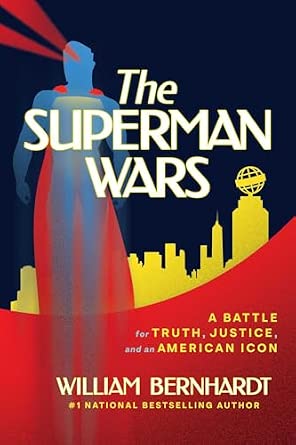
P.S.: Your recent book, The Superman Wars (love the cover, by the way), isn’t fiction, but provides a cautionary account of the intellectual property rights to the Superman character. What is the major point of the book and what should writers learn from it?

W.B.: (I love the cover too. I told them I wanted a book anyone could hold without embarrassment, no Zap! Zowie! Pow! or any of that. I thought they did a terrific job.)

This is a cautionary tale I hope all creatives will read. The vultures are still out there, more than happy to take advantage of writers and artists and internet content creators. We still have corporate sharks, plus vanity presses and AI scams and many other threats to the ability of artists to benefit from their work. Protect yourself! Connect with other writers (even if you aren’t the most social person in the world). Get the knowledge you need to succeed. And never sign anything without getting an expert opinion!

P.S.: You’ve been described as Oklahoma’s Renaissance Man, and as a polymath (or a practitioner of Crichtonism, a word I just learned today, named for James Crichton [1560-1582]). Why such varied interests, when most people are satisfied with expertise in one area?

W.B.: Look, we get one life and it isn’t that long. Probably as a result of voracious reading, I have a lot of interests, so I never get bored. And I don’t want to spend my entire life doing the same thing over and over. I practiced law for ten years. That was enough. I wrote a lot of thrillers. But after several of those, I thought it was time for new challenges. As I started researching this book, I realized there was so much more to it than most people, even in the comics world, realize.

P.S.: Do your varied non-writing interests (gardening, cooking, games and puzzles, surfing, hiking, scuba diving, kayaking, caving) interfere with your writing, or supplement it in some way? Do these activities find their way into your novels?

W.B.: The truth is, you can only write so many hours a day. Usually by mid-afternoon, it’s time to do something else. Like prep for WriterCon, the writers conference I co-host, or Bernhardt Books, my small publishing company. I don’t know if that works its way into my books—but my love of comics has over and over again. And we do take vacations. In May I spent a week roaming around New Mexico with my daughter Alice, hiking and rock climbing (nothing dangerous) and exploring caves. I consider myself fortunate to have built a life that allows me to do so many things I enjoy.

P.S.: What is WriterCon, and why did you start it?

W.B.: WriterCon is my annual writers conference, every Labor Day weekend in OKC (September 4-7 this year) and 2026 is our 20th anniversary! We have over 60 speakers, writers, agents, publishers, and others in the industry offering writing tips, publishing advice, marketing angles—whatever people need. We have contests and lots of chances for consultations with pros. I may be biased, but I think it has become one of the leading conferences in the country. Every year I see attendees get agents or publishing deals, which makes me very happy. I started this as a way of giving back. I remember what it was like being a punk kid in a small Oklahoma who wanted to be a writer—but with no clue how to make that happen. I hope WriterCon is making it a little easier for the next generation.

P.S.: What are the easiest, and the most difficult, aspects of writing for you?

W.B.: Writing is hard, and nothing is ever going to make it easier (including AI), so I just accept it. My first drafts are always terrible (or so I think), but I will revise and revise until it starts looking like something. I don’t think there is an easy part, but I enjoyed all the research I did for The Superman Wars, even though it ultimately took more than twice as long as I anticipated. I ultimately traveled to eight different states, combed through twelve archived library collections, interviewed more than fifty people and read hundreds of books, periodicals, and unpublished manuscripts. I was able to interview the members of Jerry Siegel’s family, his daughter Laura and her sons Michael and James, who have been reluctant to talk in the past. I even visited Jerry’s childhood home!

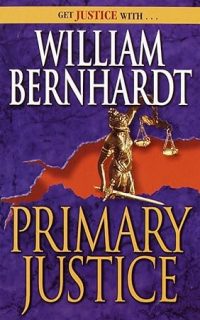
P.S.: Tell us about Ben Kincaid, the main character of your nineteen-novel series beginning with Primary Justice. What is he like, and what sets him apart from other lawyer protagonists?

W.B.: He’s Clark Kent with a briefcase. He’s smart, persistent, and wants to help—but he’s also socially awkward, insecure, and needs a partner to fill his vacancies. Christina is his Lois Lane. I’ve started a 20th book in the series but set it aside when I became obsessed with the Jerry Siegel story.

P.S.: You appeared on the TV show Jeopardy! and performed well. Tell us about that experience.

W.B.: That was a blast! I’ve been watching Jeopardy, usually with my mother, since I was four. When they started doing online tests around 2010 I took it and got a callback, then went to New Orleans for an audition, then was asked onto the show. I learned how important speed and buzzer control are. Everyone there was smart, but some people, including me, struggled with the buzzer. During our rehearsal, I didn’t get a single chance to answer a question. The producer actually came up to me and whispered, Bill are you trying to ring in? Yes, of course I am! but I wasn’t as quick as I wished (I was the oldest person in the green room by almost 20 years, not that I consider that an excuse). Anyway, once the questions got tougher, I managed to get in enough correct responses to become a Jeopardy champion.

P.S.: What is your current work in progress? Would you mind telling us a little about it?

W.B.: My next book will be The Batman Wars, and I’ll bet you can guess the subject. Bill Finger and Jerry Robinson and…that other guy. You know, the one who took all the credit. This is a story that is much less well known, and perhaps even more heartbreaking, than the Siegel story.

Poseidon’s Scribe: What advice can you offer aspiring authors?

William Bernhardt: Keep writing! Learn as much as you can, but the most important thing is to write. Listen to the WriterCon podcast (it’s free). Put in your 10,000 hours. The more you do the better you’ll get. Then come to WriterCon, learn what you need to know about the business, pitch an agent or publisher. It will happen eventually, if you keep writing and don’t quit!

Poseidon’s Scribe: Thank you, William. Great advice from the man who’s done (nearly) everything.  

Web Presence

As befits a guy who’s been everywhere, you can find William Bernhardt everywhere online. That includes his website, Facebook, Instagram, Amazon, LinkedIn, TikTok, YouTube, and Threads. You can buy The Superman Wars here, learn about, and sign up for, WriterCon here, and subscribe to William’s newsletter here.
Author Interview — Michelle Miles

The recent READiculous Book Palooza in Denton, Texas gave me an opportunity to meet more authors. Among them, Michelle Miles impressed me with her professional approach and enticing table layout. Her books proved irresistible to attendees who flocked to Michelle, listened to her enthralling pitch, and walked away smiling and anxious to read their new purchases. After you read this interview, you’ll need to buy one or more of her books too.

Bio

Michelle Miles is an empress with a war map in one hand and a romance vow in the other—writing fantasy, paranormal, and young adult adventures where magic crackles, danger prowls, and love refuses to back down. From fairy-tale retellings to angels and demons to Fae, elves, and time travelers, she builds big-hearted worlds full of quests, curses, kisses, and chaos—often in that order. When she’s not plotting her next emotional ambush, Michelle narrates audiobooks and hosts Miles Beyond the Page, a podcast spotlighting writers’ real journeys. A proud Texan, she’s usually reading, hiking, rewatching favorite movies, or savoring a glass of wine while sharpening the blade for the next adventure.

Interview

Poseidon’s Scribe: How did you get started writing? What prompted you?

Michelle Miles: I’ve been writing for what feels like forever. I started scribbling fairytales in high school, which makes perfect sense because my head has always been at least halfway in another world. When I was a kid, I couldn’t decide whether I wanted to be a Dallas Cowboys Cheerleader or an archaeologist. Yes, really. Sparkles or ancient ruins. Chaos or history. Naturally, fiction turned out to be the perfect answer, because suddenly I didn’t have to choose. I could do all of it on the page—adventure, magic, mystery, drama, and a little glitter if the moment requires it. That realization was my big turning point.

My first book was published in 2006. I’ve never really stopped since then.

P.S.: On your website, you list “A Few Things I Love,” and Scotland appears prominent. What prompted that interest in that country? Was it a fascination with golf?

M.M.: Ha! No, it was definitely not golf. It was castles. I have been obsessed with castles for a very long time, and there has always been something about Scotland that feels downright magical to me. I’d wanted to go for years, and my husband and I finally made the trip in 2024. We called it Castlemania because I was absolutely determined to cram as many castles as humanly possible into ten days. We visited Stirling, Edinburgh, Urquhart, Dunnottar, St. Andrews, Eilean Donan, and Dunvegan—and I know I’m forgetting at least one. It was incredible. Not only was it the trip of a lifetime, but it also gave me the chance to do boots-on-the-ground research for the Scottish time travel books I was writing at the time. I fell in love with the country even more, and yes, I absolutely want to go back.

P.S.: Who are some of your influences? What are a few of your favorite books?

M.M.: Oh this is such a great question and hard to answer. Here are the two books that made me wants to write.

The Forgotten Beasts of Eld by Patricia A. McKillip. I read this in high school and fell in love with the fantasy aspect of it and the talking animals. And I thought—I want to do that.

Then I read The Road to Paradise Island by Victoria Holt and I fell in love with the romance of the two characters.

My mother was a voracious reader and handed me more historical romance. But fantasy is where my heart lives. And I really wanted a good, meaty fantasy WITH a romance that was swoony. This is why I started writing it.

Today some of my favorite authors: Karen Marie Moning, Gena Showalker, Holly Black, Sarah J. Maas, and so many more. There are really too many to list.

P.S.: It appears you group your genres into fantasy romance, paranormal romance, and young adult fantasy, with multiple books in each category. How do you distinguish between those three?

M.M.: I love this question because I write in a few different genre spaces. For me, paranormal romance usually means a modern-day setting with supernatural elements woven in—angels, demons, monsters, and other dangerous magical beings. Fantasy romance leans more into a fantasy world or secondary realm, sometimes with characters crossing over from our world into another. My Age of Wizards series, for example, is a portal fantasy that eventually takes readers into Faery. My YA fantasy books—particularly my fairy tale retellings—are sweeter romances that are appropriate for readers as young as fourteen. My fantasy and paranormal romance for adults, though, are geared toward a more mature romance audience.

P.S.: You’ve created an audio soundtrack of your novel Once Upon a Woven Wish, intending for readers to listen to it while they read. The sneak peek/listen of the “Serena and the Weaver Theme” sounds dreamy and ethereal. What led you to create this soundtrack and do you intend to do more of them?

M.M.: I loved creating the soundtrack for Woven Wish. I’m always thinking about what lives beyond the book—ways to make the reading experience feel more immersive and let readers step even deeper into the world. Music is such a powerful part of that for me. It adds mood, emotion, texture, and sometimes even helps unlock the heart of a story in a different way. I want readers to feel like they’re not just reading the book, but living inside it for a little while. And yes—there will absolutely be more. I’ve already created a lot of music for other works in progress, and I keep adding to it whenever inspiration strikes while I’m writing. If you want to hear more, you can follow me on Suno and explore the music there.
P.S.: What are the easiest, and the most difficult, aspects of writing for you?

M.M.: The easiest part? The writing.

The hardest part? Also the writing.

Honestly, it depends on the day. Some days I’m flying and the words come faster than I can type. Other days, I’m staring at a blinking cursor like it personally offended me. But even on the hard days, I still love the magic of it—creating worlds, building stories, and disappearing into the lives of my characters for a while.

Edits, though? That is a different relationship entirely. Let’s just say we are not always on the best terms. LOL.

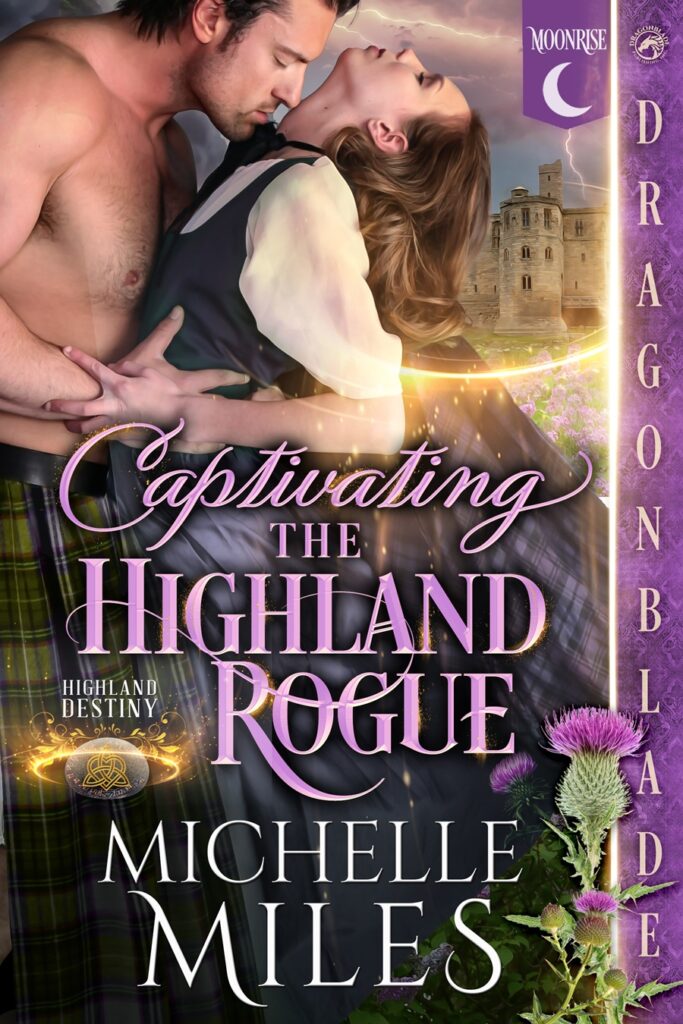
P.S.: Tell us about Captivating the Highland Rogue, third in your Highland Destiny series. Does this really involve romance, time travel, clan rivalries, and a peril endangering the universe?

M.M.: Yes, it absolutely does! I had so much fun writing these books. Dragonblade was launching a new line—Moonrise—for fantasy historical romance and invited me to write for it. I jumped at the chance to do something a little different. And because I already had a trip to Scotland planned, it felt like pure kismet.

The publisher and I tossed around a few ideas—she wanted an antique shop woven into the stories somehow, and I took that and ran with it. Then my brain did what it always does and started firing off a hundred what if questions. What if there were rival clans? What if they were battling for control of time itself? What if the heroines were all modern women suddenly thrown into the past? That’s really how a lot of my stories begin—with one intriguing idea that spirals into a whole world.

These books were an absolute blast to write. I got castles in the Highlands, time travel, ancient magic, clan conflict, and yes—plenty of romance. At the heart of the series are three modern heroines falling for three Highland warriors, with all the danger, longing, and chaos that comes with that. So yes, there’s romance. Yes, there’s clan war. And yes, it’s very much my kind of fun—basically Outlander meets The Time Traveler’s Wife, with a magical Highland relic at its heart.

P.S.: You’ve produced dozens of episodes of your cleverly-titled podcast, “Miles Beyond the Page.” The series includes interviews of many award-winning authors, including Gena Showalter, Michelle Pillow, and Harry Turtledove. What got you started with podcasting, and why do your listeners love it?

M.M.: I’d been thinking about doing something like this for a long time, but for the longest time I told myself I didn’t have the knowledge or the time. Still, I couldn’t stop thinking about it. So eventually I did what I do best: I leapt first and figured it out as I went. My writing bestie, Misty Evans, had a book releasing in January 2025, and I decided that was the perfect moment to finally launch the author interview show I’d been imagining for YouTube. We had such a great time talking about her book, the writing life, and all the behind-the-scenes creative chaos that I immediately knew I wanted to keep going.

So I started reaching out to other author friends to see if they’d be willing to come on. They were. At first, I thought I might do one episode a month—which is funny in hindsight. There was so much interest that it quickly turned into a weekly show, and sometimes even twice a week. From there, it just kept growing. I expanded distribution, launched a website, and built it into its own brand because I wanted it to feel professional and have a space of its own beyond my fiction.
Now I’ve got the entire 2026 calendar booked, with themed months planned for October, November, and December, and I’m genuinely so excited about where it’s going. These days, I kind of live in two worlds—authoring and podcasting—and honestly, I love that.

I think listeners connect with the podcast because it feels like sitting in on a real conversation with authors who genuinely love books, storytelling, and the creative life. It’s fun, relaxed, insightful, and often inspiring. We talk craft, publishing, behind-the-scenes process, and the messy, magical reality of building a writing life. Readers and writers both get to hear the human side of the people behind the books, and I think that makes it feel personal in the best way.

P.S.: Apparently, writing multiple novels and recording weekly podcasts leaves you plenty of time to narrate audiobooks. What has that experience been like?

M.M.: LOL! You know—I’m basically a feral chaos gremlin who wants to do all the things. I really wanted my fairy tales, especially, to be available in audio, but narration is a huge expense for an indie author. So I did what I usually do when faced with a challenge: I decided to figure it out myself. I bought the equipment, learned the process, and climbed the learning curve one recording at a time.

Finding the time means being extremely intentional with my schedule. I keep everything tightly mapped—writing, narration, podcasting, all of it—because otherwise the creative chaos would absolutely win. Some days in the recording booth are smooth and magical, and other days I’m convinced I should fling the whole setup out the window. But then there are those days when I finish a session and think, wow, that was the best work I’ve done yet. Those moments make it worth it.

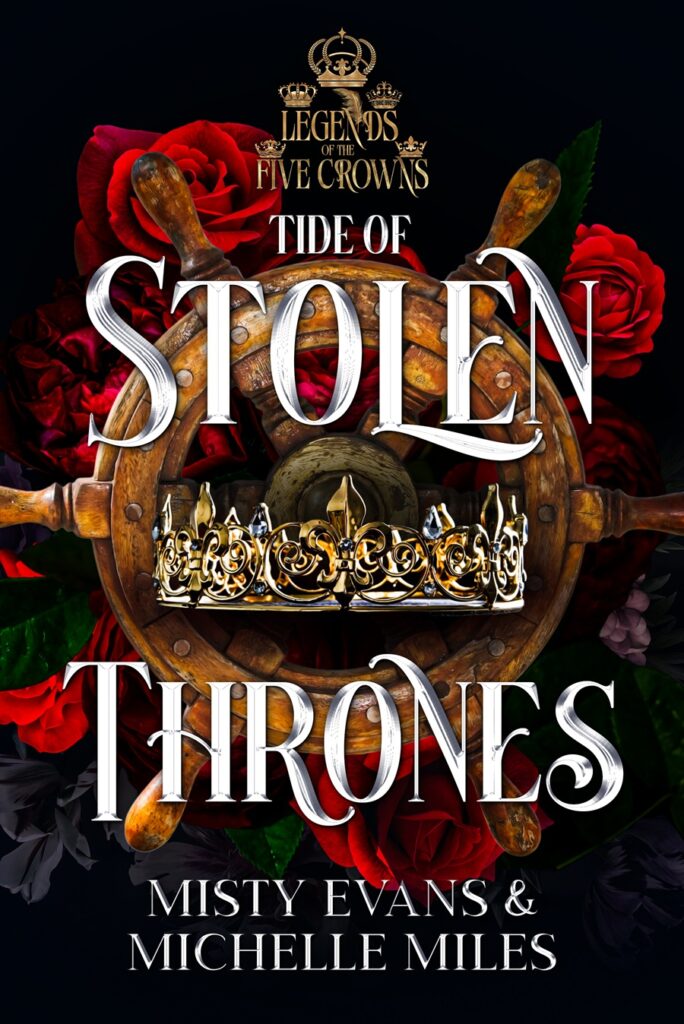
P.S.: Tide of Stolen Thrones, second in your Legends of the Five Crowns series has vanishing story-magic, pirates, and a stolen throne. Sounds like fun. You co-wrote this with Misty Evans. What was it like to collaborate with another author on a series of novels?

M.M.: Misty and I had been circling the idea of collaborating for a while, so when she finally asked if I wanted to write a romantasy series with her, my answer was basically an immediate yes. No arm-twisting required. We had an absolute blast building this world together—brainstorming the big ideas, shaping the emotional arcs, and figuring out all the moments that would make the series feel rich, magical, and unforgettable.

The first book, The Flame and the Dragon, follows Dessalyn and gives readers dragons, danger, and all the fire you’d hope for. The second, Tide of Stolen Thrones, belongs to Calliope and brings in a charming pirate, high adventure, and a whole different kind of chaos. One of the best surprises of the process was realizing how naturally our voices and writing styles work together. We have a similar rhythm creatively, and we’re both a little bit pantsers at heart, which somehow makes the whole thing even more fun.

And honestly, one of my favorite parts is the way we brainstorm. I’ll get a text from Misty saying something delightfully unhinged like, “I think we should kill off this character,” and my immediate response is usually, “That’s diabolical. Let’s do it.” We have a lot of fun in this world, and I think readers can feel that energy on the page.

P.S.: What is your current work in progress? Would you mind telling us a little about it?

M.M.: I’m currently deep in a dark paranormal romance trilogy set in the world of my Dream Walker series. This new arc—War of the Brotherhood—is all about the reckoning that comes after centuries of manipulation, control, and buried power at the hands of the ruthless Brotherhood of Watchers. Book one, Dark Night of the Soul, is finished, and I’m currently closing in on the end of book two. And because apparently I don’t know how to behave, this series has already sparked yet another spinoff. The Dream Walker universe just keeps expanding every time I turn around.

These books will be releasing later this year, and I’m so excited for readers to dive back in with Anna and Kincade and follow what comes next. I’ve absolutely loved writing this series. It’s dark, emotional, intense, and full of the kind of story chaos I live for.

I also have more fairy tales on the way later this year, including a Snow Queen retelling and a cozy fantasy that sits adjacent to my Enchanted Realms series, but in a modern-world setting. So basically, I’m over here building curses, kisses, magic, and mayhem on multiple fronts.

Poseidon’s Scribe: What advice can you offer aspiring authors?

Michelle Miles: If writing is something you truly want to do, then do it. Don’t wait for permission, and don’t let anyone talk you out of it. Read widely—not just in the genre you want to write, but across genres. Learn the craft. Study story. Keep growing. And maybe most importantly, understand that this is a long game. Publishing is a marathon, not a sprint.

Every book you write teaches you something. Every book you publish adds to your backlist, strengthens your voice, and gives new readers a chance to discover your work. That momentum builds over time. So keep going. Keep learning. Keep writing the stories only you can tell. The right readers will find you.

And whatever you do—don’t give up.

Poseidon’s Scribe: Thank you, Michelle. I love that advice.

Web Presence

Readers can find out more about Michelle, and buy her books, at her direct store, her website and blog, on Facebook, on Instagram, on Twitter/X, and Pinterest. I recommend you sign up for her newsletter. She’s even on Threads, BlueSky, and YouTube.

Author Interview – Scott Finley

Today I interview an author of mystery novels who shares my interest in ships. We differ in the types of ships we love. He dreams of the grand ocean liners of yesteryear. I met Scott Finley at a bakery and tea shop, though we didn’t go there for the cupcakes. Leaves Bakery and Books, in Fort Worth, introduces local authors to the community. Scott and I participated in two panel discussions there. If you crave murder mysteries with smart female sleuths, you’ll enjoy Scott’s interview and his historical novels.
Bio

After graduating from the University of Texas with a degree in journalism Scott launched a 39 plus year career in broadcast news where he worked for all four major network affiliates. Following that was a stint doing training and corporate videos, and then he transitioned into doing media for non-profit entities, including the Alzheimer’s Association where he covered their media for the entire state of Texas.

Along the way, and despite his best efforts, he collected one Emmy® nomination, 19 Telly Awards, three Aegis Awards, two Addy awards and five Best Newscast in Texas awards from the Associated Press, as well as an honorable mention from PR News for blogging for a non-profit. Outside of media and broadcast, he is the author of “A Little Theatre,” a two-act comedy that has been produced by Texas community theaters with relatively few over-ripe tomatoes thrown at the actors.

Scott lives in Dallas, Texas with his legal counsel Gabrielle, two cats, and a neurotic dog.

Interview

Poseidon’s Scribe: How did you get started writing? What prompted you?

Scott Finley: I believe that early reading is the start to early writing. Once I learned to read, I burned through Dr Seuss and then anything I could get my hands on. From that it was a short step to writing my own material. My English teachers through the years encouraged this wasteful habit, with the result that I knocked out my first book in high school (and it’s staying locked in a drawer) and just kept going.

P.S.: What was it about Walter Lord’s book A Night to Remember that stirred your imagination—in sixth grade!—about trans-Atlantic luxury ocean liners?

S.F.: Ha! It was the fact that here was this great ship, a floating city with its own restaurants, amenities, medical facilities, all alone at sea except for the sketchy radio signals.

For some reason or other it absolutely fascinated me — and then there was the minute by minute account of the sinking. At the time I read it, in 1969, there were still survivors alive and I began to see little articles on them in the newspaper, tangible proof to my young eyes that this actually happened. I began looking at other ocean liners in books, and wanted one to put in my backyard. Sadly, growing up in Texas, ocean liners are scarcer than the amount of real estate it would have taken up in my backyard.

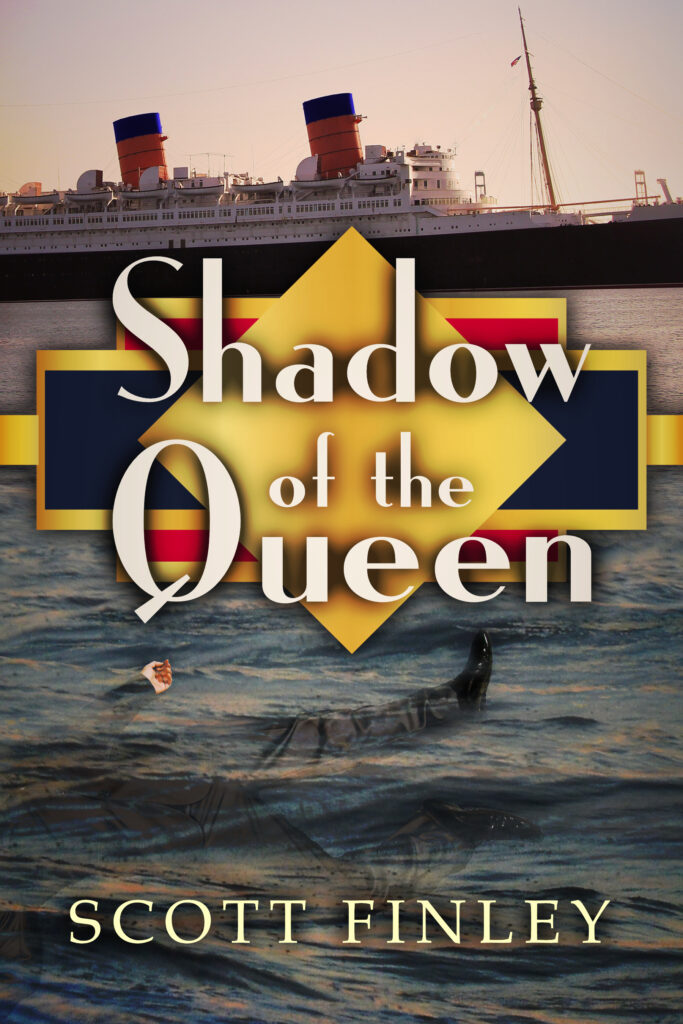
P.S.: In Shadow of the Queen, multiple murders occur and the ship’s nurse, Maeve Chandler, works to solve them before the killer can get away. Tell us about Maeve and what makes her different from female sleuths in other murder mysteries.

S.F.: First, Maeve is working on a tight deadline. When the ship reaches its destination, the killer is going to walk off and disappear unless Maeve can pin them down first. Maeve is a widow, her husband died in the influenza epidemic of 1919. Maeve also holds a degree in chemistry and has been looking after herself her entire life. She had a brother who died in the War (it was not called the First World War until there was actually a Second World War). Her parents were educators so she has had a lifetime of being curious. She is also a bit clumsy, usually at the most inopportune time. Maeve is also assisted by a passenger on board the Victoria in solving the crimes. In the first book, the passenger is a young Agatha Christie traveling to New York to meet with her publisher. In the second book, she is paired with up and coming diamond dealer Harry Winston.

P.S.: Tell us about the awards you’ve received working in broadcast news. They sound prestigious.

S.F.: I was fortunate to work alongside a lot of really talented people over my career in broadcast news. These were all team efforts – five Best Newscast in Texas awards from the Associated Press, multiple Telly Awards, a regional Addy award, an Aegis award, and one regional Emmy nomination.

P.S.: You’ve written a comedy play performed at some community theaters. Tell us about the play, and what it’s like to see your own play performed.

S.F.: The play is titled “A Little Theatre” and takes what is possibly the worst community theater in America through auditions, rehearsals, and opening night of what is possibly the world’s worst mystery play, “The Murdered Violin.” It’s been done multiple times in Texas, and each time I see it it’s like it’s brand new with different actors putting their own stamp on it. I find myself anticipating the laugh lines and it’s great fun watching the audience as they get caught up in the production.

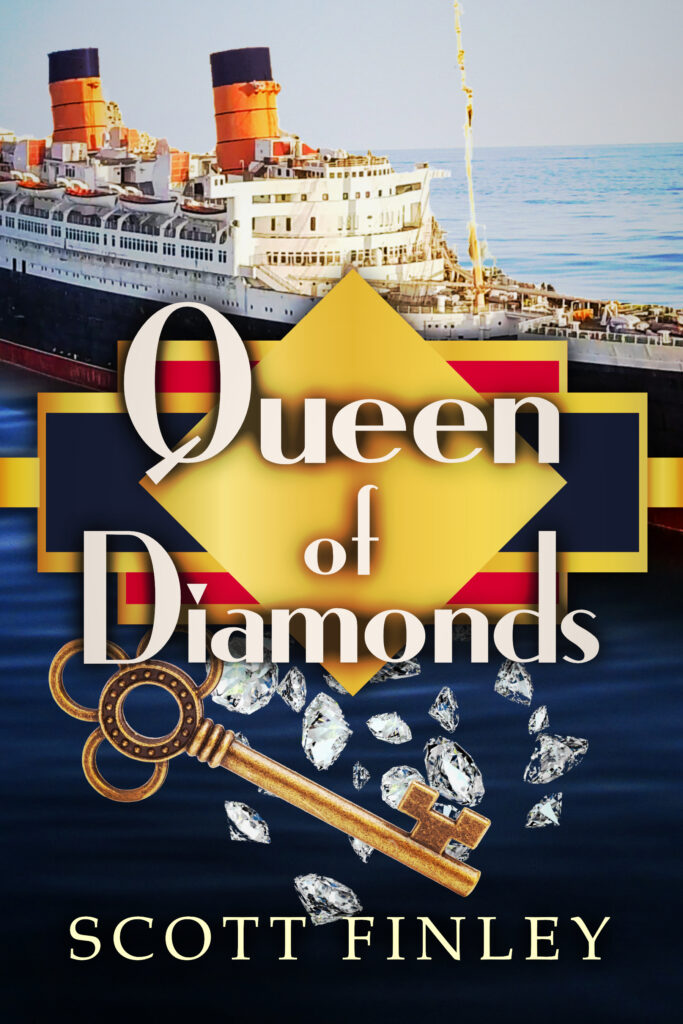
P.S.: Your novel Queen of Diamonds finds Maeve once again solving multiple murders, possibly connected to a fortune in diamonds, with a locked room mystery as well. No armchair sleuth, Maeve puts herself at risk to solve the crimes. What is the toughest spot she gets herself into in this novel?

S.F.: Maeve just can’t keep from nosing about where she’s not wanted, and she comes dangerously close to annoying a professional gunman while on her search for a cache of stolen diamonds.

P.S.: Is it true you’ve done some acting, appearing in dozens of theatrical productions? What were those experiences like, and did they impact your writing?

S.F.: Yes, I’ve done everything from playing the Cowardly Lion in the “Wizard of Oz” to Mortimer Brewster in “Arsenic and Old Lace”, and it seems everything in between. The great thing about acting and writing is you learn proper pacing and timing in dialogue which transfers over to writing.

P.S.: What are the easiest, and the most difficult, aspects of writing for you?

S.F.: This will sound strange, but the easiest thing for me is doing rewrites. It’s like polishing a rough stone into something pretty. After that it’s all the historical research, which readers can partake of in the lexicon provided at the end of the book. Most difficult is getting that opening sentence down, and doing Maeve’s musing that is always found at the beginning of every chapter because it sets up the action that’s about to happen.

P.S.: You’ve said the ocean liner in your books, the Queen Victoria, is fictional. Still, you’ve researched real ships of the time to give your novels authenticity. Please describe the Queen for us, and tell us how that setting works in your stories.

S.F.: The Queen Victoria is based on the Queen Mary, which is permanently docked at Long Beach, California as a floating museum, social destination, hotel and convention center. She is the only survivor of the age of the great ocean liners. Launched in 1936, the Queen Mary is a fabulous work of art you really have to see to believe. She doubled as a troop ship during WW2, and still holds the record for most people packed onto a ship – over 16,000 for one voyage from New York to Southampton in 1943. You have to remember that the ship was designed to carry around 3,000 passengers and about a thousand crew. A reviewer said that the Queen Victoria is itself a major character in the books. The ship is a slice of social strata from 1929 forward.

P.S.: The book covers of your series depict a noir vibe. Maybe they also include subtle clues? Beneath the title Shadow of the Queen, there seems to be a shadow of something in the water. Beneath the title Queen of Diamonds, there are diamonds, but also a key. Are these things significant? If so, could you tell us how?

S.F.: Absolutely! The shadow in the water is a first class passenger’s body floating as the ship steams away. For Queen of Diamonds, the ship seems to be awash with real and fake diamonds — and the key represents the locked room murder mystery that Maeve must solve.

P.S.: Next up in the series is Queen of the Sky. Would you mind revealing a little about it?

S.F.: It’s March of 1930 and in the course of a normal voyage, the Queen Victoria picks up a medical distress call. As the nearest vessel, and the only one with a fully equipped surgery and medical staff, she answers the call. When they arrive at the location, there is nothing in the water — but floating overhead is the German Graf Zeppelin lighter than air ship. They have an emergency appendectomy case aboard, but the patient is too ill to transfer to the Queen Victoria. Instead, the Zeppelin lands gently on the water and Maeve and her ship’s surgeon cross to it in a lifeboat, go aboard and perform the surgery. Unfortunately for them, a weather incident is brewing and so the Zeppelin must leave the area – going in the opposite direction from the Queen Victoria. Trapped aboard, Maeve witnesses a man fall from one of the engine nacelles on the Zeppelin – but was it an accident or was he pushed? Throw in five nationalities and aspiring Nazis and things begin to heat up rather quickly.

Poseidon’s Scribe: What advice can you offer aspiring authors?

Scott Finley: Read! Old favorites and new material, it doesn’t matter. Somewhere you’ll see how someone turned a phrase or structured dialogue or description and it might just sneak into your writing style. I read books in my time period – not books written FOR the time period, but books that were actually written DURING the time period. Great source for slang and other things. This should go without saying, stay away from AI. I only use it to set off research strings. And once you are done reading, write! Set aside some time every day for writing. Call it training for your brain. You don’t have to write a perfect first draft. I highlight in red phrases or words I find questionable, but I keep writing. I come back to those highlighted items the next day. Writing is an art that must be practiced on a daily basis in order to flourish. It doesn’t matter if you just spent four hours producing one page, it still means you are on your way.

Poseidon’s Scribe: Very useful advice. Thanks.

Web Presence

Readers can find out more about Scott Finley on his website, which includes a tour of the ship, and on Goodreads and Amazon.

Author Interview—Tricia Andersen

At the ICON 49.5 conference in Iowa City last month, I met and sat with author Tricia Andersen at a book signing. Luckily, I stayed on her good side—she knows kickboxing and Jiu Jitsu. If you’re wondering how a skill in martial arts helps with writing fiction, particularly romance fiction, read on to see how Tricia explains it.

Bio

Tricia Andersen lives in Iowa with her husband and her three children. She graduated from the University of Iowa with a Bachelor of Arts in English and from Kirkwood Community College with an Associate of Arts degree in Communications Media/Public Relations. She writes romance for all genres, from paranormal to historical to contemporary. She also has a couple of non-fiction historical titles and a few children’s picture books under the pen name, Lynette Andersen.

Interview

Poseidon’s Scribe: How did you get started writing? What prompted you? 

Tricia Andersen: I have actually been writing since I was young. My mom has a “book” I wrote in preschool when I was five. It’s something I have loved to do since I can remember.

P.S.: Who are some of your influences? What are a few of your favorite books? 

T.A.: I love books written by Karen Marie Moning. She made me realize that my voice and the way I write are a legitimate method. Before that, I felt that no one would want to read what I wrote because it wasn’t similar to what most authors sounded like. I also enjoy reading what my friends write. I think it’s important to support other authors.

P.S.: Thistle Tattoo features a man struggling with PTSD, on the edge of suicide, who receives help from a woman working in a tattoo parlor. Do you find it difficult to address the touchy issues of PTSD and suicide?

T.A.: I do. I was honored to help with Operation First Response, an organization that assists wounded soldiers. That experience opened my eyes to the issues that veterans face. While the original premise (and first couple of chapters) of Thistle Tattoo was a short story for an anthology, it was a challenge to continue to flesh out Rhett while being aware of the real issue of PTSD and veteran suicide.

P.S.: Tell us about your experience with kickboxing and Brazilian Jiu Jitsu. Do you engage in these sports for research, enjoyment, or what?

T.A.: It has been both research and enjoyment. I didn’t originally plan to get involved in martial arts. When I got my first publishing contract (Black Irish is the first book I published with a small publisher), I wanted to write a book as a sort of thank you for my dreams coming true. I wanted to write a book with a character that had the same disorder my daughter has, Cyclic Vomiting Syndrome. I needed a male main character who had a sports-type job that others would look down on. I settled on Mixed Martial Arts (MMA). I reached out to the owner of a local MMA gym to see if he would answer questions for me. He agreed. While I was waiting for a reply, I noticed they had kickboxing classes. I always wanted to try so I talked my husband into one month. That was in 2013. I paused my training at the start of the pandemic in 2020 but I hope to get back to it soon. I love every bit of it. I love the people I worked out with. I love the path it has put me on. I do have a bronze medal in jiu jitsu from a competition in Chicago that I took part in. It has also given me a great deal of knowledge that I put into my books.

P.S.: Congratulations on earning your bronze medal. In Welterweight, the first in your Hallow Brothers series, you give readers an MMA fighter who’s also a werewolf, and the story involves mysteriously appearing tattoos. Tell us about Meg Riley, the female main character, and also what ties the Hallow Brothers series together?

T.A.: At the beginning of Welterweight, Meg is the new ex-girlfriend of Caleb’s opponent, the fighter who is currently holding the welterweight belt. She is tough, sassy and can hold her own against a werewolf with a bad attitude. Their tension melts throughout the book as they fall in love with each other and learn the few little secrets that they didn’t know about their mate.

Each of first seven books of the series profile a brother meeting his mate, forming the mating bond and confronting whatever trouble is brewing against them. There is an underlying plot that involves the reincarnation of an ancient evil Egyptian magician and the artifacts he conjured to help him take over the world. These items, along with the current version of him, can give anyone who possesses them whatever they want. Oh, one last thing. The current reincarnation is a mate of a Hallow Brother.

P.S.: What are the easiest, and the most difficult, aspects of writing for you?

T.A.: The easiest part of writing for me is coming up with an idea. I can listen to a song or watch a show and come up with a plot. The hardest is to find time to get the words down and to keep myself to one story.

P.S.: Your novel Nature of the Beast, third in your Gods of DC series, explores love across an age difference—older woman and younger man. It also delves into Greek mythology, a common thread of this series. Without revealing any spoilers, tell us about Freddy and why he falls in love with Demeter.

T.A.: Freddy is one of my favorite characters. He is a leprechaun as well as the high priest for Ares, the Greek god of war. He works as the manager of Ares’ fight club, which is also the god’s temple in the modern world. He falls in love with Demeter at first sight despite her age. His feelings continue to grow as he gets to know her.

P.S.: How did you come to write four book series (The Hallow Brothers, Gods of DC, Black Irish, and Hard Drive)? Did you finish one series and move on to the next, or do you add a new book to a series when the mood strikes? Also, may each of your series be read in any order, or should readers start with the first book in each case? Are you expanding Fighting the Odds into a series as well?

T.A.: The Black Irish series was the first. I started the Hard Drive series while I was working on it as a huge thank you for my dreams coming true. I came up with the Hallow Brothers at the request of my second publisher. They wanted me to write a book about werewolves and required that there be a mating mark and they mate for life. I wrote what I thought was the most ludicrous thing I could come up with. They took it without hesitation. The Gods of DC came from a speed writing session on Facebook. The readers who were reading it as I wrote encouraged me to make it into a book. If I have a book about one Greek god, I have to keep on with the Parthenon.

Which book I write depends on my mood and what is going on in my head. The feedback from my readers also heavily influences what I write. If I write a cliffhanger, I don’t want them hanging on too long. Most of my books can be read in any order except the last three books of the Hallow Brothers series. Things might get confusing at that point without knowing what happened at the beginning.

I am hoping to get to the Fighting the Odds series soon.

P.S.: Apparently writing numerous novels, practicing Jiu Jitsu, and raising three children leaves you plenty of excess hours to make and sell embroidered tote bags. How do you squeeze that into your schedule?

T.A.: I squeeze them in by necessity. When someone wants one or I want to have bags on hand, I set aside other things I am working on to get them done. It helps that I have a very understanding family and that the machine that stitches them out works automatically without me. I only need to load the design, change the thread and make sure it doesn’t stitch on the wrong side of the bag. It’s a great time to work on writing while it hums along.

P.S.: What is your current work in progress? Would you mind telling us a little about it?

T.A.: As usual, I am working on two books at a time. My first is a sci-fi/horror with a little romance. It’s my first sci-fi and one of my first that is not heavily romantic. It is about a librarian who moves to Boston for her first job at the Boston Public Library. She meets a rather odd guy who spends all his time in the library reading archaeology books. She soon finds out that he is the vessel for an evil alien who sucks the blood out of humans to survive. She searches for answers – can she trust the real him? How can she help him? Does he want help?

The other one…I’m kind of keeping that one under wraps for a little bit longer. All I can say is there will be a lot of happy people when it comes out.

Poseidon’s Scribe: I guess we’ll have to wait for more news about that second one. What advice can you offer aspiring authors?

Tricia Andersen: Don’t give up. The publishing world, especially if you are an indie author, can be overwhelming. Approach each step one at a time. You can do it. Just don’t give up.

Poseidon’s Scribe: Thank you, Tricia. I love that advice.

Web Presence

Readers can find out more about Tricia from many online sources, including her website, on Facebook, Amazon, Bookbub, Bluesky, Twitter, Instagram, TikTok, and Goodreads.

November 14, 2025Permalink

Author Interview—Rachel Aukes

Could you write a million words a year? That’s the equivalent of a novel a month. Meet today’s interview guest, Rachel Aukes, who aspires to write a million words a year and has already published over forty novels. I met Rachel at ICON (an eastern Iowa scifi conference) in 2023 and saw her there again in 2025. Buckle up for a fast-paced interview, one that barely registers in her million-word count.

Bio

Rachel Recker, writing as Rachel Aukes, is a bestselling author known for gritty science fiction and chilling horror that explore humanity at the edge. She’s written over forty novels, including 100 Days in Deadland—a zombie apocalypse retelling of Dante’s Inferno that was named a “Best of the Year” pick by Suspense Magazine—and The Lazarus Key, a high-octane sci-fi thriller featured by The Big Thrill magazine. One of Wattpad’s first Stars, her stories have reached over eight million readers around the world.

Rachel is a licensed pilot, former tech executive, and lifelong comic book collector. When not plotting the end of humanity, she hikes state and national parks with her dog.

Interview

Poseidon’s Scribe: How did you get started writing? What prompted you? 

Rachel Aukes: Like many writers, storytelling is in my blood. I was fascinated with stories as a child, and I wrote quite a bit. However, life led me on a meandering journey that eventually brought me back to my original passion. While I’m thankful for my life’s experiences, I’m so glad to be writing full time.

P.S.: Tell us about your comic book collection. Do you prefer certain comics, or a variety? Does your interest in that medium (high adventure, vivid graphics, brief speech balloons) influence your fiction in some way?

R.A.: Like most kids growing up in the 80s, I began with Marvel and DC. My childhood collection grew to over 3000 comics, though now I tend to read comics digitally to save physical space and invest in high-quality graded comics.

Comics have absolutely impacted my punchy, action-driven writing style. I can pack a lot of storyline in a scant ten pages.

P.S.: With over 500 ratings on Amazon, your novel Expendable, first in the Redline Corps series, has readers enthralled. Tell us about the main character, Liv Reyes, and the book’s premise.

R.A.: The idea of Liv came about from seeing a survey of Gen As who overwhelmingly aspire to be social media influencers (yikes, but that’s a debate for another day). So, I decided to create an influencer as a main character who gets drafted as a war correspondent with the task to put a positive spin on the war.

P.S.: Having published over forty novels, you’re one of the most prolific authors I’ve ever interviewed. Your website states your personal goal of writing a million words this year. That’s over 2700 words per day, well beyond the average for the (now closed) high-speed Nanowrimo challenge. Will you achieve your goal? How do you write so fast?

R.A.: Writing is my career, and I treat it like a job, setting regular hours and deadlines. I think some writers get into this mindset that writing should only take place while inspired, but that’s hogwash. Sure, story ideas and characters come from inspiration, but a story comes from hard work, craft, and dedication.

I unfortunately won’t hit the goal this year due to a lot of personal changes in my life right now, but I definitely plan to hit it next year!

P.S.: Congratulations on earning your pilot’s license. Do you fly often? Has that knowledge and skill helped you in your writing?

R.A.: Thanks! I don’t fly often right now, but I use the ideas and concepts of flying through most of my books. Taking the “write what you know” literally, nearly every book has an aviator character.

P.S.: Your short story, “Three-Headed Problem” appears in Weird Tales #368 – The Occult Detective Issue. Tell us about this story and what prompted it.

R.A.: I was catching up with Jonathan Maberry (who’s a great guy and an amazing writer) as a recent conference, and he mentioned about my writing a story for Weird Tales, which is a magazine I adore. The next issue with an opening was the Occult Detective issue. I came up with the idea of Roy Stinson, the best damned detective in hell, who’s the most tenacious PI in the underworld. His day job takes a twist when someone steals Cerberus’s favorite bone. And without his treat, the hound refuses to stand guard at the infernal gates. So, all hell will break loose if Roy doesn’t solve the crime and fast. 

P.S.: Is there a common attribute that ties your fiction together (genre, character types, settings, themes) or are you a more eclectic author?

R.A.: I only write speculative fiction, covering primarily the science fiction, fantasy, and horror genres. Other than that, I’ve written everything from current day apocalypse to far-future galactic wars. An underlying theme in most of my stories, though, is humanity on the brink of disappearing.

P.S.: What are the easiest, and the most difficult, aspects of writing for you?

R.A.: The easiest are the ideas. I have SO many story ideas that I desperately want to write, but don’t have the time, which leads to the most difficult part: finding the time and energy to write as many of those ideas as I can (and to write them as good as I can).

P.S.: You own your own publishing company, Waypoint Books. How and why did you come to create a one-woman publishing company?

R.A.: I wanted to have a corporation set up for my self-publishing activities. I also felt it looked more professional to have books listed under a “real” publisher than under my name, especially since I write under a pen name.

P.S.: What is your current work in progress? Would you mind telling us a little about it?

R.A.: I’m co-writing a progression science fiction series with JN Chaney that we’re launching in early 2026. The series, Infinity Upgrade, is about a blue-collar guy getting a highly advanced, experimental AI shoved into his brain without his consent. Needless to say, it brings a lot of problems with it.

Poseidon’s Scribe: What advice can you offer aspiring authors?

Rachel Aukes: Just write. It’s as simple as that. Don’t let anything else cloud your mind. If you want to write, then do it. The more you write, the better you’ll get. Let the complications, like deciding if you want to publish and then how to publish, come later. When you’re new at this game, focus on the fundamentals. And it all boils down to the writing.

Poseidon’s Scribe: Thank you, Rachel. Great advice!

Web Presence

I wish readers and fans the best of luck keeping up with Rachel. She writes faster than we all can read. You can learn more about her at her website, on Facebook, Amazon, and Goodreads.

November 6, 2025Permalink

Author Interview—Darby Harn

As fortune would have it, I shared a book signing table with Darby Harn, one of the guests of honor at ICON 49.5 earlier this month. Beginners like me can learn about selling books from watching a more experienced writer like Darby. In the interview below, you’ll read how his writing career stalled at one point, but he persevered. From that experience, he offers two profound words of advice—two—for aspiring authors.

Bio

Darby Harn is the best-selling, critically acclaimed author of Dead Malls, Stargun Messenger, a Self Published Science Fiction Contest Quarterfinalist, and Ever The Hero, which Publisher’s Weekly called an “entertaining debut that uses superpowers as a metaphor to delve into class politics in an alternate America.” His fiction appears in Strange Horizons, Interzone, Fantasy Magazine, and more. He is a panelist, moderator, and programmer, designing a variety of content modules for conventions, including his One Hour Short Story Workshop, featured at several major cons. He graduated from the University of Iowa and is an alum of the Irish Writing Program at Trinity College in Dublin, Ireland.

Interview

Poseidon’s Scribe: How did you get started writing? What prompted you?

Darby Harn: I don’t remember not writing. I was writing and drawing little comics at the dining room table when I was three. I just always wanted to tell stories and share them.

P.S.: Who are some of your influences? What are a few of your favorite books? 

D.H.: Star Wars is probably the single biggest influence in terms of what it did to my toddler brain but also how it inspired me to explore myth, anthropology, and the literature that inspired it. I don’t know about favorite books. How do you choose? My favorite writers include Seamus Heaney, Virginia Woolf, Chris Claremont, Michael Cunningham, Kelly Link, and so many more.

P.S.: In your book Stargun Messenger, your protagonist sounds fascinating. Tell us about her.

D.H.: Astra Idari is an android bounty hunter who pursues thieves of starship fuel. When Idari discovers that the fuel comes from the blood of living stars, her entire moral universe is upended.

P.S.: As a frequent book reviewer for FanFiAddict, please tell us about that site and why you review books by others.

D.H.: FanFiAddict is a great resource and community for sci-fi and fantasy reviews from trad to indie. My mom died in September, and I am really slacking in my contributions. I owe some people a lot, especially my thanks.

P.S.: Our sympathies about the death of your mom. Since shopping malls are dying around the country, Dead Malls seems an apropos title. Give us the premise of this novel. Is it really a choose-your-own adventure?

D.H.: CYOA is an element of the book, and it creeps up on you, getting super twisty, and I hope super fun. The book is about Sam, a security guard at a dying mall just trying to get through their shift. One night, they discover an intruder in the mall who claims to be the only survivor of a nuclear war that happened in 1983. Then things get weird.

P.S.: Sounds fascinating! It appears you got your start writing short stories and moved to novels. If true, why the change, and if not, tell us about your experiences with the various forms (lengths) of fiction and how your fiction has evolved.

D.H.: I was always primarily a long-form storyteller, but I came up while short stories were still the primary route into traditional publishing. You sell a few stories, get noticed hopefully, and get a book deal. That’s what happened to me in the early 2000s, though it got very messy after that.

I sold my first novel in 2006, and it was 2011 before I realized it was never going to come out. The entire experience derailed my life and career. I was so stymied I didn’t finish a novel between 2007 and 2015. For a long time, I didn’t think I would.

P.S.: Sorry you had that experience, but glad you wrote your way out of it. Your book, Ever the Hero, begins the Eververse series. Please tell us about this introductory book and premise, and world(s) of Eververse.

D.H.: Ever The Hero is what happens when you don’t pay your superhero bill. In this world, if you can’t afford them, they don’t help. Kit Baldwin is a regular person trying to get through the day. She gets powers, wants to help others, but it’s illegal; they make you pay. This leads to a huge conflict over who owes what to whom.

P.S.: Is there a common attribute that ties your fiction together (genre, character types, settings, themes) or are you a more eclectic author?

D.H.: I think the defining aspect of my writing is its elasticity. I’m a mashup of a lot of different interests and inspirations, ranging from Marvel Comics to Irish poetry. That results in genre fiction, which tends toward the poetic and the literary.

P.S.: We’ll get to your Ireland connection in a moment. First, you’re not serious about writing a short story in an hour, are you? Tell us about your workshop.

D.H.: The most common question I get is ‘Where do I start?’ After that, it’s usually ‘How do I get unstuck?’ My One-Hour Short Story Workshop is a way for aspiring writers to kickstart their stories by focusing on the beginning, middle, and end of a short story, having them write to a prompt, share, and hopefully leave the experience with the foundations of a story. It’s a joy to watch people create in real-time. I’ve conducted the workshop at major cons, including Twin Cities Con, GalaxyCon, and others.

P.S.: You seem to prefer places beginning with “I”—Iowa and Ireland. Did your time in the Emerald Isle inspire your book A Country of Eternal Night?

D.H.: A Country of Eternal Light doesn’t exist without Ireland. While I was a student at Trinity College in Dublin, I visited the Aran Islands. Like so many others, I was transfixed with the place. I always wanted to go back. Cut to twelve years later or so, my dad had died, I’m not writing anything, and I’m miserable in my very well-paying job. So, in 2014, I quit, moved to Ireland, and returned to the islands. The experience unlocked what became Country, and my career today.

P.S.: It sounds like Ireland inspired more than just one book! What is your current work in progress? Would you mind telling us a little about it?

D.H.: I have a few things going on right now, but progress is pretty slow. Next up on deck is the third book in the Stargun Messenger trilogy, followed by Eververse Book 5.

Poseidon’s Scribe: What advice can you offer aspiring authors?

Darby Harn: Never quit.

Poseidon’s Scribe: Thank you, Darby. The most succinct writing advice ever given.

Web Presence

Readers can discover more about Darby Harn on his website, and at Goodreads, Amazon, Facebook, and Instagram.

October 24, 2025Permalink