Triumphant Return from my Soonercon Voyage

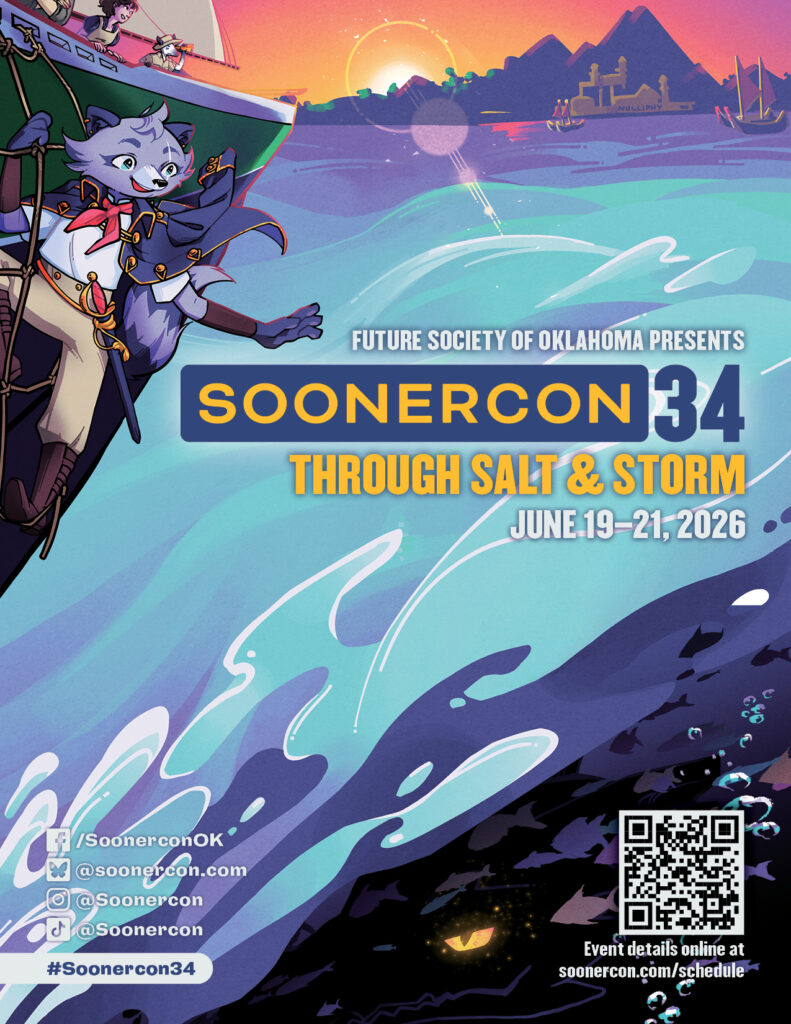
This past weekend, I participated in Soonercon 34, Oklahoma’s premier pop culture convention. Sponsored by the Future Society of Oklahoma, this year’s con chose “Through Salt & Storm” as its motto.

Food on the Seas

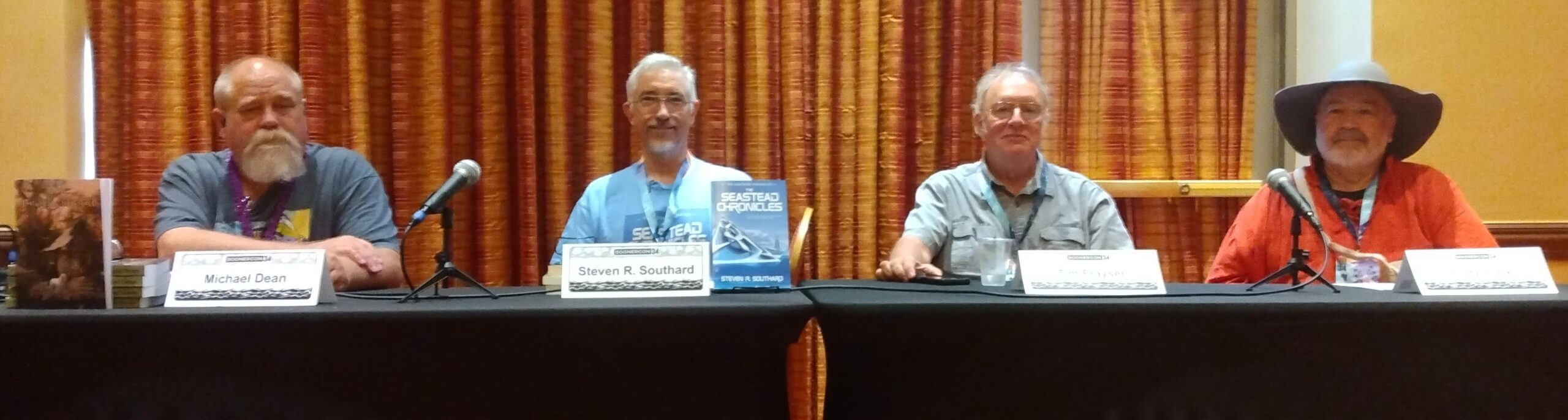
Michael Dean moderated my first panel of the weekend—“Ship’s Biscuits, Limeys, and Rum: Food on the Seas.” My fellow panelists—Tim Frayser and Cody Clark—held a lively discussion about hardtack, grog, and other maritime sustenance. Weevils also came up. Afterward, no one in the audience seemed inclined to ride an old-time sailing ship for long periods.

Michael Dean, me, Tim Frayser, and Cody Clark

Non-Human Protagonists

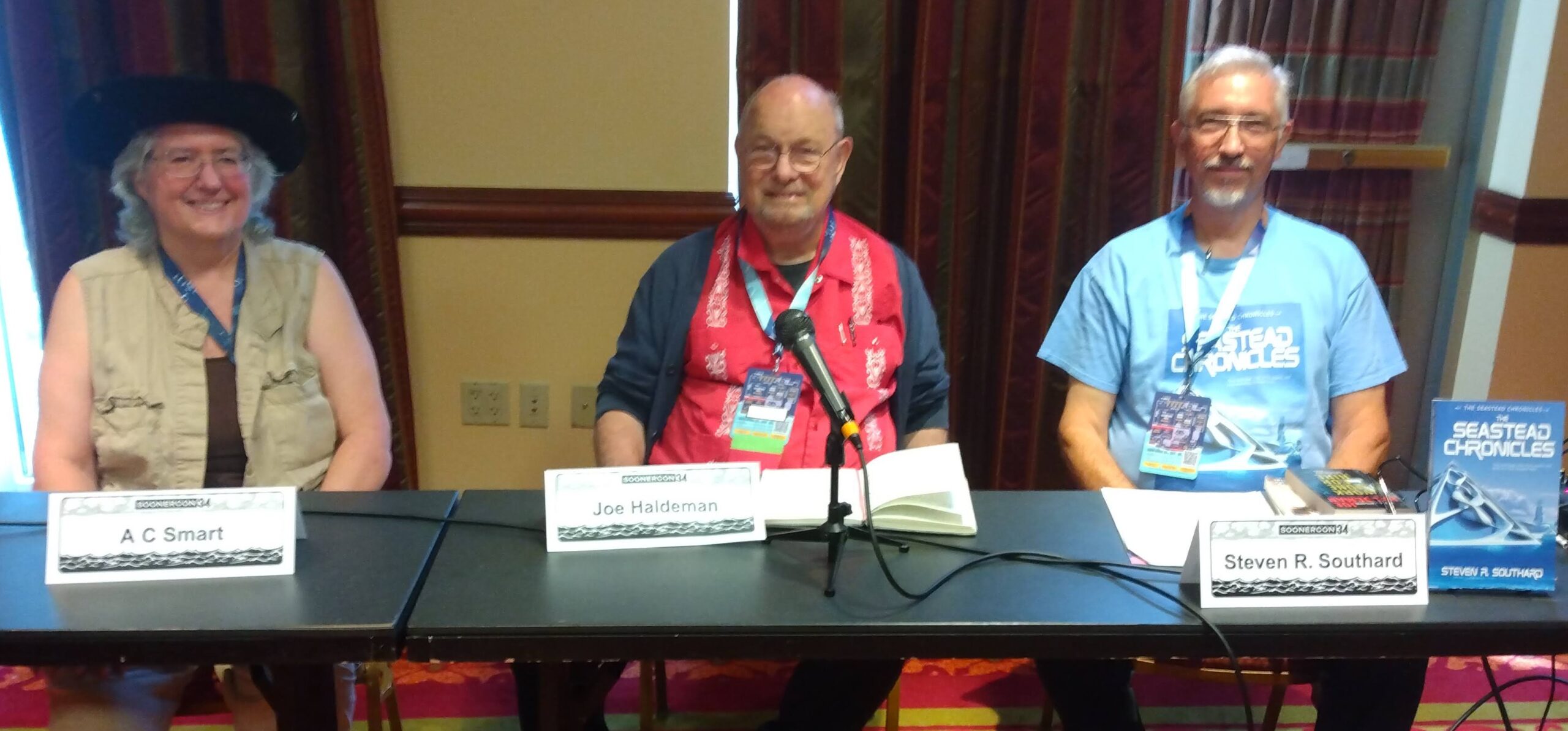
I moderated the next panel, titled “Writing the Inhuman: Crafting Non-Human Protagonists.” With no sentient non-humans willing to serve as panelists (at the prices Soonercon could pay), we made due with humans, in particular A.C. Smart and Joe Haldeman. Yes, that Joe Haldeman. Both of them delighted the audience with valuable information about robots, aliens, and other non-humans (even cats) as main characters. They gave budding scifi writers actionable tips about how to create vivid, believable non-human characters.

A.C. Smart, Joe Haldeman, and me

Book Signing

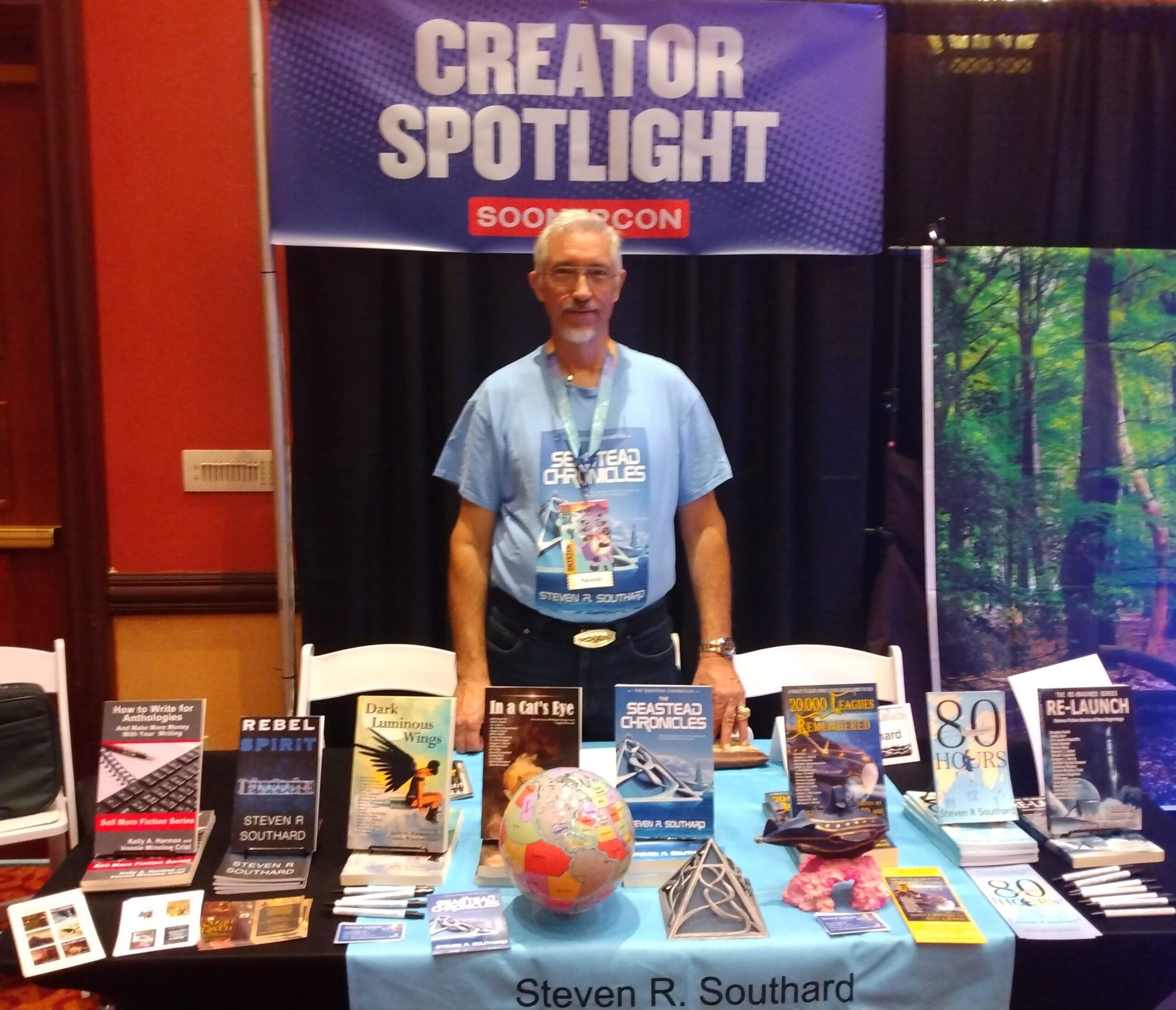
Several people, those without anything more pressing to do, stopped by the table I’d set up for selling books.

Stars and the Sea

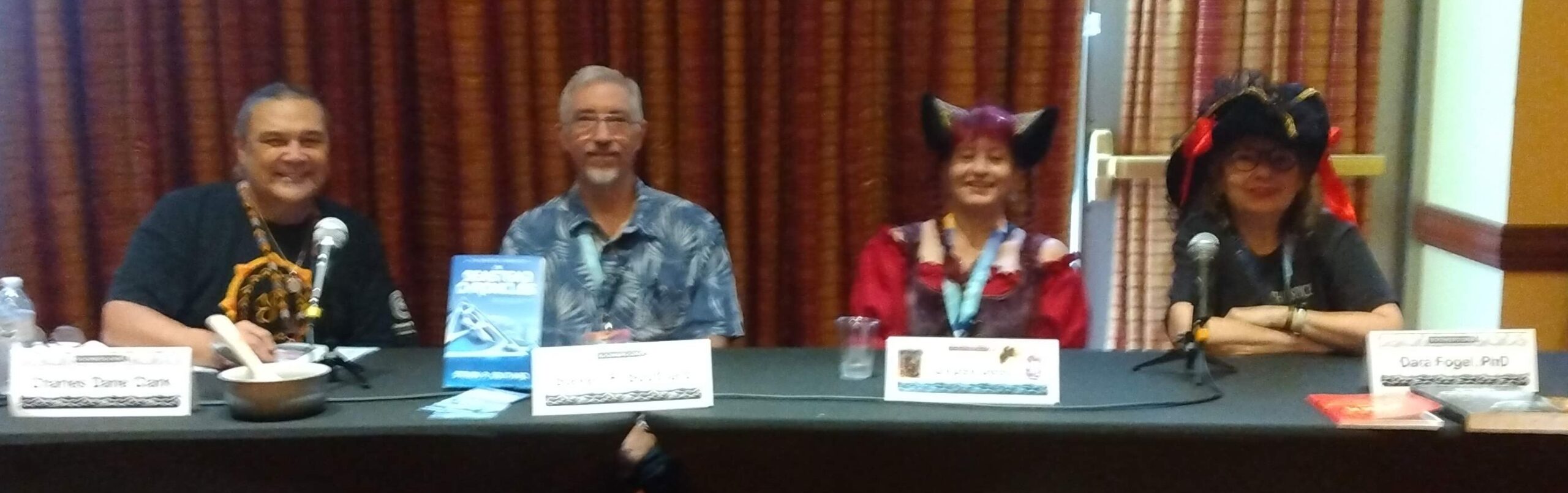
Charlie Clark moderated my only Saturday panel, “Stars and the Sea: Constellations in Myth and Legend.” The panel consisted of Dr. Dara Fogel, Gypsy Jess, and me. A member of the Choctaw Nation, Charlie told the audience about Choctaw legends involving solar eclipses. Both other panelists described how star patterns and their stories affected most cultures throughout history.

Charlie Clark, me, Gypsy Jess, and Dr. Dara Fogel

Building the Temple

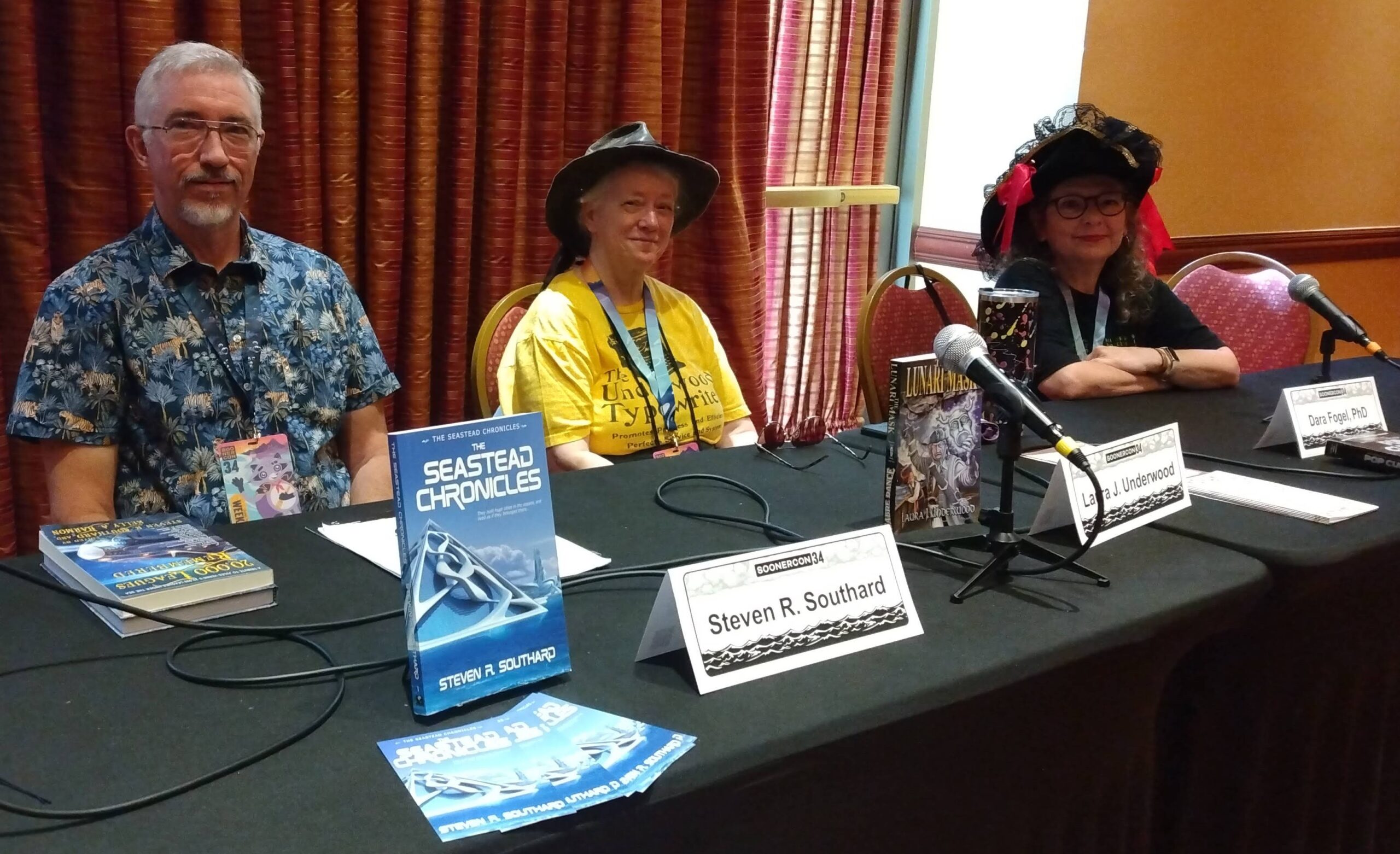
On Sunday at 11:00 (appropriately), I moderated a panel titled “Building the Temple: Believable Religion in Speculative Fiction.” Though I started it off much like a religious service, panelists Dr. Dara Fogel and Laura J. Underwood helped the audience understand the elements of a religion and how to create a credible one for a fictional work, citing examples from their own and others’ books.

Me, Laura J. Underwood, and Dr. Dara Fogel

Golden Age

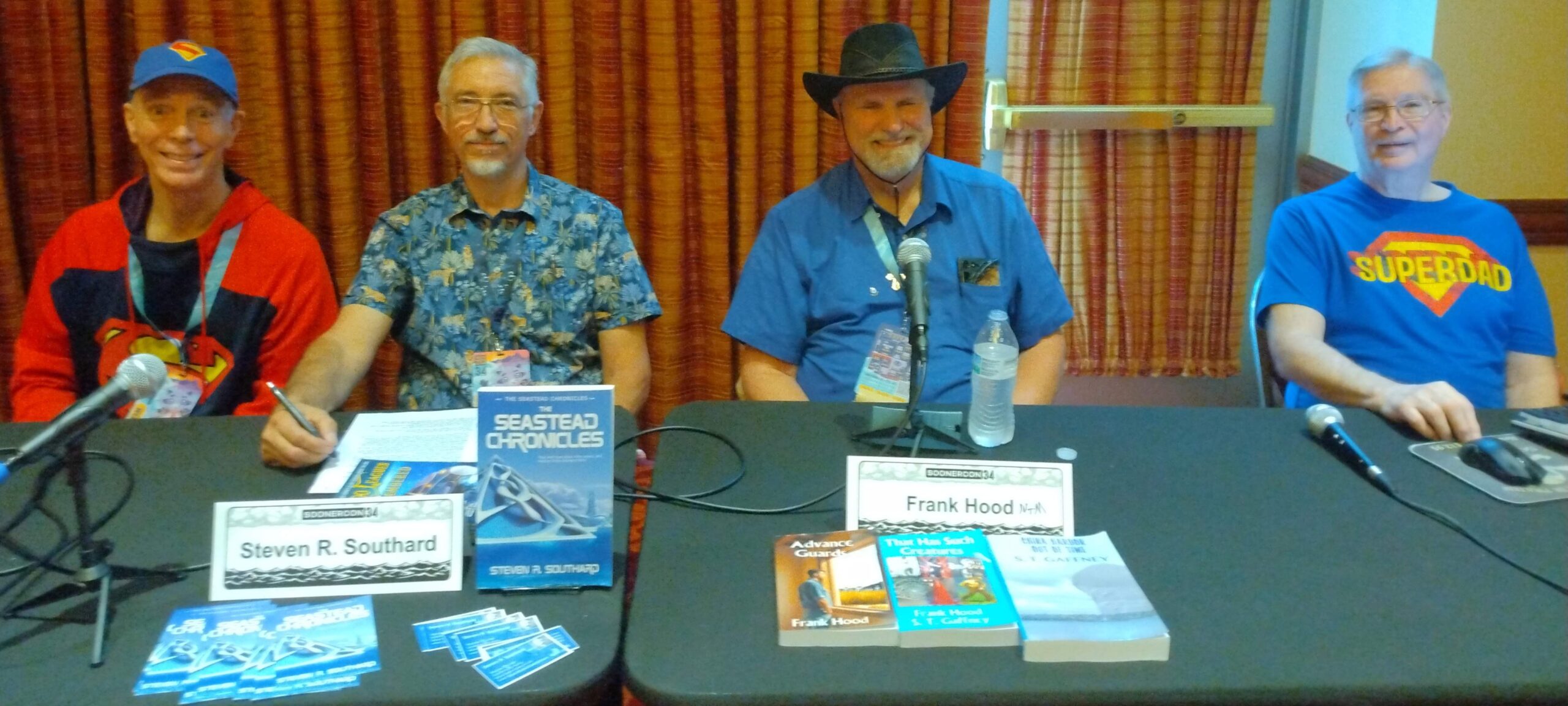
At 3:00, I moderated a panel titled “The Golden Age of Sci-Fi: What Makes Classic Stories Endure?” Panelists Frank Hood, William Bernhardt, and Mark Alfred covered the classic definition of science fiction’s Golden Age (late 1930s to late 1950s), but also the more universal definition (whatever scifi you started reading at age 12). They covered the prime examples of Golden Age literature and what qualities keep them readable today.

William Bernhardt, me, Frank Hood, and Mark Alfred

Overall

Though Soonercon got its start 34 years ago focusing on science fiction, it has broadened to pop culture. Now the vendor booths display anime, manga, stuffed animals, stickers, and other trinkets rather than books. Most of the panels and activities focus on cosplay, e-sports, hentai, and painting, etc., with science fiction as a minor sideshow. Thousands of attendees showed up, most young, and most in costumes I didn’t recognize.

I couldn’t ignore a con with a nautical theme, of course. Wherever and whenever fans go “through salt & storm,” you’ll find—

Poseidon’s Scribe

Sail the Soonercon Seas With Me

This coming weekend, from the 19th through the 21st of June, I’ll participate in Soonercon 34, a pop culture convention in Norman, Oklahoma. Despite Oklahoma’s distance from major bodies of water, their theme this year is “Through Salt & Storm,” which suits me well. Here’s my schedule:

Ship’s Biscuits, Limeys, and Rum: Food on the Seas

Friday 2:00 – 2:45

Panelists: Michael Dean (moderator) Cody Clark, Tim Frayser, and me

Writing the Inhuman: Crafting Non-Human Protagonists

Friday 3:00 – 3:45

Panelists: Joe Haldeman, Vickey Malone Kennedy, A.C. Smart, and me (moderator)

Book Signing

Friday 5:00 – 5:45

Stars and the Sea: Constellations in Myth and Legend

Saturday 10:00 – 10:45

Panelists: Charles Dane Clark (moderator), Dara Fogel, Gypsy Jess, and me

Building the Temple: Believable Religion in Speculative Fiction.

Sunday 11:00 – 11:45

Panelists: Dara Fogel, J.H. Fleming, Laura J. Underwood, and me (moderator)

The Golden Age of Sci-Fi: What Makes Classic Stories Endure?

Sunday 3:00 – 3:45

Panelists: Frank Hood, William Bernhardt, Mark Alfred, and me (moderator)

Location

You’ll find Soonercon 34 at the Embassy Suites Hotel in Norman, Oklahoma.

Though you might have to sail “through salt & storm” to get there, please make the effort. If you do, be sure to shout a hearty “Ahoy!” to—

Poseidon’s Scribe

How to Use Weather in Your Fiction

Most fiction writers refer to weather in their books. Average writers use it to complete a scene description, to paint a complete tableau. Better writers give weather reports that pair with the action or mood of a scene, or foretell an upcoming scene. The best writers do both of those, but do them with style, enabling the reader to experience commonplace weather, even a clear blue sky, as if seeing it for the first time.

Inspiration

Dr. Peter Schulman, of Old Dominion University, inspired this blogpost. He spoke on the topic of “The Poetry of Weather in Jules Verne” at a recent meeting of the North American Jules Verne Society. That talk got me thinking about weather as a tool for all fiction writers.

Universality

All humanity experiences weather. We all enjoy it, suffer from it, marvel at it, endure it, etc. When an author discusses weather—on Earth or on any planet with an atmosphere—readers relate. We see it and feel it with the characters. No matter how strange the characters, how bizarre their actions, how weird their motivations, how bewildering their speech, readers understand the weather when the author describes it. Weather unites us all. It ties together all humans in all places at all times in history.

Variety

Imagine a painter’s palette with infinite dabs of color available, or a workman’s kit containing an infinite number and type of tools. In a similar way, weather provides an unending spectrum of phenomena for writers to employ. No need for me to belabor the point, since every day of your life confirms the fact. In simplistic terms, the sun, clouds, rain, snow, fog, lightning, and wind all hint at the innumerable combinations available to writers.

Style

How do great authors use weather? What separates them from the common crowd? We all know and recognize common tropes—a journey starts at dawn with a clear sky, fierce storms occur later with thunder cracking to punctuate a key line of dialogue, and the hero rides off into the sunset at the end.

The best writers use these techniques too, but with greater flair and nuance. Their prose puts us in the scene. The sound and cadence of the words and clauses mimics the weather being described. We feel the weather along with the Point of View character. Weather matches a character’s mood, or the scene’s mood, or contrasts with them to make a larger point. Perhaps the character feels one way and the sky is sending a hint of how the character should feel. A master writer uses just enough words, and no more, to convey all this, in a way that doesn’t interrupt the flow of the plot.

Taming Weather

“Everyone complains about the weather,” Charles Dudley Warner once quipped, “but nobody does anything about it.” Here’s a deeper meaning behind his joke—writers do something about it. Writers control the weather in their stories, blowing wind like Aeolus, hurling lightning bolts like Zeus. If you hope to write well, implement my guidance in the Style section above.

Also, take some time to log the weather yourself. Write descriptions of extreme and commonplace weather as you find it, or from others’ pictures and videos. Go beyond a bare accounting. In your journal, convey the impressions on all your senses and all the emotions the weather evoked. Armed with these passages, you can use them to enhance your stories, to serve purposes in your plots, and to reflect some truth about your characters.

As the crimson orb kisses the distant horizon, dragging narrow clouds of fuchsia, lavender, and violet along with it, a singular silhouetted figure rides into the sunset of this blogpost. Who could it be? Of course, it’s—

Poseidon’s Scribe