As you and the story you’re writing go through time together, do you find yourself on the same type of emotional roller-coaster as with a personal relationship? Do you feel elated by positive events and dejected by negative ones? I’ve been through the process enough to detect a repeatable pattern. Maybe it will be the same for you.
Let’s follow through as I experience the highs and lows of writing a story and getting it published. This is my relationship with a single story, so the line will overlap with other stories in various stages.
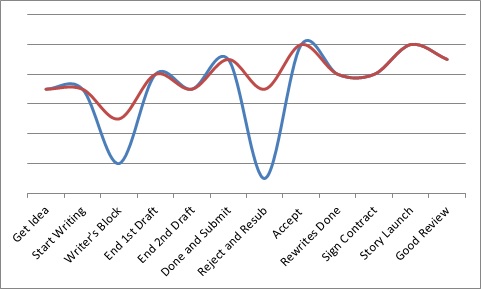 Getting a story idea is enjoyable, having it mature in my mind while I imagine the possibilities, the characters, the plotline, the settings, and some of the dramatic scenes. It’s a good feeling to go through that, because that imaginary, unwritten story is as good as it’s ever going to be. Once the reality starts and I put words down, the story never reaches the exalted heights of perfection that it achieved when just a dream.
Still, putting words down has a gratification all its own. I feel I’m making progress, producing product, assembling widgets on my keyboard / word / sentence / paragraph assembly line.
Until I get stuck with writer’s block. Here I mean the minor writer’s block I’ve described before, where I can’t get out of a plot hole, or I need a character to act contrary to his or her motivations, etc. Although temporary, this is a real downer. I don’t always experience this, (as shown by the reddish line) but there’s usually some drop-off in enthusiasm as the glow of the original idea fades a bit.
Reaching THE END of the first draft is a definite up-tic in satisfaction for me. The mad rush of getting words down is over. It’s good to know I can start the reviewing-editing-improving phase.
For simplicity, my graph only shows two drafts, but there may be more, with minor wave crests for completing each one. I get to the highest emotional state so far when I consider the story done and submit it for publication. “Here, Dear Editor, this is my newborn! Don’t you love it as much as I do?”
That emotional high fades, as they all do, while waiting for a response. Usually I’ve begun another story by then, so I get an overlap with a similar-looking graph displaced in time.
My graph depicts two paths here, one showing a rejection. Despite my earlier advice to look at rejections positively, I still find that hard to do. Rejections stink. Maybe not as much now as my first one, but still…
An acceptance of a story is a very high emotional state, especially the first time. It’s time to celebrate, indulge, and surrender to the grandeur and magnificence of me.
No one can maintain a very high or very low state forever, so I do descend from the grand summit as I get through the rewrites and signing of the contract, though these are not unpleasant.
The launch of a story is another sublime pinnacle of emotional ecstasy, and that’s no hyperbole. “For all human history, readers have awaited a story like this, and today, I, yes I, grant your wish and launch this masterpiece, this seminal work of ultimate prose, so you may purchase and read it. You’re quite welcome.”
After the story is launched, you’ll get occasional uplifting moments, such as favorable reviews, or book signings, etc. These are never quite as exciting as acceptance or launching, but they’re gratifying anyway.
I’ve not gotten through all these stages with a novel yet, but I suppose a novel’s graph is longer in time, and has many more ups and downs than that of a short story.
Also, your mileage may vary such that your graph looks quite different from mine. Leave me a comment and let me know about the emotional stages of your writing experience.
Remember, when on a roller-coaster (emotional or state fair-type), it sometimes helps to raise your hands in the air and scream. Whee! Here goes—
Poseidon’s Scribe



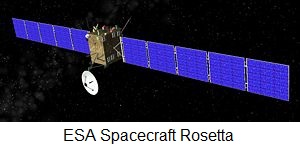
 They claim this will be the first time a human-built spacecraft has landed on a comet.