The 9 Most Interesting Monuments to Writers

On a recent trip to Scotland, I saw a monument glorifying the writer Sir Walter Scott. That got me thinking about, and researching, monuments to writers in general. In this post, I’ll examine the ones I found most interesting.

By “interesting,” I mean something other than a statue or bust on a pedestal. Those who commission, design, and build monuments to authors honor them in a wonderful way, so I don’t mean to disparage the statue-on-a-pedestal design. Most author monuments fall into that category, though, so I’m posting about the less common types.

I’ve put my list in order of monument completion date, earliest to latest.

photo taken by Poseidon’s Scribe

Scott Monument

Finished in 1846 in Edinburgh, Scotland, this giant monument stands 200 feet tall—second tallest of all monuments to authors (for the tallest, see José Martí below). Spiral staircases allow access up to platforms with commanding views views of the city. George Meikle Kemp designed the monument and John Steell designed the statue of Scott (along with his dog) between the pillars. The monument includes depictions of sixty-four characters from Scott’s novels.

The Scottish people take great pride in Sir Walter Scott (1771-1832), both for his poetry, including “The Lady of the Lake” and for his historical, romantic novels, including Waverley and Ivanhoe.
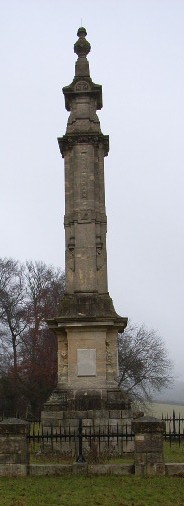
Image from Wikipedia

D’Israeli monument

In Buckinghamshire, England stands this fifty-foot monument to writer Isaac D’Israeli. The top may look like a statue, but it’s an urn. Raised panels with inscriptions and a profile portrait of the author decorate the pedestal. Designed by Edward Buckton Lamb, the monument had been commissioned in secret by D’Israeli’s daughter-in-law Mary Anne Disraeli as a surprise for her husband, Benjamin Disraeli, then Chancellor of the Exchequer. Later he became Prime Minister.

Isaac D’Israeli (1766-1848) wrote romantic novels and essays, but is most famous for Calamities of Authors and Curiosities of Literature.

Johannes Ewald and Johan Hermann Wessel Memorial

The only monument on my list honoring two writers, it stands ten feet tall. Located in Copenhagen, Denmark and completed in 1879, it features two nude, winged boys, one with lyre and the other with pan flute. The pedestal contains portraits of the poets and inscriptions honoring their works. Otto Evens designed the memorial.
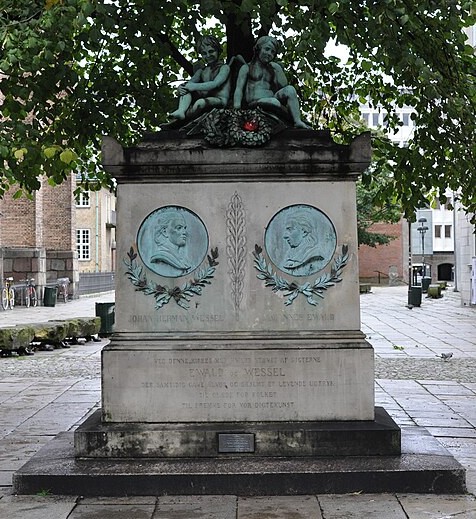
Image from Wikipedia

Born in Copenhagen, Johannes Ewald (1743-1781) wrote plays, psalms, and poetry. He’s most famous for his dramatic work Balders Død (Balder’s Death) and his poem Rungsteds Lyksaligheder (The Happiness of Rungsted).

Though born in Norway, Johan Hermann Wessel (1742-1785) studied, lived, and died in Copenhagen. A poet and playwright, he employed parody and wit in his writings. Among his most significant writings are Kierlighed uden Strømper (Love without Stockings), and Smeden og Bageren (The Smith and the Baker).
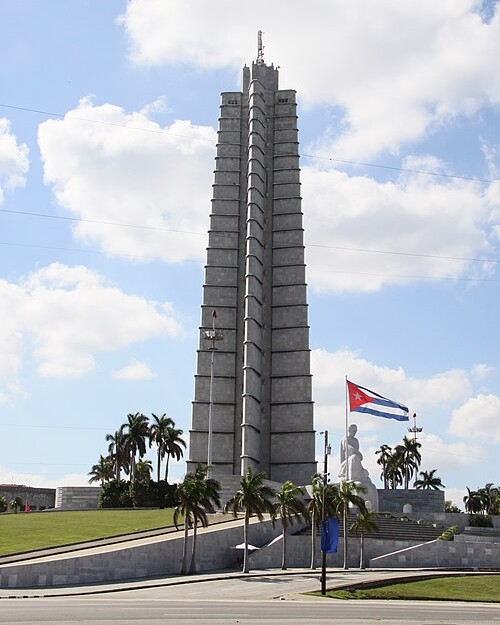
Image from Wikipedia

José Martí Memorial

At 358 feet in height, this monument dwarfs all other writer memorials. Completed in 1958 and located in Havana, Cuba, it takes the form of a tall tower with a star-shaped cross section. Nearby stands a statue of the author. Jean Labatut designed it, under the guidance of architect Raoul Otero de Galarraga. Unlike the Scott Monument’s stairs, the Martí Memorial includes an elevator at the center of the star shape. Visitors can ascend to the observation deck, where, from Havana’s highest spot, they can enjoy a panoramic view of the city.

The size of the monument suggests the adoration Cubans feel for their national hero. Through his writings, José Julián Martí Pérez (1853-1895) pushed for the liberation of Cuba from Spain and has been given the appellation “Apostle of Cuban Independence.” His roles included publisher, professor, translator, journalist, essayist, philosopher, and poet. His most famous writings include the children’s book La edad de oro (The Golden Age), the poem collection Versos sencillos (Simple Verses), and his essay Our America.

Ernest Hemingway Memorial

Image from the Library of Congress

Cuba hosts another writer memorial of note. This one stands in the fishing village of Cojimar, near the bar where Ernest Hemingway often drank. Designed by the Cuban architect José Luis Sert, it features six Ionic-style columns supporting a stone ring. Inside stands a bust of the author sculpted by Fernando Boada Martín. For the bust’s material, he melted down propellers, anchors, and chains supplied by local residents. Completed in 1962, the memorial’s simple, yet profound, design reflects the character of Hemingway’s prose.

Though American, Ernest Miller Hemingway (1899-1961) spent a lot of time in Cuba and wrote many novels there, including The Old Man and the Sea, for which the residents of Cojimar most celebrate him. He also wrote For Whom the Bell Tolls, A Farewell to Arms, and The Sun Also Rises.
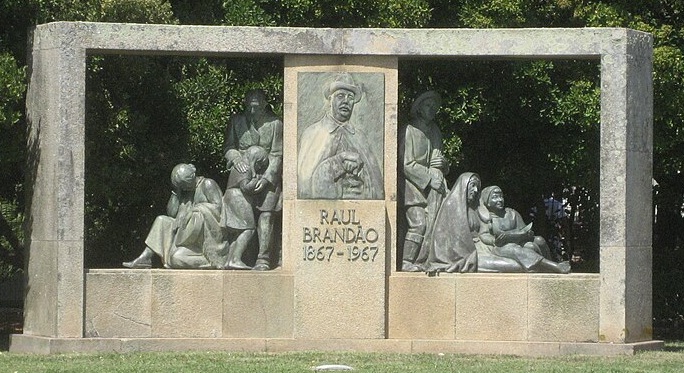
Image from Wikipedia

Monument to Raul Brandão

Located in Porto, Portugal, this monument takes the form of a hollow, granite rectangle enclosing two scenes featuring several statues. Separating the scenes is a relief image of the author with his name. Architect Rogério de Azevedo and sculptor Henrique Moreira completed the monument in 1967 to mark one hundred years since the author’s birth.

A Portuguese journalist, writer, and army officer, Raul Germano Brandão (1867-1930) wrote several books, often featuring sailors and the ocean, including Impressões e Paisagens (Impressions and Landscapes) and Os Pobres (The Poor).
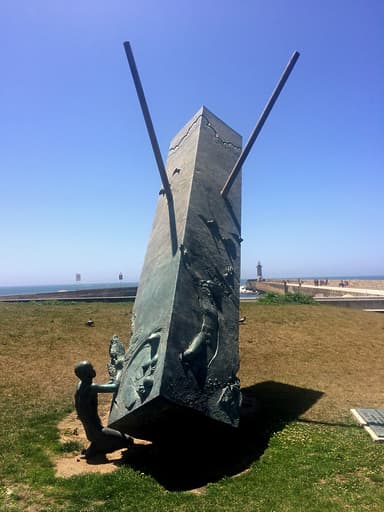
The Dream of Humanity Monument to Ferreira de Castro

Also in Porto, Portugal stands this abstract monument. Called O Sonho da Humanidade, Portuguese for “The Dream of Humanity,” and designed by José Rodrigues, it got completed in 1988. I found no information about why it looks the way it does, or how its appearance symbolizes the author’s writings.

A Portuguese journalist and writer and journalist, José Maria Ferreira de Castro (1898-1974) helped father the genre of Portuguese social-realist fiction. Among several other works, he authored A Selva (The Jungle) and A Volta ao Mundo (Around the World).
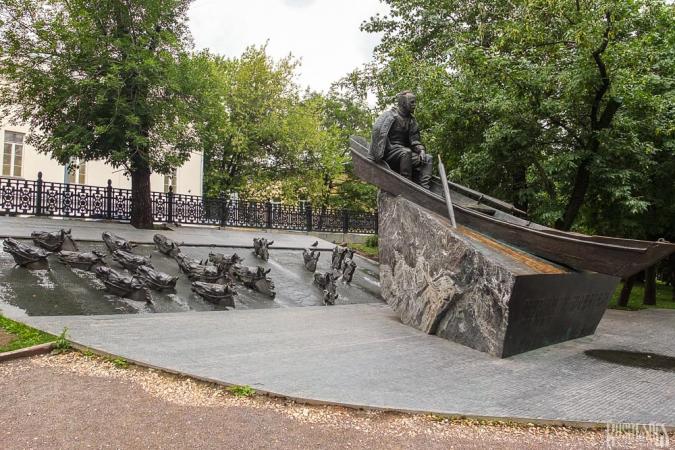
Image from Tripadvisor

Monument to Mikhail Sholokhov

The year 2007 saw the completion of this monument in Moscow. Sculptor Alexander Rukavishnikov depicted author Mikhail Sholokhov rowing a boat. Behind the boat, over a dozen horses swim with just their heads showing. Real water flows down the sloped surface to show the horses swimming, making this the only kinetic sculpture on my list.

Earning the 1965 Nobel Prize in Literature, author Mikhail Aleksandrovich Sholokhov (1905-1984) wrote novels about the Don Cossacks. And Quiet Flows the Don reigns as his most popular novel. As an additional honor beyond the monument, an asteroid is named for him—2448 Sholokhov.
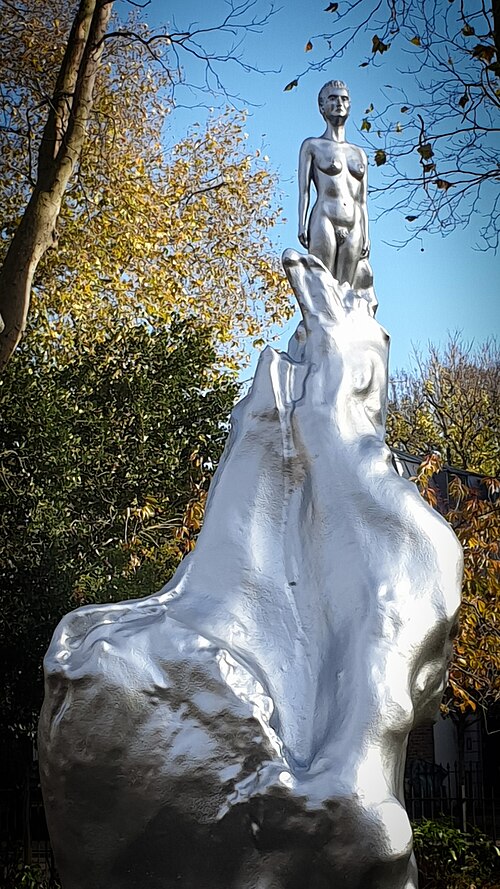
Image from Wikipedia

A Sculpture for Mary Wollstonecraft

I started my list in the United Kingdom, and I’ll finish it there as well. In this London monument, a nude female figure emerges from a swirling, curving mass of chaos. Designed by artist Maggi Hambling and completed in 2020, the monument honors the author Mary Wollstonecraft. At its base appears a quote from the writer: “I do not wish women to have power over men but over themselves.” Though meant as a tribute to one woman, the depicted female represents all women, thus showing how Wollstonecraft lifted womankind from nameless, shapeless anonymity.

An early advocate for women’s rights, Mary Wollstonecraft (1759-1797) wrote a children’s book, a conduct book, a history of the French Revolution, a travel narrative, and several treatises and novels. Her most famous treatise remains A Vindication of the Rights of Woman. She’s become a hero, a founding philosopher, of the modern feminist movement. She died soon after the birth of her second daughter, Mary Wollstonecraft Shelley, author of Frankenstein.

The Real Monuments

Consider this irony. Monuments of stone and steel, while quite a tribute, will erode and crumble in time. But the words of these authors, written on mere paper and now with even more fleeting electrons, will endure much longer than the monuments. As the Romans said, Vita brevis, ars longa, meaning “Life is short, art is long.” In that sense, these authors created their own long-lasting monuments.

Do you know of other interesting author-honoring monuments I should have included? Send a comment to—

Poseidon’s Scribe
Want to be a Good Writer?

Want to write, but you’re unsure how to become a writer, especially a good writer? You’ve surfed to the right blogpost.

It’s not like this at all. Image generated at www.perchance.org

Your Writing License

I understand the confusion. We speak of “poetic license” as if an official committee confers a certification or other formal document declaring you to be a writer. If you’re waiting for that, or searching the internet for where to apply, let me reassure you.

There’s no license.

No badge. No medal. By the power invested in me by nobody, I hereby pronounce you…a writer.

A Good Writer?

With that permission out of the way, your next thought might be, “I want more. I want to be a good writer. How do I do that?”

Again, no specific license exists. Moreover, no matter how hard you work at improving your writing, you have limited control over whether you become a good writer. The reading public has a say in it. They determine whether you’re a good writer or not.

The question then turns to, “How can I write in a way that appeals to readers?” The answer to that includes factors like (1) writing as well as you can, (2) writing what readers want to read, (3) having great timing, and (4) being lucky. You have some control over the first two, but none over the last two.

Lowered Expectations

Did you anticipate instant success as a writer? Time for resetting those expectations. Author Jessi Waugh wrote a great blogpost on that topic. In it, she included an example that stuck with me. Imagine a nursing home where the staff conducts training classes for the elderly residents. They learn activities such as painting, singing, pottery, yoga, etc. Do any of the aged participants believe they’ll excel at these newly-learned skills? No. They expect only to gain new knowledge, and have a little fun.

What if you approached writing the same way? What if you only did it because you enjoyed it? With this framing, any financial gain becomes an unexpected, surprising benefit.

Paperback Writer

Don’t adopt the attitude of the narrator of the Beatles song, “Paperback Writer.” In his fictitious pitch to an editor, he gets everything wrong and demonstrates unrealistic expectations. In particular, the line “If you really like it, you can have the rights/It could make a million for you overnight” shows someone possessing severe overconfidence.

Even the less outrageous line “And I need a job, so I want to be a paperback writer” demonstrates ignorance of why most beginning writers keep their day jobs.

Because it Feels Good

To sum up, I’ve given you license to write and helped you set reasonable expectations about becoming a good writer. Maybe you should write because it feels good. The rest is up to you and the reading public, not to—

Poseidon’s Scribe

Love the Book, Forgive the Author?

Do you refuse to read books written by authors who’ve held offensive beliefs or committed objectionable acts? Are their books, however well written, tainted by the author’s extra-literary reputation?

Image created at Perchance.org. Note: I do not mean to imply or suggest that any author, living or dead, mentioned in this post or not, is demonic or akin to a devil.

Controversial Authors

Rather than provide a complete list, I’ll mention a few, having found several discussed on this Reddit post. My beloved Jules Verne held racist and antisemitic views. Knut Hamsun supported fascists and Nazis. Ezra Pound was a fascist, racist, and antisemite. H.P. Lovecraft was a racist and Nazi sympathizer. Ernest Hemingway was a bully, alcoholic, racist, and antisemite. Ayn Rand had an extramarital affair and opposed altruism and religion. Isaac Asimov groped women. Marion Zimmer Bradley may have abused her child and tolerated her husband’s child abuse. Alice Munro defended her husband’s alleged sexual abuse of their daughter. This article about that last revelation prompted me to think about this post’s topic.

3 Degrees of Bad

We could divide our reasons for hating authors into three categories.

  1. Those who held and stated abhorrent beliefs that don’t appear, or barely appear, in their fiction,
  2. Those who held and stated abhorrent beliefs that are obvious in their fiction, and
  3. Those who performed objectionable actions, whether they wrote about them or not.

Any of these might cause you to refrain from reading books by that author. On the other hand, you might forgive an author for any of these reasons and choose instead to enjoy their books for the literary value.

Noncontroversial Authors

The world includes plenty of books. You could avoid books by troublesome authors and just read works written by saints. However, you may find saintly authors in short supply. Every author is, or was, human, and therefore burdened with faults and failings, just like non-writers.

Even those not known for offensive actions often wrote about their private beliefs. Today, many authors use social media to express opinions on news of the day. Fiction writers spend a lot of time musing about the human condition. They’re bound to form and express strong opinions on various topics, and some of those stances might offend you. The contemporary author whose works you most cherish might get toppled off the pedestal you’ve erected, after a single tweet or post.

Different Places and Times

Although plenty of today’s authors have said or done questionable things, I only included deceased authors in my list above. When judging author behaviors and beliefs, remember that we’re all victims, to some extent, of the culture we live in or grew up in. In various past societies, racism, sexism, and antisemitism once prevailed as normal. Phrases and character types that readers of those times and places accepted with little notice cause us to cringe today.

Is it fair to judge a past author’s work by today’s standards? Sure. You can judge, by any criteria you want, whether you like a book or not. Is it fair to blame a past author for not living up to our modern sensibilities? No. The author could not predict how society would change.

Authors Aren’t Their Characters

Though some do, I urge you not to judge authors by their characters. Some authors excel at showing us convincing evil characters. As readers, we might wonder how the author can get inside a twisted mind so well, and we might suspect the author of sympathizing with the bad guy.

In his novel Next, Michael Crichton portrayed a character named Brad Gordon as a creepy pedophile. I felt myself transported into the sick mind of this perverted character. Though Crichton managed the description well, I would never accuse him of pedophilia.

Your Choice

They say you shouldn’t judge a book by its cover, though many do. Is it fair to make your decision about what to read based on the author’s personal life or beliefs? Of course, but you might be denying yourself a pleasurable reading experience. What I’m saying is, you be you and I’ll be—

Poseidon’s Scribe

September 21, 2025Permalink

Dying Writers, Dying Readers

Author Annie Dillard once wrote, “Write as if you were dying. At the same time, assume you write for an audience consisting solely of terminal patients.” The quote intrigued me. What did she mean?

Source

It’s from a 1989 essay in The New York Times titled “Write Till You Drop.” The paragraph continues, “That is, after all, the case. What would you begin writing if you knew you would die soon? What would you say to a dying patient that would not enrage by its triviality?”

Picture the situation. You are near death and so are your readers. The pen and pad (or computer) sit before you. How would you write differently than you do now?

Answers?

As morbid as the thought experiment may seem, some answers to that question occur to me:

  • Don’t waste time. You haven’t much time for writing, nor do your readers for reading.
  • Don’t ‘enrage by triviality.’ Write about what’s important, vital to being human. Write the thing you’d regret not having written, the thing readers would regret not having read.
  • Don’t save your best for some later time. Don’t keep that masterpiece in reserve. There will be no later time.

Wonderful Concentration

English author Samuel Johnson said, “When a man knows he is to be hanged in a fortnight, it concentrates his mind wonderfully.” Dillard admonishes us to write that way all the time, with a wonderfully concentrated mind.

Socrates

Consider the last words of Socrates. At his trial he received a sentence of death. Imagine the ‘wonderful concentration’ of his mind as he drank hemlock and felt his limbs going numb. Some have reported his final words as, “Crito, we owe a rooster to Asclepius. Don’t forget to pay the debt.”

How can that be? On his deathbed, one of history’s greatest philosophers prattled about not having paid for a rooster? Is that not enraging by triviality?

Newer interpretations of those last words paint a different picture. Greeks considered Asclepius a god of medicine and the rooster a symbol of rebirth or eternal life, for it crows every morning. Some now think Socrates’ words a metaphor, a way of saying, “Athens may kill me, but philosophy lives on.” If so, that satisfies Ms. Dillard’s advice to write as if you were dying.

Triviality

Regarding the part of her advice referring to triviality, that confused me at first. What is trivial and what is not?

After all, author and politician Bruce Barton said, “Sometimes, when I consider what tremendous consequences come from little things, I am tempted to think that there are no little things.”

No little things? Aren’t they the trivial things?

Perhaps not. Mother Theresa said, “Not all of us can do great things. But we can do small things with great love.”

Ah, that might provide a clue regarding what Ms. Dillard meant by triviality. You may write about anything, large or small, but do so with great love. Use up every drop of your literary skill. It’s not the triviality of the subject, but the treatment of it by the writer.

In sports, we say a player ‘left if all on the field,’ meaning he gave it his utmost. I may be wrong, or I may be over-analyzing it, but that’s what I believe Annie Dillard meant in advising us to write as if we were dying, and as if our reading audience were dying as well.

If your next written sentence were your last, would readers say you ‘left it all on the field?’ Aim to write with a mind as wonderfully concentrated as that of—

Poseidon’s Scribe

Has it Been 10,000 Hours Yet?

After Malcolm Gladwell’s book Outliers, the Story of Success showed 10,000 hours of practice equaled genius, I felt good. After all, I’d been writing almost that long, so genius and success should lie just over the next rise. A few more hours to go. 

Then along came Dr. Scott Barry Kaufman, author of this article in Scientific American, saying the 10,000-hour rule doesn’t apply to creative fields like fiction writing.

Now you tell me, Doc.

His rationale makes sense, dang it. To become a genius at an activity requiring repetitive motions—oboe playing, bricklaying, pizza-making, etc.—the 10,000 hours seems logical. Some of that is creative play, but much is building muscle memory and learning more advanced techniques.

But purely creative endeavors—music composition, art, and writing—aren’t like that. Muscle memory won’t help. Spend 10,000 hours typing and retyping Sense and Sensibility, and you’ll end up a fast typist. But your skills as a novelist won’t have changed.

The article counts 10,000 hours of practice (also called the 10-Year Rule) as one factor in creativity, but gives that number a wide error band.

The author cites several other factors of importance to creativity. Unfortunately, a writer lacks control over some of these factors, such as talent, personality, genes, and socio-economic environment.

Lucky for us, the article provides some aspects of creativity lying within our control. For example, Dr. Kaufman states that creative people often use messy processes. If you’re the neat and organized type, you’ll have to work on correcting that.

The author says creative people take interest in a broad array of things. If you write fiction, consider writing stories outside your normal genre.

Too much specialized expertise, says Dr. Kaufman, detracts from creativity. Often, he says, people outside a field contribute the fresh insights and creative solutions. As writers, we can take care not to become overly specialized, and each of us can claim outsider status in something.

I give the doctor credit for identifying personal attributes that influence creativity, but I don’t believe you’re stuck with whatever creativity you were born with. (Nor did he imply that in his article.)

You can increase your creativity. I believe you, and all of us, were born overflowing with creativity. However, society’s pressures to conform squeezed much of that creativity out.

You can get it back through regular exercise. Here’s the exercise to try. Think of a problem. If it’s a fiction-writing problem, maybe you’re stuck for an idea, or fell into a plot hole, or need a character motivation, or seek a setting description. The problem could be anything.

Now start writing solutions as they occur to you. Include stupid ideas, impractical ideas, zany and magic ideas. It doesn’t matter—no one will see your list. Often very good ideas only emerge after thinking of dozens of bad ones first.

Yes, you may call it brainstorming. Unlike normal brainstorming, though, you’re doing this alone. Also, unlike normal brainstorming, you’re seeking more than just a good answer to your problem. You’re trying to stretch your creativity muscles. You’re retraining your mind to free it from a cage built long ago to hold it.

Maybe you’ll run dry after ten listed solutions, but I encourage you to push on. It might help to consider this–back when you were five years old, you could rattle off fifty ideas without slowing down. That’s the childlike creativity you’re looking to recapture.

If you aim to be a writer, forget about the 10,000 hours, the 10-Year Rule. That’s for others. You need creativity, and no clock or calendar can give you that. Let your inner kid loose again, this time to skip around in the infinite playground of your mind where milliseconds equal millennia and a pace is as good as a parsec.

And, there he goes, the five-year-old version of—

Poseidon’s Scribe

Equation for a Great Science Fiction Story

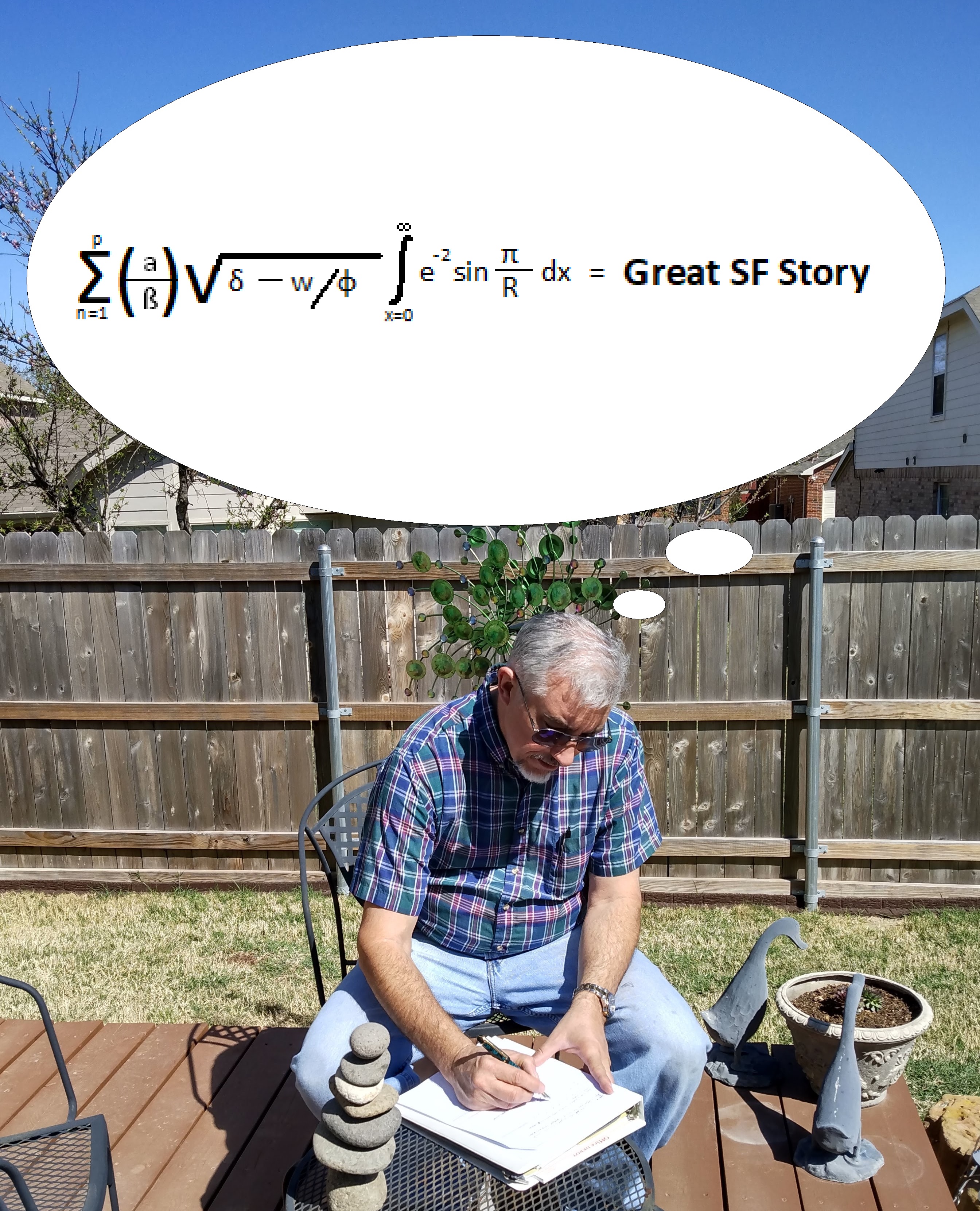
If only we could write great SF by following a step-by-step process, or a connect-the-dots diagram, or a mathematical equation.

I seem to recall Isaac Asimov once said a good story maximizes the emotional impact on the reader. That definition starts out resembling an equation, but trails off into the unquantifiable chaos of human emotion.

NASA scientist Christine Corbett Moran did a nice mathematical analysis of what she enjoys about SF. She chose an interesting metric. First, she noted the point at which she became engaged enough in the book that she had to finish it. She divided the number of pages left after that point by the story’s total length. At the very least, it’s a good measure for determining how early a story grabbed her interest. She called the parameter engagement.

I tried a different approach to quantifying good SF. I listed twelve attributes I thought important (engaging protagonist, intriguing setting, interesting style, etc.) and performed a pair-wise analysis on them. This required comparing every attribute to each of the others to determine importance. Yes, it’s tedious, and yes, it forced me to make hard choices, but such are the hardships I endure for my readers.

My resulting list, from most important to least, is as follows:

  1. Logical Plot. Events must make sense in a cause-effect relationship.
  2. Engaging Protagonist. I have to care about the main character, and some lesser ones.
  3. Difficult Problem/Ingenious Solution. The problem should be important and appear impossible. The solution, unexpected and elegant.
  4. Consistent (or Explained) Motivations. The characters shouldn’t say or do things out-of-character. Or, if they do, I need to know the reason for the deviation.
  5. Believable Science. I can tolerate some stretching of science, but give me enough convincing techno-babble to make it seem plausible.
  6. Intriguing and Well-described Setting. Make your world fascinating and immerse me in it. Explore the implications to help it seem vivid and real.
  7. Plot Twists. The unexpected turn, the jaw-dropping surprise. A few of these keep me reading on.
  8. Interesting and Distinct Writing Style. If you choose words well, if your story flows like a stream with interesting ripples and eddies, I’ll follow you anywhere.
  9. Symbolism, Inside Jokes, and Easter Eggs. I’m a sucker for this stuff. I don’t always get them, but when I do, I feel like I’ve broken a secret code.
  10. Humor. Not all stories need humor, and not all writers pull it off well, but it’s a plus.
  11. Message. Don’t lecture me with a message or morale. Still, I like it when I finish a story and a day later realize what the author was really saying.
  12. Relevance to My Life. It’s nice when a character thinks and acts like me, but that’s not necessary for me to enjoy the story.  

Your list of attributes would be different from mine, and even if some items match, the order of your list would be different. That’s why one reader’s “great!” is another’s “meh.”

Sorry, I don’t know the equation for writing a great science fiction story. If it exists, and if top SF authors know it, they aren’t posting it on their websites.

It’s possible, too, that our elusive equation might include terms like luck and timing, both largely out of the writer’s control.

Perhaps there’s no use searching for an equation to write great science fiction. Maybe it’s better to spend your time trying to write better stories. That’s the nonmathematical goal of—

Poseidon’s Scribe

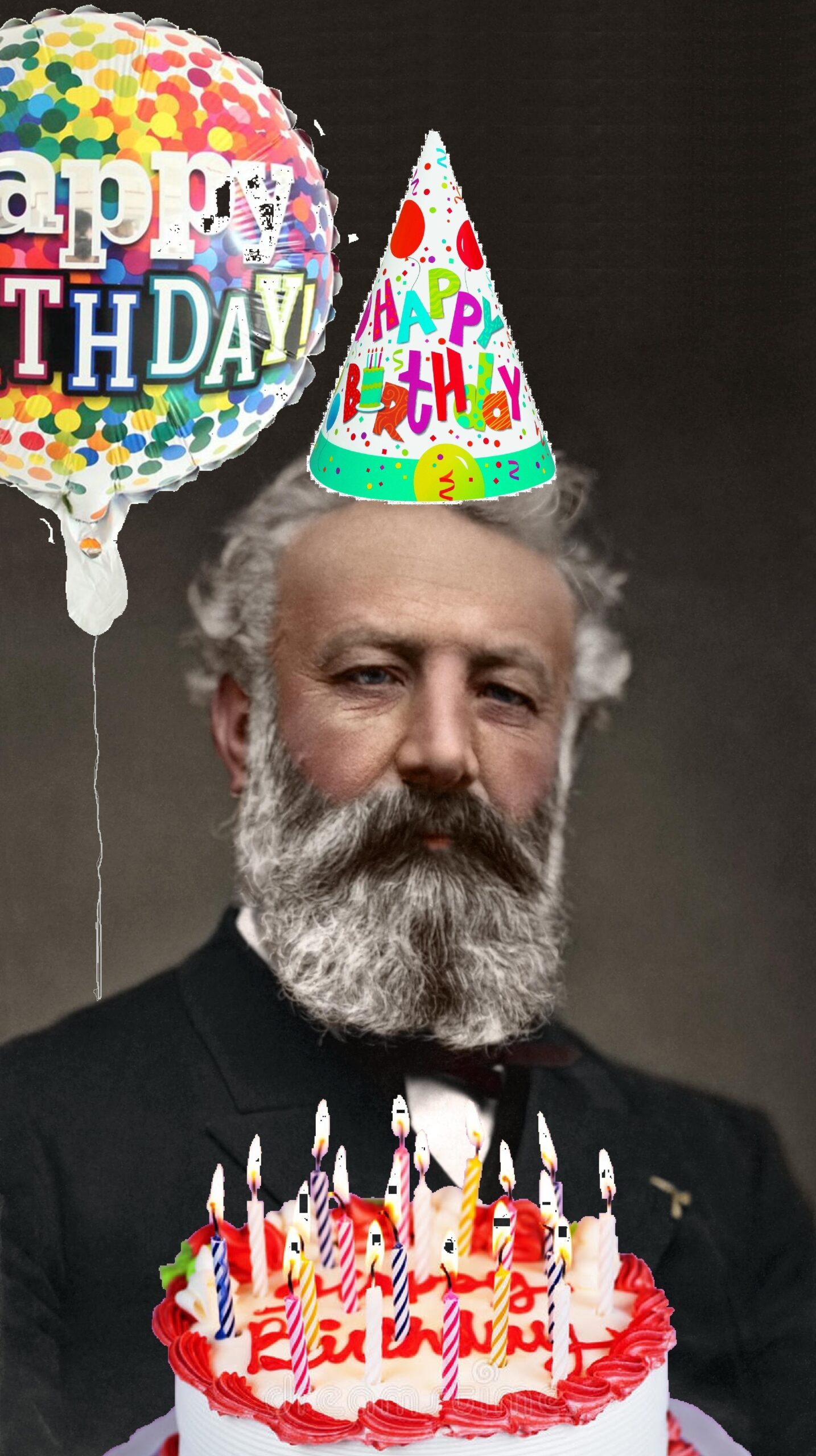
27 Ways to Celebrate Jules Verne’s Birthday

Just two more days until Jules Verne’s birthday on February 8th. He’ll turn 194. How will you celebrate?

I have a few ideas for you. For convenience, I’ll separate them into categories.

Low-Cost At-Home Activities

  • Read (or re-read) one of his books. Perhaps the best way to celebrate.
  • Join the North American Jules Verne Society.
  • Watch a movie inspired by one of Verne’s books. There are dozens to choose from, some available on the internet.
  • Toast to Verne with some French wine, and, as the wine takes effect, imagine taking an extraordinary voyage of adventure to some far-off, exotic location.
  • Play a game of whist with three fellow Verne enthusiasts. (Verne’s characters often played that game.)
  • Write your own fictional adventure story set in a place you’ve never been.
  • Imagine a trip back through time to meet Jules Verne. What would that conversation be like? What would you ask him? What might he ask you?
  • Do what Verne did in writing Paris in the 20st Century—imagine what your own city or town will look like a century from now, in the year 2122.
  • Find a globe or world map. Say you have to reach a specific location, but have only the latitude (as with The Children of Captain Grant), or just the longitude. Imagine the adventures you’d have as you searched along one line.
  • Imagine Verne time-travelled to 2022 and you could talk to him. What about our world would you show him first? What might fascinate him most?
  • Bake a birthday cake for Jules Verne. It could depict (or be in the shape of) a balloon, a submarine, a moon projectile, or anything else from his novels.
  • Compose, and sing, a birthday song for Jules Verne. For the lyrics, try to work in titles of his novels or character names.
  • Dress up as your favorite Verne character.
  • Write a poem in honor of Jules Verne
  • Write a letter to Jules Verne, wishing him a happy birthday.
  • Draw your own illustration of your favorite Verne character, vehicle, or scene.
  • Many people have their own version of what the Nautilus might have looked like. Pick your favorite from this website maintained by Michael & Karen Crisafulli, and draw your own.

More Involved Activities

  • Build a model of one of his vehicles. A search of the internet will give you many to choose from.
  • Build and launch a balloon made from a garbage bag, safely following instructions on this site, or this one. Imagine you’re aboard it, floating high in the air, for five weeks.
  • Use a 3D printer to print a Verne-inspired vehicle, or hire someone to print it for you.
  • Find a suitable cave and go on your own journey to the center of the Earth, (or as close as you can get).
  • Join a local model rocketry club. (Not the same as launching a manned projectile from a cannon, but it’s cheaper and safer.)
  • Visit the nearest submarine museum and tour its featured submarine. Note the differences between it and the Nautilus.

Activities for the Truly Dedicated

  • Jules Verne often set his stories on islands. Plan and take your own trip to an island somewhere.
  • Visit Verne’s birthplace and museum in Nante, France.
  • Visit Verne’s gravesite in Amiens, France.
  • Make a bet with some friends about how fast you can travel around the world, then win the bet.  

Later this year, the North American Jules Verne Society will have an anthology published under the title of Extraordinary Visions: Stories Inspired by Jules Verne. Among the millions of people eagerly awaiting that event are you and—

Poseidon’s Scribe

February 6, 2022Permalink

When Robots Write Better

Here’s a thought experiment. We know researchers push Artificial Intelligence (AI) technology further all the time. What if AI begins writing stories and novels better than humans do?

To make it more fun, let’s assume AI lags behind humans in all other areas. That is, AI programs start to write wonderful fiction, but accomplish nothing else of note.

At this point, that seems unlikely. According to this article by Andrew Mayne, AI has made some progress writing two-sentence flash fiction. and author Erik Hoel found AI did a fair job of generating reasonable prose when he fed it prompts from one of his novels. To date, no AI has written a story or novel that has been widely read as literature.

Before AI comes to the point of writing better than humans, we’ll pass through a phase where human writers partner with AI to improve their productivity. A human author will come up with a story concept—characters, plot, setting—and put the AI to work generating text. The human will then edit and submit. We’re pretty close to that now, with software such as Marlowe, AI Dungeon, Jarvis AI, and GPT-3.

Perhaps not long after that, some AI software might become capable enough to create the story concept and write the manuscript and edit it. At some point, such submissions will pass a literary version of the Turing Test. A human editor won’t be able to tell if a human or AI wrote a story. In fact, some experts believe AI will write a best-seller by 2049.

A short time later, AIs might become capable of writing stories and novels better than any human writer. By that, I mean human readers might come to prefer fiction written by AI.

Since fiction explores the human condition and is designed to provoke an emotional reaction in human readers, my thought experiment postulates that AI might come to do this better than human writers. AI might know us better than we know ourselves.

What then? Is our species ready for that day?

No human writer after that time will stand a chance of keeping up with AI writers in quantity or quality. People inclined to take up writing will choose other pursuits and the number of human authors will dwindle. A small niche industry will linger on, since a few purist readers will refuse to read AI-written fiction. That small slice of the market will support a handful of human authors for a while.

Setting aside that tiny minority, think of the millions of readers devouring the prose churned out by clever machines. Assuming they pay for the books, who pockets that money? The AI developers?

What if fiction-writing AI software evolves on its own? That is, the software imagines—and programs—improvements in itself? Who gets the money when AI moves beyond the need for human programmers?

Moreover, what will motivate AI to write? We know why human authors write stories—they feel an urge to say something, in words, about the human condition in story form, and to earn money from doing so.

Why would AI write? What’s in it for them? Will AI feel some similar urge to reach humans emotionally, through language?

I don’t know the answers, and it’s disturbing to think about. Imagine that day when the last human author dies. Still, the advent of superior AI writers may usher in a wonderful era for human readers, able to read fiction surpassing all that’s been written before.

Perhaps, after even the memory of human writers fades, one person driven by an urge no other human feels, will strive to write as well as AIs. That scribbler will learn from the machines, and will put words together as the person’s ancestors once did. Perhaps this lone writer will offer a novel to the world, a novel in the true sense of that word—new. Perhaps readers will be amazed that a human can write as well as a machine.

Maybe that lone author’s efforts will inspire others, leading to a rebirth of human writing not seen since our Stone Age.

There’s a story idea for you, free of charge, from the (human) mind of—

Poseidon’s Scribe

The 4 Stages of Writing Productivity

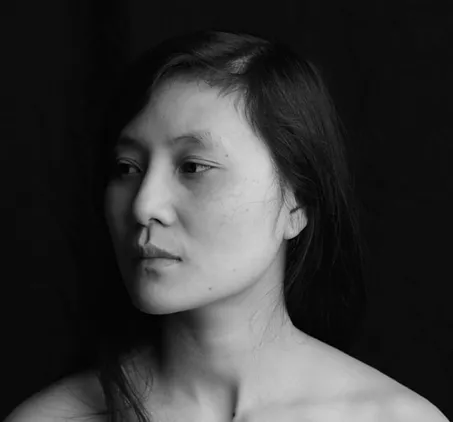
If you write, you’d like to write faster. But how? On October 20, I attended a webinar by prolific author Vi Khi Nao, and she said some things that might interest and help you.

Vi Khi Nao

She titled her talk, ‘How to Write Effortlessly and Quickly,’ and I was struck by her four ‘productivity techniques,’ called Inflexible, Exact, Flexible, and Ideal Muse.

When she declared that last one, Ideal Muse, as her favorite, I figured I’d skip to it. Then she said you can’t skip. You must work through each technique in order.

Dang. That makes them more like steps or stages. You must go through them in order, she stated, because you will learn something at each stage that helps you in the next one.

I’ll outline each stage in my own words. What follows is my interpretation of what she said. If I got it wrong, it’s my fault, not hers.

Inflexible

Determined to write more, Vi Khi Nao put aside as much of her non-writing life as possible. She limited her interactions with others, devoting herself to writing. She filled her days with writing, and became ‘inflexibly disciplined’ about it.

Her output grew. She wrote a lot. However, she considered most of the resulting manuscripts bad. Her own prose bored her, and it required heavy editing. In the end, after many drafts, she ended up with a tiny amount of quality writing. Practicing this technique, many of us might find our health suffering, along with our relationships with friends and loved ones.

Still, she learned writing discipline, the value of daily ritual. She experienced writing in the flow, without self-editing.

Exact

She tried something else, setting a more modest goal of 10,000 words every two weeks. This time, she strove for quality as well as quantity. She decided any kind of writing counted as part of her 10,000 words—short stories, novellas, screenplays, and poems. She worked on bits of everything, alternating, much like a farmer rotates crops.

With a variety of projects going at once, she found her creativity stimulated. Although she didn’t mention it, I suspect her relationships with others improved after stopping the previous Inflexible technique. The new, modest, 10,000-word goal helped relieve some mental pressure, and her product required less editing. However, I suspect most of us would gravitate toward short and easy projects to meet the word count goal.

From this technique she learned a better balance between quality and quantity.

Flexible

Still seeking a way to produce high-quality writing faster, she set precise end goals (a novel by this date, a screenplay by that date, etc.) but allowed time for flexing. She wrote based on the momentum of the moment, when the mood struck. While maintaining the discipline of writing each day, if she entered the flow zone, she went with it.

The emphasis on quality helped her writing. Having established good writing habits in the earlier techniques, she got quantity along with it. However, I suspect she still felt guilty when not writing, and she still wasn’t in tune with her muse, her inner creativity.

The Flexible stage teaches the elasticity of time itself. All hours are not equal for a writer. All days are not equal. Quality writing requires time, but cannot be created in a linear way.

Ideal Muse

Knowing now that her muse didn’t clock in and clock out at specific times, she merged all previous techniques and allowed her muse to schedule her writing. When the muse struck, she dropped everything and wrote, no matter what. If shopping, she wrote in the store. If driving, she pulled over and wrote. She set product-driven goals, not date-specific ones. Sometimes she wrote for five minutes, other times for five hours. She monitored her health, knowing she couldn’t write in an unhealthy state.

At which stage are you right now? If increasing my productivity means I must start with the Inflexible stage, I’m not ready to sacrifice everything else in life for my writing. Still, I believe I’ve gone through a lesser version of the first two stages, and am in the Flexible stage now.

Whoops. Hang on. The muse is calling—

Poseidon’s Scribe

October 31, 2021Permalink

How Readable is Your Story?

If you’d like your fiction to sell well, wouldn’t it be beneficial if readers found your stories easy to read?

Not all writers see it that way. Some authors of the world’s great classic literature made it tough on their readers, but their books still became bestsellers. Obviously, readability alone doesn’t determine great writing.

For the most part, the factors of great writing remain intangible, but you can measure readability. Many word processor software packages calculate the ‘Flesch-Kincaid Reading Ease’ score, as well as the ‘Flesch-Kincaid Grade Level,’ both standard measures of readability. The higher the Reading Ease score and the lower the Grade Level, the more readable your story.

Journalist Shane Snow inspired me to think along these lines with this wonderful blogpost. He did a lot of research obtaining Flesch-Kincaid data on many great fiction authors, and graphed it all.

That made me wonder how I measured up. I obtained the data on my ten most recently published stories. Listed from least readable to most readable, here they are:

StoryFlesch-Kincaid Reading EaseFlesch-Kincaid Grade LevelGenreYear Written
“The Steam Elephant”69.06.8Alt Hist2006
“Target Practice”69.36.5Scifi1999
“The Unparalleled Attempt to Rescue One Hans Pfaall”69.86.5Alt Hist2011
“Reconnaissance Mission”71.46.2Alt Hist2019
“Ripper’s Ring”72.26.4Alt Hist2015
“Moonset”74.85.3Horror2018
“A Clouded Affair”75.95.5Scifi2014
“The Cats of Nerio-3”76.35.1Scifi2016
“After the Martians”78.35.1Scifi2015
“Instability”79.14.8Alt Hist2017

Not too many obvious patterns there. My alternate history stories tend toward less readability than my straight science fiction, but not always. To some degree, I’ve improved readability with the passing years, but there’s some scatter in that, too.

When I average the F-K Grade Level of these stories, I get 5.82. According to one of the charts in Shane Snow’s post, that puts me around the readability level of Hunter S. Thompson, and between early J.K. Rowling and Stephen King. Not bad company.

If my stories don’t sell as well as theirs, it only proves that, as I mentioned above, readability alone doesn’t make for great writing.

What if it did? Could you write in a way that maximizes your Flesch-Kincaid readability score? The Wikipedia entry gives the formula. It’s very simple. Just take your average number of words per sentence and the average number of syllables per word, and the rest is math.

To make readers struggle, use long words and long sentences. To make your writing more readable, do the opposite.

To make your stories irresistible and widely sold…ah, that’s the magic formula I’d really like to know. That equation—whatever it is—might contain readability as one factor, but also many others. Ernest Hemingway earned a F-K Grade Level of just over 4, and Michael Crichton earned one a little under 9.

Shane Snow makes the point that a lower F-K Grade Level allows you to reach a larger potential audience for your stories. However, he cites two other factors that help determine whether your writing will gain traction and catch on. I’ll discuss my take on those in a future blogpost.

Although readability alone won’t determine whether your stories sell in the marketplace, consider this: if all other factors rated the same between two stories, wouldn’t you prefer the more readable one? I suspect you would, and so would—

Poseidon’s Scribe

October 10, 2021Permalink