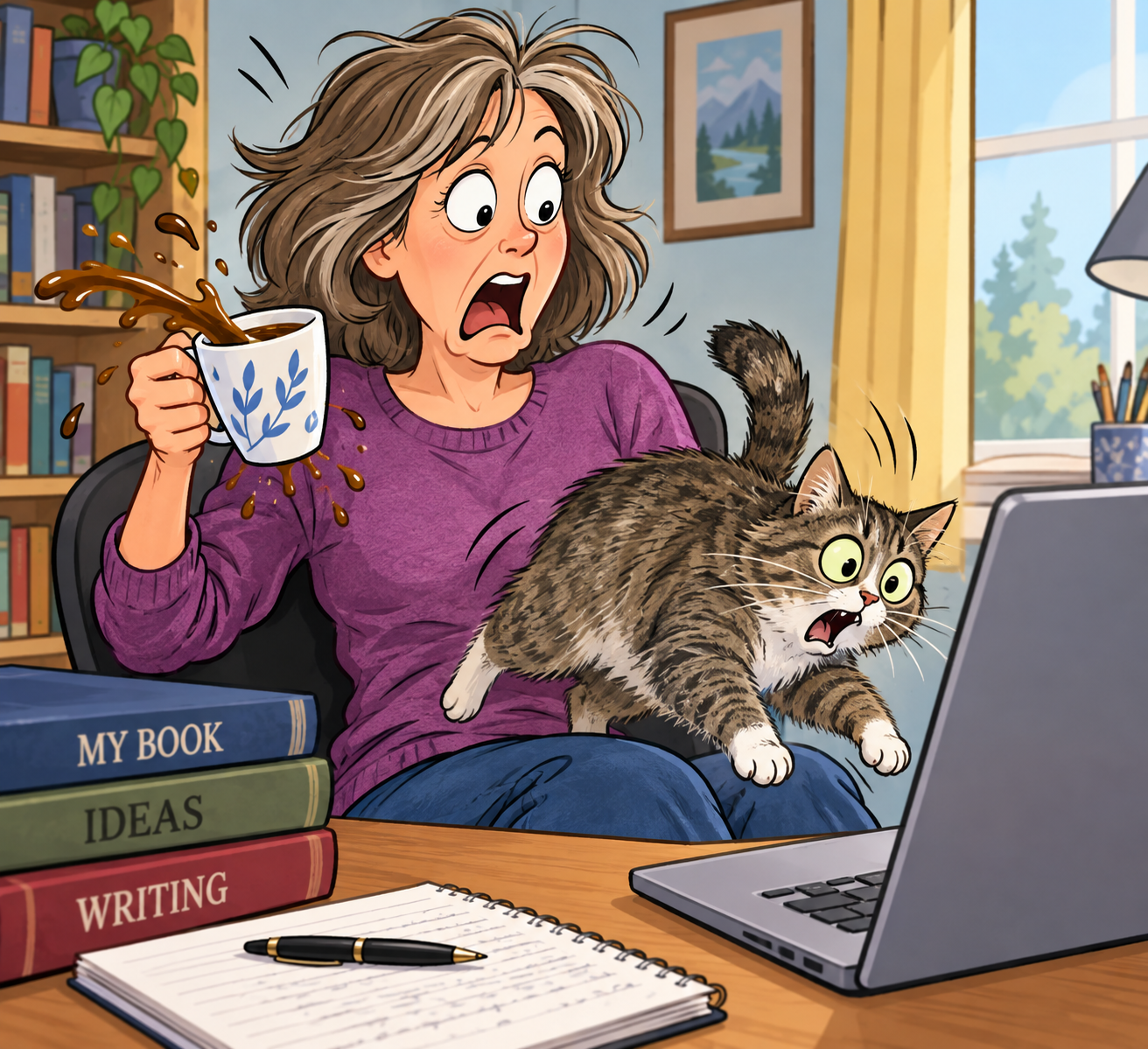
One day, your most loyal fan-reader contacts you. “Your latest book, The Great American Novel,” she says, “isn’t up to your standards. Frankly, it’s terrible. You really let me down this time.”
You’re puzzled. You didn’t write The Great American Novel. But, checking your Amazon author page, you discover it there, with your name on it. What the heck?
Perhaps you’ve traveled to an alternate universe—one where the alternate you is more prolific, but less talented.
More likely, you’re the victim of a Parasite Author.
The Parasite Problem
Using Artificial Intelligence (AI), an unscrupulous person can generate a novel manuscript, written in your style, in minutes. An AI image generator will provide him a book cover similar to your other novels. He can publish this book on Amazon, with your name as the author, and even get it posted on your Amazon author page. Any earnings from that book go, of course, to him, not to you.
Like a parasite in nature, he attaches to a host for his own benefit.
Examples
According to this article in The Atlantic by Alexandra Tremayne-Pengelly, and this article in DNYUZ, several writers have experienced this, including authors Anna Blakely and Ben H. Winters.
Recently, author Noelle W. Ihli discovered another version of her novel, The Last to Drown, listed on her Amazon author page. It featured a similar cover and a price $5,00 more than her own novel.
Author Vanessa O’Loughlin writes crime stories under the pen name Sam Blake. So does one of those parasite authors.
The example I used to begin this blogpost may have sounded hypothetical, but it happened to author Tamra Westberry. A reader contacted her, disappointed by her novel, Project Erebus. Tamra hadn’t written Project Erebus, but saw it listed, under her name, on her Amazon author page.
My Proposed Partial Fix
Knowing top executives at Amazon read my blogposts, I offer them a simple—though partial—solution. Amazon already knows how to pay authors the revenue for their books. Consider implementing this policy change—revenue from all books listed on an Amazon author page go to the author listed on that page. That removes the financial incentives for parasites to attach to those pages.
It wouldn’t stop parasites from offering copycat books on Amazon—a search for an author’s name would still display the parasitic books as well. But the Amazon author page would provide readers with accurate information.
Amazon could suggest potential book buyers check the author page first, before purchasing, to know for sure.
How about it? Would that work? I’d love for Amazon executives or others with knowledge of the industry, to contact—
Poseidon’s Scribe


