
I met author Rick Cutler at the P-Con event in Dallas a couple of months ago. With his Western scifi space cowboy novels, he fit in well with the Texas vibe. He’s written outside that genre, too, with some of what he calls glitched Grimm fairy tales. Modest in temperament, he struck me as an author with a well-established writing voice and style, further along the path to success than even he realizes. Though he calls himself a “Wordslinger for Hire,” (a phrase I love), it appears to me he’s writing what he pleases. Gather ’round and listen as I interview the wordslinger.
Bio
Rick Cutler is a science fiction and fantasy author best known for his Space Cowboy stories featuring Colt Ostergaard, a gunslinger on the high plains of the planet Fenris. His short fiction has appeared in multiple Raconteur Press anthologies, including every volume of the Space Cowboys series, Glitched Grimm, Uncanny Valet, Best of Raconteur Press 2024, and Auntie Heroes. His debut novel, Colt Ostergaard: A Man with a Gun (2026), expands those tales into a full science-fiction Western. His SF murder mystery Jack Gamble: A Man with a Grudge publishes in February 2027. He is currently working on a Historical Fantasy and a sequel in his Wild Colonial Universe series: Jack Gamble: Shipwrecked on Paradise.
Interview
Poseidon’s Scribe: How did you get started writing? What prompted you?
Rick Cutler: I think like a lot of other writers, I’ve always had a creative side, even starting from Elementary school with my story “Attack of the Slime Molds.” Over the years if I wasn’t writing, I was drawing my own comic books, drawing cartoons instead of writing essays, playing guitar and writing songs, creating adventures for my D&D gaming group, wandering up and down the Florida coastline with my Nikon taking pictures, or using photoshop to create ads to sell to retailers. Through it all, I always came back to writing.
P.S.: Who are some of your influences? What are a few of your favorite books?
R.C.: There are two kinds of influences for me. Influences for the craft of writing and the influences of my reading for entertainment. (Which of course bleeds over to the craft).
The late Professor James Gunn at the University of Kansas once said when it comes to writing, sell it twice. In other words, if you have an idea for a short story, write it, and if someone buys it, write a bunch more in the same universe until you have enough to bundle them together as a novel then sell the novel. Now you’ve sold it twice. Some classic examples of this are Keith Laumer’s “Retief” series and Harry Harrison’s “Stainless Steel Rat” stories.
I followed that advice with the “Colt Ostergaard” stories for Raconteur Press. Each of the stories in their six “Space Cowboy” anthologies are sequential for the main character of Colt Ostergaard. I bundled those together, wrote six more, then connected each story with a transitional scene and a grand finale.
Also in the vein of the writing craft, a writer’s group initially filed off some of the rough edges of my writing and listening to the WriterDojo podcast polished it to the point that some folks thought my work was worth publishing and paying me for it.
Favorite books…David Weber’s Honorverse, Safehold, and Prince Roger (with John Ringo) series. John Ringo with too many different series to list. Monster Hunter International and Son of the Black Sword by Larry Correia. The Vorkosigan saga by Lois McMaster Bujold. The Jon and Lobo series by Mark L. van Name. Wolfling by Gordon R. Dickson, and Space Relations: A Slightly Gothic Interplanetary Tale by Donald Barr.
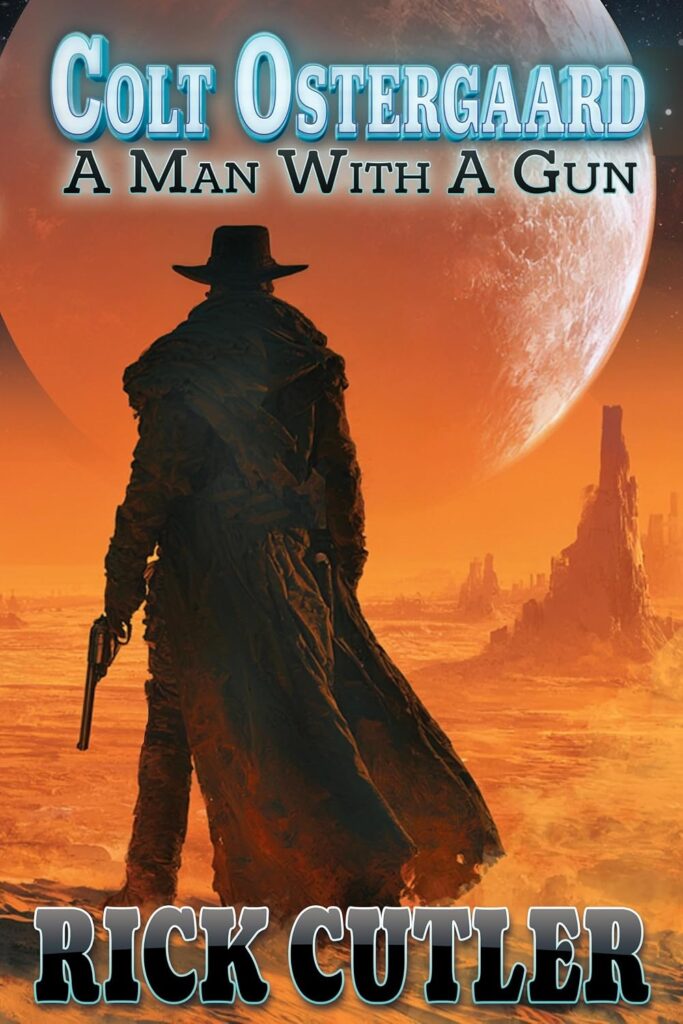
P.S.: In your latest book, Colt Ostergaard: A Man with a Gun, you present short stories about a man on the planet Fenris. Tell us about Colt himself, the planet, and why you wrote the stories.
R.C.: Colt is the classic, Western-style drifter, a “good man with a gun” who doesn’t want trouble but won’t walk away when trouble happens, especially if there are innocent folks involved. He lives by a strict code of honor, often at his own expense, and no matter how many times he gets shot or poisoned or left for dead, he never gives up.
Colt’s home world is Fenris, one of two inhabitable planets in the Lympos solar system, cut off from Old Earth for more than 800 years. Alpha, the inner planet is close enough to use Fenris as a dumping ground for criminals, malcontents, and political pariahs. The planet itself has an eccentric orbit that gives it seasons lasting as much as forty years. The sub-zero temperatures during the long winters make batteries and mechanical parts unreliable and it freezes LCD screens. People are forced to rely on older technology like gunpowder and six-shooters instead of rail guns and electric cars.
I wrote these stories, as I do my others, to entertain. That’s my only agenda. Sure the money is nice, but the pay is minimal so it’s icing on the cake and only enough for an occasional splurge at the Texas Roadhouse or Olive Garden with my wife.
P.S.: A couple of your friends composed a wonderful song and video about your fictional hero, Colt Ostergaard. How did that come about?
R.C.: One thing you can never have enough of is good friends. I started playing around with lyrics for Colt Ostergaard while the book was being edited by my publisher. I sent a rough draft of the lyrics to my friends Jim Foster (a voice actor and narrator-for-hire) and Jesse A. Barrett, a fellow author and tech guru. I guess it fired up their imaginations because they jumped in and cleaned up the lyrics, put down an audio track with music, and created a video of “The Ballad of Colt Ostergaard.” Jim has even gone on to put together a couple more songs based on the book. With friends like these, who needs Spotify?
P.S.: On your website, you claim to have worked in a movie theater, construction, and advertising sales. You’ve been a tour guide, a spot welder, a truck driver, a vacuum cleaner salesman, and a wholesale sales rep. How have those varied experiences influenced you as a fiction writer?
R.C.: Those bits and pieces of my work life color and sometimes inspire my stories, as do my past loves, family life, and even folks who have done me wrong.
For example, I sold a story about an interstellar vacuum cleaner salesman with a talking briefcase. When I was selling advertising, my company provided me with a laptop and printer built into a battery powered Haliburton briefcase. I just put the vacuum cleaners and the briefcase together in my favorite genre, Science Fiction, and “The Uncanny Valise” was born.
P.S.: What non-writing hobby or interest do you have? Does it complement your writing or is it a relief from writing?
R.C.: I’m still an amateur photo-shopper, left over from my days in selling advertising, but there’s a lot of “Been there. Done that. Won’t be going back there again” in my life. So an easy chair with my feet up and watching whatever my wife is binge-watching is good enough for me.
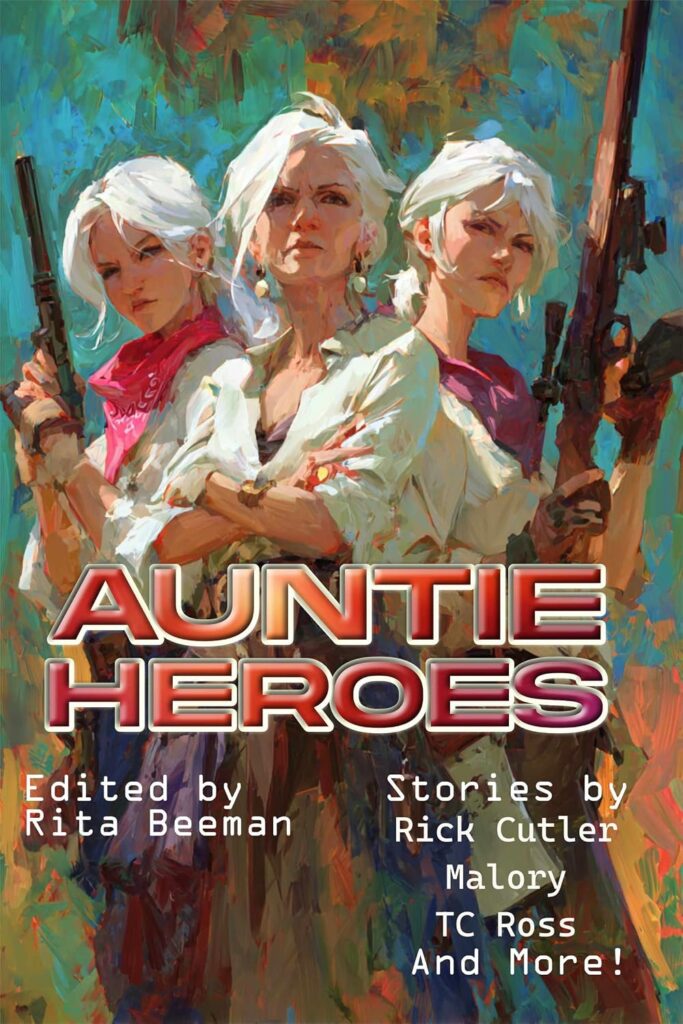
P.S.: Your story, “Walking the Beans” appears in the anthology Auntie Heroes. What is this story about? Also, please describe your “auntie” character.
R.C.: Aunt Leone is retired military living on a farm she and her late husband own somewhere out where cell service is sketchy and there are more cows than people. She still wears her combat boots, keeps her .45 under her pillow, and loves to cook, especially cherry pies. When she isn’t cooking, she’s crocheting in a rocking chair on the front porch. She also takes family ties very seriously. When her sister and brother-in-law die in an auto accident, she takes in her nephew, David, who doesn’t quite know what to make of “farm living.”
What David discovers is that Aunt Leone may look like a much older version of his mother, but she is still spry enough to kick nosey government bureaucrats off her property, prowl her 400 acres with a shotgun, and put down aliens who ransack her home and leave disemboweled strangers in crop circles. She also leaves cherry pies out for the “nice” aliens who work her farm for her at night.
P.S.: Is there a common attribute that ties your fiction together (genre, character types, settings, themes) or are you a more eclectic author?
R.C.: I have written quite a bit in the “Wild Colonial Universe” where the Colt Ostergaard, Jack Gamble, and Lena Reyes stories take place. It’s just easier to tell more stories in an established universe because you’ve already done the work building it.
On the other hand, Hasty Hastings and Aunt Leone are in separate universes. As is Hugh the stone mason.
If there is a common trait, I suspect it would be that the man characters are honest, loyal, ethical, and refuse to give up in spite of the circumstance without getting sappy about it.
P.S.: What are the easiest, and the most difficult, aspects of writing for you?
R.C.: The easiest part is the most fun. Writing that initial draft. The most difficult part is being consistent. Writing every day no matter what is going on or where I am.
P.S.: You’ve got a murder mystery coming out in 2027. Is it a novel, or some other form? Tell us about it, and how it relates to your Colt Ostergaard series.
R.C.: Jack Gamble: A Man with a Grudge is a novel in the Science Fiction Murder Mystery aisle. It takes place in the same “Wild Colonial universe” series and solar system as the Colt Ostergaard stories, only 100 to 200 years later. (I’m leaving the exact timeline vague just to give me elbow room if I need it).
The story is that someone murdered Jack Gamble’s parents on Fenris. He’s next, unless he gets to them first.
Jack is an Ensign in the Lympos System Space Navy, on leave and tired of waiting for the local lawdogs to solve the murders. He takes things into his own hands and follows a lead to the inner planet, Alpha Lympos, where someone keeps trying to kill him. New leads pop up, including loan sharks, religious zealots, assassins, and a rogue AI with its own agenda. Jack runs them all down until he finally confronts the killer, barely escaping with his life. His foster sister Kaya Ostergaard, his family’s lawyer Victor Pfeffier, and a butler named Sterling Longford help him along the way.
P.S.: What is your current work in progress? Would you mind telling us a little about it?
R.C.: My current work-in-progress is a historical fantasy The Judas Covenant.
Hugh, a stone mason, was from the duchy of Brittany in France. He died in 1399 but was sent back from the Abyss to reanimate his corpse by Llew Llaw Gyffes, one of the ancient Sidhe. He’s on a mission to deliver a Celtic torc to Milan as a favor to Llew Llaw Gyffes, and his reward is to be granted an after-life in Llew’s palace, where there’s endless food, wine, and dancing.
Things go sideways when he accidently trades bodies with Durante del Brandino, an infamous womanizer and assassin for hire. Being a walking corpse was bad enough. Now he has to dodge spurned lovers and their kinsmen, rival swordsmen, a witch determined to cut off his head, a monk who’s vowed to exorcise him, and Durante del Brandino, who is chasing after him in Hugh’s old body.
Poseidon’s Scribe: What advice can you offer aspiring authors?
Rick Cutler: I’m still a wee fish in a big pond, but for what it is worth, here’s what has worked for me…
Writing is fun. Getting published is hard. There’s a lot of disappointment in getting a hundred or two-hundred rejections. And chances are you’ll never make it rich. But that first sale is a thrill that makes it all worth it.
If you write as a hobby, don’t worry about publishing. Write what you like. Write fan-fiction. Share it with your friends and family. Have fun with it.
If you find you want more and want to be published, be disciplined and never give up. Write every day as if it was a job. An accountant can’t say “I can’t run numbers and spreadsheets today. The Accounting Muse just isn’t speaking to me.” They’ll get fired pretty quickly.
That sounds dull, but that’s what it takes.
Find other writers who like the same kinds of stories that you do. Make friends and network with them. Maybe get into a Writers Group with them. But don’t let your loyalty to your group hold you back. If you outgrow them, stay friends, but move on.
Never throw away stories you couldn’t sell. Put them in a “trunk” and keep them. You might be able to cannibalize them for a different story or it might sell in the future. “The Uncanny Valise” was stuck in a box with my other unsold short stories for thirty years. I spotted an open call for a Human/Robot anthology, updated the technology and storytelling, and submitted it. It sold.
Cultivate your “Beta” readers. Make sure they know how much you appreciate their time and feedback. And never make changes based on that feedback until you’ve let it marinate for 72 hours, and then only if you agree with it. If multiple readers make the same criticism, you may need to step back and see if you agree with them. But you don’t have to. It’s your story.
Finally, never stop learning.
Poseidon’s Scribe: Thanks, Rick. Good advice.
Web Presence
You can find out much more about Rick Cutler at his website, and on Facebook, Substack, and Twitter/X. Check out his Amazon Author Page, and you can email him at Rick@RickCutler.com.