At SoonerCon in June, I met science fiction author Frank Hood. Like me, he started as a kid in the Midwest reading scifi. Early on, he decided to write short stories, dreaming of huge success. As with me, he found out the world may not fall in love with your writing at first. In his case, it meant he had to put off his writing ambitions and get a job with more certain prospects. From the interview that follows, you’ll enjoy learning about his writing journey.
Note: Frank mentions Ray Bradbury’s 1950 story, “There Will Come Soft Rains” as one of his favorites. By a fitting coincidence, today, August 5, 2026, is the date repeated endlessly by the automated house in that story.
Bio
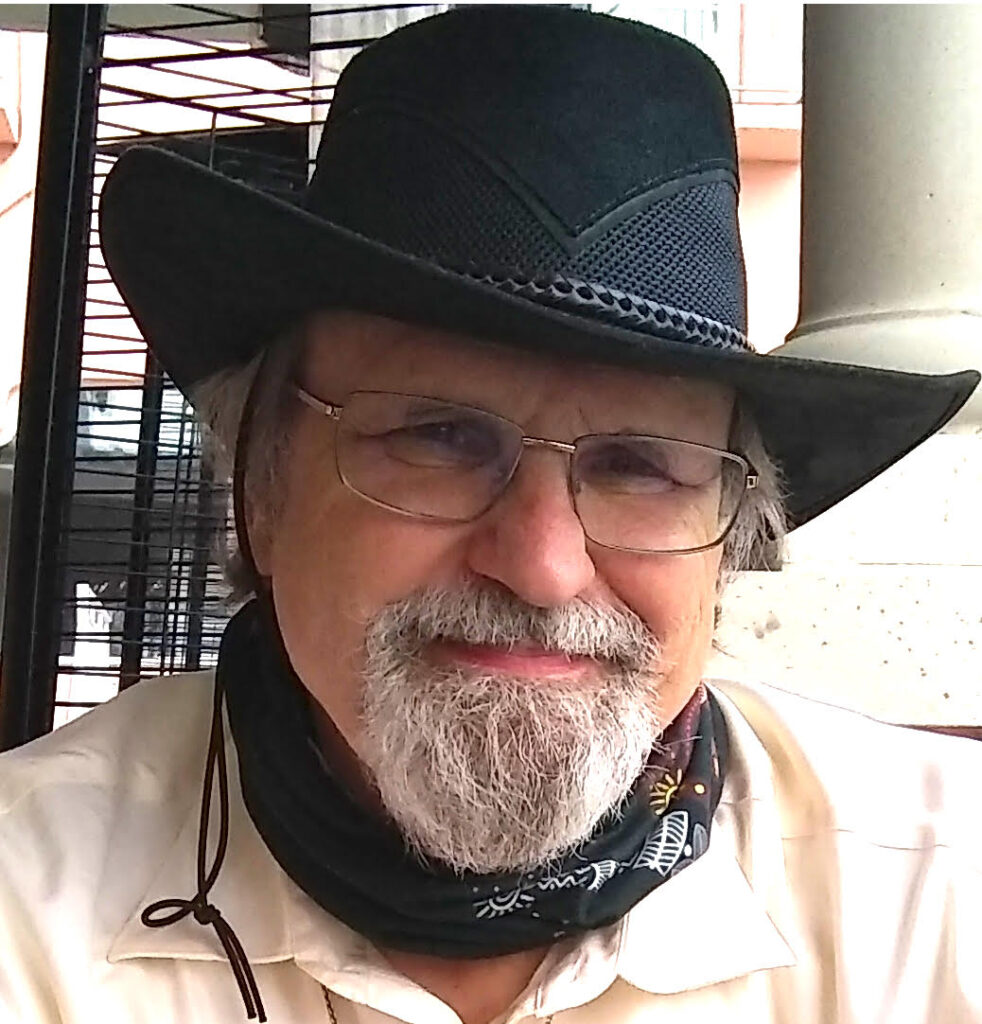
Frank Hood sold his first story at age 26 then spent 40 years as a software engineer from punch cards to AI. He documented that career in his first book A Geek’s Progress. Published his first novel Advance Guards in September 2025, and, along with his wife, a collection of horror/science fiction/fantasy/mystery stories, That Has Such Creatures in 2026. His second novel A Child’s Uneven Scrawl is expected in late 2026. Is well known for his ability to explain how AI really works to general audiences and for the depth of his fiction writing. He writes about whatever strikes his fancy from history, travel, science, humor, and social commentary at frank-hood.com.
Prefatory Remarks
I’m a storyteller, and, as Mick Jagger puts it, “I’ve been around a long, long time….” That is a lethal combination, so prepare yourself for a journey through the labyrinth that purports to be my mind, full of more digressions and dead ends than those of a mercury-addled mad hatter or ancient gold miner (I’ve met one of those. It was a trip.) There will be references and diversions such that you may never find your way out, so “Abandon all hope you who enter here.”
Interview
Poseidon’s Scribe: How did you get started writing? What prompted you?
Frank Hood: I blame the accident of geography. Until I was 10, I was raised in an Irish Catholic neighborhood in north Detroit. It was a tight-knit community. We played baseball in the streets (not stickball, we had real bats). None of us even knew where the public school was. The Catholic high school was 2 blocks north. The Catholic hospital was 3 blocks east, and the church with its elementary school was about 8 blocks south. Basically you could live your whole life from baptism to funeral in that little neighborhood. Our playgrounds were the streets, backyards, and construction sites. Construction sites made great jungle gyms.
Then, when I was 10, we moved to San Diego where my dad switched from engineering cars to engineering airplanes and rockets. We rented a house on a 170-acre ranch that was a mile from the nearest neighbor and 10 miles from the nearest town that had only 19,000 people. You can see a picture of the ranch on the front page of my website.
That left 10-year-old me with only my 13-year-old and 4-year-old brothers for company. So, mostly I was on my own. On grocery trips to town with my mother, I skipped over to the drugstore where I could afford a couple of the 10 cent comics from the spinner rack. Those fed my imagination. Breakfast was informal, and usually the family didn’t talk much at that meal, so I read and re-read my comics while I consumed my cereal and toast. Dinner was for the formal interrogation and teasing of us boys by my father, but breakfast was my reading time.
My parents were readers, and we had Life Magazine and Readers’ Digest always lying around, so I read those too. I also had a subscription to Baseball Digest, which featured sportswriters’ columns from all over the country. Remember when a sports column was about poetic writing and dramatic moments rather than a bland listing of obscure statistics? No, well I feel sorry for you. It was fun.
In high school, I mostly wrote non-fiction, usually satires of everybody at the school to amuse my friends. I especially liked to satirize the administration and teachers. Our principal’s last name was Foucar (pronounced foo-kar). How could I resist writing about Mother Foucar? Or the just-this-far from senile Civics teacher? Or the brilliant but somewhat crazed German teacher? Or the 5’3” barrel-chested, ramrod straight WWII Marine veteran of Iwo Jima English teacher with the razor-sharp wit?
College was where I started to write fiction seriously. First, I concentrated on making entertaining plots that might make people shake their heads. An early one was two professors talking as they waited for a computer to output its solution on how to make a computer think, and ended with the computer typing out the scene they were in to the extent that it repeated the professors’ own conversation (albeit somewhat badly) until they tried to stop it before it took over the story—they weren’t fast enough. I guess I’ve been thinking about AI for a long time. Then I worked on creating characters for you to care about, but what the heck does an 18-year-old know about depth of character unless you’ve had a very traumatic childhood?
P.S.: Who are some of your influences? What are a few of your favorite books?
F.H.: My biggest writing influence was probably Ray Bradbury. I love his way with words and the spooky stories he told, like “The Small Assassin,” “Skeleton,” and “There Will Come Soft Rains.” Boy, I wanted to be able to write like that!
After that, there’s Shakespeare. The depth and wisdom of his dialog as well as the breadth of his characters blow me away. Most of his plots were just borrowed from older works, but he gave voice to every piece of human instinct and desire. There is only one document that we can claim is what Shakespeare “said.” That is his last will and testament. He does not speak in any of his plays. There is no author’s voice proclaiming from a soapbox in Shakespeare. He writes conniving villains like Iago, brilliant and clever villains like Richard III, roguish young men who become heroes like Henry IV, and conflicted men who either yield to temptation like Macbeth or who finally claim the side of their better instincts like Hamlet. And all of his characters, including Shylock, the stereotypical greedy, conniving Jew, are given brilliant lines to express their views of life. None of those amazing speeches in all those plays are Shakespeare talking, rather they are his characters talking. Shakespeare encompassed all of life and expressed every point of view magnificently. “He summed it all up,” is the best, most insightful quote you will ever hear about Shakespeare. I try hard to be true to that method. There are no self-inserts in my fiction. I try to recreate real people with all their desires, motivations, and weaknesses.
Also in Catholic elementary school, we had a bookshelf at the back of the classroom with a dozen of Heinlein’s juveniles among other books, and I devoured them to feed my imagination. I’m trying to pay that debt back by donating books to my church’s new elementary school.
As an adult, I love the Horatio Hornblower books.
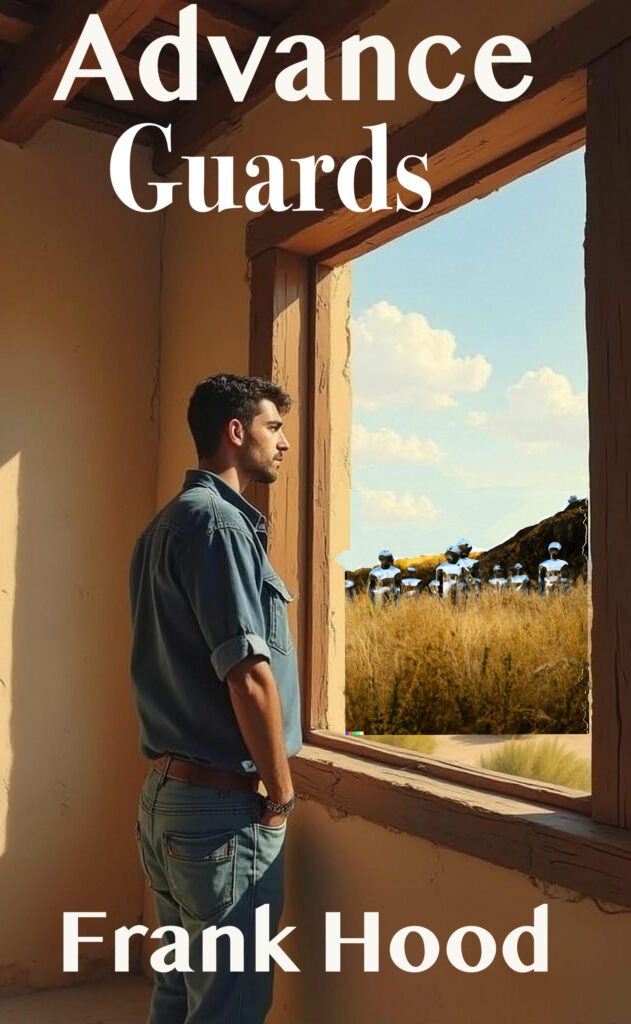
P.S.: Your debut novel, Advance Guards, shows readers a future of plenty, with human wants satisfied. How does that world affect the main character, Thom? The cover shows a male—is it Thom?—looking out a window at a group of robots in a field. How does that cover image suggest the themes of the novel?
F.H.: Actually, that’s Thom’s youngest son Samuel on the cover. More on that later. The cover image is meant to show the contrast between the old adobe house without even glass for the windows and the shiny robots from the city.
One of the things about the novel is that it’s a family saga covering some 40 years, so I wrote it as 12 short (and some not so short) stories to accommodate time shifts and different points of view. The future Los Angeles I depict is dystopian, not because of any catastrophe, but because it’s simply a continuation of the way things are going. There’s no apocalypse, no plague, no totalitarian regime behind it all, just incremental improvements in technology until people have begun to lose human contact with each other.
Thom accidentally discovers a love interest in the first story. He begins to realize the bland life of isolation from both nature and humanity that lays ahead of him. Also he wants to rescue his love, Celia, who is going down a dark path of drugs and partying in her own form of rebellion against the city’s lifestyle when he meets her.
Thom finally asserts himself to find a different, less artificial way of life for himself and Celia. They end up raising a family of 7 kids in the wilderness 150 miles north of LA, learning, sometimes painfully, how to live off the land.
Then the kids grow up, and there’s still nobody out there beyond the family. When they notice one of the boys beginning to eye his older sister in a different way, they resolve to send each of their children back to the city when they turn 18. The second part of the novel explores the children’s individual and very different reactions to the city life their parents left and how they end up influencing the city for better or worse.
As a joke, I say the Hollywood pitch is, “Swiss Family Robinson meets The Jetsons, wrapped in a Shakespearean tragedy.”
The cover illustrates the opening scene from the last story where the youngest son, having returned to the family’s abandoned, hand-built adobe house to live in the country, sees a dozen robots that he helped design, coming to fetch him back to the city, doubtlessly at the behest of one or more of his siblings.
The title, Advance Guards, is from an old Seals & Crofts song whose lyrics they claim were taken from a centuries’ old Middle-Eastern poem. I frequently use songs as inspiration for my stories.
P.S.: Does this first novel signal a shift to the longer form, or will you still write short stories? How different was it to write a novel?
F.H.: I will probably never abandon short stories, but they just don’t sell as well as novels and novellas. A lot of independent novels these days are about 60-80k words, which is short for what I remember growing up with, but makes it easier to put out a lot of work.
Advance Guards was not too different because I wrote it as a series of short stories with the same characters and one plotline, but the new novel is more traditional, so we’ll see how that goes.
P.S.: In your bio, you state you set out to be a great writer, but the expected large advances didn’t materialize. You chose a day job for steady income but dreamed about writing during that forty-year career. Were you able to write at all during that interval, or did the dream burn inside for those decades, awaiting the moment you had time to write?
F.H.: I never gave up on wanting to write. A lot of that was ameliorated with trying to help my wife’s writing career. More of it was satisfied by writing technical documents and proposals for novel approaches to applications for the DoD. At about 20 years into my career, I decided to sit down and write a story to see if I could still do it. The result was “The Gardener’s Wife” that is included in That Has Such Creatures as well as for sale individually as an ebook. That story convinced me that I hadn’t lost my fiction touch, but I waited until I retired to take up writing as a profession again.
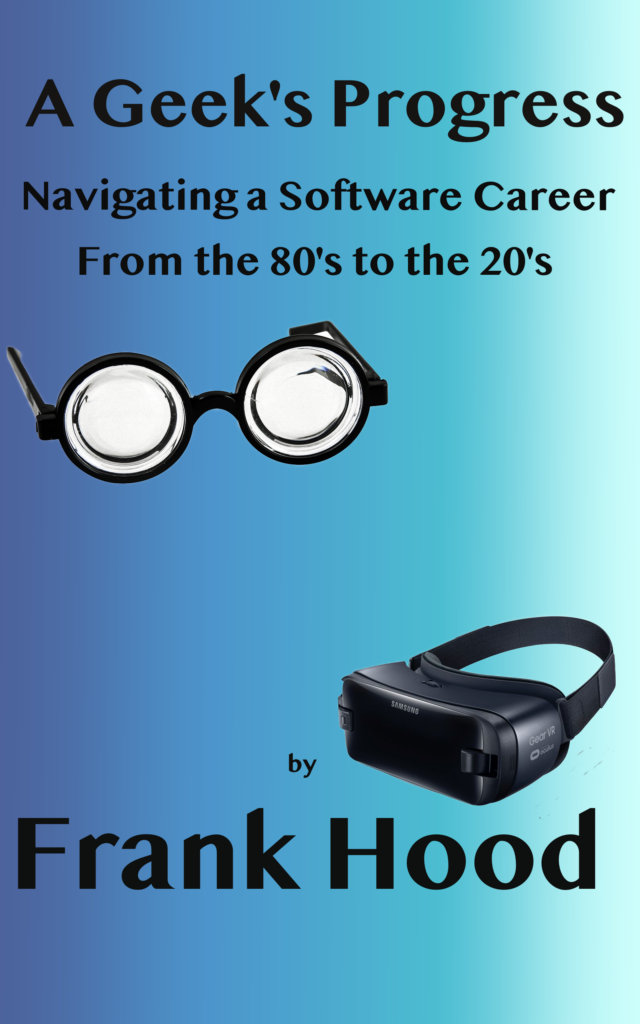
P.S.: You wrote A Geek’s Progress: Navigating a Software Career from the 80s to the 20s. The book discusses your career and your aim to live a good life, not necessarily to innovate your way to Silicon Valley billionaire status. Who is your intended audience for that book and what do you hope they get out of it?
F.H.: There are two groups I intend as an audience for A Geek’s Progress, grizzled software veterans like me, who, I hope, see themselves in my book and feel nostalgic about old times, and young people starting a career in the corporate world. I hope to give the latter a realistic idea of how to survive in the corporate world and make useful products for the end user even if management seems to prefer you didn’t. As I say, there are already a ton of books out there for the budding entrepreneur wanting to become the next Elon Musk or Steve Jobs, and A Geek’s Progress is not for them, it’s for the rest of us nerds who just want a satisfying career that enables us to have a family and a good life.
P.S.: What non-writing hobby or interest do you have? Does it complement your writing or is it a relief from writing?
F.H.: I write fiction. I write non-fiction. I dispense the wisdom of the ancients. I listen to my 10,000-song Pandora playlist. I donate platelets every 2 weeks or so because I have a talent for bleeding. I stream old TV series. I watch movies (and write reviews), and read books (and write reviews). I walk to the grocery store and back every other day, and, if I time it right, ogle the young ladies emerging from one of the many yoga studios in their stretchy leotards. I go out to lunch with former colleagues and friends. I go to SF Conventions, and each summer now I buy a 30-day Amtrak rail pass and take a cross-country train trip to LibertyCon in Chattanooga TN via Atlanta, with stops to play tourist along the way. One year it was DC, the next Cooperstown and the Baseball Hall of Fame, then Memphis (yes, I walked Beale St., but my feet didn’t leave the ground). The train gives me the opportunity to talk with quite an interesting mix of strangers (and write about it). This year SoonerCon was the week before LibertyCon, so I took that opportunity.
Oh right, you asked about non-writing. I’ve spent the last couple of years painfully learning art programs. (I have no coordination for real hand-drawing.) Someday I might actually get good at it, so I can make my own covers. I suppose I’m the definition of monomaniacal.
P.S.: What are the easiest, and the most difficult, aspects of writing for you?
F.H.: Easiest? I’d rather write about what I enjoy most about writing—just about everything. If I can make you laugh, if I can make you cry, then I feel I’ve done something wonderful and worthwhile. Writers and actors are manipulators (in a good way). We want to make our audience feel things they would normally suppress. The Greeks called it catharsis. Ray Bradbury said, when he found himself crying as he wrote something, he knew he’d written something good. J. Michael Straczynski wrote that, as a kid, he was reading a story where a little boy begged his grandfather for an ice cream cone. As soon as he left the store, the boy was distracted, tilted his hand, and the ice cream dropped on the pavement. Joe describes himself crying reading that. He read it a second time and cried again. He decided that if someone could make him care that much about somebody who wasn’t real, then he needed to learn how to do that. People have described my behavior upon seeing a good comedy in a movie theater as laughing so loudly that everybody looks my way.
What I like least is getting stuck because I’m so hung up on making the details consistent and plausible. Sometimes I just have to tell myself, “Pshaw, just say it happened, and they’ll figure it out.” A lot of times that’s the right answer. When Howard Hawks was directing The Big Sleep, he was doing the scene where the rich family’s dead chauffeur is pulled out of the bay in the limousine. Someone on the crew asked him why that scene was there, and he realized he didn’t know. It didn’t actually figure in the mystery. Finally he called up Raymond Chandler and asked.
“Why did the chauffeur drive off the pier?”
“Damned if I know,” Chandler replied.
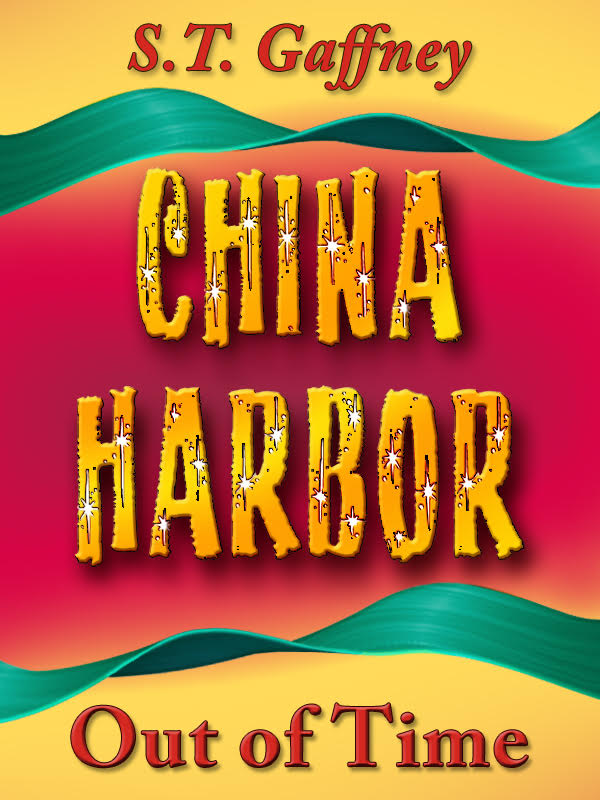
P.S.: Sorry to read about the death of your wife, Sharon. You wrote lovingly about her on your website. An author herself, she wrote under the name S.T. Gaffney. Tell us about her novel, China Harbor: Out of Time. How is it different from what you write?
F.H.: Pardon me for going on for a bit, but Sharon is probably my favorite subject. She was the most brilliant person I ever met. She taught herself to be an effortless storyteller. In third grade, she learned every cliché there was and deployed them at every appropriate opportunity to the annoyance of her friends. She then spent the next year changing every cliché into something non-cliched, so she never used a cliché again.
She devoured mysteries and read lots of Best Short Stories of [insert year here] collections and subconsciously absorbed what made good writing. When we left after seeing The Empire Strikes Back in the theater, I casually asked, “That scene where Luke leaves and Obi Wan says, ‘That was our last hope,’ to which Yoda replies, ‘No, there is another,’ I wonder what he was talking about?” She calmly replied, “It’s Princess Leia. She’s Luke’s sister,” as if it should be perfectly obvious. When we watched mystery movies, she always knew who the murderer was within the first 15 minutes, but she considerately wouldn’t spoil it for me.
China Harbor: Out of Time is a dramatic time-travel thriller, set in a small island off the coast of China after China has nuked America. The main character is a female physicist who invented a time travel machine and has spent the last 5 years living as an American refugee in an unfamiliar land where she barely speaks the language, and guts fish for a meager living, until events conspire to give her the precarious chance to rectify the war she feels she may have inadvertently caused while trying to prevent it.
Sharon was what they call a pantser (she preferred the term organic writer, nurturing and letting the story grow rather than pretending to make it up as she wrote it). China Harbor started as a vision of the first scene that came into her head as she stared into her tea cup at our favorite Chinese restaurant. She came home and started typing. Two weeks later, she said, “This story is getting kind of long. How long is a novella?”
I told her, and a month later, she asked, “How long is a novel?”
I told her about 80K to 120K words. A month later, she asked, “How long is War and Peace?”
It ended up being 180K words of very taut prose. There is no wasted space. As I saw it coming off the printer as she wrote it, I remember thinking about one passage, “Well, that’s kind of a diversion, but I’ll give her that for local color.” To my astonishment, two-hundred pages later that became an integral plot point.
She had a unique voice. When she was in 5th grade, her English teacher took her aside and told her, “Reading your stuff is like I’m sitting there listening to you. That’s a great voice for fiction. Don’t lose it, but it isn’t the right way to write a formal essay.” Thank God for that man. Blessings be upon him.
Also, despite our 41 years together, her life was very different from mine. She grew up in Beverly Hills (on the wrong side of the tracks, she always noted, as her family was far from rich) where 95% of her high school class went on to college vs. my small-town roots. She also suffered from fibromyalgia for 30 years because of childhood trauma from an abusive, alcoholic father and a mother who had what they today call a “borderline personality disorder,” in other words not quite crazy enough to be locked up, but you wouldn’t want to live with her.
Also she was a chemist who taught at the community college level for many years whereas I was just a bum, as her mother accurately described me when we got married. Modern medicine has no cure or even treatment for fibromyalgia, so she explored other avenues. When California legalized acupuncture, one of her students recommended an acupuncturist, so she tried that. A curious chemist who is given the diagnosis, “The wind and the damp have come into your shoulder,” does not just shrug it off when the treatments start to work. To understand this thing that made no sense, she became a Chinese scholar, reading dozens of books on acupuncture and the Chinese philosophy and culture that it grew from and was infused with. When she died, I donated her 300 books on the subject to the local Chinese Historical Society.
Also she taught a diverse set of students at the community college level. It was the time of the Vietnamese boat people who had fled the communist takeover, and she taught Chemistry to many refugees from Vietnam and Cambodia, who barely spoke English.
All that fed into her book. When I was reading it as it came off the printer, I realized it had an unusual power that was different from anything else I had read. That year, at Comic-Con as we watched the 4th of July fireworks, it hit me. America has taken in refugees from all over the world, but Americans have never been refugees. It was that perspective that was one of the things that gave her book such unusual power.
Sorry, but I could talk for days about the best woman who ever lived. My writing is not so instinctual or magical. I consider myself Robert Browning to her Elizabeth Barret Browning, an excellent writer but more restrained and intellectual, not the genius one that I married.
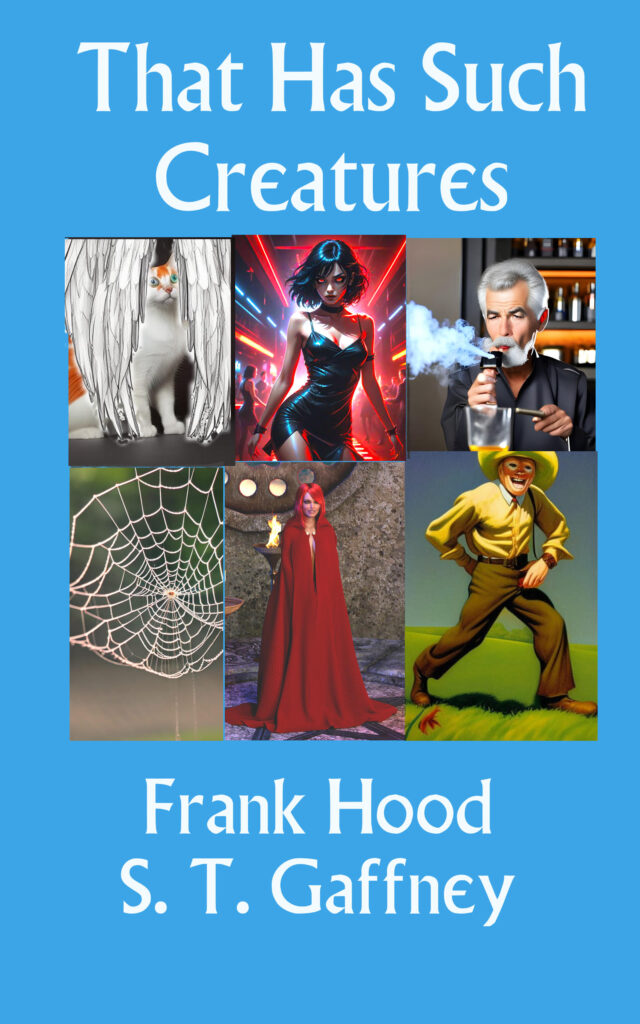
P.S.: Short stories by you and your wife appear in the book That Has Such Creatures. Aside from the marriage between the two authors, are there any traits connecting the stories? Common settings, themes, tone, etc.?
F.H.: Sharon and I wrote very different types of stories. I pulled a couple of her stories into the collection, partly because I wanted to tell the story of How Sharon and I “Met”, and the different type of stories we write figured into that. Many of her stories were darker, reflecting her background. That Has Such Creatures is 14 stories by me, 2 by Sharon, and 2 non-fiction stories that people have trouble believing aren’t fiction, so the connection is more tenuous rather than collaborative.
We tended to push each other and help refine our ideas rather than really co-write things. You can get a little flavor of that in the last stories and essays in That Has Such Creatures. I hope to finish and publish our real collaboration later this year. When she realized her lone novel wouldn’t sell very well on its own, she came up with the idea of a twelve issue Pogo-esque comic book with talking animals, called Hermit and Vulture about, “A man who is about to go over the edge—and a bird that’s ready to help.” It’s a satirical look at modern life set in the tiny, High Sierra hamlet of Another Fine Mess. We brainstormed a number of scenarios. She could never find an artist to collaborate with though, so she eventually settled on the idea of just publishing it as prose under the subtitle, “A comic book that isn’t”. Unfortunately her health deteriorated, and she never finished it, but she left elaborate notes. I hope to finish it and do it justice.
P.S.: What is your current work in progress? Would you mind telling us a little about it?
F.H.: I’ve got two works going on right now. The first is a traditional novel, A Child’s Uneven Scrawl, set in 1968-1969. Those were amazing and turbulent years to live through, and the period and culture is a heavy influence on the book. It involves a grad student studying the human brain who ends up apprenticing to a former Nazi scientist whose research has been continued by the Defense Department. (Think Werner von Braun, and it won’t seem so far-fetched.)
It also features his DoD boss, a retiring WW II Marine captain on his last tour of duty in San Diego, so he can leave the service and get his teaching credential at San Diego State to begin a high school teaching career.
Biology in the old days was a particularly cruel science to explore, where mice, cats, and sometimes even primates were experimented on, sometimes brutally, all in the name of science. Much of what we know now about the functioning of the brain stems from those early, gruesome experiments that happened before functional MRIs. Trust me, the history of biology is a scary place.
When the ex-Nazi dies, both the captain and the grad student are left with an experiment that poses both seemingly great opportunities and ethical dilemmas.
By the way, A Child’s Uneven Scrawl is another song lyric, this time from Simon and Garfunkel, that helped inspire the story.
The other work is the afore-mentioned Hermit and Vulture.
Poseidon’s Scribe: What advice can you offer aspiring authors?
Frank Hood: The best writing advice I ever got was from Ted Sturgeon. In 1976, I found myself sitting next to him at Tuscon IV. He found out I wanted to be a writer, and told me, “I have a guaranteed method to make you a published writer. Write 50 stories in a year. By the end of that year, I guarantee you’ll be a published writer.”
It took me two years, but I did sell my 32nd story. Learning to write is like learning to walk. You’re going to fall down a lot, but keep getting back up and persist. Just write, my friends!
Other advice I got from a veteran Hollywood screenwriter was, “Make ’em love. Make ’em hate. Make ’em wait.”
That’s my writing advice. My business advice is, “Stay away from so-called traditional publishers. That industry exists mostly as a money-laundering scheme for politicians. Write something people want to read, and publish a lot of it. It may take time for people to discover you, but don’t get discouraged, just keep putting it out there.”
Poseidon’s Scribe: Thank you, Frank.
Web Presence
Readers may find out more about Frank Hood at his Amazon author page, his website “Musings of a Restless Mind,” and his Goodreads author page. You can find his wife’s novel, China Harbor: Out of Time, here.