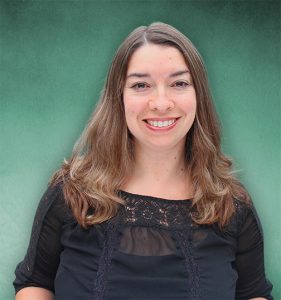
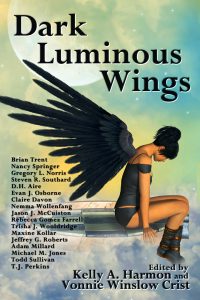
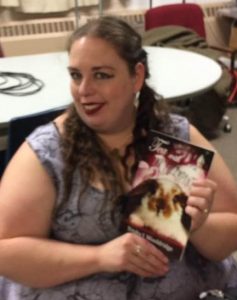
One by one, you’re getting acquainted with the authors whose stories appear in the anthology Dark Luminous Wings. Visiting us today is writer and editor Trisha J. Wooldridge.
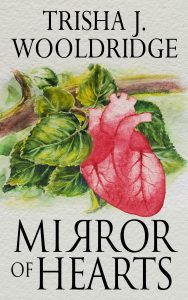
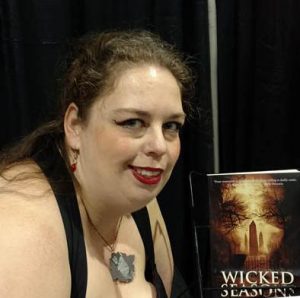 Trisha J. Wooldridge writes grown-up horror short stories and weird poetry for anthologies and magazines—some even winning awards! Under her business, A Novel Friend, she’s edited over fifty novels; written over a hundred articles on food, drink, entertainment, horses, music, and writing for over a dozen different publications; designed and written three online college classes; copy edited the MMORPG Dungeons & Dragons Stormreach; edited two geeky anthologies; and has become the events coordinator and consignment manager for Annie’s Book Stop of Worcester. Because she is masochistic when it comes to time management, she created the child-friendly persona of T.J. Wooldridge and published three scary children’s novels, as well as a poem in The Jimmy Fund charity anthology Now I Lay Me Down To Sleep. Her recent publications also include two novellas, “Tea with Mr. Fuzzypants” and “Mirror of Hearts.” You can find her most recent work in the 2017 anthologies Gothic Fantasy Supernatural Horror, Dark Luminous Wings, and the collector’s book of the Blackstone Valley Artists Association 2017 Art and Poetry Showcase.
Onward, to the interview:
Poseidon’s Scribe: How did you get started writing? What prompted you?
Trisha J. Wooldridge: I was always a reader, and when I got started with vocabulary words in school, I realized that I, too, could weave the magic I’d found in books! Vocabulary sentence days and homework were my favorite things; I’d rush home to share my creations with my parents. When I was 11 or so, I started writing fan fiction (I didn’t know “fan fiction” was a thing at a time) for stuff like Teenage Mutant Ninja Turtles in notebooks, certain—certain!—I would write the first novelization of the comics and cartoon season. Later, I started playing with mashups of my versions of Narnia being visited by the science-minded folk in Madeleine L’Engle’s time series. By the time I hit high school, I was chronicling the adventures of our Dungeons and Dragons characters in story form and passing those out each week…as well as working on an interstellar adventure along the lines of Joanna Russ’s Adventures of Alyx.
P.S.: What other authors influenced your writing, and what are a few of your favorite books?
T.J.W.: As mentioned above, I was a huge fan of the Chronicles of Narnia and would read anything I could get my hands on by Madeleine L’Engle. I was also a massive fan of the DragonLance novels by Margaret Weis and Tracy Hickman, as well as the Drizzt Do’Urden novels by R.A. Salvatore and the Daughter of the Drow series by Elaine Cunningham. If there were dragons, space ships, monsters, unicorns (especially unicorns!) involved, I wanted to read it.
I also ended up discovering horror as a genre… I loved Scary Stories to Tell in the Dark, along with the Goosebumps, Fear Street, and all the teens-in-horrific-peril tales by Christopher Pike that were popular in the 90s. And, of course, Stephen King.
I also have always loved comics. Particularly the X-Men ones in my youth—because who doesn’t want cool superpowers? As I grew older, though, I discovered the horror and dark fantasy comics, like The Sandman by Neil Gaiman—which led me to devouring everything Gaiman has done, from comics to poetry to children’s books to novels.
P.S.: You’ve written science fiction, fantasy, and horror. Which do you consider your primary genre and how did you become interested in it?
T.J.W.: I also do poetry! Though, more than half the poetry falls under the speculative umbrella, too—and much of it is also story-poems with plot and character development. I would say the majority of my prose and a large portion of my poetry, falls under “dark fantasy.” There are almost always fantastical elements (or mundane elements disguised as / mistaken for fantastical), and I am drawn to explore the things that frighten me. I also believe that in exploring the darker parts of life and humanity, the brighter parts end up shining even more—so it is through the most painful and frightening experiences that a character can find and potentially choose to be their best person.
I became interested in such a wide variety of themes, styles, and genres because I read widely. I read widely not only because I just loved stories—but they were a safe place from bullies and awful people. So, I always knew the world was not a safe place, that people were complicated mixes of good and evil, and magic was also a complex compound of literal power and metaphorical power. Thus, my books tend to weave all that together because they are a reflection of the real world, a commentary on the real world, a hope that more good than evil shines through in the world, and a safe place with which one can explore the world.
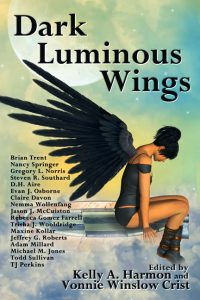 P.S.: Your short story “Cemetery Angels” appears in the recently-released anthology Dark Luminous Wings. Please tell us about that tale and its main character.
T.J.W.: I wrote “Cemetery Angels” a while ago when I was dealing with my father’s death a few years ago. It came from a story I remember as a child—though I don’t recall if it was an urban legend or an actual news story. There were some people, I vaguely remember “college kids”, who were going to cemeteries, breaking into cars while family was visiting the graves, and stealing purses and valuables. I also remember a discussion about locking doors in cemeteries. My mom, actually, was very similar to the mom in the story when it comes for locking doors everywhere. However, when I had taken my mother to visit my father’s grave, she asked me why I’d locked the car in a cemetery. That story had stuck in my mind as something she’d told me, so I was shocked she’d asked, and that exchange stuck in my head for a while, too.
Now, the cemetery where my father (and most of my mother’s family) is buried is an actual Polish Catholic cemetery in Western Massachusetts—and it is a gorgeous cemetery. All of the statues I reference, all of the beautiful stone angels and saints are real (though not necessarily on all my family’s monuments). And we did visit my mother’s grandparents, and my grandmother, with some frequency as I was growing up—and it was a beautiful ritual (albeit boring for a child who could say the entire “Our Father” and “Hail Mary” in as many breaths). So, the two main characters are both strongly drawn from my life and my family—particularly my mom, who I wouldn’t doubt would weaponize her oversized purse against anyone threatening her family. And is a very practical person.
P.S.: You also work as an editor, a member of that blue-penciled breed that writers love to hate. What is it like being on both sides of that fence?
T.J.W.: I love editing. It works a different side of my brain, and I learn a lot about my own writing by editing. But, moreso, I love asking questions and challenging authors to make their works the best they can be. Being an editor is like someone hiring you to help them with their child—and I say that having also worked as a nanny and tutor in my life. You grow to love that child and you want the best for them, but you also have the distance of the work not being your child, so you can be more objective and ask some very hard questions that the author might not see because they have that special relationship with that work.
Mind you, I haven’t been looking or advertising for clients for a few years. The authors I work with are authors I have a relationship with or referrals from authors I’ve worked with over several books and sometimes several series. Still, when I send back one of their manuscripts marked back up, my greatest fear is “Oh, I hope this isn’t the round of edits where they discover they actually hate me!” It was a relief, this fall, when an editor who’d worked on one of my novels sent me an email asking a similar question because I’d been away and hadn’t let her know I’d received her notes. She’d done a wonderful job tearing my ms apart, and it was a tough edit—which was perfect, so I told her so when I got back and looked at her notes. So, we editors really don’t want you to hate us, please?
P.S.: Do you think your experiences as an editor have helped your writing?
T.J.W.: Absolutely. Without a question. Before I was an editor, I was also a writing tutor—and that also was a massive learning experience when it comes to writing. Part of being a tutor, which is what I bring to my editing clients, is that you also want to nurture the writer. It’s just as important to point out what works as what doesn’t work. You want your student or your client to walk away from the experience inspired to make their work stronger.
P.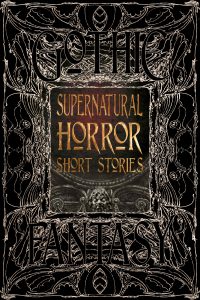 S.: You attend a number of science fiction, fantasy, and horror conventions. What do you enjoy about those, and where can readers meet you next?
T.J.W.: I am a regular attendee (if not panelist or vendor) at Arisia, Boskone, Conbust, Necon, DragonCon, and Rock and Shock every year. I’m usually a panelist or running a workshop or three at any one of those conventions, and you can often find me at either a Broad Universe or a New England Horror Writers table at most. This year, you’ll also find me at StokerCon, very likely at the NESCBWI (New England Society of Children’s Writers & Illustrators) Conference, possibly at ReaderCon, and I’m not sure what else yet.
What I enjoy about these… Goodness! So much! I started out going as a “student,” because I find panels and workshops offered very educational and I’m a believer of life-long pursuit of learning. Then I started reading my work at them and discovered I love performing and reading aloud. As I went to more, I made friends at these conventions with whom I stay in contact virtually, but only get to hug in-person at these events. Many of these friends have become very dear to me. After that, I started working tables and found I enjoyed meeting people and promoting my new friends’ and colleagues’ books—and making money selling stuff I was in! And after that, I started getting invited to be on panels and to run workshops—and I do love teaching and talking and educating. I could give back to the communities that have given so much to me!
And those don’t even include the very special moments, like sitting on the hallway floor with Lois McMaster Bujold and talking about feminism! Or hanging out with Jim Butcher after moderating a packed urban fantasy panel with him! Or randomly running into Neil Gaiman and Amanda Palmer after Gaiman won a Shirley Jackson award! Or snickering alongside Jane Yolen about the grammar and editing issues that make both of us cringe!
P.S.: Tell us about the Broad Universe organization and your involvement in it.
T.J.W.: Broad Universe is an international non-profit dedicated to supporting, promoting, and celebrating women creators in science fiction, fantasy, horror, and everything in between. I joined after hearing about it at my second DragonCon, ended up becoming the coordinator for readings and events, moved on to become president, and count the organization as one of the main reasons I’ve been able to make a profession out of my writing and my geekery. I had my first publication with an editor I got to chat with through Broad Universe. It was my friend, and president-before-me, Phoebe Wray, who pushed me to start reading aloud even before I had published anything. Other members, Inanna Arthen and Justine Graykin, taught me about performing and reading aloud. And even more members gave me confidence to submit work, to sell my work, and to keep pushing myself to achieve my dreams of writing professionally. I started editing through friendships I’d forged among Broads, and I made my connections at conventions and with the New England Horror Writers through Broads. Honestly, I wouldn’t be here today without the lessons, connections, and experience I’ve had through Broad Universe.
 P.S.: Since you first began writing, how has your writing evolved in terms of style, theme, genre, etc.?
T.J.W.: I distinctly remember in grammar school making a mistake on one of those vocabulary exercises I mentioned where I crafted a sentence where “I through a ball” and my mom corrected me… so I’m fairly sure I’ve gotten better since then.
In terms of style, theme, genre, etc…. That’s tough. I’ve probably gotten darker over the years. Thanks to social media, the ease of access for news, the more information we get, I see a lot more darkness. But I also see hope having to shine brighter—so stories of people getting through difficult and dark times, or not, just happen in my head. So, there is more horror and darkness; and that horror and darkness are more embedded in real life and current social issues.
I’ve also gotten better about tightening my writing. There is still a lot of work to do, but I used to have to cut sometimes 30-40% of a manuscript for it to not be “wordy” and “redundant”. Now it’s more like 20% average, sometimes even less!
As I’ve written more poetry, I also feel I’m more aware of rhythm in my sentence structure, regardless of how I write. And that, also, has helped me with making each word and sentence work harder.
I still tend to lean toward fantasy, fantastical, and magical stories, but I’ve gotten more comfortable in grounding myself in reality and research rather than trusting myself to “make it up,” and I think that makes for a better story, too.
 P.S.: What is your current work in progress? Would you mind telling us a little about it?
T.J.W.: I usually have five or six WIPs going at once, so I’ll just chat about a few.
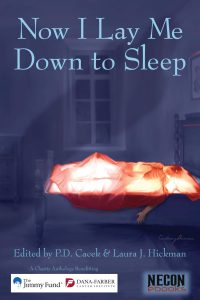
Novelwise, I’m working on a children’s book (middle grade) called The Circus Under the Bed. I wrote that last NaNoWriMo (and into January and February following), and now am working on beta edits to clean it up for submission. The story is about the fragments of dreams and nightmares, Figments, that each of us creates when we are startled awake. These Figments create communities traveling from one Under the Bed to another Under the Bed, rescuing the little beings that hide there. Of course, they are terrified of the Dreamers who create them—after all, most are born from those fears!—so when one Figment gets captured by a Dreamer who is also the school bully, its adopted family must leave the Circus’s sanctuary to go on an impossible rescue mission. The poem I wrote to help me with worldbuilding (because, of course, my brain said that I needed to write poetry to go with this prose!) was actually published in Now I Lay Me Down To Sleep, a charity anthology for The Jimmy Fund put out by Necon Ebooks.
I’m also working on a novella inspired by Pole to Pole’s In a Cat’s Eye anthology. It ended up being a novella, so it didn’t work…but I love this story just the same. It takes a look at the dark underbelly of breeding show animals by launching into a future where we have special cat shows for genetically modified cats that score for intelligence as well as appearance. One might ask what could go wrong when we make intelligent designer cats and a whole culture around breeding intelligent designer cats… and I explore a few such things. I have notes from my writers group that are several months old that I need to attend to, and then I’ll be looking for a home for it.
I’m also tinkering with an alien invasion novel with an Outlander flavor, set in Scotland with impossible romantic relationships, a dragon / salamander short story, a poetry collection, and going through my many other unfinished projects to see what is viable to work on for 2018.
 Poseidon’s Scribe: What advice can you offer aspiring writers?
Trisha J. Wooldridge: One thing I’ve seen a lot of aspiring writers do is self-publish their very first novel (or submit it to me while I was an acquiring editor for a mid-sized press)—and 99.9% of the time it was a huge mess. Not only would a piece need serious editing, but the author needed to learn more on writing craft. Mind you, I fully support all routes to publishing, from self and independent publishing to traditional and “Big Five” contracts. But whether it’s an author with their self-pubbed first novel or an author who is submitting their first novel to a publisher, I ask, “Are you sure it is ready?”
This may be an unpopular opinion or piece of advice, but don’t rush to publish. Take time to hone your craft. Then take time to learn the business of publishing. But most of all, learn about the craft of writing—not just the fiction part, but the writing you’ll use to market the book. Learn about sales writing, journalistic writing, business writing. Even poetry. All of that helps. And it’s perfectly okay to write things that won’t get published. Think of how many times an Olympic medalist has run a track, swam a lap, practiced a routine. With writing, we need to get our practice time in; we need to allow ourselves to write stories, novels, poetry, etc. that might not get published and be all right with that. By rushing to publish our practice work, we do ourselves a disservice and we do readers a disservice. Take the time to practice and learn.
Thank you very much, Trisha. Great answers, and very helpful advice. Readers can keep up with all things Trisha at her two Facebook pages, her personal one and her author page. Also check out her website and get to know her on Twitter.
Poseidon’s Scribe

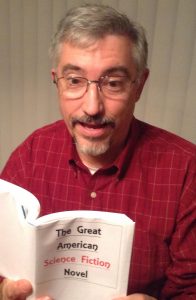
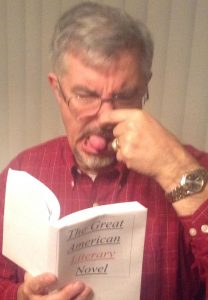 Some accounts of a recent scientific study are concluding that reading SF makes people stupid. Researchers Chris Gavaler and Dan Johnson of Washington and Lee University set out to challenge the results of an earlier 2013 study suggesting literary fiction makes readers smarter. These researchers believed whatever was going on in the earlier study had nothing to do with genre, and hoped to prove it.
 With Dr. Carl Sagan’s help, I’ve
 Since that description is rather subjective, I prefer the simpler version provided by