As a writer, you can’t afford to bore readers. Modern technology has dwindled their attention spans to a few seconds before they hit Delete. I’ll give you some techniques for writing stories that capture and sustain attention.

The Problem
We live in a fast-paced age. Busier than ever, your readers get blasted every day with an information fire-hose, spewing mostly useless noise. What doesn’t attract attention gets deleted or remains unclicked.
The book you’re writing will vie for reader eyeball time against many competitors—other author’s books, TV shows, movies, Facebook, X, Instagram, Tiktok, etc. Readers abhor boredom. They’ve no time to read dull prose. If the story’s first paragraph doesn’t trigger a dopamine hit, readers won’t continue.
Anti-Boredom Techniques
I drew inspiration for today’s topic from this post by Sabyasachi Roy. I’ll list his techniques, put into my words.
- Learn from other’s successes. Consider techniques proven to work. Sabyasachi Roy suggests you analyze what it is about certain Facebook or X posts, or Netflix series, that grab attention and tell a story too irresistible to ignore.
- Seize interest from the start. Your opening sentence and paragraph must compel the reader to read on. Spend time crafting and re-writing this hook, since it serves multiple purposes.
- Use the high-low-high-low technique. As the story goes, alternate high-tension moments with low-tension moments.
- Understand high-tension moments. High-tension needn’t mean a fist fight, a car crash, or an explosion. It means putting your protagonist under high emotional strain. Use short sentences and short paragraphs here to hasten the pace.
- Use low-tension moments to let characters and readers catch a breath. Don’t put them to sleep, though. Pack these moments with meaning—thoughts and emotions that suggest the themes of your story. Allow the characters time to react to what just happened, and to wonder—or dread—what will happen next.
- Add surprises and twists. Disrupt the reader’s notions of where the story is going.
- Start with high stakes for the character. Then raise them. What bad thing will occur if the character fails? Lost love? Poverty? Diminished social status? Death? If possible, make the consequences more dire as the story proceeds.
- Leave your character hanging from a metaphorical (or actual) cliff at each chapter’s end. Cliffhangers deny readers the chance to end their reading session there.
- Kill darlings. When re-writing, cut all unnecessary words, sentences, paragraphs, scenes, and chapters. Delete or condense the parts that bore you, since they’ll also bore readers.
Your Book
I hear you. You’re telling me your book doesn’t belong in the thriller genre. It’s a slow-paced, thoughtful book, a deeply philosophical tome meant to be savored, not sped through on the way to something else.
Even so, you don’t want to bore readers. Some of the above techniques may still apply to your book. It still needs to pass the “So What?” Test.
As Lincoln said, “You can bore all of the people some of the time…” Wait. That wasn’t Lincoln. That was—
Poseidon’s Scribe
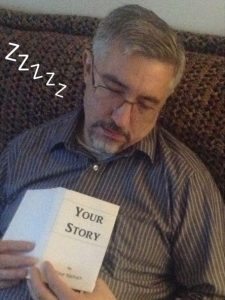 Let’s say you’re looking over the story you just finished writing and you see a section where the action really drags. While writing, it seemed necessary to describe a scene fully or explain a character’s backstory so later plot actions would make sense. Now you’re torn. Should you follow Hitchcock’s advice and just cut that section, or leave it in at the risk of boring your readers?