How Fiction Writers Exploit the Mind-Body Connection

You texted the wrong person—you blush—you feel embarrassed. A snake slithers toward you—you lurch backward and hyperventilate—you feel afraid. You scored a soccer goal—you pump your fist—you feel elated.

Images created with the help of ChatGPT

In Science

Note the order: stimulus—physical response—emotion. It’s as if your body knows, in advance, how you’re about to feel. According to scientists, it does.

Your body reacts first, before your brain feels an emotion. How can your body react so fast and your brain lag so far behind? If our mighty brain distinguishes us from other animals, why that slow response?
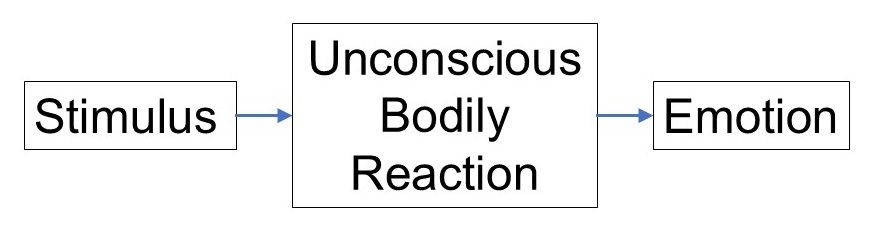
Rather than a bug in the system, think of it as a feature. Our species evolved to prioritize readiness over reflection, survival over sentiment. This post by Christine Walter and this post by the Eastside Counseling Center discuss the phenomenon in more detail.

In Fiction

Knowing this human characteristic, how do fiction writers exploit it? How can you use it in your stories?

In books, characters often respond to a stimulus—an event or spoken dialogue. A given character’s body reacts in an instant, most often in an appropriate and unconscious way. That physical reaction may or may not be noticeable to other characters. A moment later, the character feels one or more emotions.

For Point-of-View characters, the writer may (or may not) state the emotion felt. For non-POV characters, the writer must convey their emotions in a second-hand way—by physical actions, tone of voice, word choice, etc.

Sabyasachi Roy expressed these ideas well in this post.

Show, Don’t Tell

A writer may omit naming the emotion, allowing the reader to infer it. Often, the bodily reaction suffices to inform the reader what the character is feeling. Flared nostrils, bared teeth, and flinty eyes convey enough without having to state the character’s anger.

Not only does showing the body reaction make it unnecessary to tell the emotion, it makes for superior story-telling. Readers want to feel emotions along with the characters. Show readers the tingling of a spine, the gasp, the shallow sigh. Don’t just tell us the character felt scared, awed, or nostalgic. In fact, avoid naming emotions at all—allow readers to feel them.
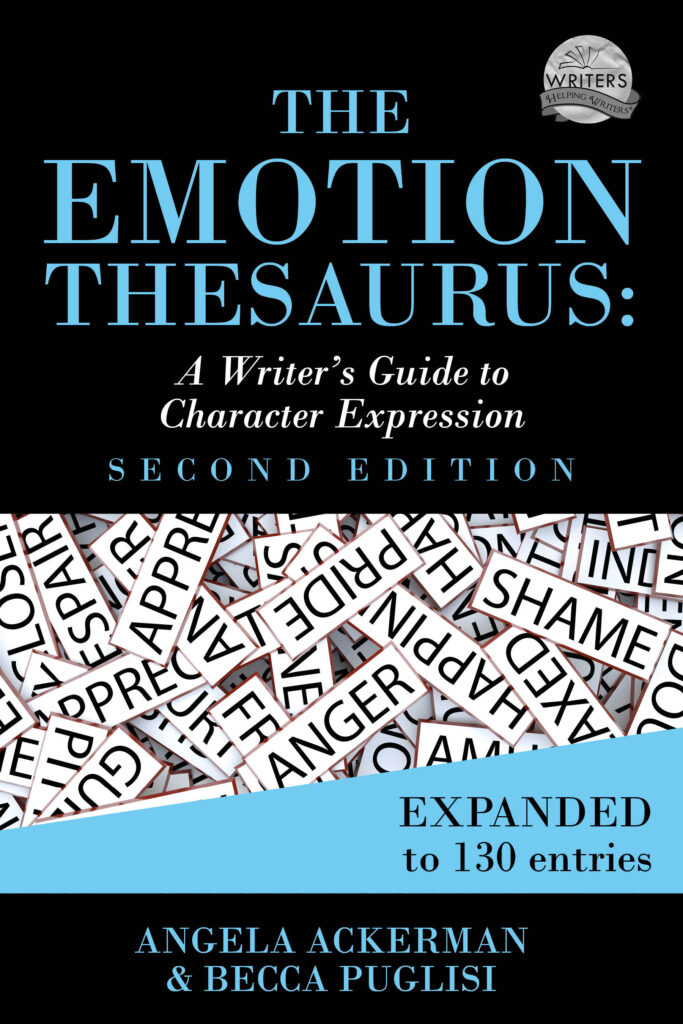
The Emotion Thesaurus

While writing, I struggle to think of the appropriate bodily reactions for a given emotion, especially if I’m not feeling it myself. The Emotion Thesaurus by Angela Ackerman and Becca Puglisi rescues me every time. This valuable resource provides lists of physical signals for seventy-five emotions. Look up the feeling and peruse the list of bodily reactions. A given character won’t display all the physical signals on the list, so select one or two appropriate ones. You needn’t describe the bodily reaction the same way the thesaurus does. Choose your own words. The book serves as a catalyst for your creativity.

Leaning back in my chair, hands clasped behind my head, smiling as I review this post, I’m—

Poseidon’s Scribe

Write With Fervor

You long to write stories like the ones you enjoy reading, but doubt you could. Writing seems tedious and you think you lack the required expertise. You just know you’d get bored and disillusioned after a few pages. The late author Ray Bradbury offered some advice that might help you.

In his 2001 lecture at The Sixth Annual Writer’s Symposium by the Sea, sponsored by Point Loma Nazarene University, he provided great tips about writing, including these two gems:

  • Make a list of ten things you love, madly, and write about them. Make a list of ten things you hate, and write about killing them. Make a list of the ten things you fear, and write about them.
  • Don’t write self-consciously, commercially, what will sell. Find the deep stuff, your inner self. Don’t ask what will sell. Ask who am I?

Exercise

First, you’ll be jotting down three lists of ten items each—things you love, things you hate, and things you fear. No one else will see these lists. Think of ten as a minimum number. Bradbury chose ten to prod you to think beyond the first few easy ones. You’ll be stretching to reach ten, and that’s the point. He’s trying to get you to dive down to your essence, your core.

Given that introduction, I suggest you do the exercise now. Really. Now. Stop reading this and generate your three lists of ten each. I’ll wait until you finish.

Intermission

After the Exercise

All done? Good. You’ve got lists of things you love, things you hate, and things you fear. For every item on all three lists, you feel some level of passion. Positive feelings of adoration accompany each item on the ‘love list.’ Feelings of anger boil up in response to those on the ‘hate list,’ and feelings of dread ooze out of those on the ‘fear list.’

The lists, then, provide two things you’ll need—subjects to write about, and feelings to sustain you while writing.

Subjects

As a fiction writer, you don’t have to write about the exact objects of love, hate, and fear you listed. Perhaps it’s better if you don’t. Use a stand-in, a metaphor, something to represent one or more of the specific things listed.

Say you wrote ‘my spouse’ on the list of things you love, and decided to write on that topic. I’m suggesting you shouldn’t write about your own spouse, but rather write about a character’s love for that character’s spouse. Readers won’t know it’s really your own spouse—they’ll just note the tenderness with which you convey the love.

Caution

I offer a quick note about the list of things you hate. Don’t turn your writing into an angry manifesto. The list should serve as a catalyst for writing, not a prelude to violent action. Take out your vengeance on fictional characters only.

Feelings

The real power of Bradbury’s advice comes from the intense emotions you feel about every item on each list. Those emotions should make it easier (1) to write ‘in the flow,’ (2) to know, at any point, what to write next, (3) to stay enthused about the project until completion, and (4) to infuse your writing with spirit. Your strong feelings about the subject will pass through to readers.

Digging Deep

The other piece of Bradbury’s advice really nails it. “Find the deep stuff, your inner self. Don’t ask what will sell. Ask who am I?” By listing things you love, hate, and fear, you’re getting at your essence, your basic humanity, your soul. Write from out of that core, and your words will ring true. They’ll shine.

Writing from the heart, with fervor, gives you a better chance of reaching readers, too, especially those who care about the same things, readers whose own love/hate/fear lists—if they made them—would reveal some commonality with yours.

Thanks to Ray Bradbury, you’ve got the tools you need. Your lists have fired the coals of an inner boiler. That high-pressure boiler powers a potent writing machine—you. The steam is up, the throttle is open. Go! Nobody can stop you now, least of all—

Poseidon’s Scribe