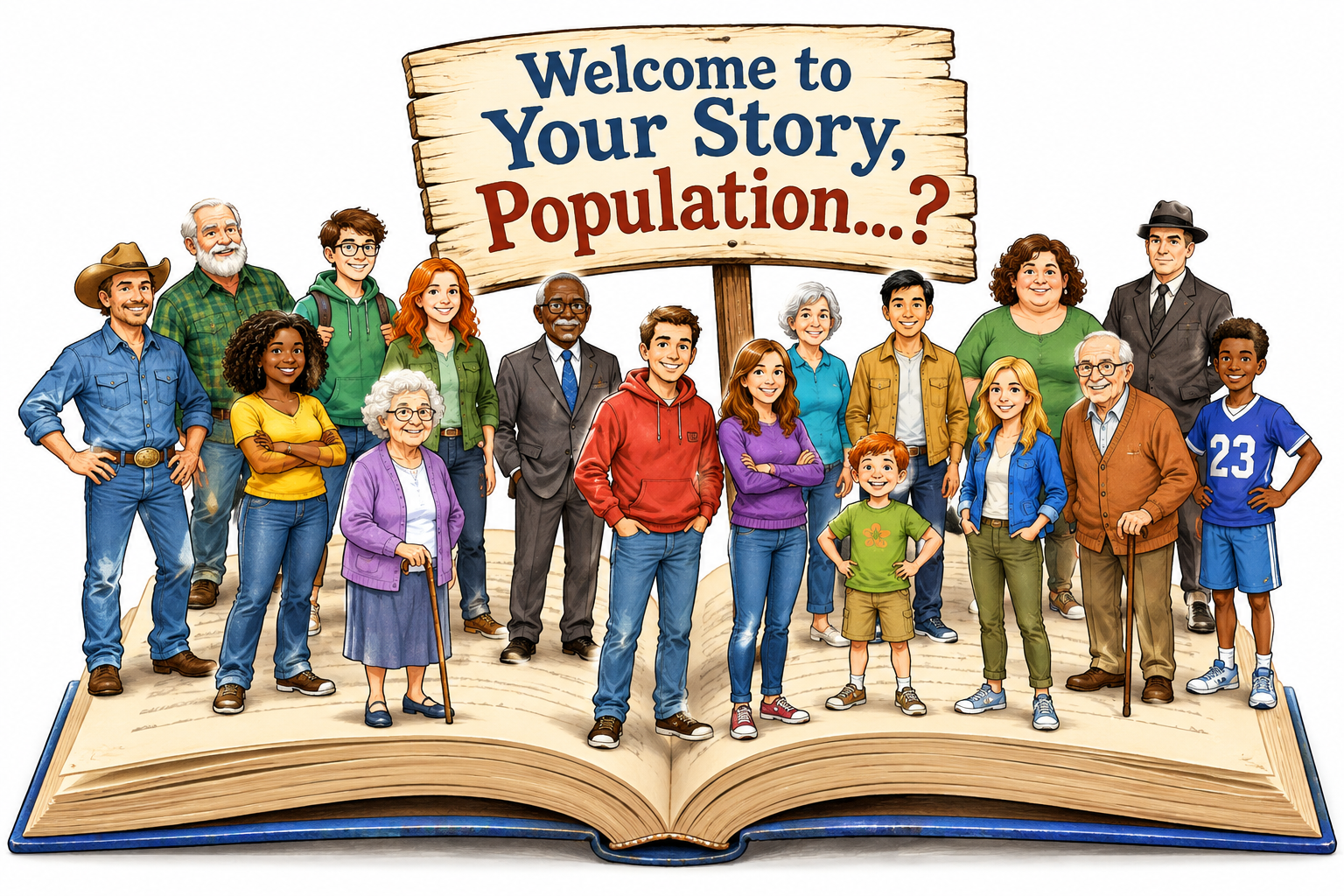
How many characters should your story include? How do you know when you have too many? Too few?
A post by K.M. Weiland inspired this one. I’ve put many of her thoughts in my post, using my own words, and added other thoughts.
Let’s populate a story.
Story Length
The length of your tale will drive the maximum number of characters. In flash fiction you’ll find it difficult to include more than two major characters. Short stories usually feature fewer characters than the longer formats of novellas and novels.
Perhaps it’s more useful to go at this the other way, and to build from the minimum number of characters up to the right number.
Protagonist
All stories are about the human condition, so it’s good to include a human in your story. Even if your protagonist isn’t human, it’s a stand-in for humans. The protagonist has goals/wants/needs/a mission that drives the story’s plot.
Antagonist
The antagonist stands in opposition to the protagonist, striving to thwart the protagonist’s aims. The antagonist may be a force of nature or an aspect of the environment. Often, the antagonist is human. Even in a hero-vs.-society story, authors usually select a single person to represent society.
Significant Characters
In addition to the protagonist and antagonist, you’ll likely include other major characters. These can include mentors, romantic interest characters, sidekicks, comic relief, or combinations of these. They’ll often be associated with the protagonist or the antagonist, or both. You can use them as the conscience of the story—the ones warning the protag or antag not to do the wrong thing, or urging them to do the right thing. They’re significant in the sense that they’re almost as three-dimensional as the protag and antag, with their own personality, goals, motivations, etc.
Minor Characters
Your story may include quite a large number of minor characters, often called “spear carriers.” Coffee shops have customers, armies have soldiers, spaceships have crews.
Overpopulated
How do you know if you’ve included too many characters? First, identify your protagonist, your antagonist, and the significant characters. Then ask some questions.
- Do you have two significant characters filling one role? Consider deleting one.
- Did you overdevelop a minor character to the status of significant because you like that character? Consider demoting back to minor status, or deleting.
- Is one of your significant characters hogging the limelight, stealing scenes, performing actions better done by the protag or antag? Consider demoting or deleting that character.
Underpopulated
Maybe your story has too few characters. This can happen in a constrained setting—a small vessel, a deserted island, a locked room, etc. You still need a protagonist struggling against an antagonist. The antagonist could be the constraint itself—the environment.
Even here, you can create significant characters. Consider the role of Wilson in the movie “Cast Away.” Wilson is a volleyball with a face painted on it. It never talks, but it represents another human, a reason for the Tom Hanks character to hold onto sanity.
Just Right
When your story contains the appropriate number of characters, it just feels balanced and right. You’ll know it. You can replace the question mark on that population sign with the correct number. I know one reader who’ll want to visit your story, and that’s—
Poseidon’s Scribe