

My recent experience moderating a panel on Science Fiction submarines at Chessiecon inspired this blog post. As a former submariner and current science fiction writer, I’m fascinated by the submarines of SF. Earth’s ocean, or oceans in general, are not common settings in SF, and I really enjoy such stories when I come across them.
Before I reveal the list of the seven best, here’s my chronologically ordered list of the more prominent submarines of science fiction. The list includes those from books, movies, TV shows, and some Anime. I included the Red October as a SF sub because of its advanced “caterpillar drive.”
| Name | Source (Book, Movie, TV, Anime) | Year(s) |
| Nautilus | (B,M,T) 20,000 Leagues Under the Sea | 1870 (B)
1916, 1954 (M) 1997 (T) |
| Wonder | (B) Tom Swift and His Submarine Boat | 1910 |
| Rocket Submarine | (M) The Undersea Kingdom | 1936 |
| The Iron Fish | (C) The Beano | 1949 |
| USS Triton | (B) Attack From Atlantis | 1953 |
| Jetmarine | (B) Tom Swift and His Jetmarine | 1954 |
| Diving Seacopter | (B) Tom Swift and His Diving Seacopter | 1956 |
| Fenian Ram S1881 | (B) Under Pressure or The Dragon in the Sea | 1956 |
| Seaview | (M,T) Voyage to the Bottom of the Sea | 1961, 1964-1968 |
| Flying Sub (FS-1) | (T) Voyage to the Bottom of the Sea | 1964-1968 |
| Unnamed | (M) Atlantis the Lost Continent | 1961 |
| Stingray | (T) Stingray | 1964 |
| Gotengo | (M) Atragon | 1963 |
| Proteus/Voyager | (B,M) Fantastic Voyage | 1966 |
| Blue Sub 006 | (A) Blue Submarine #6 | 1967,1997-2000 |
| Dyna-4 Capsule | (B) Tom Swift and His Dyna-4 Capsule | 1969 |
| <Unknown> | (B) The Deep Range | 1970 |
| Rorqual Maru | (B) The Godwhale | 1974 |
| S.S. Cetacean | (T) The Man from Atlantis | 1977-78 |
| Sea Trench | (B) Aquarius Mission | 1978 |
| Blue Noah | (T) Thundersub | 1979-80 |
| Red October | (B,M) The Hunt for Red October | 1984 (B) 1990 (M) |
| Seaquest | (T) Seaquest DSV | 1993-96 |
| Gungan Bongo Submarine | (M) Star Wars: Episode I The Phantom Menace | 1999 |
| Ulysses | (M) Atlantis: The Lost Empire | 2001 |
| UX | (A) Submarine 707R | 2003 |
| I-507 | (M) Lorelei: The Witch of the Pacific Ocean | 2005 |
| Vorpal Blade | (B) Looking Glass series | 2005, 2007, 2008, 2009 |
| I-401 | (A) Arpeggio of Blue Steel | 2009-Present |
| Hydra MiniSub | (M) Captain America: The First Avenger | 2011 |
To choose the best of these, I considered these criteria:
- Vividness. How detailed was the description, or how thoroughly was it depicted on screen? Did the audience form a clear mental picture of the sub?
- Technological Advancement. How much more advanced was the submarine when compared to typical submarines of the era in which the work was produced (not necessarily the time of the story)?
- Necessity to Plot. Did the plot of the story require a submarine at all, or would the story have worked if set aboard a different kind of vessel?
- Coolness. Was the depiction of the submarine aesthetically pleasing?
- Memorability. Does (or will) the submarine in this fiction work stand the test of time? Can you recall details of the submarine and the story years later?
Here’s my list of the 7 best science fiction submarines:
- Fenian Ram S1881. This is the submarine from Frank Herbert’s 1956 novel The Dragon in the Sea
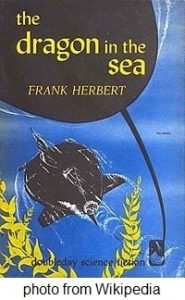 (also published as Under Pressure). The novel is intense, and focuses on the psychologies of the characters, and how the submarine setting affects them. The Fenian Ram is a nuclear-powered “subtug” that sneaks into the underwater oil fields of enemy countries, pumps out the valuable oil, and tows it back home. Herbert took the name of his fictional vessel from the submarine built by John Holland for the Fenians in 1881.
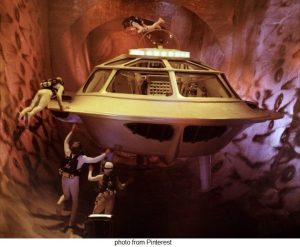 Proteus/Voyager. Most will recall the submarine from the 1966 film, and Isaac Asimov novel Fantastic Voyage. In the book and movie, the submarine was known as Proteus, but in the 1968-1970 cartoon it was known as Voyager. It didn’t go underwater, but was miniaturized and injected into a human body. You’ve got to love the many windows, and the bubble window on top. The movie version was designed by Harper Goff, a movie prop man I’ll mention again later.
- Sea Trench. Here is the submarine from the 1978 novel Aquarius Mission by Martin Caidin. The
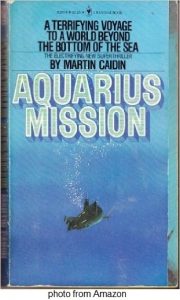 novel is not well-known, but I like that the book contained a foldout picture of the submarine, a complete side view depiction of its interior. This sub was huge, and well equipped for both exploration and military missions. Nuclear-powered, it had an observation deck with a window, an observation bubble that could be lowered, a mini-sub, torpedoes, nuclear missiles, and a handball court.
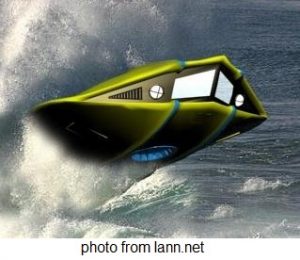 FS-1.You’ll recognize the flying submarine from the 1964-1968 TV Show “Voyage to the Bottom of the Sea.” Nuclear-powered, it had windows, a manipulator arm, and room for two operators, plus perhaps a passenger. It launched from and returned to its mother sub, the Seaview. Oh yeah, and it could fly. It could land on water, on an aircraft carrier, or on a runway ashore.
- Seaview. Now we’ve come to the submarine from the 1961 movie “Voyage to the Bottom of the Sea,”
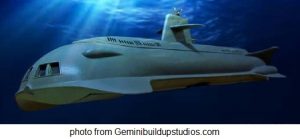 and the 1964-1968 TV show of the same name. In the movie, it was USOS Seaview, for United States Oceanographic Survey, but in the TV show it was S.S.R.N. Seaview, apparently to indicate it was part of the US submarine fleet, but still a research sub. Nuclear powered, it could deploy the Flying Sub, as mentioned. It had observation windows near the bow. The bow had a distinctive shape, reminiscent of a manta ray. The stern looked like the back end of a 1961 Cadillac.
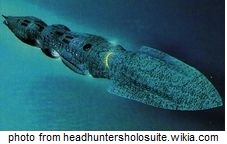 SeaQuest. The second-best SF submarine is from the 1993-1996 TV series “seaQuest DSV” (or “seaQuest 2032” in the final season). Measuring over 1000 feet long, the sub could move at 160 knots thanks to its twin fusion reactors. Its shape resembled a squid, and its hull had a bio-skin coating to repel sea organisms. It could dive to 29,000 feet. Seaquest travelled with a cloud of unmanned undersea vehicles, with sensors and other capabilities. Its armament included torpedoes, missiles, and lasers. One member of the crew was a genetically enhanced dolphin that moved throughout the sub in water-filled tubes.
- Nautilus. The best science fiction submarine could only be the Nautilus, from Jules Verne’s 1870 novel
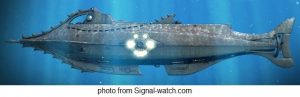 Twenty Thousand Leagues Under the Sea. Verne also mentioned it in his 1874 novel, The Mysterious Island. The story has been depicted in at least six films and there have been several spin-off novels and films featuring the submarine. With a length of 230 feet and a maximum speed of 50 knots, the vessel used a bow ram as its weapon. It could deploy divers as well as a small rowboat. It had a large “living room” with a pipe organ. Despite Verne’s meticulous description, there have been numerous different depictions of what the Nautilus looked like. The best, in my view, is the version Harper Goff created for the 1954 Disney movie.
There they are, the 7 best science fiction submarines. Did I miss your favorite, or would you have put them in a different order? Leave a comment for—
Poseidon’s Scribe


 At my book reading, I read the entirety of “The Cats of Nerio-3,” my story from the recently published anthology
  I had a fine time at the book signing later Saturday night. For one of the copies of
  That schedule is subject to change. I’ll post any changes here as I find out about them. There are many other things to see and do at Chessiecon, other than attending my panels, readings, and signings.
 Today, I’ll delve into major writer’s block (MajWB) and its cures. I define MajWB as the state of being unable to start writing a new work, a condition of long duration. It can last for years and can end a writer’s career.
 We could seek advice from accomplished authors. Unfortunately, the various quotes I’ve compiled run the gamut from the ‘don’t edit at all’ extreme to ‘seven revisions might not be enough.’


 This blog post comes with a giant disclaimer. I’ll be discussing general tendencies, not rules. Rather than concentrating on having a female character “talk like a woman,” focus instead on having her talk consistently with her personality, age, nationality, time period, upbringing, geographical location, and gender. In other words, the way your characters talk depends on a lot more than gender.