8 (+2) Science Fiction Predictions for 2022

Yes, it’s true, not all of my previous year’s predictions have proven accurate. But some have. Rest assured, though. I’ve abandoned the flawed methods I used back then. Those crystal balls, tea leaves and tarot cards are for amateurs.
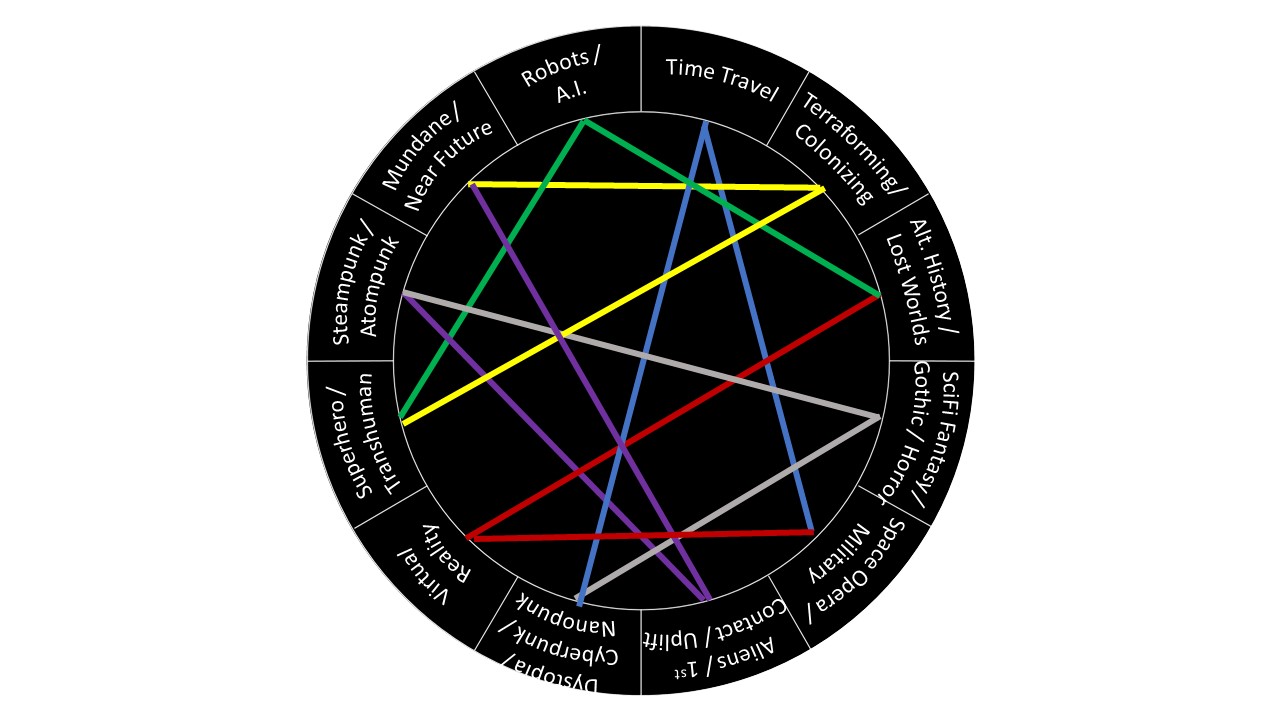
I spent all of 2021 working on a special astrological chart for science fiction literature. After all, it’s only natural to turn to the stars for scifi trends, right? Here are my predictions for 2022:

  • Games and Virtual Reality. This recent trend will continue in 2022 as authors explore the landscape of these settings. Moreover, readers will enjoy the escapism aspect of these stories.
  • UFOs/UAPs. As the government promises to release data on UFOs or Unidentified Aerial Phenomena, scifi authors will capitalize on the public’s interest in these sightings.
  • Pandemic. After predicting this last year, I realize I was a year ahead of myself (it happens, in this prognostication biz). 2022 will be the year for pandemic scifi. Expect bizarre diseases with weird symptoms.
  • Post-pandemic. As we emerge from the COVID-19 Pandemic, scifi writers will give us tales of humanity returning to normal after devastating pandemic diseases.
  • Private space exploration and tourism. Another example of me misreading the tarot cards. It wasn’t 2021, but will be 2022 when we read scifi novels featuring billionaire-funded space travel, both for tourism and exploration.
  • Humor. We’ll see a welcome surge in funny scifi, just in time to meet the public’s need for a lighter mood.
  • CliFi.  Many readers and scifi writers share concerns about climate change, which will inspire new novels about how humanity copes.
  • AI. Artificial Intelligence will continue to prompt the scifi of 2022 as it has for years now. I predict stories involving the whole spectrum of AI, from specialized AI capable of one type of task, to general AI similar to human intelligence, all the way to superintelligence.

Personal Predictions

As a bonus, here are two prophesies involving me:

  • The North American Jules Verne Society will publish its first anthology of short stories, titled Extraordinary Visions: Stories Inspired by Jules Verne. I’m on the editorial team.
  • My collection of short stories about the future history of seasteading, titled The Seastead Chronicles, will be published in 2022.

A year from now, you’ll be amazed at how such accurate predictions were even possible. You’ll be begging for a copy of my secret scifi astrology chart and the instructions for using it. You’ll be kicking yourself for having ever doubted—

Poseidon’s Scribe
December 26, 2021Permalink

Happy Bicentennial, Frankenstein

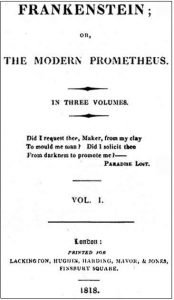
Two hundred years ago, author Mary Shelley wrote a remarkable novel— Frankenstein, or the Modern Prometheus—which endures in popularity and bears an increasingly meaningful warning for us today.

Title page from the original 1818 edition

(Yes, I know I’m a few months late. Lackington, Hughes, Harding, Mavor, & Jones published the novel on January 1, 1818. Amazing that a publisher was working on New Years Day!)

Today, we know Shelley’s novel mainly from its numerous movie incarnations and from the term “Frankenstein monster” itself, which has become shorthand for creating something with unintended negative consequences. I’ll be commenting on the original story, though, not its later derivative works.

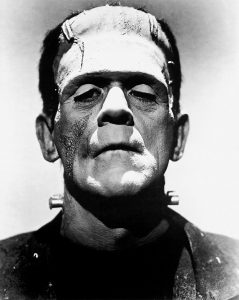
Boris Karloff depiction of the monster, from the 1931 movie

In my own stories, I explore the relationships between people and new technology. That is a key aspect of Frankenstein. In fact, that novel is one of the first ever to consider that theme.

Inventors typically create new technology to improve human life, to meet a need. However, the introduction of new technology can also bring about undesirable changes, including fear, active opposition, unforeseen faults in the tech (bugs), and inventor’s regret.

Not only does Shelley show us all of these aspects in Frankenstein, she turns the table on the whole technology impact concept; her sentient technology reacts to its own existence in a world of people.

To us, her novel seems well ahead of its time. Two hundred years ago, the Industrial Revolution had just begun. Electricity was a new and exciting phenomenon, not yet harnessed for effective use. Scientists were discovering elements and chemicals at a rapid pace.

Up to that time, fiction authors had written of golems and homunculi, humanoids created from magic. No stories yet existed of creating human-like life through science.

Perhaps, to readers of Frankenstein in 1818, then witnessing an explosion of scientific discovery, it might have seemed as if the animation of dead human tissue might well be next week’s news. Two centuries later, we have a better idea of how difficult the feat is. We can manipulate DNA to some extent. We’ve achieved remarkable results in extending human lifespans. We can revive the recently dead through mouth-to-mouth resuscitation and other techniques.

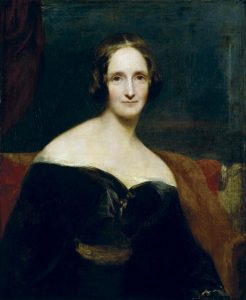
Mary W. Shelley

Still, we can’t do what Dr. Frankenstein did…yet. Nonetheless, when I said Shelley’s novel contains a particularly relevant warning for us today, I was referring to science’s quest to create artificially intelligent, sentient, self-aware “life.” This achievement may be decades, or only years, away. The ability for humans to create thinking, human-like life by means other than reproduction will be a breakthrough of far greater impact than any previous scientific development in human history.

We now find ourselves in the role of Dr. Frankenstein before he created the monster. We can consider the ethics of our actions in advance. We can ask if we’re insane even to pursue the enterprise. We can examine and plan for as many possible consequences as we can imagine.

Mary Shelley gave us a novel full of these consequences to consider. From twenty decades in the past, her visage warns us to be careful. She’s cautioning us with a worst-case scenario. If we fail to prepare for these consequences, we’ll have only ourselves to blame.

Thank you, Mary, for your wise counsel. On Frankenstein’s bicentennial, we’re still recklessly curious beings who discover how to do things before thinking whether we should, and before taking appropriate precautions. Maybe things will turn out fine, and much credit will go to you, for your prescient advance notice. Conveying my belated gratitude back through two centuries to you, I’m—

Poseidon’s Scribe