That’s a Great Story!

What makes a story great, or even good?  For this discussion I’ll concentrate on short stories, my main medium, but the principles apply to all fiction.  Fair warning:  I’ll explore the topic to the best of my ability, but if I was an expert on writing great short stories, I would be better known.

Philosophers since at least the ancient Greeks have puzzled about what makes one thing better or of greater value than another.  Is it really all subjective, in the mind of each individual reader, or are there some objective aspects on which we can all agree?  Further, what is meant by ‘great?’  Do we measure great stories by sales, by the number of favorable reviews, or by how the story stands the test of time?
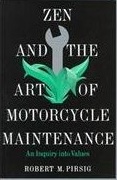
For an interesting romp through the fields of quality, goodness, and value (in general, not specifically as related to stories) read Zen and the Art of Motorcycle Maintenance by Robert Pirsig.

Of course, people differ in the stories they like, and a given reader may change her own tastes over time.  So there must be a subjective component to any definition of a good story.  I touched on this in a previous blog entry.

Still, perhaps we can agree on a few elements that should be present in a good story.  Not every element need be present, and excellence in some of them can make up for mediocrity in others.  Further, as you’ll see, these aren’t exactly objective elements, so people could disagree about whether they are present or absent in any given story.  Here are my ten elements, expressed in one long sentence:

  • A good story deals with one or more aspects of the human condition and starts with
  • an attention-grabbing hook that introduces
  • a compelling protagonist, with whom the reader can identify, who is
  • dealing with a difficult problem, a problem
  • with some relevance to the reader’s own life
  • in a vivid setting that puts the reader right there while the protagonist
  • encounters more difficult obstacles along the way
  • with enough tension and suspense to keep readers reading
  • and with the protagonist resolving the problem in the end in a satisfying, logical way, with bonus points if the protagonist learns something, and more bonus points if the reader can’t guess the ending early
  • with the whole story told in strong, clear language that produces an emotional reaction in the reader.

As it turns out, it’s easier to write down that list than it is to write a story that hits most of those marks.  Thinking back over the best short stories you’ve read, are there common elements they share?  Have I left out any elements in my list?  As writers, we ought to be striving for greatness as we tell our tales, so it helps to know what separates good or great stories from the rest.  I welcome your thoughts, which you can provide by clicking “leave a comment” below, whether or not you agree with–

                                                                     Poseidon’s Scribe 
November 13, 2011Permalink

Pioneers and Giants

For this blog post I’m dividing the great writers into two categories–pioneers and giants.  I define pioneers as those who start a new genre of fiction by themselves, and giants as those who come along later and take an existing genre to new heights and greater popularity.

Here is a table listing a few literary genres and some of the pioneers and giants in each one:

Genre

Pioneers

Giants

Adventure Heliodorus, Homer Edgar Rice Burroughs, Alexandre Dumas, Ian Fleming, H. Rider Haggard, Victor Hugo, Emilio Salgari, Robert Louis Stevenson, J.R.R. Tolkien, Jules Verne
Comedy Aristophanes Douglas Adams, Joseph Heller, William Shakespeare, R. L. Stine, Kurt Vonnegut
Crime Steen Steensen Blicher, Edgar Allan Poe Arthur Conan Doyle, Raymond Chandler, Agatha Christie
Fantasy Homer Marion Zimmer Bradley, Edgar Rice Burroughs, Stephen King, C. S. Lewis, J.R.R. Tolkien
Historical Chariton of Aphrodisias Pearl S. Buck, Ken Follett, Robert Graves, Eleanor Hibbert, James Michener, Baroness Emma Orczy, Ryotaro Shiba, Leo Tolstoy
Horror William Beckford, Ann Radcliffe, Matthew Lewis Stephen King, H. P. Lovecraft, Edgar Allan Poe, R. L. Stine, Mary Shelley, Robert Louis Stevenson, Bram Stoker, Oscar Wilde
Mystery E.T.A. Hoffmann, Edgar Allan Poe Jiro Akagawa, Agatha Christie, Arthur Conan Doyle, Erle Stanley Gardner, Dashiell Hammett, Kyotaro Nishimura, Edward Stratemeyer
Philosophical St. Augustine Albert Camus, Fyodor Dostoyevsky, Hermann Hesse, Aldous Huxley, Soren Kierkegaard, Stanislaw Lem, C.S. Lewis, Jean Paul Sartre, Ayn Rand, Voltaire
Political Plato Edward Bellamy, Benjamin Disraeli, Franz Kafka, Sinclair Lewis, Thomas More, George Orwell, Aleksandr Solzhenitsyn, Harriet Beecher Stowe, Jonathan Swift, Voltaire, Gore Vidal
Romance Chrétien de Troyes, Sir Thomas Malory, Ann Radcliffe Barbara Cartland, Jackie Collins, Catherine Cookson, Janet Dailey, Eleanor Hibbert, Debbie Macomber, Stephenie Meyer, Nora Roberts, Denise Robins, Danielle Steel, Corín Tellado,
Satire Aristophanes Ambrose Bierce, Anthony Burgess, Candide, Joseph Heller, Aldous Huxley, George Orwell, Jonathan Swift, Mark Twain, Kurt Vonnegut
Science fiction Jules Verne Douglas Adams, Isaac Asimov, Ray Bradbury, Edgar Rice Burroughs, Orson Scott Card, Arthur C. Clarke, Robert Heinlein, Frank Herbert, H. G. Wells
Steampunk James Blaylock,  K. W. Jeter, Tim Powers Paul Di Filippo, William Gibson, Bruce Sterling
Thriller Homer, John Buchan Dan Brown, Tom Clancy, Clive Cussler, Michael Crichton, Ian Fleming, Ken Follett, Frederick Forsyth, John Grisham, Robert Ludlum, Alistair MacLean
Urban Robert Beck TN Baker, Kole Black, De’Nesha Diamond, K’wan Foye, J.Gail, Erick Gray, Shannon Holmes, Pamela M. Johnson, Solomon Jones, Mallori McNeal, Miasha, Meesha Mink, Jeff Rivera, Big Rob Ruiz, Sister Souljah, Vikki Stringer, Nikki Turner, Anthony Whyte

You can quibble with the names in the table and that’s fine; I don’t pretend that it’s 100% accurate or complete.  But as I look through the table a couple of things are apparent:

  • There are a lot of genres, and probably more for you to invent.  (I didn’t list all genres, or very many subgenres.)  There will be more pioneers.
  • Just because a genre is old (the pioneer long dead) doesn’t mean new, modern giants can’t emerge.  It’s never too late to be a giant.

In general, the pioneer lays down some of the rules for the genre and takes the first tentative steps within its boundaries.  The pioneer faces the difficulty of convincing a skeptical publisher to take a risk on a book that doesn’t fit in any known category.

But it is the giants who really explore the full extent of the genre and help to popularize it for more readers.

Perhaps one day you’ll be looked upon as a great author.  Which type will you be–a pioneer or a giant?  There’s glory in both.  Which would you rather be?  Let me know by clicking “Leave a comment.”  Hoping to become one or the other, I’m–

                                                              Poseidon’s Scribe

September 18, 2011Permalink

Writing and the Outlier Theory

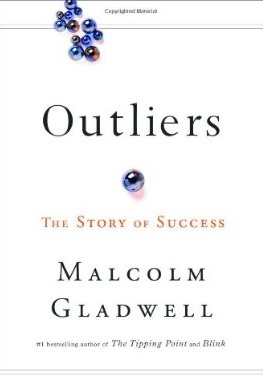
In a previous blog post, I mentioned Malcolm Gladwell and his book Outliers: The Story of Success.  In it, he explored why some people seem to stand out as geniuses in their fields–what made them so good?  His conclusion was that success requires two things:  (1) Luck, and (2) 10,000 hours of practice.

There’s not much we can do about luck.  Gladwell suggested it was a matter of being born at the right time and being exposed to the right influences.  When it comes to luck, you either have it or you don’t.  If you have it, ride that wave, baby.  If you don’t, well, reconcile yourself to the fact that not all books sold are written by the greatest writers of all time.  And know this, too:  there’s no way of knowing in advance whether you are lucky.  Only time will tell.

Although we can’t alter our luck, we can do something about the 10,000 hours.  Well, not shorten it, I’m afraid.  But we can accomplish it.  We can devote ourselves to it.  If you spend 10,000 hours honing your skill at one thing, it’s highly likely you’ll become good at it.  Perhaps not great, but good.  And you may grow to enjoy that activity, such that the idea of the next 10,000 hours doesn’t frighten you, but thrills you.

Gladwell goes on to discuss what the 10,000 hours should consist of.  Many of those hours should be devoted to freeform play where failure has a low cost.  There should be a lot of experimentation and attempts at trying out different approaches without any external criticism.  Examples he gives in his book include hockey players, musicians, and computer pioneers.  But you can see how his theory applies to writers.

For writers, the 10,000 hours is spent mostly alone, writing.  The freeform play consists of many attempts at stories of different types, many drafts that get discarded, many early tales of poor quality.  The 10,000 hours should include some study as well–research into the mechanics of writing, research into how great writers plied their craft.

At this point you might be thinking of examples of great writers who didn’t have to spend 10,000 hours perfecting their skills.  Okay, there might be a handful.  And you might end up being one.  If so, great!  But do you really think you should assume that you’re going to be one of that very rare breed that achieves greatness without a lot of work?

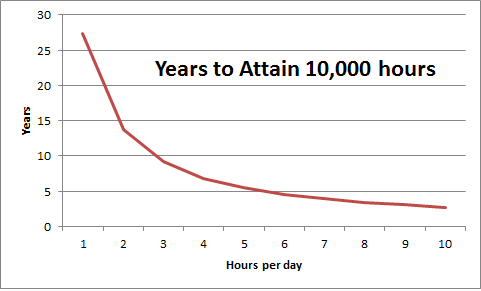
Yes, I’ve done the math.  I know that if you can only devote three hours a day to writing, you won’t reach 10,000 hours for over nine years.  But for most of us, there’s just no way around that.  And you need to remember that much of those 10,000 hours are spent in enjoyable play.  It needn’t be all drudgery.

So those 10,000 hours won’t happen by themselves.  If you want to be an author, get moving.  The clock’s ticking and the calendar’s flipping.  Oh, and if you know some sure-fire shortcut, please send it to–

                                                      Poseidon’s Scribe

September 11, 2011Permalink