Why Young Adults Should Love Tom Swift

In a significant way, Tom Swift guided me toward a career in engineering, and also toward the genre of fiction I write. I wonder if authors of young adult (YA) fiction understand the seeds they plant in young minds.
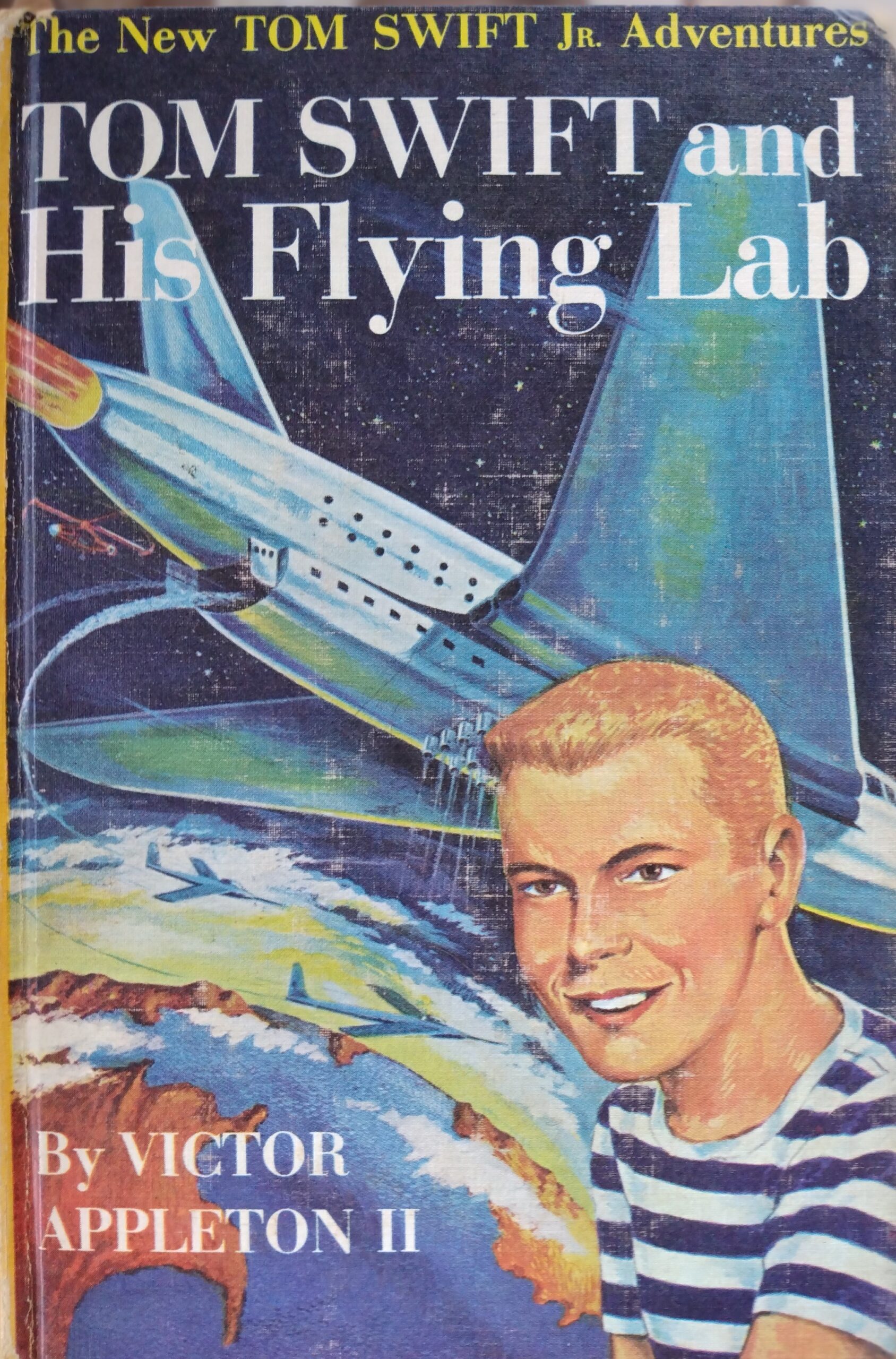
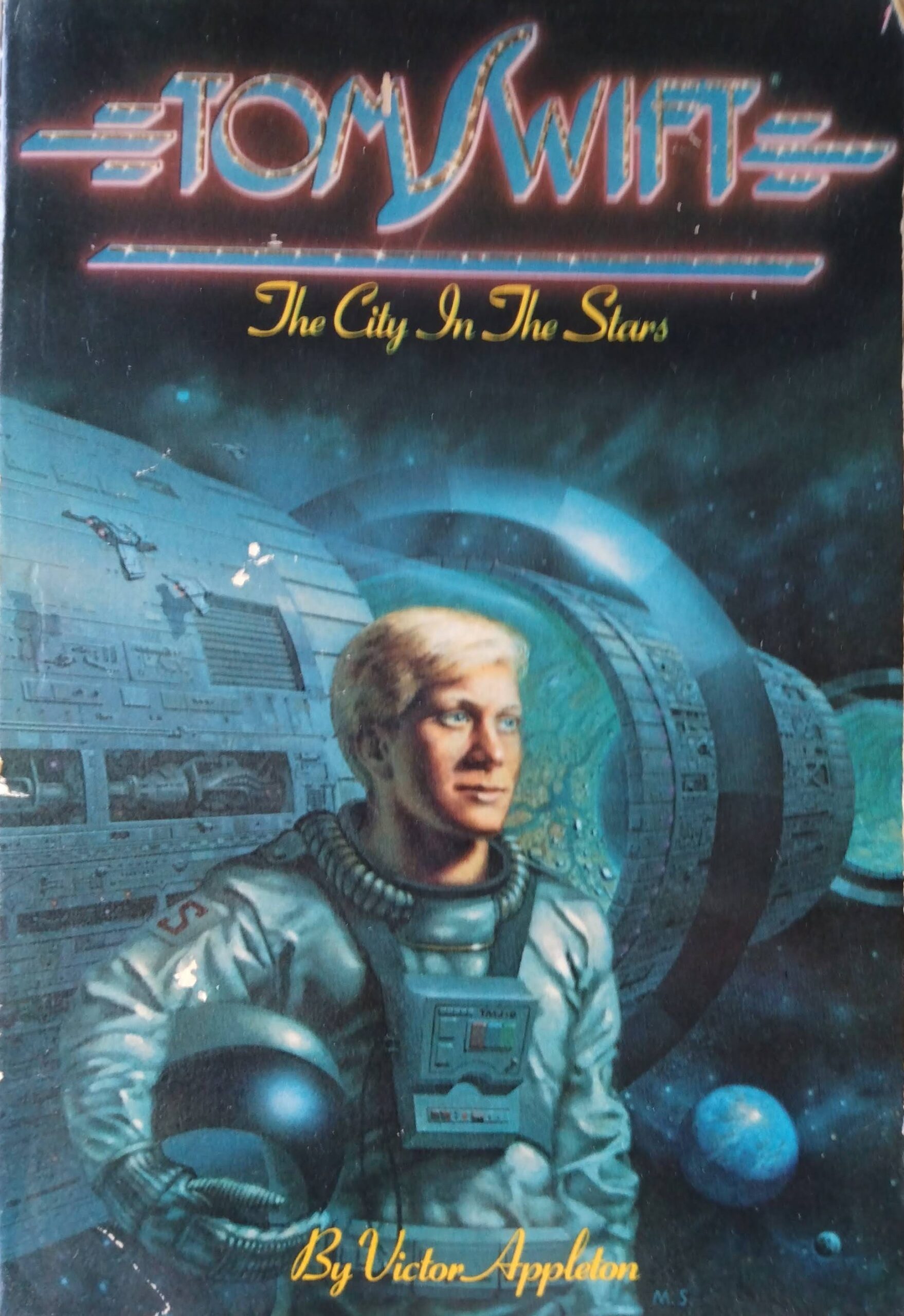
First book in the Tom Swift Jr. (second) series 1954-1971

Tom Swift and Me

As a young boy growing up in the 1960s, I enjoyed reading the Tom Swift Jr. series, attributed to Victor Appleton II (a pseudonym for several contributing authors), and published by Grosset & Dunlap during the years 1954 to 1971. One of my aunts gave me the first book in the series, Tom Swift and His Flying Lab, as a gift. After that, my collection grew to include most of the thirty-three books in the series.

I loved reading about Tom Swift’s inventions and adventures. He built a nuclear airplane, a submarine, a spaceship, a robot, and earth-blasting machine, and many, many more. Each book fired my imagination. In my mind, I traveled along with Tom and his sidekick, Bud Barclay, in their amazing vehicles.

Tom Swift, I believe, influenced my later choice to major in engineering (specifically, Naval Architecture) at college. After serving in the military, I spent a career as an engineer and program manager at an engineering organization. However, I didn’t end up building my own nuclear airplane, submarine, spaceship, etc.
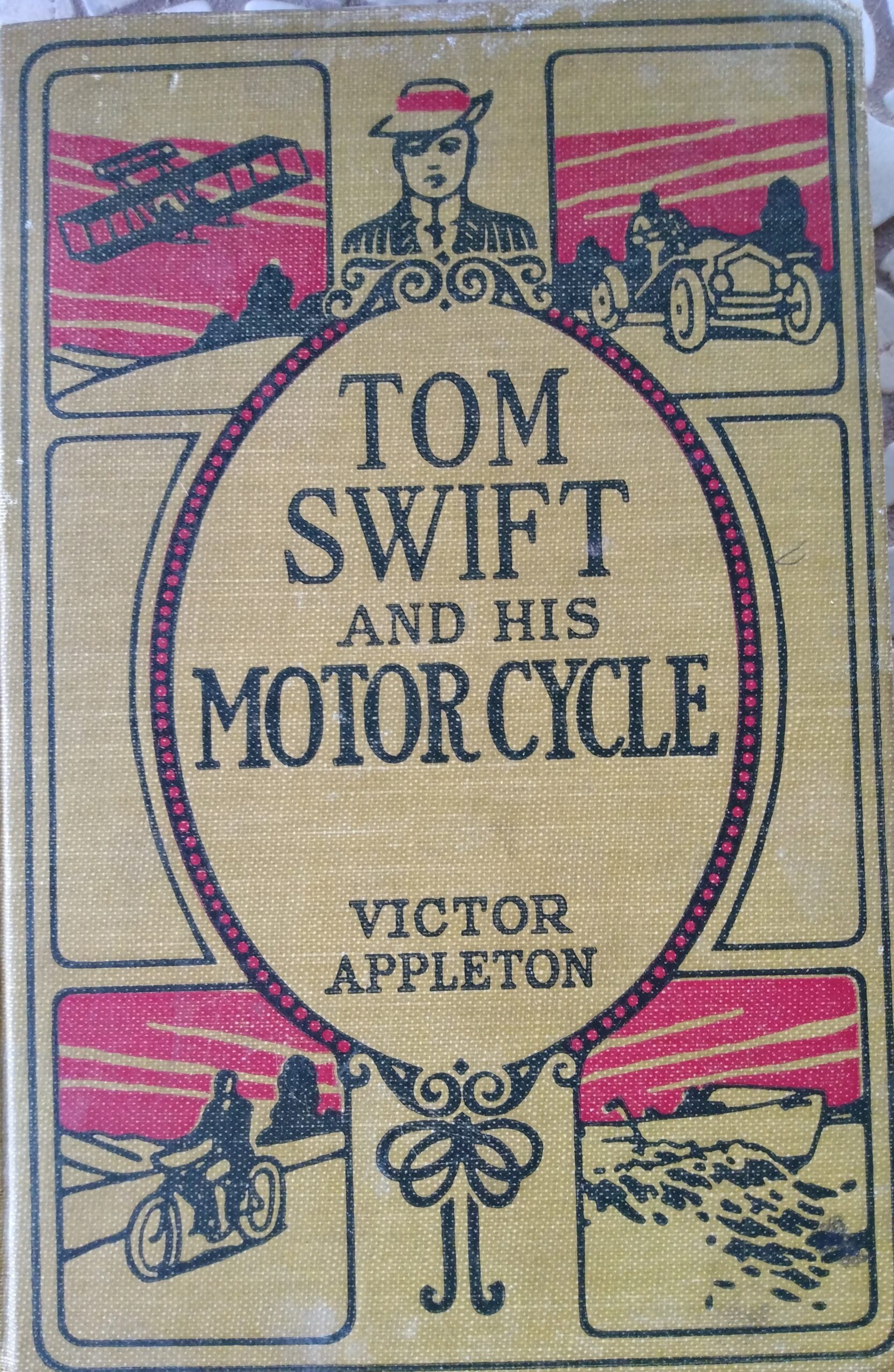
First book in the Tom Swift Sr. (first) series 1910-1941

The Senior Tom Swift

The 1960s-era Tom Swift series I loved followed an earlier series, published from 1910 to 1941. That first series of forty books showcased the father of Tom Swift, Jr. and his inventions and adventures. I’ve collected a few of them, but their racism makes them difficult to read now.

Tom Swift vs. Harry Potter

Not meaning to disparage the Harry Potter series, but I’d rank it a step below Tom Swift. You can’t become a wizard in real life, but you can become a scientist, inventor, or engineer. Yes, I understand Harry Potter inspires qualities besides magic, such real-life attributes as friendship, hard work, cleverness, and a willingness to confront and overcome evil. All of those virtues will serve Harry Potter fans well in their later working lives.

I also know, if I point out how unrealistic a magic academy is, you’ll counter with how unbelievable it is for an eighteen-year-old to be inventing the gadgets Tom Swift does. You’ll tell me how Tomasite plastic and Swiftonium nuclear material and “repelatrons” violate just as many laws of physics as Harry Potter’s magical conjuring does.

Still, Tom Swift inspires kids toward real lines of work, but Harry Potter doesn’t.

Tom Swift Reborn
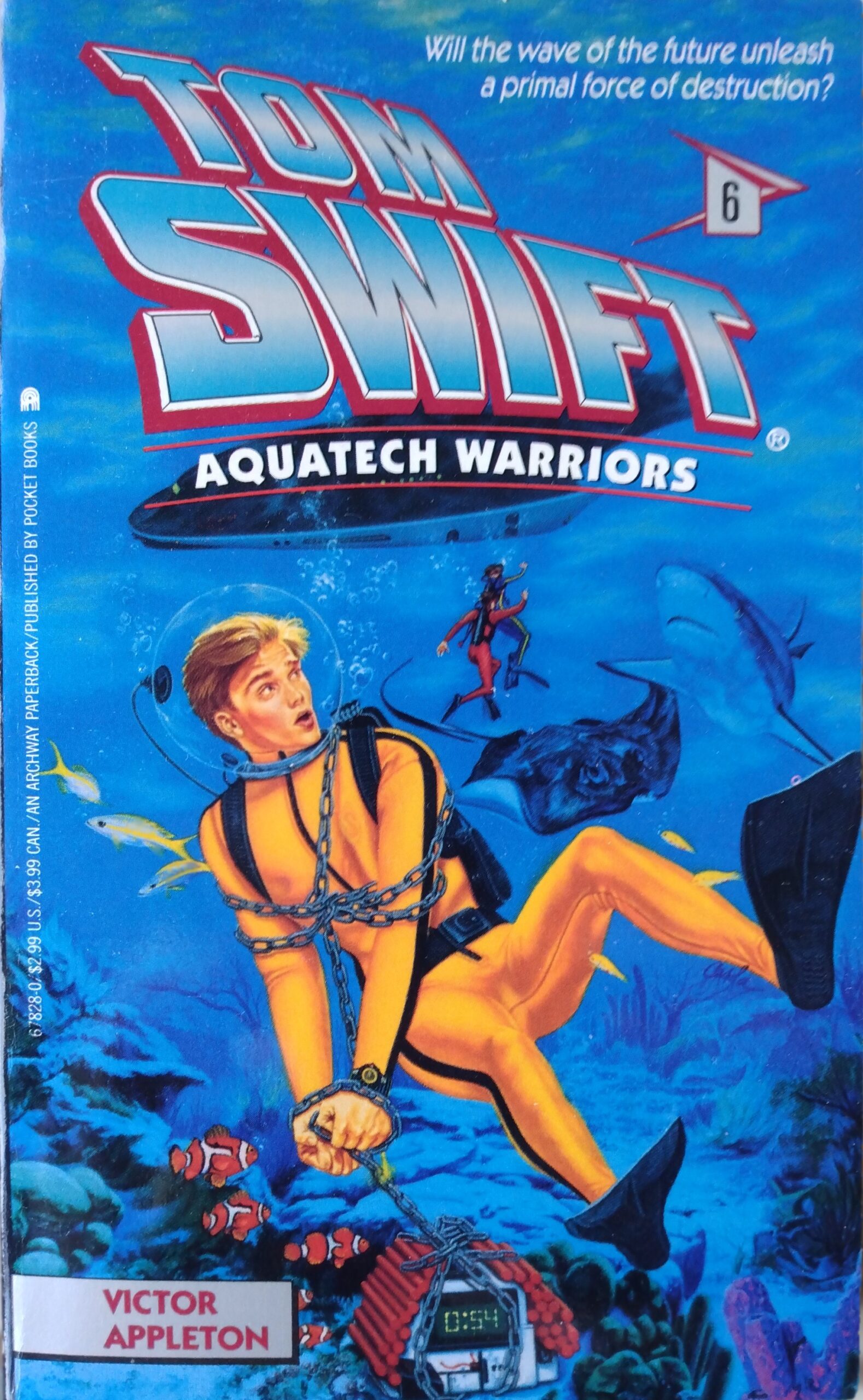
Sixth book in the fourth series 1991-1993
First book in the third series 1981-1984

Modern authors have updated Tom Swift for today’s young readers. I know of five such series:

  • 1981-1984, Tom Swift III series, 11 books
  • 1991-1993, Tom Swift IV series, 13 books
  • 2006-2007, Tom Swift, Young Inventor series, 6 books
  • 2019-2022, Tom Swift, Inventors’ Academy series, 8 books
  • 2018-2023, Tom Swift Lives! series, by Scott Dickerson, 50 books

I hope one or more of these series gains in popularity and serves to steer many children toward science and engineering.

Past attempts to bring Tom Swift to the screen in movies or TV series have all failed. Perhaps with good screenwriting, realistic computer graphics to depict the inventions, and a strong focus on the target audience, a Tom Swift show could succeed.

Two to three decades ago, when society lamented how few women graduated in male-dominated fields, I considered writing a series of YA books about a female version of Tom Swift. I never wrote that, but now, women hold their own in most fields. You go, girls!

Perhaps someone could write YA novels featuring twins—a boy and a girl—working together on amazing inventions, and experiencing perilous adventures.

I offer that idea for free—go crazy with it. The world would have to wait a long time for those books to get written by—

Poseidon’s Scribe
Where to Get Your Best Story Prompts

What inspires you to write your stories? A picture, a song, an idea, a TV show, a movie, an article you read, an event in your life or someone else’s?

Perhaps you’ve drawn inspiration from varied sources. You may be wondering which of these sources resulted in your best stories. If you knew that answer, you could dip your mental bucket into that well more often. There’s a way to find out.

First, look over your collection of stories. Rate them in order from best to worst. Now list the source that inspired each story beside the appropriate title in your list. Does a single source dominate the top of your list? That should be your go-to source for inspiration.

I surveyed my 31 published short stories. Here is the breakdown of the inspiration sources: anthologies—10, historical research—10, critique group discussion—4, movies—2, book—1, TV show—1, song lyrics—1, family—1, and SF convention—1.

After rating my stories from best to worst using the pair-wise comparison method (a painful task, since I love them all), I found 6 of the top 10 owe their genesis to calls for submission to anthologies. That is, an anthology publisher put out a call for submission, the subject intrigued me, and I wrote a story. Of my 10 worst stories, no single prompt dominated that list.

I’d be tempted to conclude that anthologies spark my best stories, and, if so, I’d be advised to continue to look for those possibilities.

However, I’m trying to grow as a writer. Neither my current work in progress nor any of my recently written, unpublished stories found inspiration from anthologies.

If you try this exercise, perhaps the results will turn out differently for you and prove more useful to your writing. For me, I’ve decided to remain open to all sources of inspiration. When my muse nags me about an idea, I’ll listen to her and write that story, no matter what prompted it.

Who knows what source will inspire your next story? It could be anything. The world is full of ideas, plenty enough for you, and for—

Poseidon’s Scribe

Was 20,000 Leagues Inspired by a Woman?

Did one of Jules Verne’s female fans inspire history’s most famous undersea adventure novel, a work that includes not a single female character?

First, readers of my posts will note I’ve been writing a lot about 20,000 Leagues Under the Sea lately. That’s because I’ve teamed up with editor par excellence Kelly A. Harmon of Pole to Pole Publishing to develop 20,000 Leagues Remembered, an anthology filled with short stories paying tribute to Verne’s submarine masterpiece. It’s scheduled to launch on June 20, 2020, the sesquicentennial of the famous novel. Write your own story now, and submit to this site.

Let’s set the scene. It’s 1865, early in Jules Verne’s career. He has contracted with the famous editor Pierre-Jules Hetzel, and two of his novels have already achieved fame in Paris and across France: Five Weeks in a Balloon (1863) and Journey to the Center of the Earth (1864). Another novel, From the Earth to the Moon, will soon be released.

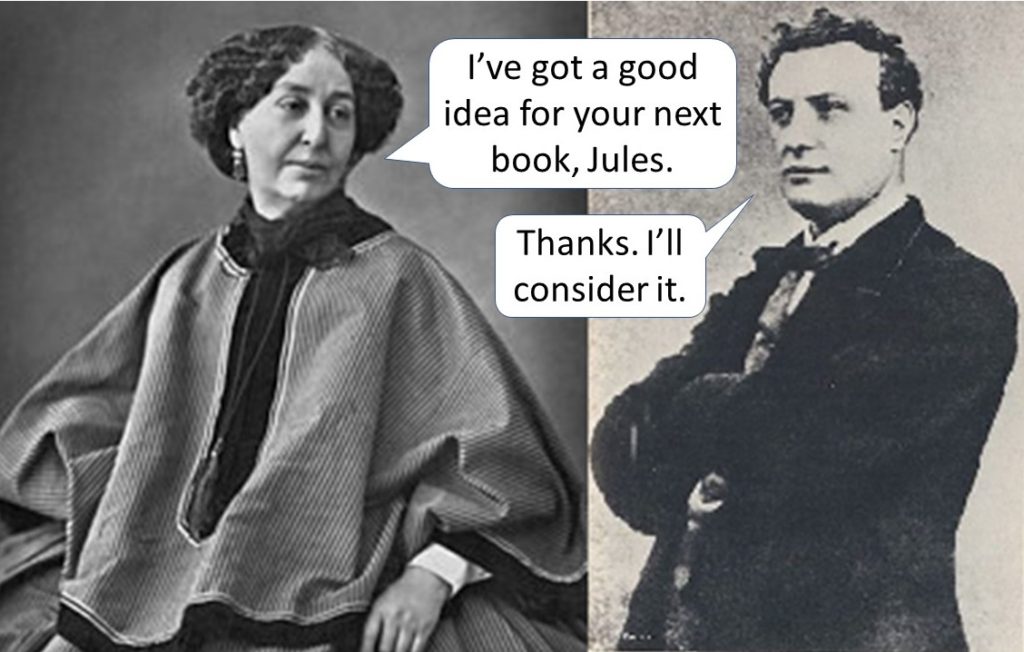
Sometime during that year, Verne receives a letter from a woman. After she praises both Five Weeks and Journey, she writes “Soon I hope you’ll take us into the ocean depths, your characters traveling in diving equipment perfected by your science and your imagination.”

Within a few years after that, Verne sails on the ship Great Eastern to visit America, and acquires his own sailboat, the Saint-Michel. Writing aboard his boat, he boasts to his publisher that he’s writing a new novel with an oceanic setting unlike anything written before. It will be “superb, yes superb!” By March 1869, the first chapters of 20,000 Leagues begin appearing in Hetzel’s magazine.

What can we conclude? Did Verne get the idea for 20,000 Leagues from a fan letter? Had she not written to him, would Verne have begun such a novel?

First, who was this mysterious woman? She was none other than George Sand, the pen name of Amantine Lucile Aurore Dupin. By 1865, Sand had achieved fame in her own right, having written numerous popular novels and plays. Her publisher was the same Pierre-Jules Hetzel who published Verne’s works. When she wrote to Verne, she would have been about 61, and he about 37.

No doubt Sand had noted Verne’s talent and observed the success of what would come to be known as Verne’s Voyages Extraordinaires. She had a keen sense of what would catch on with the French reading audience of the time.

So, was Sand’s letter truly the spark that led to Captain Nemo and the Nautilus? We may never know for sure. I’ve seen no evidence that Verne wrote back to Sand or admitted to anyone that the idea had originated with her.

We know, too, that Verne visited the Exposition Universelle (World’s Fair) in Paris in 1867 and saw a model of a primitive (and unsuccessful) submarine, Plongeur. He also saw demonstrations of electrical apparatus there. Could these exhibits have inspired 20,000 Leagues instead?

It’s impossible to say with any certainty whether George Sand provided the true impetus for Verne’s novel. It’s fun—and a bit ironic—to think she did, for there are only a few minor mentions of women in the novel.

Still, in case George Sand did inspire Verne to write 20,000 Leagues, she deserves this sincere thank-you, sent back through time, from—

Poseidon’s Scribe

October 27, 2019Permalink

Are All the Good Story Ideas Taken Already?

You’d like to write a story, but every time you think of an idea, you realize someone else wrote that one already. You figure all the good story ideas are used up. That’s it. There are no more. The last original novel has been written.

I don’t think so. New books, movies, and TV shows are coming out all the time.

no-story-ideasNo, you protest. Those aren’t new. They’re just rehashes or remakes of old ideas, with some new flair added. They’re just old stories brought into modern times, well-used story lines put in a new setting, or known plotlines with the main characters’ genders reversed.
If so, that’s great news for you. It means you don’t have to think of something completely original, either. If rehashes or slight twists work so well, then you can succeed with that method, too. That’s the message Melissa Donovan delivers very well in this post.

I think what you’re really telling me is, you’re stuck for an idea, and every time you think of one, you recognize you’d be copying what someone has already done.

There’s a particular genre you enjoy reading, and you consider yourself knowledgeable about that genre, and you’d like to see if you can write a story yourself. But you see that field as being well-plowed already. For every story idea, you immediately think of the existing, published story that used that idea.

You’re just in a mental rut, that’s all. It’s possible to climb back out.

Here are some suggestions for coming up with story ideas. These might work for you, or they might spark thoughts about other ways to accomplish the same thing:

  1. Do Internet or Twitter searches for trending key words. Combining seemingly unrelated key words might result in the nugget of a story idea. I’m convinced that’s how Kevin Eastman and Peter Laird came up with the idea for the Teenage Mutant Ninja Turtles.
  2. Search websites in your genre for words or thoughts that are trending. Those might suggest story ideas.
  3. Try the Suzanne Collins method. She came up with the idea for The Hunger Games while flipping TV channels. That turned out all right for her and might work for you.
  4. Pick two books at random off your shelf at home and see if you could combine the two in some way. If not, pick two other books.
  5. Try the generational/nostalgic method. Look for what was popular 25-30 years ago, and update it. First you have a new audience who wasn’t around when the original came out. Second, the older folks in your audience will appreciate the nostalgic trip down memory lane.
  6. Take a song you like (either instrumental or voice), and think of the story that might go along with that song.
  7. Take an interesting picture or image from anywhere (web, your own life, magazines, etc.) and think of the story behind that image.
  8. Take a favorite character from a book or movie, and consider what you enjoy about that character. What if that character was completely different in appearance? For example, if that beloved character was a handsome, young, athletic man, what if you wrote about an older, plump woman with the same abilities and faced with similar conflicts?

Your next story idea is out there. Be open and receptive, and let it find you. Oh, and be sure to send a comment thanking—

Poseidon’s Scribe

September 12, 2016Permalink

My Story Inspires More Antikythera Mechanism Research

These scientists and anthropologists must have read my story. Is there any other explanation?

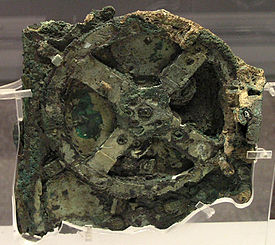
NAMA_Machine_d'Anticythère_1
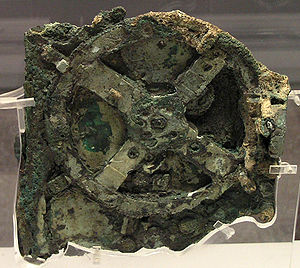
Antikythera Mechanism (from Wikipedia)

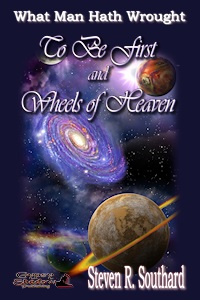
ToBeFirstWheels3fLet’s review the timeline. My story “Wheels of Heaven” was published two years ago, in June 2014. “Wheels” tells the story of the Antikythera Mechanism, that ancient Greek geared machine found in the seabed wreck of a Roman ship. Then in September of that year scientists mounted a diving expedition to see if they could find more pieces of the device. I blogged about that expedition.

Although the expedition did not uncover any additional gears, there’s been a new development, reported last week here, here, and here. With Computational Tomography (CT) imaging and Polynomial Texture Mapping, or PTM, they’ve discovered the Antikythera machine came with written instructions, a guide to its operation, an owner’s manual etched on its surfaces.

The newly translated 3500 characters of text refer to parts of the mechanism that weren’t recovered, such as a display of spheres representing the Sun and known planets. The text suggests the device wasn’t an astronomical research tool, nor an astrological prediction tool. Rather it was a teaching aid, an astronomy textbook of sorts.

Well, that would have been useful to know when I was writing “Wheels of Heaven.” In my tale, the machine has no display spheres, and no engraved text to read. The character in my story, Drusus Praesentius Viator, is an astrologer, and does use the machine to make horoscopic predictions. I based my story on the best understanding of the Antikythera Mechanism at the time.

Ah, well, science marches on, I suppose. Science Fiction writers are used to new discoveries rendering their stories obsolete. That phenomenon doesn’t happen as often to writers of alternate history, but it’s not unknown.

Of course, “Wheels of Heaven” is not obsolete. Scientists don’t know for sure that the ancients didn’t use the machine for astrological predictions. It would be a simple matter for me to update my story to include the text and display spheres.

AntikytheraMechanismSchematic-Freeth12
Gear Arrangement in the Antikythera Mechanism (from Wikipedia)

Further, I’m not accusing scientists of deliberately trying to undermine my story. They may well be motivated to find the truth about this mysterious artifact. After all, no one credited the Ancient Greeks with having any understanding of gears before finding this machine containing at least thirty meshing gears. Not just simple gears, either, but some are complex epicyclic gears.

Still, I’d like to think some of the anthropologists might have read, and been inspired by, “Wheels of Heaven.” Could my story have sparked some of the research? Who knows?

Maybe you’re a scientist who’s curious about ancient technology. Or maybe you just enjoy reading good stories. Either way, perhaps you, too, could be inspired by reading the works of—

Poseidon’s Scribe

Modernizing the Muses

What is the source of creativity? Why are some people creative, and others not as much? To those who aren’t, creative people can seem imbued with magical power, able to see beyond, and to make something out of nothing.

The ancient Greeks judged many such abilities to be god-given, and attributed creativity to the Muses. Later Greek mythology settled on their being nine of them, all goddesses, and all daughters of Zeus and Mnemosyne. Each was an expert in some field or group of related fields. Though a muse might inspire a certain level of skill in a mortal, woe be unto the mortal who dared to challenge a muse herself.

I’ve blogged several times (notably here, here, and here) about muses, since I’m interested in creativity and enjoy the idea of somehow making that mysterious attribute more tangible and understandable. In my own uncreative moments, when stumped for a story idea, I wonder if I’d be more creative if I had a muse figurine. If I stared at such a figurine, would the muse herself inspire me?

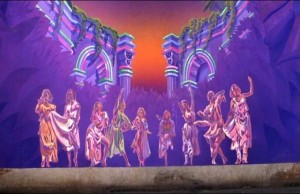
Xanadu MusesGuilty pleasure confession: I liked the 1980 movie Xanadu, especially the scene where the nine muses emerge from a wall mural, to the tune of the wonderfully exuberant song “I’m Alive,” by the Electric Light Orchestra.

For today, I thought I’d ponder the various fields mastered by the ancient muses, and see how we would update that and assign modern creative fields to 21st Century muses.

Here are the classical muse job assignments:

Muse Name Domain
Calliope Epic poetry
Clio History
Euterpe Music, Song, and Elegiac Poetry
Erato Lyric poetry
Melpomene Tragedy
Polyhymnia Hymns
Terpsichore Dance
Thalia Comedy
Urania Astronomy

Today, I’m not sure we’d count History or Astronomy as being such creative endeavors as to be each worth having their own muse. Also, I doubt we’d split poetry three ways. Note that prose fiction (my preferred field) is nowhere on the list.

Here’s my initial attempt to modernize the muses, taking into account the different and newer creative endeavors available today:

Muse Name

Domain

Alpha Literary arts (fiction, poetry)
Euphemia Performing arts (music, dance, choreography, theater, movies, singing, comedy)
Idola Visual arts (painting, sculpture, photography, architecture, interior design)
Mágeira Gastronomy / chef
Polycassandra Multimedia artistic works (comics, video games)

My list has only five, not nine. But even ancient accounts weren’t clear about the number of muses.

I stuck with the idea of giving them Grecian names (or feminized versions of Greek words). Alpha is, of course, the first letter. Euphemia means to speak or declare. Idola means vision. Mágeira is intended to refer to chefs and cooking. Polycassandra is intended to mean manifold helper.

Perhaps in a future blog post I’ll re-examine this list. I might be able to split up their duties in a way to better even out their workload. After all, Idola and Euphemia would be very busy, compared to Mágeira.

What do you think? Have I left out any creative fields of endeavor worthy of inclusion? Is there a better way to organize the assignments? In the task of modernizing the muses, it’s time for you to get creative and to out-do—

Poseidon’s Scribe

Recalling the Moment

When people ask, “how did you get the idea for that story?” it’s useful to be able to remember that exact instant when the lightning struck, when the light bulb glowed, when the muse whispered. For some of my stories, I can. For others, I have no idea.

People expect you to remember. They want to hear about the light bulb moment. After all, that’s a bit of a story in itself.

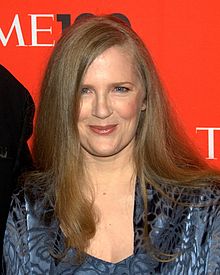
220px-Suzanne_Collins_David_Shankbone_2010Suzanne Collins, author of the Hunger Games series, has a great story for how she came up with the idea for the first book in the series. As reported here, she was channel-surfing between a reality show involving a competition among young people, and some news coverage of a war. The two TV shows blurred in her mind, and she came up with her book idea. She also claims that the Greek myth of Theseus and the Minotaur, which she read at age eight, became the inspiration for the plot.

This is often how it happens. Two or more ideas get merged in your mind, and they can be widely separated in time. Some of these ideas could be something half-remembered from childhood.

On occasion, an entire story coming to a writer in a flash, so that it becomes a race to get it written down before the memory degrades. Other authors refine and mature a basic idea over time before they are ready to write. Whichever method you use, it’s still a good thing to write down the initial idea right after the bulb illuminates, perhaps in a daily journal. That way you’ll be ready when people ask.

What’s that you’re thinking? You’re wondering how I got the ideas for some of my recent stories? How nice of you to ask.

A Clouded Affair” came from a clash of two ideas. I was in a dieselpunk mood, having never written in that subgenre. Then I saw the call for stories for an anthology titled Avast, Ye Airships! Clearly, they wanted steampunk. What to do? How about a battle between a steampunk pirate and a dieselpunk pirate?

For “Time’s Deformèd Hand,” I was responding to a planned anthology of Steampunk Shakespeare stories. I wanted a lighter tale, so I reviewed the Bard’s comedies, and selected “A Comedy of Errors.” Clockpunk seemed a better fit than steampunk, so I went with that. While my story didn’t get picked for the anthology, it found a happier home as part of my What Man Hath Wrought series.

The Cometeers” is one story whose genesis I don’t recall. For some reason, I must have been thinking about save-the-Earth-from-destruction plot lines, and thought about how I could set such a story in the steampunk era.

Here’s a sneaky notion, to wrap things up. Since you won’t always recall the “ah-ha moment” when a story idea occurred to you, and since your zillions of fans will demand to know how it actually happened, it’s probably okay in this instance to make up a story. After all, you’re a fiction writer—making up stories is what you do. Moreover, who would say your explanation is wrong? Certainly not—

Poseidon’s Scribe

How I Inspired an Expedition

According to news accounts here, here, and here, divers will use a special diving suit (called the Exosuit) to explore off the coast of Antikythera Island near Greece. The site is a debris field left by a Roman merchant ship estimated to have sunk around 60 B.C. in 200 feet of water.

300px-NAMA_Machine_d'Anticythère_1They’ll be looking for more pieces of “the world’s oldest computer.” It’s a geared calculating machine, discovered by divers in 1900. No one credited the ancient Greeks with much knowledge of gear technology, until the discovery of this machine.

The question you’re probably wondering is, why now? The mechanism has been known about for more than a century. Why are scientists and explorers suddenly interested in finding out if they are missing some parts of the machine, or if they already have extra pieces and there were two devices aboard the ship? What prompted this new expedition?

I might have had something to do with it.

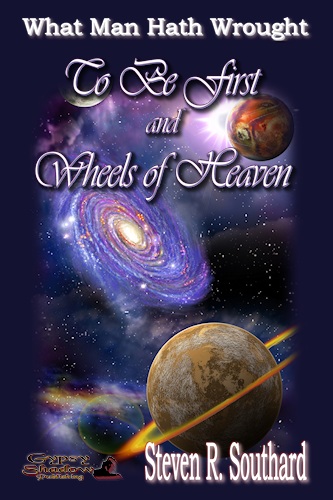
ToBeFirstWheels3fYou see, I wrote a story about the Antikythera Mechanism called “Wheels of Heaven,” and it just got published (by Gypsy Shadow Publishing) a couple of months ago. In my tale, I explain what the machine is and how it came to rest at the bottom of the Aegean Sea.

You’d have to agree this can’t be a coincidence. Obviously someone read my story and got to thinking, “I wonder if he’s right? Is that how it happened?”

No one associated with the expedition is likely to admit it, of course. They might even deny it if asked. After all, no scientist wants to confess to being inspired by a mere fictional short story.

But we know the truth, don’t we? The connection is too strong to ignore. They can refute it all they want.

At this point you’re probably curious what the fuss is all about. You can purchase “Wheels of Heaven” along with another story “To Be First” here, here, here, and other places too. Sail along on the ship Prospectus with the Roman astrologer Drusus Praesentius Viator, and a common sailor from Crete named Abrax as they argue over whether the machine can tell the future.

Once again we see mysterious parallels between the breaking news of today’s world and the worlds depicted in my stories. A few weeks ago, I told you about the upcoming landing on a comet, an event similar to the one in my story “The Cometeers.”

The question we must ask, then, is which will be the next story of mine to have some strong link to the news headlines? Which of my other books of alternate history will prompt the next scientist, explorer, or engineer to undertake a grand investigative effort? You can offer your own answer to this question by leaving a comment to this blog post.

Strange how this keeps happening, isn’t it? If you want to know the science and technology news of tomorrow, simply to turn to the works of—

Poseidon’s Scribe

September 21, 2014Permalink

The Story behind “The Cometeers”

As I mentioned in my News page, Gypsy Shadow Publishing has accepted my story, “The Cometeers” which will be published as part of the What Man Hath Wrought series. The intended launch date is in early September.

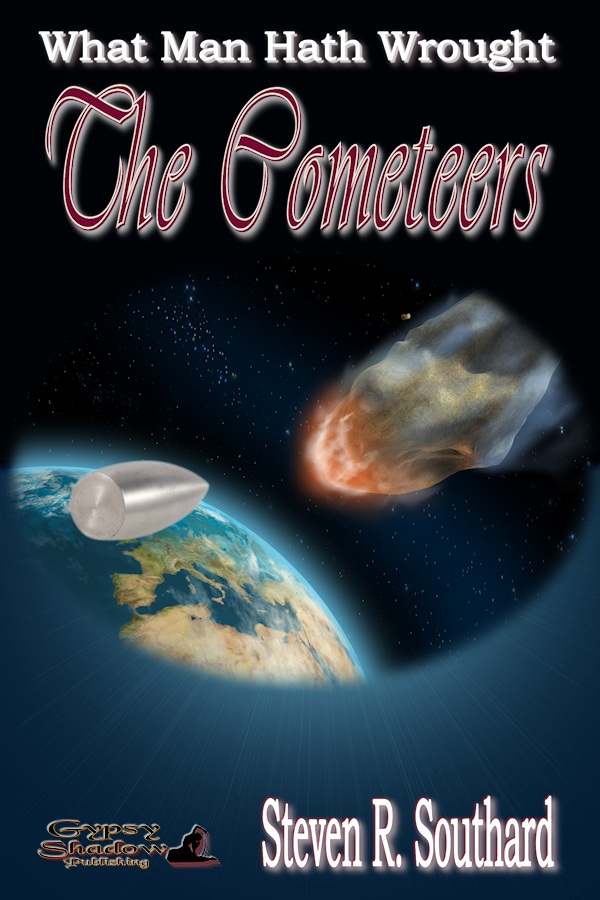
TheCometeers72dpiHere’s the marvelous cover, designed by Charlotte Holley.  Yes, that’s a planet-destroying comet headed right toward the Earth.  But if you look closer, you’ll see an silvery man-made projectile on an intercept course.  Just possibly, its occupants might save the entire world.

Inquiries have been streaming in from every corner of the planet (and from some of the comets), asking what this story is about. Far be it from me to deny my fans information about my latest tale.

Here’s the book blurb: A huge comet speeds toward a devastating collision with the Earth, but no one will launch space shuttles filled with nuclear weapons. It’s 1897. Instead they’ll fire projectiles from the Jules Verne cannon and try to deflect the comet with a gunpowder explosion. Commander Hanno Knighthead isn’t sure he can motivate his argumentative, multinational crew of geniuses to work together. It turns out one of them is a saboteur. Then things get worse. Only a truly extraordinary leader could get this group to cooperate, thwart the saboteur, and jury-rig a way to divert the comet. Lucky thing Hanno brought his chewing gum.

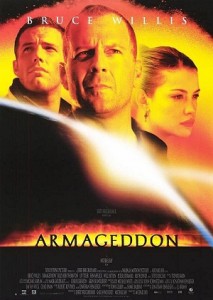
Armageddon-poster 1998If you recall the 1998 movie “Armageddon,” then you can think of my story as Steampunk Armageddon.

I don’t recall the exact inspiration for this story. As stated in this post, and this one, I use the “seed and twist” method of coming up with story ideas. In this case the seed is the standard save-Earth-from-destruction idea, and the twist is to set the action in Victorian times.

My problem became one of technology. They just didn’t have sufficient know-how in the Nineteenth Century to divert or destroy a comet. It’s an open question whether we really have the technology today.

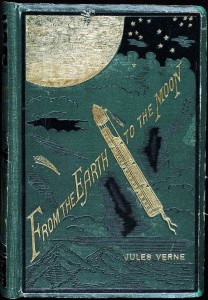
640px-From_the_Earth_to_the_Moon_Jules_VerneTherefore, I assumed the world of Jules Verne’s novel From the Earth to the Moon.  In that world, men had already achieved space travel in 1867. With funds from many nations, the Baltimore Gun Club had built a 900 foot long cannon outside Tampa, Florida, and launched a projectile containing three men.

My story is set thirty years later and no one has used the cannon since, due to the enormous expense. With a giant comet on the way, however, something must be done, so every country contributes what it can.

You can’t simply launch projectiles full of gunpowder at the comet and expect to hit it. The target is too small, the distance too great, and the calculations too imprecise. You must send men up also, in separate projectiles, to travel with your gunpowder bombs to make the necessary course corrections along the way.

That plan should work.

Unless something goes wrong.

“The Cometeers” will launch in September. For further updates, keep visiting this blog and reading the posts by—

Poseidon’s Scribe

The Story Behind “To Be First”

ToBeFirstWheels5As the launch date for “To Be First” and “Wheels of Heaven” nears (this Tuesday, July 1st), and excitement builds, I think it’s time for me to reveal the story behind “To Be First.”

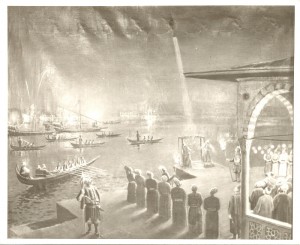
A few years ago, I watched an episode of the TV show Mythbusters where they replicated a feat supposedly performed by Lagâri Hasan Çelebi in the Ottoman Empire in 1633. Çelebi is said to have constructed a rocket chair, launched himself into the air, and flown down safely using a wing-like apparatus. The event was intended to commemorate and honor the birth of the Sultan’s daughter.

The Mythbusters team considered the myth busted, but it got me to thinking. What if such a marvelous flight had taken place? What if the Sultan had understood the geopolitical and military implications?

LagariThink of it. Manned rocket flight in the 17th Century. Defensive city walls and high castle walls would mean nothing to a country with armed rocket-men. Rather than expanding and then beginning its slow decline to finally die with the end of World War I, the Ottoman Empire might have spread much more quickly and farther.

Had the Ottomans also embraced the science behind rocketry, they might have hastened other technical achievements, and been the source of those advancements rather than watching America and the rest of Europe prosper.

It seemed like an interesting basis for an alternate history tale, so I wrote one. In my version, it’s 1933, three centuries after Çelebi’s flight, and two Ottoman astronauts (called lunanauts) are returning from the first manned flight to the Moon. Yes, I said 1933, not 1969.

Nuruosmaniye_MosqueI imagined their space capsule being about the same size as the Apollo capsule, but dome-shaped with a central spike like the roof of an Ottoman mosque.  The capsule would have a couple of windows and there would be some of that beautiful, flowing Ottoman Turkish writing on the outside.

As the story commences, the lunanauts encounter a strange ionic storm in space, and their capsule passes into an alternate universe. The tale takes off from there.

My central characters, Yazid and Kemal, hold differing views on what it means to be an explorer. What are the motivations behind those who roam beyond all prior journeys, who probe far into unknown regions? Do they do it for the money? For fame? For love? Or is it something simpler?

If you read my story, perhaps you’ll be motivated to become an explorer, and you’ll write your own gripping story of heroic and fantastic adventure. You, too, can manage ‘To Be First.’ At least, so says—

Poseidon’s Scribe