Most fiction writers refer to weather in their books. Average writers use it to complete a scene description, to paint a complete tableau. Better writers give weather reports that pair with the action or mood of a scene, or foretell an upcoming scene. The best writers do both of those, but do them with style, enabling the reader to experience commonplace weather, even a clear blue sky, as if seeing it for the first time.
Inspiration
Dr. Peter Schulman, of Old Dominion University, inspired this blogpost. He spoke on the topic of “The Poetry of Weather in Jules Verne” at a recent meeting of the North American Jules Verne Society. That talk got me thinking about weather as a tool for all fiction writers.
Universality
All humanity experiences weather. We all enjoy it, suffer from it, marvel at it, endure it, etc. When an author discusses weather—on Earth or on any planet with an atmosphere—readers relate. We see it and feel it with the characters. No matter how strange the characters, how bizarre their actions, how weird their motivations, how bewildering their speech, readers understand the weather when the author describes it. Weather unites us all. It ties together all humans in all places at all times in history.
Variety
Imagine a painter’s palette with infinite dabs of color available, or a workman’s kit containing an infinite number and type of tools. In a similar way, weather provides an unending spectrum of phenomena for writers to employ. No need for me to belabor the point, since every day of your life confirms the fact. In simplistic terms, the sun, clouds, rain, snow, fog, lightning, and wind all hint at the innumerable combinations available to writers.
Style
How do great authors use weather? What separates them from the common crowd? We all know and recognize common tropes—a journey starts at dawn with a clear sky, fierce storms occur later with thunder cracking to punctuate a key line of dialogue, and the hero rides off into the sunset at the end.
The best writers use these techniques too, but with greater flair and nuance. Their prose puts us in the scene. The sound and cadence of the words and clauses mimics the weather being described. We feel the weather along with the Point of View character. Weather matches a character’s mood, or the scene’s mood, or contrasts with them to make a larger point. Perhaps the character feels one way and the sky is sending a hint of how the character should feel. A master writer uses just enough words, and no more, to convey all this, in a way that doesn’t interrupt the flow of the plot.
Taming Weather
“Everyone complains about the weather,” Charles Dudley Warner once quipped, “but nobody does anything about it.” Here’s a deeper meaning behind his joke—writers do something about it. Writers control the weather in their stories, blowing wind like Aeolus, hurling lightning bolts like Zeus. If you hope to write well, implement my guidance in the Style section above.
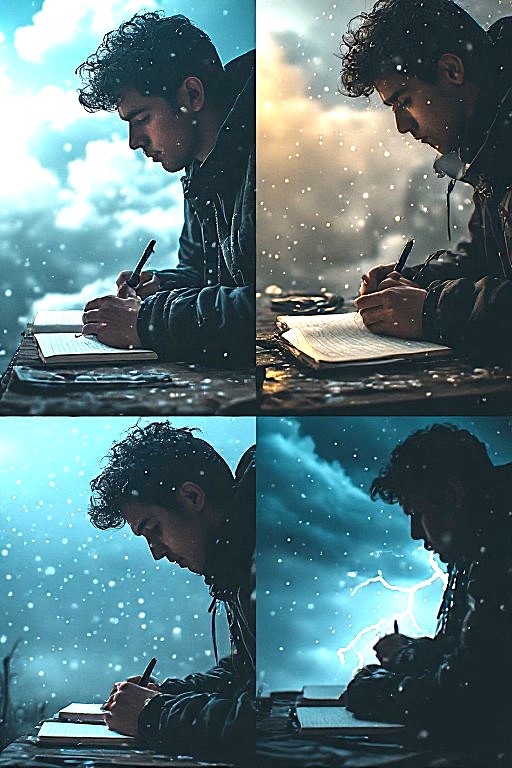
Also, take some time to log the weather yourself. Write descriptions of extreme and commonplace weather as you find it, or from others’ pictures and videos. Go beyond a bare accounting. In your journal, convey the impressions on all your senses and all the emotions the weather evoked. Armed with these passages, you can use them to enhance your stories, to serve purposes in your plots, and to reflect some truth about your characters.
As the crimson orb kisses the distant horizon, dragging narrow clouds of fuchsia, lavender, and violet along with it, a singular silhouetted figure rides into the sunset of this blogpost. Who could it be? Of course, it’s—
Poseidon’s Scribe


