You Bored Your Reader—Here’s How to Prevent That

As a writer, you can’t afford to bore readers. Modern technology has dwindled their attention spans to a few seconds before they hit Delete. I’ll give you some techniques for writing stories that capture and sustain attention.

Image generated at Perchance.org

The Problem

We live in a fast-paced age. Busier than ever, your readers get blasted every day with an information fire-hose, spewing mostly useless noise. What doesn’t attract attention gets deleted or remains unclicked.

The book you’re writing will vie for reader eyeball time against many competitors—other author’s books, TV shows, movies, Facebook, X, Instagram, Tiktok, etc. Readers abhor boredom. They’ve no time to read dull prose. If the story’s first paragraph doesn’t trigger a dopamine hit, readers won’t continue.

Anti-Boredom Techniques

I drew inspiration for today’s topic from this post by Sabyasachi Roy. I’ll list his techniques, put into my words.

  • Learn from other’s successes. Consider techniques proven to work. Sabyasachi Roy suggests you analyze what it is about certain Facebook or X posts, or Netflix series, that grab attention and tell a story too irresistible to ignore.
  • Seize interest from the start. Your opening sentence and paragraph must compel the reader to read on. Spend time crafting and re-writing this hook, since it serves multiple purposes.
  • Use the high-low-high-low technique. As the story goes, alternate high-tension moments with low-tension moments.
  • Understand high-tension moments. High-tension needn’t mean a fist fight, a car crash, or an explosion. It means putting your protagonist under high emotional strain. Use short sentences and short paragraphs here to hasten the pace.
  • Use low-tension moments to let characters and readers catch a breath. Don’t put them to sleep, though. Pack these moments with meaning—thoughts and emotions that suggest the themes of your story. Allow the characters time to react to what just happened, and to wonder—or dread—what will happen next.
  • Add surprises and twists. Disrupt the reader’s notions of where the story is going.
  • Start with high stakes for the character. Then raise them. What bad thing will occur if the character fails? Lost love? Poverty? Diminished social status? Death? If possible, make the consequences more dire as the story proceeds.
  • Leave your character hanging from a metaphorical (or actual) cliff at each chapter’s end. Cliffhangers deny readers the chance to end their reading session there.
  • Kill darlings. When re-writing, cut all unnecessary words, sentences, paragraphs, scenes, and chapters. Delete or condense the parts that bore you, since they’ll also bore readers.

Your Book

I hear you. You’re telling me your book doesn’t belong in the thriller genre. It’s a slow-paced, thoughtful book, a deeply philosophical tome meant to be savored, not sped through on the way to something else.

Even so, you don’t want to bore readers. Some of the above techniques may still apply to your book. It still needs to pass the “So What?” Test.

As Lincoln said, “You can bore all of the people some of the time…” Wait. That wasn’t Lincoln. That was—

Poseidon’s Scribe
Select Your POV Character in 6 (or 7) Steps

You’re planning to write a story, but you don’t know whose point of view (POV) to tell it in. Author K.M. Weiland wrote a wonderful post on the subject, and I suggest you start there. I’ll wait here while you read that. The rest of my post supplements hers.

Credit to www.perchance.org for the images

List the Contenders

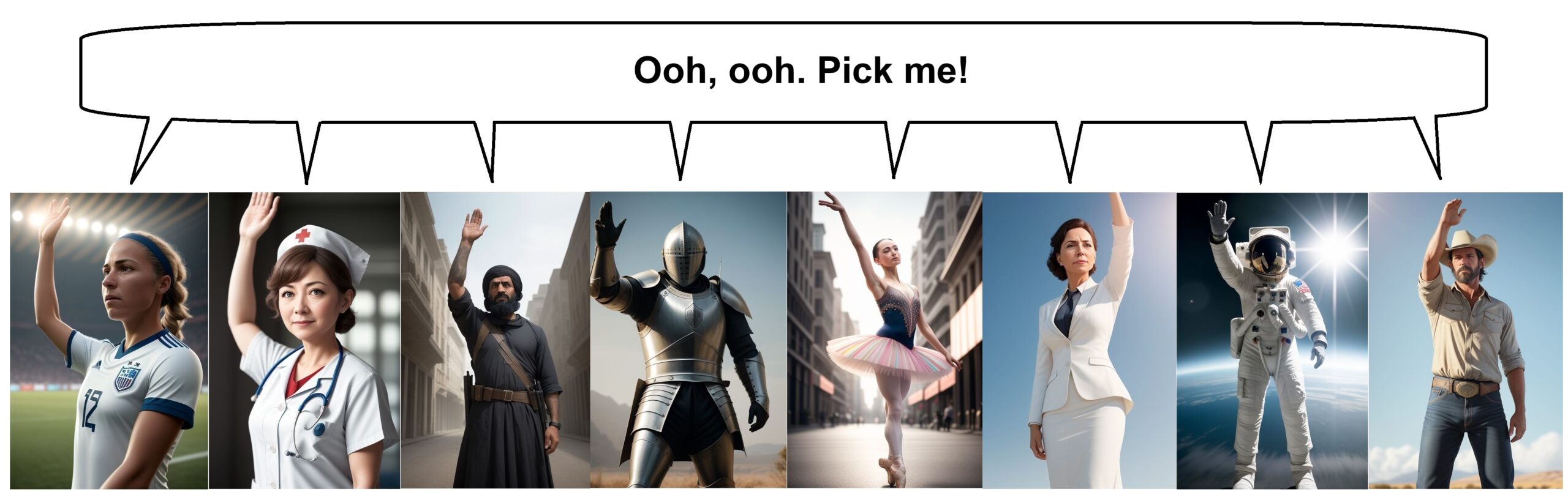
Weiland’s 6-step process starts with identifying the contenders. You could choose any character in your story, or even select an omniscient, god-like POV.

Winnow Down the List

Next, Weiland suggests you think about which contenders matter least to the story’s drama. For example, a servant or guard who rarely speaks and whom you’ve only included for authenticity—a ‘spear carrier’ in literary lingo—makes a less useful POV character.

Rate the Stakes

In the next step, you consider each character’s stakes. What do they lose if they don’t get what they want? You’ll get more dramatic impact from characters with the most to lose.

What Type of Narration?

Choose from among first person (I/me), second person (you), third person (she/he), and omniscient (god-like). I’ve written about these before.

Pitch Your Tense

Most writers chose past or present. In past tense, she ran, she sat, she said. In present tense, she runs, she sits, she says. More stories use past tense, but you may choose either one.

Final Auditions

After going through the above steps, you might still face a choice between more than one possible POV character. Weiland suggests you write a few paragraphs of the story in each of the remaining contenders’ POVs. They don’t know it, but they’re auditioning for the POV role. Choose the one with the most interesting voice, the one who tells your story best.

One More Consideration

The post by K.M. Weiland addresses all the above points better than I have, but I’ll add another thought. Nothing limits you to one POV for an entire story (though in flash fiction, you should restrict yourself to one).

You might choose a different POV for each chapter, or even each scene. As you do so, use the same six-step process mentioned above in selecting the appropriate character.

Also, make transitions between POV characters clear to the reader. In the first sentence of a section with a new POV character, include a thought, or a feeling, or both, from that character. That alerts the reader about the POV shift.

Of course, throughout the literary world, experts agree the very best point of view is that of—

Poseidon’s Scribe

October 27, 2024Permalink

Raise the Stakes!

Does the current draft of your story seem uninteresting? Do you have to wake up your Beta readers after they get through the first page? Perhaps the stakes aren’t high enough.

Earlier this week, I attended an excellent Zoom talk by author Amber Royer called ‘Giving Everyone a Stake in the Story.’ That talk inspired this blogpost, but, as usual, I’m putting her presentation into my own words.

No, not even spelled right
Yes, a stake, but not the kind we mean

What, exactly, is a ‘stake?’ As a noun it has two meanings, the first being a stick or post driven into the ground, but we’re interested in the second meaning. One theory suggests that people in medieval Europe would wager on events (jousts or other contests) by placing bets on wooden posts—stakes. Over time, they referred to the bets themselves as ‘stakes.’

A stake, then, is the thing being risked, the thing that could be won or lost depending on an outcome of a future event.

What do the key characters in your story have at stake? If they aren’t taking some risk with a chance to win or lose something, your readers won’t care about them.

To have a stake, the characters must want something. The more important that thing is and the more they want it, the more interesting your characters will be. Stakes are tied up with motivations.

The thing your character wants could be tangible, like a physical object, or a job promotion; or it could be intangible, like love, status, or respect. Maybe it’s not something they want, but something they want to avoid, like humiliation, defeat, loss of self-respect, injury, death, etc.

Once you decide what your characters have at stake, think about how far they’re willing to go to get what they want, or avoid what they don’t want. Would your characters give up money, time, their reputation, their honor, a friendship, their life?

Stakes aren’t just for protagonists. Your antagonist needs a stake, too. Consider thinking about this even before developing your protagonist. What does your ‘bad guy’ want, and how far is she willing to go to get it?

Your story might also include a ‘Stakes Character.” This character personifies and represents what’s at stake for your protagonist. Often both the protagonist and antagonist strive for the Stakes Character, or want what that character has, but they use different means.

For example, in the movie Mary Poppins, George Banks is the protagonist. Mary Poppins is the antagonist, and the children, Jane and Michael, are the Stakes Characters. George thinks his career as a banker is what’s at stake, but really, it’s his role as a father. Mary opposes his focus on his career and works to make him realize being a good father is far more important. Seen in that way, they’re both fighting for the children.

Even your minor characters will have stakes. However, don’t let them steal the show away from the main protagonist/antagonist conflict.

How do you find out what’s at stake for your characters? Ask them. (Well, not out loud if you’re in public—that would seem weird.) Ask tough, deep questions. Think about their answers and let those deep, personal confessions influence how you write about those characters in the story.

Amber Royer credits editor Donald Maas with categorizing stakes as Personal, Public, or Ultimate. Personal stakes are inside, usually unknown to the world. Public stakes are known and often shared. If the protagonist fails, more than that one character would be affected. Ultimate stakes are the really deep ones underlying all other motivations. They’re at the end of the ‘why?’ chain of questions. They’re the ones you’d give your life for. A single character can have one, two, or all three types.

If your story is tedious or dull, or the characters seem flat and lifeless, raise the stakes! Give them something more to win or lose. Make them willing to risk more. If that doesn’t work, ask yourself how you’d write your story if you were more like—

Poseidon’s Scribe