As humans, we can make up stories about anything. Take stars, for instance.
Sky Patterns
Put yourself in the place of your prehistoric ancestors. To them, the stars looked distant, mysterious, and chaotically random. In trying to make sense of it all, they noticed patterns in the chaos, as we do with clouds and other random displays. However, the star patterns recurred, night after night. Unlike many things on Earth, the star patterns persisted, unchanged.
These reliable, repeating sky pictures demonstrated seasonal changes—never in shape, but only in their position in the sky. As they drifted with the seasons, the shapes, or constellations, became associated with seasonal human activities—planting, harvesting, hunting, etc. Over centuries and millennia, our ancestors passed down not only knowledge of the constellations and their relevance to human activities, but also stories to aid in remembering it all. As civilizations grew more complex, so did the stories.
Pleiades


Something about the Pleiades star cluster attracted the notice of multiple ancient civilizations, including the Celts, the Maori, the Achaemenid Empire, the Arabs, the Chinese, the Quechua, the Mayans, the Aztec, the Sioux, the Kiowa, the Cherokee, and the ancient Hindus. The Greeks named the cluster the Pleiades, meaning “to sail,” as the sailing season coincided with its appearance. Later they referred to the cluster as the Seven Sisters. The Japanese called the group “subaru,” meaning “to cluster together.” We see it stylized today on a familiar automobile company logo.
The Greeks
Many constellation stories come to us from the ancient Greeks. Often, in their tales, a deity from their pantheon of gods would honor (or punish) some person or animal by placing them in the heavens. Aphrodite and Eros fled from a monster by transforming into a pair of fish we know as Pisces.
A prince of Troy named Ganymede attracted the eye of Zeus, who made him the cup-bearer on Mount Olympus. We know that one as Aquarius.
When Perseus slayed a sea-monster, the monster became the constellation Cetus.
Reckless driving inspired the meandering constellation of Eridanus. One day, Phaethon took over the task of driving the sky-chariot from his father, the sun-god Helios. Unable to steer it, Phaethon lost control and burned great chunks of the Earth. Zeus struck him dead, and the winding constellation represents the crooked path he took.
Constellations Today
Since the advent of telescopes, we’ve learned what stars are, and we no longer believe gods arranged them in pictures we’d recognize. However, astronomers still use constellations as handy references for naming stars, as well as for locating galaxies and other cosmic phenomena.
SoonerCon
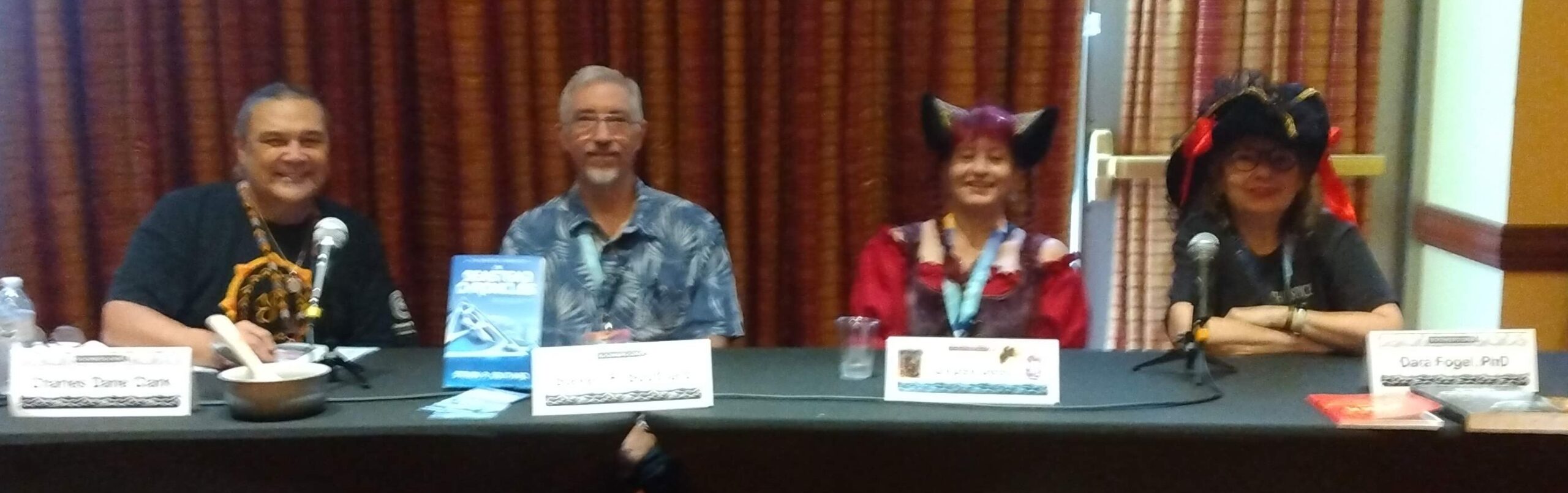
Last month—along with Charles Dane Clark, Gypsy Jess, and Dr. Dara Fogel—I spoke on a panel at SoonerCon titled, “Stars and the Sea: Constellations in Myths and Legend.” That experience inspired this blogpost.
Wheels of Heaven
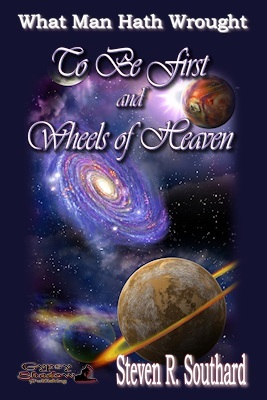
I can’t resist mentioning a story I wrote, since it pertains to this topic. In “Wheels of Heaven,” an arrogant Roman astrologer finds the Greek Antikythera Mechanism. He uses it to determine the positions of celestial bodies, speeding up his process of making astrological predictions. On the voyage back to Rome, he meets a sailor who dismisses astrology. When the sailor’s prediction is right, and every one of the astrologer’s is wrong, he must question his most basic beliefs. At present, the book remains unavailable while the publisher updates their website.
Bunk and Hokum
As I said, few people today believe the constellations of the zodiac have any control or influence over our lives. The fault, dear reader, is not in our stars, and I can prove it. I was born under the constellation Aquarius. As everyone knows, no linkage exists between water or water-bearing and—
Poseidon’s Scribe