On a recent trip to Scotland, I saw a monument glorifying the writer Sir Walter Scott. That got me thinking about, and researching, monuments to writers in general. In this post, I’ll examine the ones I found most interesting.
By “interesting,” I mean something other than a statue or bust on a pedestal. Those who commission, design, and build monuments to authors honor them in a wonderful way, so I don’t mean to disparage the statue-on-a-pedestal design. Most author monuments fall into that category, though, so I’m posting about the less common types.
I’ve put my list in order of monument completion date, earliest to latest.
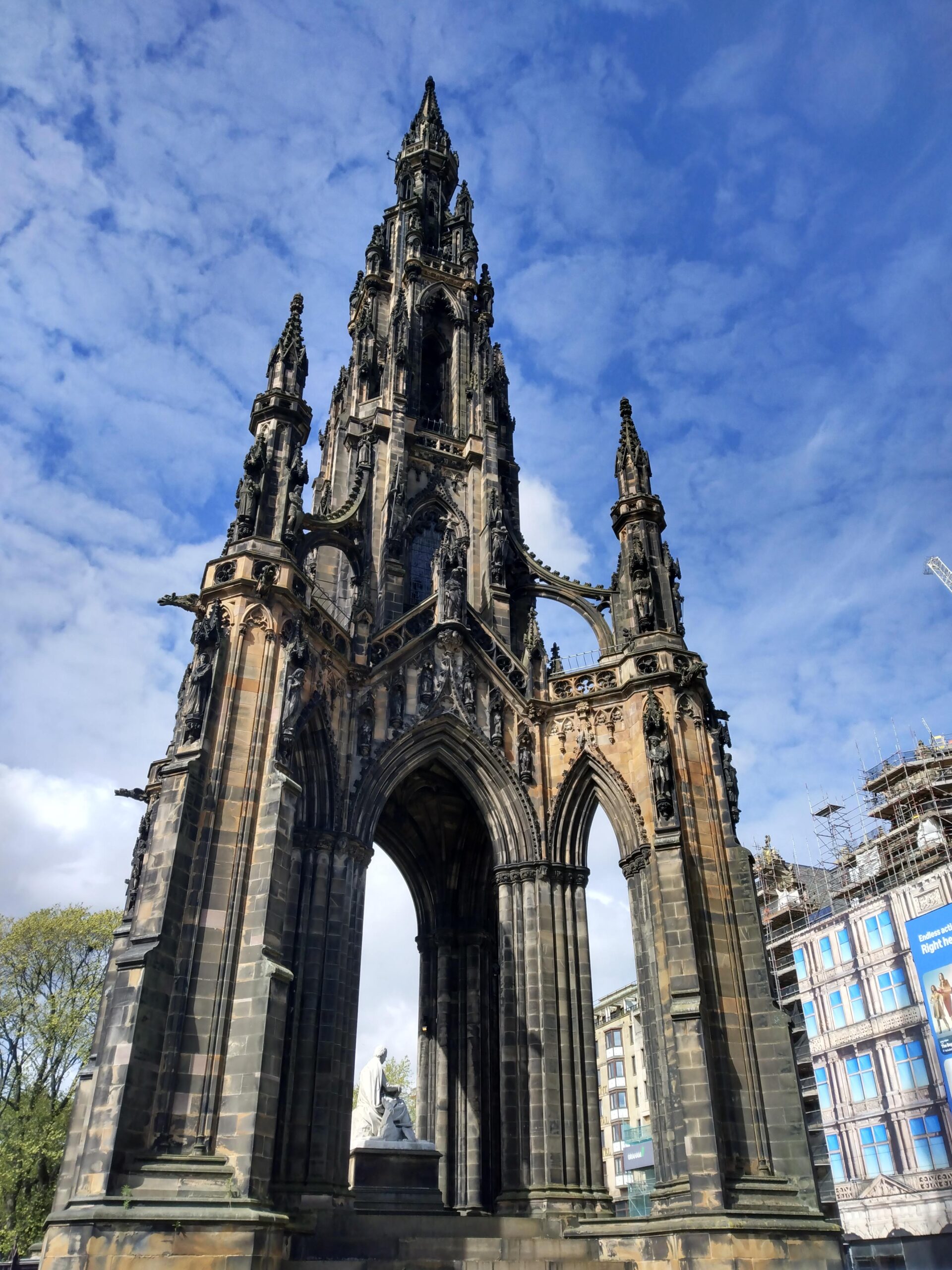
Scott Monument
Finished in 1846 in Edinburgh, Scotland, this giant monument stands 200 feet tall—second tallest of all monuments to authors (for the tallest, see José Martí below). Spiral staircases allow access up to platforms with commanding views views of the city. George Meikle Kemp designed the monument and John Steell designed the statue of Scott (along with his dog) between the pillars. The monument includes depictions of sixty-four characters from Scott’s novels.
The Scottish people take great pride in Sir Walter Scott (1771-1832), both for his poetry, including “The Lady of the Lake” and for his historical, romantic novels, including Waverley and Ivanhoe.
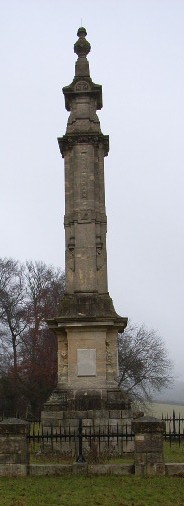
D’Israeli monument
In Buckinghamshire, England stands this fifty-foot monument to writer Isaac D’Israeli. The top may look like a statue, but it’s an urn. Raised panels with inscriptions and a profile portrait of the author decorate the pedestal. Designed by Edward Buckton Lamb, the monument had been commissioned in secret by D’Israeli’s daughter-in-law Mary Anne Disraeli as a surprise for her husband, Benjamin Disraeli, then Chancellor of the Exchequer. Later he became Prime Minister.
Isaac D’Israeli (1766-1848) wrote romantic novels and essays, but is most famous for Calamities of Authors and Curiosities of Literature.
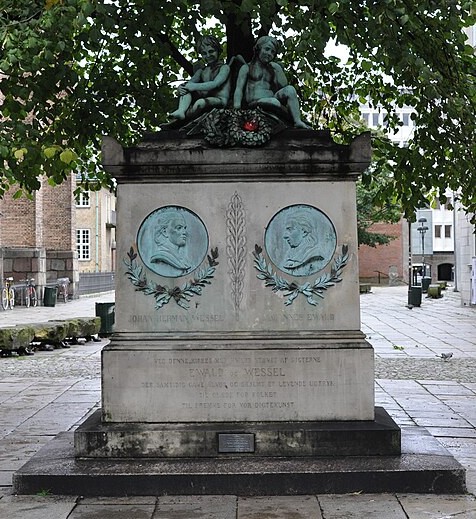
Johannes Ewald and Johan Hermann Wessel Memorial
The only monument on my list honoring two writers, it stands ten feet tall. Located in Copenhagen, Denmark and completed in 1879, it features two nude, winged boys, one with lyre and the other with pan flute. The pedestal contains portraits of the poets and inscriptions honoring their works. Otto Evens designed the memorial.
Born in Copenhagen, Johannes Ewald (1743-1781) wrote plays, psalms, and poetry. He’s most famous for his dramatic work Balders Død (Balder’s Death) and his poem Rungsteds Lyksaligheder (The Happiness of Rungsted).
Though born in Norway, Johan Hermann Wessel (1742-1785) studied, lived, and died in Copenhagen. A poet and playwright, he employed parody and wit in his writings. Among his most significant writings are Kierlighed uden Strømper (Love without Stockings), and Smeden og Bageren (The Smith and the Baker).
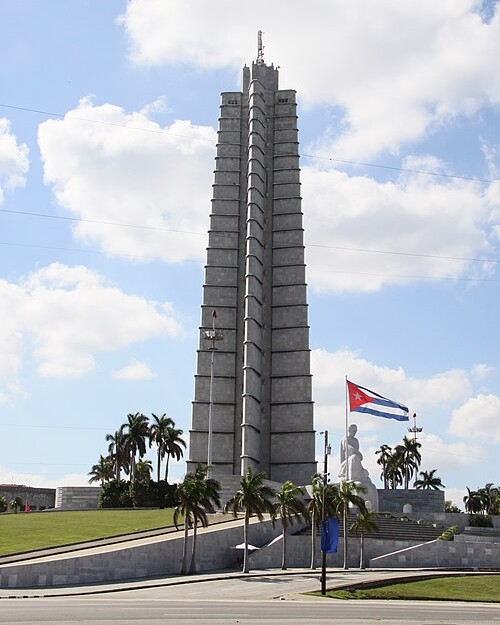
José Martí Memorial
At 358 feet in height, this monument dwarfs all other writer memorials. Completed in 1958 and located in Havana, Cuba, it takes the form of a tall tower with a star-shaped cross section. Nearby stands a statue of the author. Jean Labatut designed it, under the guidance of architect Raoul Otero de Galarraga. Unlike the Scott Monument’s stairs, the Martí Memorial includes an elevator at the center of the star shape. Visitors can ascend to the observation deck, where, from Havana’s highest spot, they can enjoy a panoramic view of the city.
The size of the monument suggests the adoration Cubans feel for their national hero. Through his writings, José Julián Martí Pérez (1853-1895) pushed for the liberation of Cuba from Spain and has been given the appellation “Apostle of Cuban Independence.” His roles included publisher, professor, translator, journalist, essayist, philosopher, and poet. His most famous writings include the children’s book La edad de oro (The Golden Age), the poem collection Versos sencillos (Simple Verses), and his essay Our America.
Ernest Hemingway Memorial
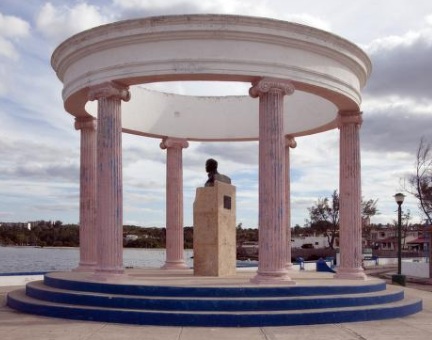
Cuba hosts another writer memorial of note. This one stands in the fishing village of Cojimar, near the bar where Ernest Hemingway often drank. Designed by the Cuban architect José Luis Sert, it features six Ionic-style columns supporting a stone ring. Inside stands a bust of the author sculpted by Fernando Boada Martín. For the bust’s material, he melted down propellers, anchors, and chains supplied by local residents. Completed in 1962, the memorial’s simple, yet profound, design reflects the character of Hemingway’s prose.
Though American, Ernest Miller Hemingway (1899-1961) spent a lot of time in Cuba and wrote many novels there, including The Old Man and the Sea, for which the residents of Cojimar most celebrate him. He also wrote For Whom the Bell Tolls, A Farewell to Arms, and The Sun Also Rises.
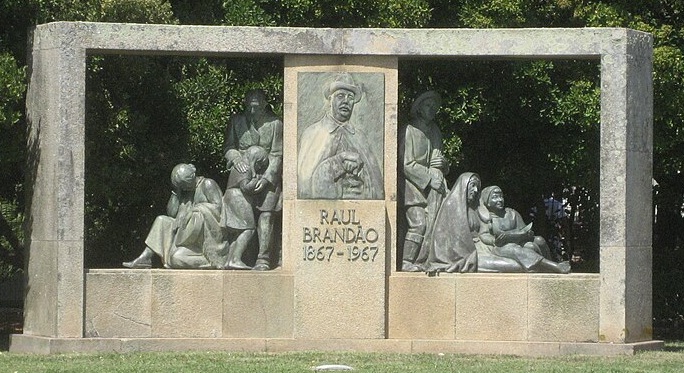
Monument to Raul Brandão
Located in Porto, Portugal, this monument takes the form of a hollow, granite rectangle enclosing two scenes featuring several statues. Separating the scenes is a relief image of the author with his name. Architect Rogério de Azevedo and sculptor Henrique Moreira completed the monument in 1967 to mark one hundred years since the author’s birth.
A Portuguese journalist, writer, and army officer, Raul Germano Brandão (1867-1930) wrote several books, often featuring sailors and the ocean, including Impressões e Paisagens (Impressions and Landscapes) and Os Pobres (The Poor).
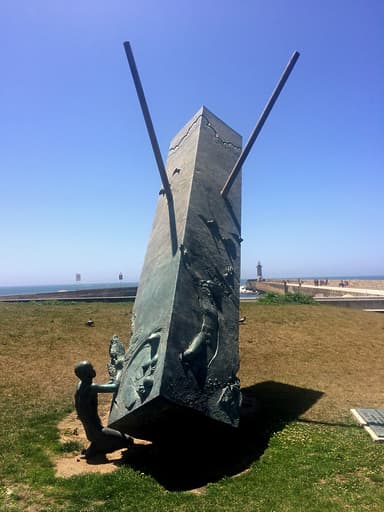
The Dream of Humanity Monument to Ferreira de Castro
Also in Porto, Portugal stands this abstract monument. Called O Sonho da Humanidade, Portuguese for “The Dream of Humanity,” and designed by José Rodrigues, it got completed in 1988. I found no information about why it looks the way it does, or how its appearance symbolizes the author’s writings.
A Portuguese journalist and writer and journalist, José Maria Ferreira de Castro (1898-1974) helped father the genre of Portuguese social-realist fiction. Among several other works, he authored A Selva (The Jungle) and A Volta ao Mundo (Around the World).
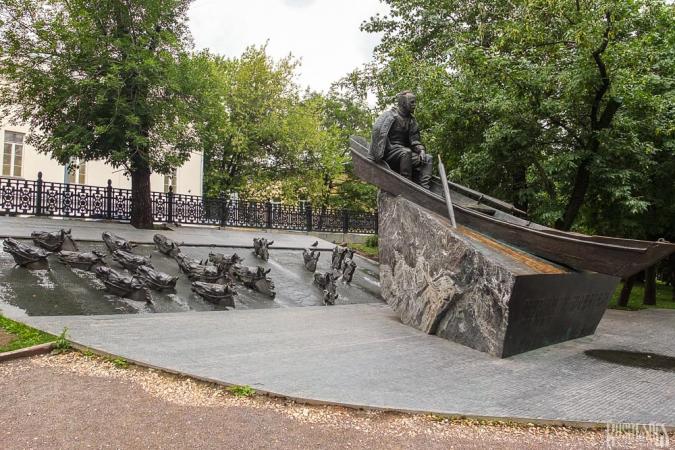
Monument to Mikhail Sholokhov
The year 2007 saw the completion of this monument in Moscow. Sculptor Alexander Rukavishnikov depicted author Mikhail Sholokhov rowing a boat. Behind the boat, over a dozen horses swim with just their heads showing. Real water flows down the sloped surface to show the horses swimming, making this the only kinetic sculpture on my list.
Earning the 1965 Nobel Prize in Literature, author Mikhail Aleksandrovich Sholokhov (1905-1984) wrote novels about the Don Cossacks. And Quiet Flows the Don reigns as his most popular novel. As an additional honor beyond the monument, an asteroid is named for him—2448 Sholokhov.
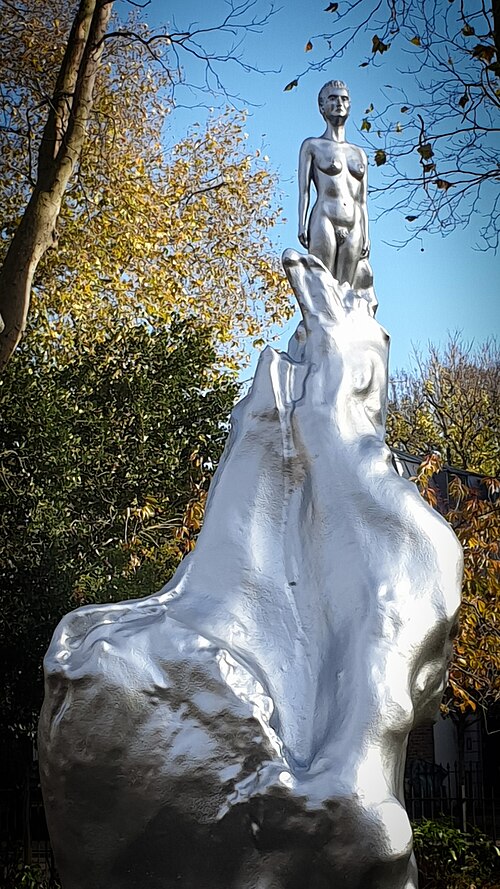
A Sculpture for Mary Wollstonecraft
I started my list in the United Kingdom, and I’ll finish it there as well. In this London monument, a nude female figure emerges from a swirling, curving mass of chaos. Designed by artist Maggi Hambling and completed in 2020, the monument honors the author Mary Wollstonecraft. At its base appears a quote from the writer: “I do not wish women to have power over men but over themselves.” Though meant as a tribute to one woman, the depicted female represents all women, thus showing how Wollstonecraft lifted womankind from nameless, shapeless anonymity.
An early advocate for women’s rights, Mary Wollstonecraft (1759-1797) wrote a children’s book, a conduct book, a history of the French Revolution, a travel narrative, and several treatises and novels. Her most famous treatise remains A Vindication of the Rights of Woman. She’s become a hero, a founding philosopher, of the modern feminist movement. She died soon after the birth of her second daughter, Mary Wollstonecraft Shelley, author of Frankenstein.
The Real Monuments
Consider this irony. Monuments of stone and steel, while quite a tribute, will erode and crumble in time. But the words of these authors, written on mere paper and now with even more fleeting electrons, will endure much longer than the monuments. As the Romans said, Vita brevis, ars longa, meaning “Life is short, art is long.” In that sense, these authors created their own long-lasting monuments.
Do you know of other interesting author-honoring monuments I should have included? Send a comment to—
Poseidon’s Scribe