How much should
your readers know about you? In this age of Facebook, Twitter, and Instagram, when
everything private is public, is it necessary to reveal every detail?
Before social
media and even before the internet, authors were mysterious. Each one seemed like
a magical wizard living in some unknown and hidden cave. A publisher would release
a book, but readers wouldn’t know anything about the wizard, and publishers
wouldn’t tell what they knew.
In those days,
you could read the ‘About the Author’ section on the book jacket or an occasional
magazine interview, but that was all you knew. The wizards stayed in their
caves, typing away.
Times have changed.
If you like a particular author, you can find out home town, number of cats owned,
shoe size, political leanings, and a description of that writer’s most recent
meal. No more wizards; no more mysteries; it turns out authors are just everyday
people with an odd tendency to sling words around.
As a writer,
you may still choose to remain a digital hermit, invisible to Facebook, a wizard
in your cave. But you’d be going against the trend, and against the current
guidance.
The web is
filled with advice blogs for new authors. You must have a social media
presence. Your readers are curious about you, so you must connect with them. Be
authentic; show your audience you’re a real person. A few hours spent on social
media will help grow your book sales.
Not all authors follow this advice. One of them, Tom Corson-Knowles, recommends writers shun social media entirely. He argues you’ll achieve better sales by writing better books; staying off Twitter will give you more free time to write; and social media is cramping your creativity.
Each writer
must take the path that seems right, and be willing to change if that’s not
working. As for me, I write these weekly blogposts, post on Twitter and
Facebook once a week or so, and sometimes post book reviews on Goodreads. I rarely
talk about personal stuff on those platforms.
Although I’d be
more comfortable as a mysterious, cave-dwelling wizard, I’m willing to admit things
are changing. Almost everyone shares personal details these days, and if I knew
I could increase sales by posting a few things, I’d do it.
For now, I’ll reveal
one spicy secret. Though I like dogs and (sometimes) cats, there are currently no
pets in the home of—
Now we’ve come
to the last major character in Jules Verne’s Twenty Thousand Leagues Under
the Sea. Let’s study Captain Nemo.
Before we do, I’ll remind you to submit a short story to 20,000 Leagues Remembered, a tribute anthology scheduled for publication on the 150th anniversary of Verne’s marvelous novel. Along with unparalleled word-master, Kelly A. Harmon, I’m co-editing this anthology for Pole to Pole Publishing. The official closing date is April 30, but you should submit early. We’re accepting stories as we go, and this publisher has filled each of its anthologies before the closing date. For more details, and to submit your story, click here.
Regarding Captain
Nemo, I’ll restrict this analysis to what we know from the 20,000 Leagues
novel and disregard information provided later in The Mysterious Island
as well as later adaptations.
When readers
first encounter Nemo, they learn he appears self-confident, energetic, and
courageous. He is tall, of indeterminate age, and has wide-set eyes. He says, “To
you, I’m simply Captain Nemo,” adding a rank to the name “no one” by which
Odysseus (another sea captain) fooled the Cyclops.
In subsequent chapters,
Pierre Aronnax learns Nemo is a highly intelligent scientist and engineer, has
divorced entirely from the land and all nations, and is immensely wealthy. Later,
Aronnax discovers Nemo cares deeply for a dying crewman and buries him on the
seafloor. He assists a stricken pearl diver off the coast of India, saying he “lives
in the land of the oppressed, and I am to this day, and will be until my last
breath, a native of that same land!”
Nemo provides a
huge sum of gold to a Grecian diver, apparently to aid in the uprising of Crete
against Ottoman rule. Aronnax sees a set of paintings in Nemo’s cabin, all portraits
of historical revolutionaries. Using the Nautilus’ ram, Nemo slaughters a pod
of sperm whales to save some baleen whales. He then attacks and sinks a ship whose
nationality is unknown to Aronnax. Following this act of destruction, Aronnax
spies Nemo kneeling and weeping before a portrait of a woman and two children.
The Captain combines several opposing characteristics and sentiments:
He
claims to support the downtrodden, yet he designed the Nautilus with a distinct
two-class system, and treats Aronnax as an upper-class gentleman, in contrast
to the way he treats Conseil, Land, and his own crew.
He financially
supports freedom-seeking revolutionaries, and his Mobilis in Mobili
motto implies a love of freedom, yet all who enter his Nautilus are confined
aboard forever.
At the
outset, Nemo declares, “I’m not what you term a civilized man! I’ve severed all
ties with society, for reasons that I alone have the right to appreciate.
Therefore I obey none of its regulations…” yet he plants a flag at the South
Pole just as any imperialistic conqueror from a land nation might.
It’s well-known
that Verne initially gave Nemo a detailed back-story with a former nationality
and a traumatic past to explain his motivations, but his publisher urged him to
delete all that. We’re left with an unexplained mystery, a Byronic Leonardo da
Vinci, a marauding scientist, a sea hermit, a gentleman savage.
Like Captain
Ahab, Nemo suffers from a troubled past that leads him on an obsessive oceanic quest,
resulting in madness. Unlike Ahab, the cause is not as evident as a bitten-off
leg, but resides only in his mind. His motives remain as invisibly submerged as
his submarine.
I hope you’ve
enjoyed reading these recent blogposts about the four main figures in 20,000
Leagues Under the Sea. This one completes the quartet of character analyses
by—
Having analyzed
Conseil and Ned Land in recent blogposts, I’ll turn my attention today to the
narrator of Twenty Thousand Leagues Under the Sea, Pierre Aronnax.
First, don’t forget to submit your best short story to the upcoming anthology 20,000 Leagues Remembered, my tribute to Verne’s undersea masterpiece on its sesquicentennial. I’m co-editing this book, along with editor and award-winning author Kelly A. Harmon of Pole to Pole Publishing. We’ll officially close for submissions on April 30, but I encourage you to submit well before then. We accept stories as we go, and every previous anthology from this publisher has filled up before its closing date. See this site for guidelines and to submit your story.
Pierre Aronnax,
forty years of age, was an Assistant Professor at the Paris Museum of Natural History.
He’d written a definitive book on sea creatures, titled TheMysteries
of the Great Ocean Depths. Aronnax had been visiting the Nebraska Badlands and
was in New York when he received an invitation to join the crew of the frigate
USS Abraham Lincoln on its mission to hunt down the reported ‘sea monster.’
Of the three men taken aboard the Nautilus, only Aronnax is given a tour and introduced to most of the wonders aboard. Captain Nemo treats him as an approximate equal, a gentleman, while he treats the rest of his crew, and both Conseil and Ned Land, as lower-class commoners. To our modern sensibilities, this sounds absurd, but to Verne’s class-conscious readers it must have seemed understandable, even natural.
Some have theorized Verne was playing with the word ‘arrogant’ in giving the Professor his surname, but I disagree. I don’t believe Verne thought of Aronnax as arrogant or intended him to appear that way to readers. The Professor was a Nineteenth Century gentleman-scholar and behaved that way. Though he may seem arrogant to us, it is unlikely Verne would have foreseen our modern sensibilities and named his character accordingly.
I’ve mentioned before that Conseil served as the imaginative voice of Verne. I think Aronnax and Nemo together represent what Verne aspired to be. Verne would have loved to be a scientific scholar like Aronnax and an engineer like Nemo.
That said, Aronnax is a disappointing character. He enjoys being free to examine undersea life from within a submarine, while ignoring that he’s trapped aboard. He admires the scientific and engineering genius of Nemo while choosing to ignore warning signs of the Captain’s insanity. Aronnax knows he must someday try to leave the submarine, but would prefer that date be well in the future. In short, he’s there to observe and to marvel for us, not to act in any daring way.
Modern writers can understand Verne’s dilemma. To pull off his undersea novel with all its various travels and adventures, Verne needed at least one character who was content to remain in an iron prison for the duration. Aronnax is that character, but he comes off as too trusting and too slow to act. He is carried along by events rather than causing things to happen. These aren’t traits we like to see in a main character.
In a way, we can think of Verne’s Aronnax as an unreliable narrator. The Professor gives us accurate information on the Nautilus, Nemo’s scientific and engineering prowess, and the many fish they see and places they visit. But he ignores and then rejects Ned Land’s opinion about Nemo and the Canadian’s plans for escape. Only in the end do we (and Aronnax) see that Ned was right all along.
I suppose you can guess the next 20,000 Leagues character to be analyzed by—
Today we’ll
consider the character Ned Land in Jules Verne’s Twenty Thousand Leagues Under
the Sea.
Before doing so, I’d like to remind you to submit a short story to Twenty Thousand Leagues Remembered, an anthology I’m co-editing along with the creative and capable Kelly A. Harmon of Pole to Pole Publishing. We’re open for submissions and accepting stories as we go, and this publisher’s previous anthologies have all filled up before their closing dates. Therefore, don’t wait until the official closing date of April 30. Submit your story here.
Turning now to
Ned Land, Verne introduces him as a Canadian harpooner from Quebec assigned to the
frigate USS Abraham Lincoln to assist the crew in hunting a menacing sea creature.
Verne has fun with this character’s name. In French editions, it is rendered as “Land,” the same as in English translations, not the French word for land, “terre.” Verne’s audience would have had to know the English word to get his pun. Ned is a man of the sea named for the land, who craves to escape from under the sea and eat food of the land.
Between Professor
Aronnax and Ned Land, readers come to understand two opposing ways of dealing with
their imprisonment aboard the Nautilus. The pair are opposites, with Aronnax’s
servant Conseil serving as the median. On several spectra, the two men occupy extreme
ends.
Ned Land is the
‘physical’ to Aronnax’s ‘intellectual.’ Land is often depicted as taking action,
while Aronnax observes and deliberates. It is Ned who throws the harpoon, who assaults
a steward, who goes ashore and shoots birds and kangaroos, who grabs the electrified
railing, who kills a shark, who harpoons a dugong, and who joins in the attack
on the giant squid, who tries to signal a nearby ship, and who arranges their escape
from the Nautilus.
Further, Ned
Land acts without thinking, while Aronnax thinks without acting. Often, Ned acts
impulsively, sometimes with a bad result but sometimes heroically. Aronnax suffers
from ‘paralysis by analysis,’ knowing what he should do, but not doing anything
about it.
Land represents
the common man in contrast to Aronnax, the upper-class gentleman. Aronnax eats
with Nemo and bunks in a room next to the Captain’s. Ned bunks and eats with
Conseil in the midships area reserved for the crew. Ned speaks plainly, occasionally
joking, while Aronnax speaks like a professor throughout.
The last facet
of their contrast is what I’d term the ‘man of nature’ vs. the civilized man.
Ned’s comfort zone is the out-of-doors, in the wild, killing and preparing his
own dinner. For his part, Aronnax would be lost without his servant and is more
at home in drawing rooms and eating gourmet food. Here, most of Verne’s audience
would identify closer with the professor, but nonetheless be fascinated by the harpooner.
Given their differing
viewpoints, it’s no wonder Aronnax sees the Nautilus as a vessel of underwater exploration,
while Land sees only a prison. Aronnax sees Captain Nemo as a rational engineer
and scientist, while Land sees him as an insane pirate and jailer.
Although the two share the same goal, leaving the Nautilus, they differ on timeframe and method. Aronnax would like to leave someday, after persuading a captain he sees as reasonable. Land wants to get off the submarine immediately, by force if necessary.
Verne resolves
this conflict in a draw. The trio departs the Nautilus far later than Ned would
have liked, after spending seven months aboard. However, they must sneak off
the ship without the Captain’s permission, during an emergency, and with Ned
guiding.
Ned Land, then,
is the perfect ‘friendly opposition’ to Pierre Aronnax, giving the novel
dramatic tension throughout. Have you ever known someone like Ned Land (except for
his harpooner occupation, of course)? A few like him have been known to—
This post
begins a short series discussing major characters from Jules Verne’s Twenty
Thousand Leagues Under the Sea. I’ll start with Conseil.
First, a reminder. Along with the esteemed and talented Kelly A. Harmon, I will be co-editing Twenty Thousand Leagues Remembered, an anthology of short stories honoring Verne’s novel. Submissions open this Friday, January 10. Although submissions are scheduled to close on April 30, Pole to Pole Publishing accepts stories on the fly, so once the anthology is filled, later stories get rejected. Submit early; all their anthologies have closed before the advertised closing date. See all the details here.
Now, to Conseil.
The book’s narrator, Professor Pierre Aronnax, introduces him this way: “Conseil
was my manservant. A devoted lad who went with me on all my journeys; a gallant
Flemish boy whom I genuinely liked and who returned the compliment; a born
stoic, punctilious on principle, habitually hardworking, rarely startled by
life’s surprises, very skillful with his hands, efficient in his every duty,
and despite his having a name that means “counsel,” never giving advice—not
even the unsolicited kind!”
Well, this is
mostly true. At thirty years old, Conseil is hardly a lad or boy. Also, that
last sentence is doubly ironic. ‘Conseil’ means ‘counsel’ or ‘advice’ in
French, and though Aronnax thinks his servant never gives advice, he often does
so.
Aronnax goes on
to mention Conseil’s habit of referring to his master in the third person. Although
we often see Conseil beginning a sentence with, “If Master pleases…” or “If
Master will permit me…” this, also, turns out to be a rule broken on occasion.
Conseil’s first characteristic mentioned by Aronnax is devotion, and in this, Conseil is consistent. The servant jumps into the ocean when his master falls in, and helps to keep him afloat. Conseil agrees to don a diving suit when Aronnax does so, and accompanies him on every excursion.
The utterly loyal
servant became a stereotypical character in Verne’s novels, most notably with Passepartout
in Around the World in Eighty Days, and Nebuchadnezzar (Neb) in The
Mysterious Island. In each case, Verne has literary purposes for these characters,
such as representing the “common man” to whom the genius explains certain
scientific phenomena, or to dramatically play off some other character’s eccentricity,
or simply to keep conversations going.
In 20,000 Leagues,
Conseil serves as an intermediary between Aronnax and Ned Land. Conseil may be
devoted to his master, and shares the professor’s interest in sea creatures,
but he is, like Land, a common man and spends a lot of time with the Canadian
harpooner. It is Conseil who must explain to Aronnax why Ned Land behaves the
way he does.
The servant
also becomes the calming influence on all actions in the novel. Whenever Aronnax
becomes overly excited or afraid or alarmed, Conseil grounds him and helps him
relax. Conseil also attempts to sooth the impetuous Ned Land, but with less
effective results.
In a couple of
scenes, Conseil becomes the imaginative voice of Verne himself. Early on, Conseil
laments “the drawback in not having one universal language,” a cause for which
Verne was an enthusiast. Later, when they reach the central Mediterranean, Conseil
considers the possibility of a volcanic upheaval closing off that sea from the Atlantic.
This foreshadows, in a way, Verne’s later novel Invasion of the Sea.
Conseil serves yet one more purpose in the novel. He is Verne’s tribute to his friend Jacques-Francoise Conseil, who is said to have built a submarine craft in 1858.
Watch this space
for more character analyses from—
Continuing the tradition
established last year, I’ll make some predictions for science fiction for the
coming year.
First, however, I have an update on Twenty Thousand Leagues Remembered, the upcoming anthology I’m co-editing along with the talented writer and editor Kelly A. Harmon of Pole to Pole Publishing. We’ve moved the opening date for submissions to January 10. Click here for details.
Back, now, to
the prognostications. Abandoning my crystal ball, which didn’t work so well, I’ve
since mastered the technique of Tasseography, or reading tea leaves. Let’s peer
into the cup and see what the leaves reveal:
Partisan
Politics. SciFi
will become more political in this U.S. election year. With the citizenry
becoming increasingly partisan, authors will show their political biases and opinions
in their stories. Stories will increasingly be either left/liberal or
right/conservative. This trend disturbs me, but I have to call ‘em as I see ‘em.
Post-Apocalypse. With the decline and death of the dystopia
will come the birth of a more hopeful and positive future. We’ll see more
stories of civilizations rising from the ashes of past global destruction.
Time
Travel. There are
plenty of time periods left to explore, many with subtle lessons for us today. Despite
the risk of paradox, authors will give us more time-traveling protagonists
heading off to the past or future. Most of these stories will involve romance
to some degree.
Climate Fiction. CliFi will remain a strong sub-genre, with authors exploring humanity’s influence on the Earth’s climate. I predict most such stories will either deal with human attempts to fix the climate before a catastrophe or will take place after a climate catastrophe.
LBGTQ
characters. More
protagonists and other major characters will be part of the LGBTQ spectrum. Within
these fictional worlds, the cisgendered characters will respect and admire the
LGBTQ main characters, not ostracize or mistreat them. Other related works will
continue to take place in transhuman, post-gender worlds.
Strong Female. The damsel in distress is dead. During the last decade or two, she’s been replaced by the Strong Female. This woman is strong in the sense of being fierce, capable, and not dependent on men. Though by now she’s a stock character, SciFi authors will continue to explore various subtleties and nuances of the Strong Female in 2020.
Star Wars Reaction. With the completion of the triple trilogy “Skywalker Saga” in 2019, authors will pen stories reacting to all things Star Wars. In 2020, I anticipate stories satirizing and otherwise mocking aspects of the George Lucas-created franchise, and probably other SciFi fantasies trying to fill the void by launching Star Wars variants.
Afrofuturism. Authors in 2020 will weave tales
comporting with Afrofuturism 2.0 and Astro-blackness. Audience reaction to the
2018 film Black Panther demonstrated a strong enthusiasm for works merging
the themes of the African Diaspora with high technology.
Boomer
Lit. I see some
SciFi in 2020 examining baby boomer themes. This will include stories with
older protagonists, as well as stories with strong 1960s nostalgic references.
At the end of 2020, I’ll make every effort to assess these predictions, as I did for my 2019 prophecies. Yogi Berra said, “It’s tough to make predictions, especially about the future,” but I have confidence in the tea leaves, so you should have confidence in the prognostication prowess of—
A year ago, I made
several predictions about what would happen in 2019. It’s time to assess my
skill as a prognosticator.
Like any good soothsayer, I worded some of my predictions so that it’s difficult to say whether they came true or not. Also, I don’t have access to solid data that would confirm whether some came true or not. Still, here goes:
Prediction: In 2019, you’ll see more science fiction books written by authors from previously underrepresented groups (women, people of color, LGBTQ, etc.) and these books will explore concepts of belonging and isolation, as well as bending our current notions of gender and race.
Assessment: I think this one came true. Certainly 2019 saw the publication of SciFi novels written by women such as Elizabeth Bear, Margaret Atwood, Sarah Pinsker; and people of color such as Cadwell Turnbull, Tade Thompson, and Chen Qiufan; and self-identified members of the LGBTQ community such as Charlie Jane Anders, Annalee Newitz, and C.J. Cherryh. I haven’t verified the second part of my prediction, but I suspect it’s true.
Prediction: The superhero theme in movies will
peak and begin a gradual decline. It’s been an amazing ride, but I believe the
market has saturated and audiences are getting tired.
Assessment: It’s too early to tell if I was right.
Four superhero movies came out in 2019 compared to seven in 2018, but one of
them, Avengers Endgame, was the highest grossing film of all time.
Prediction: Very few, if any, best-selling scifi books will feature faster-than-light drive. Most authors have accepted Einstein’s speed of light limit. FTL now seems hokey to readers.
Assessment: I don’t have good data on this. Tiamat’s Wrath (Expanse #8) by James S. A. Corey contains gates to other star systems. Alliance Rising by C. J. Cherryh and Jane S. Fancher contains FTL with jump points. Obviously, FTL hasn’t gone away in SciFi, but it’s hard to say if it’s on a downward trend.
Prediction: Having already peaked, the steampunk
and alternate history genres will continue to wane in books and movies, though
they may retain strength in the video gaming world. This genre trend in books
is troubling to me, since I enjoy writing steampunk and other alternative
history.
Assessment: I got that one very wrong. Several
good Steampunk novels came out in 2019, including The Secret Chapter (The
Invisible Library #6) by Genevieve Cogman; Made Things (Made Things #1) by
Adrian Tchaikovsky; Counter Culture by J.L. Merrow; Tarnished Are the
Stars by Rosiee Thor; The Light at the Bottom of the World (The
Light at the Bottom of the World #1) by London Shah; The Sinister Mystery of
the Mesmerizing Girl (The Extraordinary Adventures of the Athena Club #3) by
Theodora Goss; and White Hornet (The Viper and the Urchin #5) by Celine
Jeanjean)
Prediction: We’ll see more Solarpunk, and the Punk
Family will grow by a few more. I think there’s a great deal of uncharted
territory in the solarpunk genre and a general hunger for it among readers.
Most new ‘punks’ added in 2019 will be future-based, rather than alternative
histories.
Assessment: Again, this prediction’s hard to evaluate.
Certainly, The Weight of Light: A Collection of Solar Futures, edited by
Clark A. Miller and Joey Eschrich is solarpunk and some have likewise
classified Emergency Skin (Forward Collection #3) by N.K. Jemisin; and All
City by Alex DiFrancesco as solarpunk. As to new ‘punks’ being added in
2019, I haven’t seen evidence of that.
Prediction: There will be fewer dystopian young adult books, and there will be an upsurge in YA depicting a positive (though not utopian) future. I think dystopias have run their course for the time being, and readers are ready for less bleak outlooks.
Assessment: I think there were fewer dystopian YA books in 2019, but among them were Internment by Samira Ahmed; The Farm, by Joanne Ramos; and The Water Cure by Sophie Mackintosh. Certainly, Peyton Skoczylas thinks this genre has run its course. However, I didn’t sense an upsurge in 2019 of YA SciFi involving positive futures.
Prediction: Overall, as a genre, science fiction will do well in the visual media of movies, video games, and graphic novels, but not in traditional book form. Plenty of authors enjoy writing scifi, but readers will turn away from this genre in greater numbers. This is another prediction I find personally disappointing.
Assessment: I couldn’t find data to confirm or deny the truth of this prediction. Plenty of authors did produce SciFi in 2019, but whether readership or revenues went up or down, I don’t know. SciFi in movies, video games, and graphic novels remained strong.
Prediction: The trend toward series novels will
remain strong. Once modern readers make an emotional investment in a set of
characters and their fictional world, they want to know what happens after the
first novel, and after the next.
Assessment: I nailed this one. In addition to the
series novels mentioned above, Moon Rising (Luna #3) by Ian McDonald, Atlas
Alone (Planetfall #4) by Emma Newman, Dark Age (Red Rising Saga #5)
by Pierce Brown, and several other series novels were published in 2019.
Like the best
oracle, my results are an ambiguous mixed bag, subject to interpretation. Perhaps
I didn’t do so badly after all. Next week, check this space for predictions about
2020 by—
Pole to Pole Publishing just released Not Far From Roswell, an anthology of dark short stories involving aliens in New Mexico. My tale called “Reconnaissance Mission” appears there, and you’re about to discover the story behind that story.
When the submission call went out, I figured I’d pass. I don’t often write dark stories or alien visitation fiction. My intellectual side had moved on, but my muse grabbed it by the collar and said, “Come back here. I’ve got an idea. Hold my beer.”
Over the years, I’ve learned to listen to my muse, even when she’s drunk. With alcohol on her breath, she whispered her idea about an alternate version of history where Edgar Allan Poe visits New Mexico and encounters something. My intellect argued back: “I don’t think Poe ever visited that area, and the state of New Mexico didn’t even exist in his time.” The muse replied, “Details, shmetails. Those are your problems.”
My crack research team uncovered some interesting and useful tidbits about Poe. Before going to West Point (yes, he was a cadet, though he didn’t graduate), he had enlisted in the Army in 1827. At that time, many of our Army’s enlisted personnel were recent immigrants from Ireland and Germany, so Poe probably stood out. His regiment was posted to Fort Moultrie in Charleston, South Carolina. Highly intelligent and a quick learner, Poe became the battery’s “artificer.”
The U.S. Army
doesn’t have much need of artificers these days, but back then “Tiffys” were vital.
They calculated explosive loads and fuse lengths for artillery shells. Any computational
error could result in a missed shot, a premature detonation, or even death of the
gun crew.
Poe was skilled,
though, and rose to the rank of Sergeant Major. His commanding officer,
Lieutenant Howard, recognized his talent and urged Poe to apply for the Military
Academy. Upon acceptance, Poe entered West Point in 1829.
All that is true. But, my muse asked, what if…? What if the Army ordered one platoon to conduct a clandestine mission to Santa Fe de Nuevo México, then a territory of Mexico? What if their mission had been to assess the military strengths and potential threats of the Mexicans and the Apaches?
Further, what if the platoon encountered something unusual, something that might explain Poe’s later writings, something that seemed very…well…alien?
Then, as is usual
for me, the story wrote itself. It’s an origin story for Poe, one that could
have happened. Well, there’s no evidence it didn’t happen. As they say, the
truth is out there.
You can purchase Not Far From Roswellhere. Knowing the fine editors at Pole to Pole Publishing, I’m certain all the stories in that anthology are terrific.
Yes, I know. I owe
my muse a beer. Without her, I really wouldn’t be—
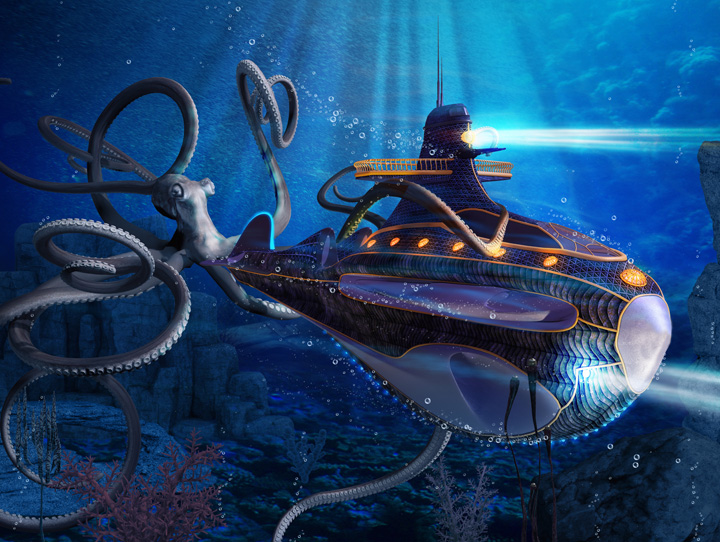
The submarine
in Jules Verne’s novel Twenty Thousand Leagues Under the Sea is one of the
most amazing settings in all of literature. Let’s explore it.
Before we do, I’ll invite you to write and submit a short story to an anthology I’m co-editing along with the esteemed Kelly A. Harmon of Pole to Pole Publishing. Twenty Thousand Leagues Remembered is intended for release on June 20, 2020, the 150th anniversary of Verne’s masterwork. Click here for details about submitting your story.
As a degreed naval architect and former submariner, I could write many posts about the design of the Nautilus. You can read this book or this one, or peruse this website for more information like that. My purpose today is to explore this submarine as a literary setting.
Before the publication
of Verne’s novel, submarines were tiny and dangerous; they could only stay
submerged a short time. In the public’s mind they were curiosities, odd little experimental
toys. Moreover, electricity was new—a phenomenon with known, but unrealized
potential.
At a stroke, Verne
astounded readers with a submarine like they’d never imagined. He gave them a
glimpse through the veil of the future. The Nautilus was far bigger than any
real submarine to date, nearly as big as the naval ironclad surface ships of the
time. With a maximum speed of fifty knots, the Nautilus could outrace anything
at sea. Moreover, it could dive into any deep-sea trench and only needed to
surface once a day for air.
At a time when people
lit their homes with whale oil, cooked with wood, and powered ships with coal, Verne
sparked their imaginations by giving them an all-electric vessel. “Electricity”
was then still almost magical, and Nemo had tamed it for lighting, cooking, and
propelling his vessel.
Verne alarmed his
readers with a horrible new weapon of war. No longer would the seas be safe
when an unseen danger could rise from the depths and cleave ships in two. It’s
how the book began, with mariners terrified of a ‘sea monster’ that struck without
warning.
Yet the
Nautilus had another side, as Pierre Aronnax learned. It was a civilized
vessel, with a vast library and a relaxing parlor or salon with paintings, busts,
and display cases. Yes, even a pipe organ. Large portals opened to provide a
window to the sea, making this submarine a vessel of exploration, too.
But Verne’s
surprises didn’t end there. For the sailors of the Nautilus, the sea wasn’t
merely their workplace. It was home. Unlike all previous humans, they lived
their lives in the ocean, never making land, eating only seafood, and being
buried in the depths.
For Conseil, Pierre
Aronnax, and especially Ned Land, the Nautilus was also an iron prison from which
escape seemed impossible. Before the phrase ‘gilded cage’ came in vogue, Verne trapped
his characters within one. The scenes played out between metal bulkheads with
characters caught in an odd dichotomy. Freer than anyone else to explore the
vast oceans, they could not pass beyond the Nautilus’ steel hull. Were they
guests, or prisoners, or both?
The Nautilus was,
and remains, unique. Some literary scholars consider it a character in its own
right. I don’t go that far, but this submarine makes for a remarkable setting. Many
novels since have been set aboard submarines, but we must measure all fictional
subs against the standard of the Nautilus.
That concludes our tour. Watch your step on the ladder and don’t hit your head on the hatchway. Please exit quickly; if Captain Nemo found out I’d brought you aboard, I’m not sure what he’d do to—
Readers with long memories will recall I interviewed Todd Sullivan
once before. I decided to interview him again because a lot has happened in his
writing career. He’s got two novellas being published soon.
Author Todd Sullivan
Todd Sullivan teaches English as a Second Language, and
English Literature & Writing in Asia. He has had numerous short stories,
novelettes, and novellas published across several countries, including Thailand,
the U.K., Australia, the U.S., and Canada. He is a practitioner of the
sword-fighting martial arts, kumdo/kendo, and has trained in fencing (foil),
Muay Thai, Capoeira, Wing Chun, and JKD. He graduated from Queens College with
a Master of Fine Arts in Creative Writing, and received a Bachelor of Arts in
English from Georgia State University. He attended the Bread Loaf Writers’
Conference and the National Book Foundation Summer Writing Camps. He currently
lives in Taipei, Taiwan, and looks forward to studying Mandarin.
Here’s the interview:
Poseidon’s Scribe: Since I last interviewed you in
September 2017, what have you been writing?
Todd Sullivan: Funny enough, I’ve still been writing from the same narrative universe that that 2017 story, “Wheels and Deals,” published in the Dark Luminous Wings anthology, took place in. My current novella, Butchers, is a vampire story that takes place in South Korea. But the actual storyline, along with several other short stories that were published between 2016 and 2018, all exist in the same nightmarish reality.
P.S.: What are the titles of the other stories?
T.S.: “Gwi’shin,” published in Eastlit Journal;
“Transubstantiation,” published in Aurealis Science Fiction & Fantasy.
“Chingu,” published in Tincture Journal. “The Ascent Made Him Plunge,” published
in The Big Book of Bootleg Horror 2. They’re all connected.
P.S.: You’ve been busy, and successful in getting your stories published. Congratulations on the publication of Butchers. The book cover is eye-catching. If you had to describe this novella in three words, what would they be?
T.S.: To coin Public Enemy, “Fight the power.”
P.S.: The story is set in Seoul, South Korea. Why did
you choose that setting?
T.S.: I lived in South Korea for ten years, three of
which were spent in Seoul. The very first incarnation of this story took place
on a small island at the southern-most tip of the country called Jeju. Jeju
will still play a pivotal role in how the ongoing narrative unfolds. If one can
imagine the narrative universe as a typhoon, Jeju is the center of the
maelstrom.
P.S.: So many horror stories deal with vampires
working alone. In Butchers, there’s an entire vampire organization with
initiation rites, rules, a mission, and rogue members. What can you tell us
about this group?
T.S.: The Gwanlyo is, in many ways, the tyrannical
employer. Mindlessly cruel, and diabolical, with arcane regulations that seem
to serve only one purpose: to torture their employees.
P.S.: The novella’s protagonist, Sey-Mi, sounds
fascinating. Please tell us what she’s like at the beginning of the book.
T.S.: Kim Sey-Mi is a graduating high school senior
who, like Alice, tumbles down the rabbit hole. She meets strange and terrible figures,
and the question is will she become one of them: a strange, terrible person.
P.S.: You describe this as a novella of extreme
horror. Why will this book appeal to horror and vampire fans?
T.S.: As a vampire fan myself, I have to admit that
it doesn’t take much to make me fall in love with a vampire story. I think a
lot of vampire fans share a similar sentiment. I think, though, that Butchers
is a unique take on the mythology. It combines Korean culture with Western
horror to create an exciting fusion of ideas. I think even a vampire fan really
appreciates a new take on the undying genre.
P.S.: Is the launching of this book coming soon? How
can eager readers find out more, and buy it?
T.S.:Butchers is available to purchase now in ebook and book form. The official launch date is December 5th, and there will be a Facebook event from 10am to 12am EST where I’ll answer questions, and where an attendee can win a free copy of the novella.
P.S.: I understand this will be the first of a
series. What can you tell us about the second book?
T.S.:The Gray Man of Smoke and Shadows is a
stellar tale that focuses on a character introduced in Butchers: Hyeri.
I had a lot of fun writing Hyeri, and I knew that the next book in the series
would be about her. There’s no point in wasting a character this good.
P.S.: You’ve also got another novella soon to be published, called Hollow Men. I love its cover image as well. Please give us three words to describe this book.
T.S.: Death comes easy.
P.S.: Please describe the setting of this work of
epic fantasy. Where and when are you taking your readers this time? What makes
this setting different from most other works in this genre?
T.S.: So, Hollow Men takes place in a fantasy version of medieval South Korea. The story revolves around men who go on quests to become heroes. The story also deals with the politics of being a foreigner in a homogeneous society. And it’s different because it fuses the east and west in a tale of swords & sorcery. It’s a D&D campaign that takes place in the Hermit Kingdom.
P.S.: What are the fantasy elements in the story? I
understand there’s a heroic quest, a magic sword, and a knight. What else will
readers encounter?
T.S.: I guess the narrative touches upon the ideas of
globalism. We can say that we are all just the human race, but do we really
believe it? Actions speak louder than words, and if one were to look at the
actions of the world’s people, can one really say that we truly believe we are
all of the human race? So imagine this quandary using the metaphor of the
fantastical, and that’s Hollow Men.
P.S.: Please paint a word picture of Ha Jun, your
protagonist.
T.S.: Ha Jun is a young man who increasingly realizes
that the world is trying to kill him. And he’s simply trying to figure out how
to stay alive.
P.S.: When and where can readers get this book?
T.S.:Hollow Men’s expected release date is
December 9th, 2019. It would make a great Christmas gift for teen
readers.
P.S.: It certainly would. You also intend this
novella to be the beginning of a series. Can you give us a glimpse of the
second book, and what connects the two?
T.S.: Life is a constant struggle. That’s actually
the general theme of this fantasy series. One keeps fighting, and either one
dies, or one survives to fight again. There is no peace. There is only the
hustle, the struggle to survive.
Poseidon’s Scribe: Where can readers go to find out
more about you?