
In any specific human endeavor involving more than one person, the people involved soon find themselves repeating the same phrases over and over. It’s inevitable they should seek some shorthand way to avoid that. So they develop jargon, specialized terminology suited to their activity.
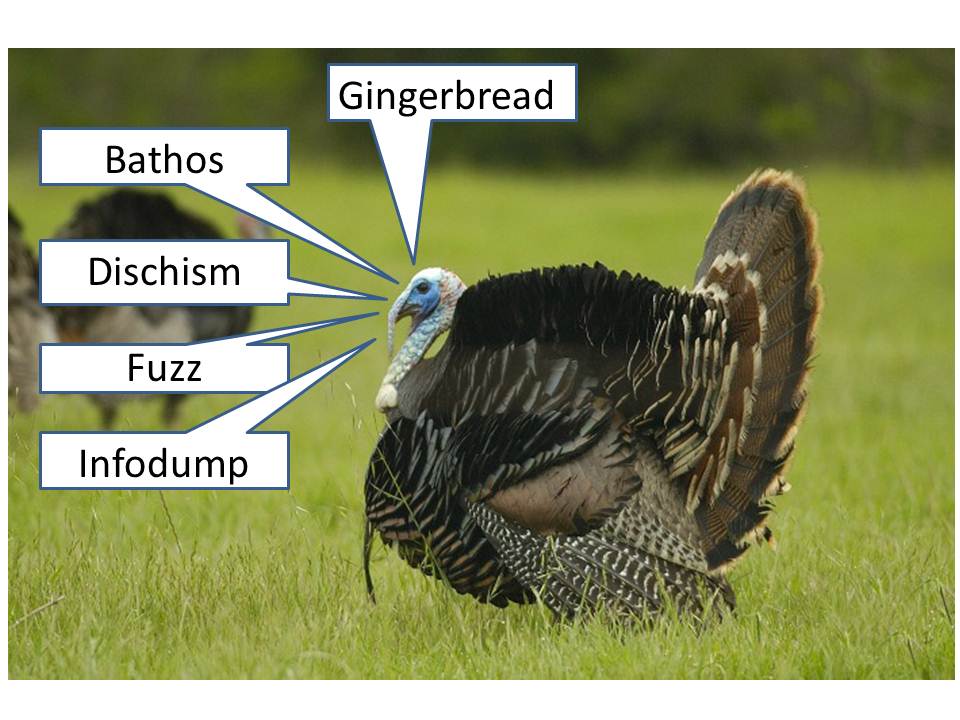 Some time ago, in science fiction writing workshops, the participants worked out a vocabulary of writing terms called the Turkey City Lexicon (TCL). There is no authoritative source for the TCL, nor is it copyrighted. It’s available on many websites; just search for “turkey city lexicon.”
I won’t reiterate the list here. My purpose is just to introduce it to you and comment on its usefulness to me. I encourage you to search for and read through the list, then come back to finish reading my blog entry. Several of the items are humorous to read through.
A few TCL terms are more applicable to science fiction (The Jar of Tang, Abbess Phone Home, Reinventing the Wheel, and Space Western), but the vast majority of the terms are applicable across all fiction genres. TCL might be useful to you even if you don’t write SF.
A number of the terms are disconcerting for me to read through since I’ve committed these errors before. These include Burly Detective Syndrome, You Can’t Fire Me–I Quit, Fuzz, and Bogus Alternatives.
But that gets right to the value of this list. Most of the terms describe deficiencies common to beginning level writing. Worse, they describe failings even experienced writers can succumb to, like a bad habit. Even just reading through the list periodically can refresh your resolve to avoid the bad habits.
I’ve found it vital to subject my writing to the crucible of my critique group just so they can identify faults I don’t see. Once you’ve been accused of any of the items in the TCL, chances are you’ll hear that accusatory voice again in your head while editing all subsequent stories. Thus will your writing improve.
My critique group has found three TCL terms to be the most useful—Infodump, As You Know Bob, and Telling Not Showing. I’m not sure why those three dominate, but they do, at least for us.
Do any of the TCL items ring embarrassingly true for you as you think over your own writing? Are there other fiction writing failings that should be recognized by the TCL but aren’t yet? If so, leave a comment for me and let me know. On a mission to improve own writing and that of others, I’m—
Poseidon’s Scribe
 Federmann could be played well by actor Chris Hemsworth. He’d have to speak English with a German accent, but doesn’t have to do it well, since it’s a comedy. Count Federmann is a brooding character, angry at and jealous of Baron Münchhausen. The Count is intelligent, determined, and optimistic, but lacks sense.
 The Count has a young French servant named Fidèle, and I’ll select Shia LaBeouf for that role. Mr. LaBeouf would have to speak English with a French accent, but not an especially good one. Fidèle is full of life, but has the sense to fear danger, though he’s always respectful of nobility.
 Robin Williams. I need an older character of plain appearance who’s able to speak English with a German accent and captivate an audience with his words alone. Robin Williams played the part of the King of the Moon in the 1988 Movie “
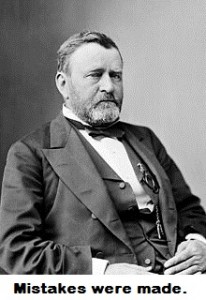 Among the worst passive sentences ever written is “Mistakes were made.” Politicians since Ulysses S. Grant have used that one to acknowledge a problem but to hide the responsible party from blame. However, the press and the public are on to that tactic, and would pounce on any official who uttered it (after laughing out loud).