Last week, I blogged about sympathizing with a hypothetical AI writer trying to break into the publishing biz. That post imagined a time when AI could write as well as humans. Today, it can’t. But it can write fast, and that affects how writers self-publish.
History of Self-Publishing
Before Amazon’s Kindle Direct Publishing (KDP) and similar services, authors could publish books themselves, but it cost money and took time. Either you bought your own printing press and book-binding machine, or paid a company to publish your book. They called those companies “vanity presses.”
The internet explosion led to free self-publishing. Although some of these services started before KDP, it became the most popular. Authors didn’t have to pay a vanity press thousands of dollars to get a book published. That new, free model worked fine for several years.
Teaming with Your AI Agent
Enter Artificial Intelligence. Just as you can command your AI Agent to order your household supplies, summarize long emails, or take meeting minutes, you can also have it publish a book.
You can direct your AI agent to write the book, format it (including cover design), upload it to the retailers, and publish it. Four difficult and time-consuming steps for you, but ten minutes of work, beginning-to-end, for AI.
Don’t count on your computerized agent writing a best-seller. In fact, you’ll likely get a bland and uninteresting book. Let’s say you don’t care. The prompts you gave the AI mimicked a current best-seller, so your knock-off might hoodwink a few readers to buy it. All you need are a few sales, since you and your AI pal put in only ten minutes of work. You could pop out a hundred of these trashy books a day.
A Centaur Stampede
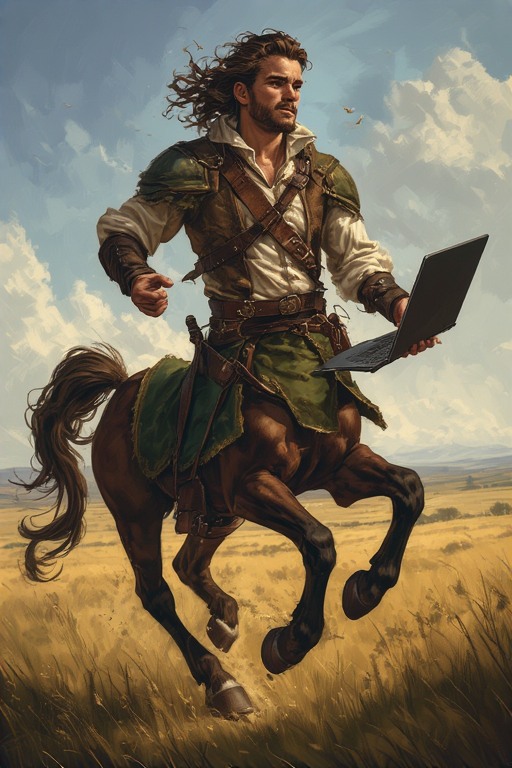
Some have used the centaur metaphor to explain this human teaming with an AI agent. I’ve blogged about it before. Just as the mythological centaur combined the speed of a horse with the intelligence of a human, so a modern centaur combines the speed of AI with the creativity of a human. In its current form, AI won’t write or publish a book on its own—a human must prompt it.
And prompt it they do. They’re swamping the publishing service with centaur-generated books. Some call this bookspamming.
The Publishing World Reacts
The empire struck back. Amazon requires authors to affirm whether they used AI, and limits authors to three new titles per day. Using algorithms, Amazon detects rule-breakers and removes their books from distribution.
Draft2Digital will soon charge $20 to open a new account and will also charge an annual $12 maintenance fee.
Barnes & Noble is setting a minimum book price of $14.99, and will limit authors to 100 books per account.
When Noise Overwhelms Signal
You can read more about this trend in this post by S.T. Ranscht, this Facebook post by Kevin McLaughlin, this post by Paul Ugbede Godwin, and this post by the author of Rhino Puzzlings.
What can readers and non-centaur writers do about all of this? Here’s my take. Writers should keep on doing what we’ve always done—strive to write the best books we can and hope they get noticed. Readers should do what they’ve always done—spread the word about books they love. Ideally, readers should leave reviews (good or bad), if so inclined. That will help separate the wheat from the growing mountains of chaff.
On the list of authors still grinding out words by himself, without the assistance of an AI agent (except for help with images), you’ll find—
Poseidon’s Scribe