
I met Jan Gephardt two years ago at Demicon, the scifi conference in Des Moines. Since then, she often reposted my Facebook posts and read my blog. She even made a great Poseidon’s Scribe image for me, which I’ll show in a future post. That’s a real fan! About time I got around to interviewing her. In this interview, you’ll learn why she started her own publishing company, and how she’s made uplifted dogs the stars of her books. Here’s her bio:
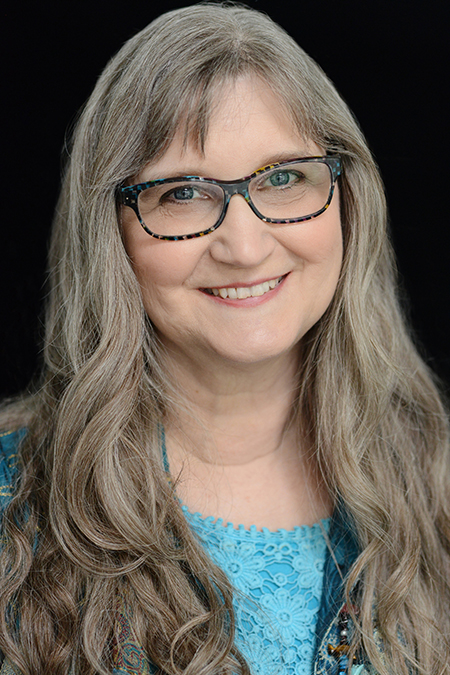
Bio
Jan S. Gephardt (pronouns: she/her) is a science fiction novelist, fantasy artist, publisher, and longtime science fiction fan from Kansas City.
Her XK9s Saga books feature a pack of uplifted police dogs. Her XK9 “Bones” Trilogy consists of What’s Bred in the Bone, A Bone to Pick, and Bone of Contention. The Other Side of Fear is a prequel novella. She’s now at work on a fourth XK9 novel, Bones for the Children.
Her stories are set in a far-future science fiction world, where the XK9s solve crimes and sniff out bad guys while seeking recognition of their own sapience. They live in a space station (inhabited by humans and several other sapient species) in a different star’s planetary system.
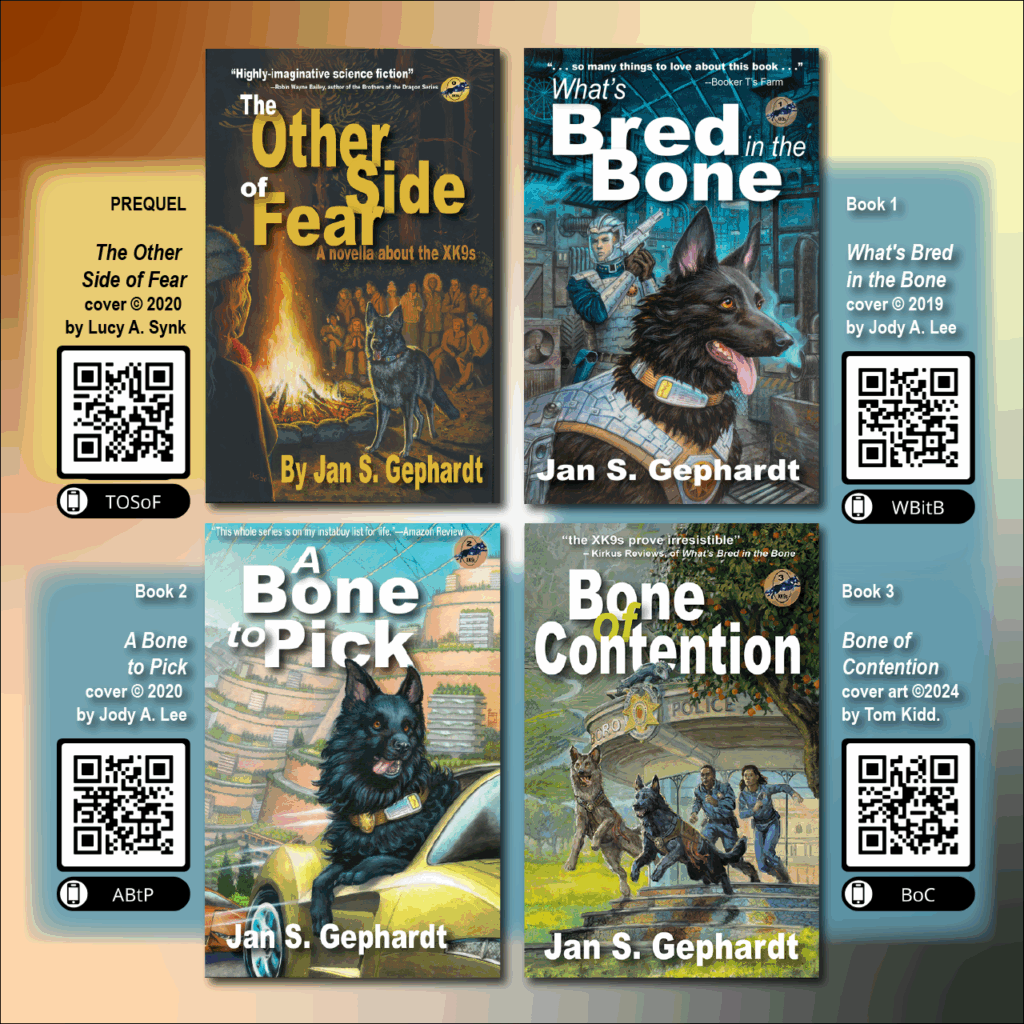
She and sister G. S. Norwood co-founded Weird Sisters Publishing LLC in 2019, after G.’s death in September 2024, her son Tyrell E. Gephardt joined the partnership.
She has exhibited her fantasy artwork at sf conventions since 1981. Since 2007 she’s developed a unique paper sculpture technique. Her artwork also has been featured in regionally-exhibited one-person shows, and juried into mainstream national exhibitions all over the United States. She’s a member and former officer of the Association of Science Fiction and Fantasy Artists (ASFA).
Interview
Poseidon’s Scribe: How did you get started writing science fiction?
Jan S. Gephardt: Science fiction was always kind of “there” all my life – one of the reading and viewing options. My first conscious memory of any kind of science fiction was a Saturday morning puppet show on TV called Fireball XL5 that I watched when I was in grade school. For anyone who knows, by that statement I have just revealed that I really am older than dirt.
I read voraciously the whole time I was growing up, and I started writing stories before I actually could read and write: I dictated a story to my mother at age four, and illustrated it with crayons. It was a tale of the adventures of a horse and a black cat who went in search of something, but I forget what. The important part, for me, was their journey and how they talked each other through problems. There are, of course, no themes there that relate to my later work (unless you count talking animals; a black animal; collaborative cooperation, adventure, mutual respect . . . )
P.S.: I doubt the “older than dirt” claim, but, moving on. Who are some of your influences? What are a few of your favorite books?
J.S.G.: Early influences? Anything illustrated by Leo & Diane Dillon, and The Chronicles of Prydain, by Lloyd Alexander. My sister and I would walk four blocks to our local bookstore to buy each new book when it came out. Then we’d take turns reading it to our mother.
Later, I was influenced by a wide variety of stories in a broad range of genres, from Regency romances by Georgette Heyer to mysteries by Mary Stewart, to sf by Heinlein, Asimov, and Poul Anderson. Can’t leave out fantasy, either. My Tolkien craze lasted quite a while. And of course I watched Star Trek, and later Star Wars (in movie theaters.)
My favorite books? You mean other than my own? (I confess, I do like what I write). But you probably mean by other people. Wow, there are so many!
In the past decade I’ve been reading a lot of what one might call “K9 Mysteries.” Probably my top favorite writer in that group is Margaret Mizushima, although I also follow Kathleen Donelly, Sara Driscoll, and Jodi Burnett.
Can’t get away from the mystery genre without also professing my love for Louise Penny and Deborah Crombie (the fact that Deb was my late sister’s best friend has nothing to do with my enjoyment of her Kincaid and James series. She writes a really good mystery!).
I’ve been loving the Legends & Lattes series by Travis Baldree in the fantasy field. I also enjoy the Innkeeper Chronicles by Ilona Andrews – they’re technically science fiction, but they read a lot like fantasy. I was charmed by the first Becky Chambers book, The Long Way to a Small, Angry Planet. I thoroughly enjoyed Lindsay Buroker’s Star Kingdom series. I’m currently re-reading War for the Oaks by Emma Bull. I’d forgotten what a wonderful book that is.
I’ve also recently been fascinated by a trio of nonfiction books that really unlock a lot of understanding about why our world works as it currently does. They are: Why Nations Fail, by Daron Acemoglu and James A. Robinson; The Wolves of K Street, by Brody Mullins and Luke Mullins; and Survival of the Richest, by Douglas Rushkoff. They explain so much!
P.S.: Tell us about your company, Weird Sisters Publishing. Sorry about the loss of two of its founding members, but it’s great news that your son has joined.
J.S.G.: Thanks. My sister Gigi (yes, the one who used to trek to the bookstore with me for Lloyd Alexander books) and I formed the company in 2019, about 14 years after the “third, honorary Weird Sister,” my late brother-in-law, Warren C. Norwood, had died.
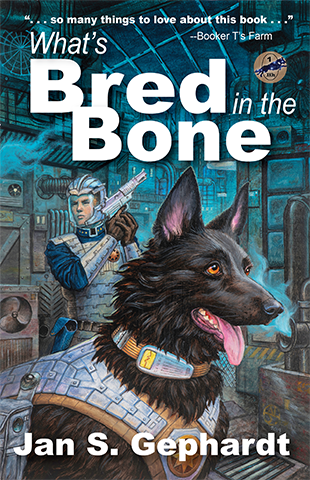
When we created the company, I had just finished my first novel, What’s Bred in the Bone. I was looking at the pros and cons of trying to get traditionally published, but I could also try to “go Indie,” or become part of an author collective.
Gigi and I looked at her big pile of unpublished books, and at Warren’s backlist, to which Gigi had the publishing rights, and my ambitions for the XK9 books. We decided we could form a closely-held family LLC, our own little author collective, focused on only selling our own books.
So, that’s what we did. We called it Weird Sisters Publishing for several reasons. Gigi was a theatre major in college where she specialized in Shakespeare for her BFA. Also, we’d been fantasy and folklore geeks. Of course we knew about the Wyrd Sisters, the Three Norns, the Fates, and all their other incarnations. Plus, when we were growing up we were always the nerdy girls with the big vocabularies and the “encyclopedia brains.” We knew we were often looked at as “those weird sisters.” All in all, it seemed like a natural.
P.S.: Weird Sisters Publishing offers books by you, your sister, and (I believe) her husband. How do the three authors’ styles, genres, and subjects differ? Are there similarities?
J.S.G.: Well, we’re working on getting Warren’s books back into print. When Gigi died suddenly in September, 2024, the rights to his literary property reverted jointly to his daughter Margaret and the D.M. Willis Library of the North Texas University.
The Willis Library has a collection devoted to Texas writers that they’ve been building around Warren’s papers. When Gigi died my legal right to publish Warren’s work went “poof.” Lucky for me, Margaret and a representative for the Willis Library have verbally expressed enthusiasm for seeing Warren’s work back in print. I have long believed his books deserved a better fate than to be backlisted and then forgotten.
Most of Gigi’s finished novels were written in the 1990s, and they were supposed to be what we would today call “spicy” romances. However, romance publishers consistently declined to buy her intricately plotted, cleverly crafted stories about young women finding their true self-worth while also discovering and establishing mutually satisfying relationships with their life partners. One of the great joys of my life was bringing Deep Ellum Duet, a collection of Gigi’s first two “Deep Ellum” novelettes, into print as a book. Deep Ellum Duet was the only printed book with her byline that she got to see and hold in her lifetime.
P.S.: You’re not only a writer, but an artist as well, with a gallery of beautiful and evocative artwork. Do the two interests—art and writing—intersect, or do you keep them separate?
J.S.G.: Oh, golly. For a long time I tried to figure out “what am I going to be? A writer or an artist?” I never did decide. My undergraduate major was art with an emphasis in printmaking, and a heavy side of what we used to call “commercial art,” now called graphic design.
While I studied art, I also got a teaching degree. I came out of college in 1976 (yes, older than dirt) with teaching certificates in art K-12 and journalism 7-12. Just about the time I thought I’d settled into doing “mainly art” or “mainly writing,” a new door would open and all at once I’d be mostly doing the other. Thus, I’ve done a lot of marketing – both writing and graphic design work – teaching, and I had a brief career in journalism. The range of skill sets I developed has helped me a lot with my work for Weird Sisters.
I was originally a pen-and-ink artist, a proclivity that fit well with my intaglio printmaking emphasis in college. I’ve shown my 2D science fiction and fantasy artwork at science fiction conventions since the early 1980s. The paper sculpture came later, sparked by a “pop-up book” assignment I did with my art students. I showed my paper sculpture in national and international juried exhibitions, and I had several solo shows regionally.
The “art work” that currently fuels my passion is commissioning illustrations. After all my years in sf fandom, including participating on all those art-related panels, showing my work alongside that of other artists, and working as an officer of ASFA, the International Association of Science Fiction and Fantasy Artists, I have become friends with a lot of marvelous illustrators. I love collaborating with them on both covers and interior art.
P.S.: How did you come to write about uplifted space dogs? Did you or do you have a dog of your own that inspired the idea?
J.S.G.: My books are built from my lifelong fascination with animals, animal intelligence, multiple cultures (my master’s degree is in multicultural education), future technology and societies, and mystery stories. I’ve had dogs all my life (lots of cats, too). Anymore, I tell my husband that “Professionally, I need to have a dog.”
It’s true that I regularly get inspiration from my current two, just as I have from all of their predecessors. Current canines in residence are an Australian Kelpie mix named Yoshi and one of Gigi’s dogs, an older Border Collie mix named Kata. My lifetime spent around dogs, plus recent research into canine cognition, fueled my invention of the “XK9s,” who are genetically engineered and cyber-enabled for communication.
P.S.: Is Rex the main canine character in all the XK9 books? What breed is Rex, and are his packmates of the same breed?
J.S.G.: XK9s are their own special breed. According to the story, they were developed from all the wonderful working and hunting breeds we know today. They have characteristics of Border Collies, German Shepherds, Belgian Malinois, Dutch Shepherds, Bloodhounds, Labrador Retrievers, Golden Retrievers, and many more. Many of my readers have dogs (including some who have one or more of the aforementioned breeds), and I imagine they recognize elements of their favorite breeds in some of the things the XK9s do.
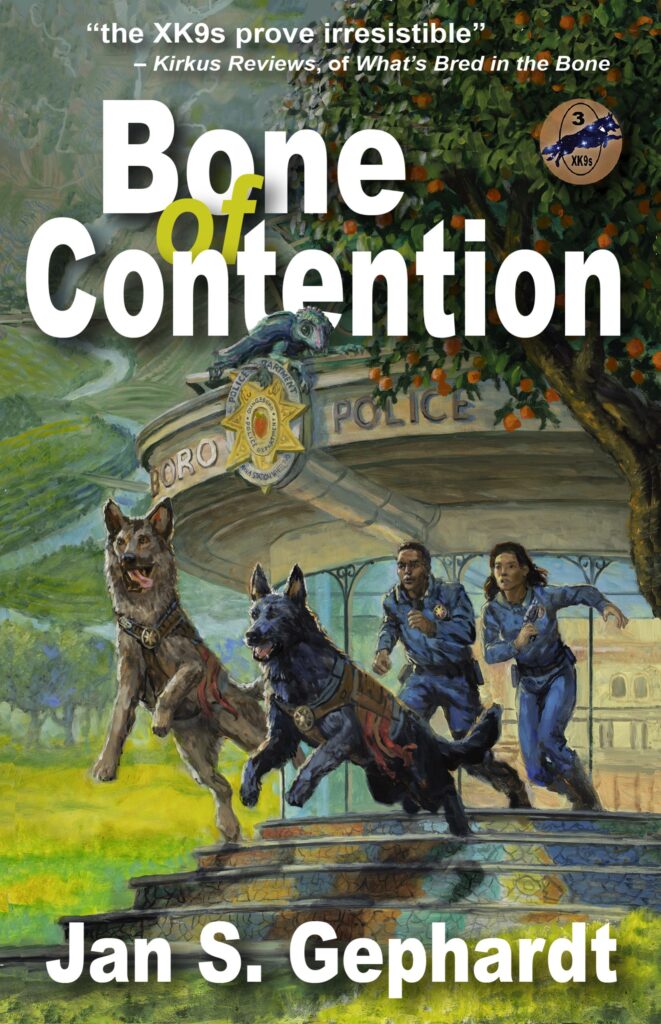
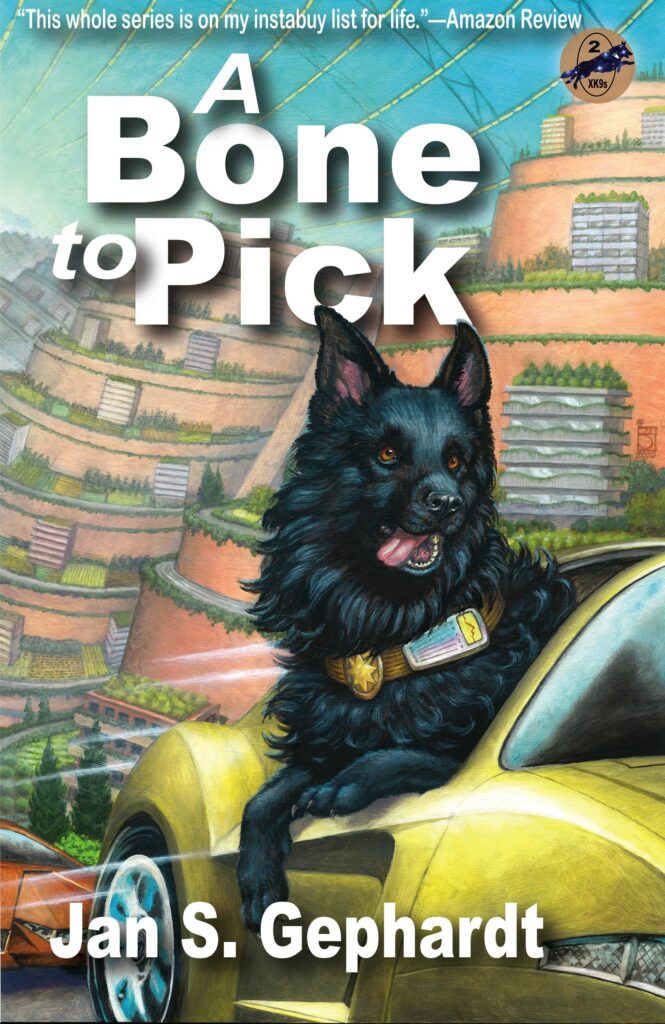
Rex is officially the protagonist of the XK9 “Bones” Trilogy, the first three novels. But you could argue that his mate Shady rivals him for “primacy” as the protagonist, especially in the second and third books, A Bone to Pick and Bone of Contention. As to who is the “top dog” in the book I’m currently writing? That’s probably Shady, although Rex and a new XK9, a refugee from Transmondia, are both viewpoint characters, too.
I recently learned that Kirkus Reviews will publish the Starred Review of my book Bone of Contention in the Dec.1, 2025 issue. That’s perhaps not a major literary prize, but they don’t just hand those out to any old body, especially not to Indies.
P.S.: Congratulations on that upcoming review! You’ve put a lot of thought into your space station’s design. Please describe Rana Station—where it is, what it looks like, and how it functions as the setting for your books.
J.S.G.: Rana Habitat Space Station is a space-based megastructure consisting of eight habitat wheels that counter-rotate in pairs to produce normal gravity for their inhabitants.
It occupies the L4 (LaGrange) point of the planet Chayko in an extrasolar system somewhere we haven’t discovered yet in Heritage Earth Year 2025. Rana Station was largely constructed using materials mined from M- and C-class Chayko trojans that had previously orbited in the L4 point where the station now has its own stable orbit.
Rana Station is also is the home of a multicultural, indeed, multi-species, society. It was jointly founded by a group of idealistic humans and a refugee subculture from a species called ozzirikkians. Neither could have created the station without the other. The ozzies” have their own two habitat wheels, calibrated to artificially create gravity compatible with ozzirikkian evolution, just as the human wheels centrifugally create 1G.
Rana Station is a fabulous place to raise your kids, but they still have crime. They still have politics. And they still need a police force. I did not “abolish” the Orangeboro Police Department (home of “The Orangeboro Pack”), but it does differ in some key ways from what we’re used to in our world.
P.S.: Regarding the XK9 trilogy, you’ve got three novels and a prequel novella. Will you be writing more in this series or starting something different?
J.S.G.: Oh, you bet I’ll be writing more in this series! Neither I nor my readers are tired of the XK9s yet! In fact, it’s humbling to realize how long and patiently they’re willing to wait for each new book. I’m almost finished with a fourth XK9 novel, Bones for the Children, and I have plans firming up for several more. As long as people keep buying them and I stay healthy, I’m not likely to run out of ideas. There are so many rich veins of possibility that I haven’t yet explored!
P.S.: Tell us more about Bones for the Children, at least what you can reveal.
J.S.G.: As noted above, it’s another XK9 novel, set a couple of months after the end of the Trilogy. As with all of these novels, it’s kind of an “ensemble cast.” Lots of moving parts, in other words.
There are six viewpoint characters, each with their own storyline and challenges in their own personal life. Rex, his human partner Charlie, Shady, and her partner Pam are all POV characters again in this one. But there also are two new viewpoints: those of OPD Chief Kwame Klein, and a new XK9 named See, who’s led a very different life from the ones Rex, Shady, and the rest of the Orangeboro Pack have had.
There’s a new mystery to solve in this book – or rather, a nested set of mysteries, wrapped up in a public safety crisis and complicated by a long history of political corruption and criminal enterprise. So, fun stuff! And loads of fun to write.
Poseidon’s Scribe: What advice can you offer aspiring writers?
Jan S. Gephardt: If you write, you’re a writer – no “aspiring” to it. But to be an aspiring professional, learn the craft and then persist. Put in those 10,000 hours of learning and growing and practicing the art and honing your skills. All through that process and long after it, don’t stop writing. Keep doing it, keep learning, keep putting your work out there. Be patient. Be humble. And don’t stop writing.
Poseidon’s Scribe: Thank you, Jan. Great advice!
Web Presence
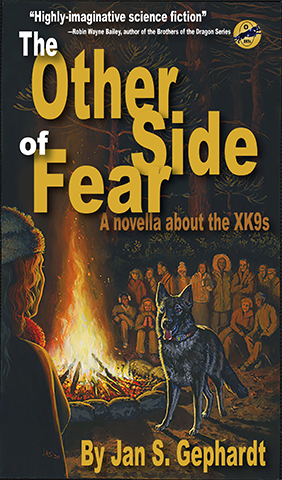
Readers and all dog lovers can find out more about Jan Gephardt at her website, her publishing company’s website, her Amazon page, her Goodreads Author Page, her Facebook Author Page, her Facebook Artdog Studio Page, her Facebook Weird Sisters Page, and on Instagram, and Bluesky. Jan blogs at her art studio and at The Weird Blog on her publishing site. You may sign up for her bi-monthly newsletter, and get a free ebook, The Other Side of Fear.