Talk about burying the lead. I announced a huge, new prize-winning opportunity for you, but I put it at the end of my last blogpost on August 9th. What was I thinking?
Here’s how the Pole to Pole Publishing Book Review Event works:
Email links to your reviews to Pole to Pole Publishing at submissions[at]poletopolepublishing.com.
Each posted review earns 1 point, but reviews of 20,000 Leagues Remembered earn 2 points each.
The person earning the most points will win three (3) books of the winner’s choice from Pole to Pole Publishing, in either ebook or paperback format. The winner may choose any Pole to Pole Publishing books as prizes, not just the anthologies.
Fine print: to count toward the prize, reviews must be posted between June 20 and September 30, 2020. You must email Pole to Pole Publishing with your review links on or before October 3, 2020. Editors of 20,000 Leagues Remembered reserve the right to judge what constitutes a legitimate review (write a few sentences, please; a ‘stars-only’ review doesn’t count). Authors of stories appearing in P2P anthologies are eligible to participate. Anthologies to review are: Hides the Dark Tower, In a Cat’s Eye, Dark Luminous Wings, Not Far From Roswell, Re-Launch, Re-Quest, Re-Terrify, Re-Enchant, Re-Haunt, and 20,000 Leagues Remembered. Winners will be contacted via email.
Why are you still reading this blogpost? You have book reviews to do! You already know how this post ends, just like all posts by—
Until recently, I had been a writer like you, churning out stories and submitting them before Oz, the Great and Powerful…er, I mean editors.
I just co-edited a book myself for the first time and I learned a few things. Today, I’ll pull back the curtain and show you what I found out. Some editors might tell you to pay no attention to the mere mortal behind that curtain, but not me. Perhaps the following nuggets of wisdom will help you as you write and submit stories.
Get away from your gender planet. I’ll try to put this delicately. In 2020, I assumed women weren’t from Venus anymore and men weren’t from Mars. That is, I assumed female writers had gotten beyond long descriptions of characters’ apparel and deep explorations of relationships with no real plotline. Likewise, male writers were well past stories filled with violence and action, peopled with stereotype characters who speak in monosyllables. I thought we’d transcended all that. Nope. Without looking at a writer’s name, I could generally tell the gender in the first couple of paragraphs. My advice—bend your writing toward the other gender’s planet.
Don’t expect your poorly written good idea to sell. Occasionally, we’d get a story with a wonderful premise, engaging plotline, and compelling characters, and we’d really want to accept it. Unfortunately, the work suffered from grammar mistakes, plot holes, anachronisms, and other problems. As editors, we’d have to weigh the time required for thorough editing, as well as the back-and-forth communication with the writer, against the idea of accepting a different story that was almost as good but had far fewer mistakes. Self-edit your story with care before submission.
Don’t throw junk at the wall. If the submission guidelines state the editors are looking for stories inspired by Jules Verne’s Twenty Thousand Leagues Under the Sea, send a story like that. We received more than one story way, way outside those bounds. As a new editor, I read every submission all the way through. For some, I kept hoping as I read that there’d be some connection, some reference, some link to Verne or submarines, but no. What a waste of the writer’s time, not to mention mine.
Learn to write a cover letter. Luckily, there’s not much to learn. If the submission guidelines tell you what the editor wants in your cover letter, follow those. If not, here are my guidelines: (a) No spelling or grammar mistakes. If you can’t get the cover letter right, the editor will have little hope for your story. (b) Just include relevant facts about yourself, things that connect to your story. If you’re sending fiction, don’t list your non-fiction and poetry credits. If you have no relevant credentials yet, don’t stretch what you have to fit. (c) Shorter is better, by far. If your cover letter bores an editor, there’s little hope for your story. If you can get away with no cover letter at all, do that. If all you say is “Please consider my story, ‘<title>’ for your anthology,” that’s fine too.
Follow submission guidelines. Sure, it stinks that every editor has her own filename structure, font rules, quote mark guidance, page formatting, etc. Yes, it would be easier if they all agreed on the same submission process. We don’t live in that world yet. Just read and follow each editor’s rules. Better that than to give the editor a good reason to reject your story.
Understand that rejections aren’t only hard on the writer. Boy, I hated having my stories rejected, until I learned to get over it and keep submitting. But it’s actually worse from the editorial side. Several stories were on the borderline, really close to getting accepted for our anthology. It broke my heart to reject them. Not much advice here, but just realize that you’ll never know how difficult it was for an editor to reject your submission. Even if they tell you, it won’t help much. Just pick yourself up and submit that story elsewhere.
Aim for a smooth author-editor relationship. After acceptance, be positive and professional in all your communication with the editor. If an editor recommends changes to your story, consider them dispassionately before exploding. You can push back against changes where you disagree, but explain your reasoning when you do. In the mission of making your story the best it can be, you and the editor are on the same team.
Help with marketing. If your story is accepted by a small press, understand that they won’t have a marketing team. They’ll appreciate any advertising help you can provide, including promoting the anthology on social media, interviewing the other authors on your blog or having them guest-post, and posting a review of the anthology.
Now that I’ve given you a peek behind the curtain, you’ve got the brains, heart, and courage to find a good home for your story. All granted by that great and powerful wizard—
Three days after the party and I’m still recovering. No, not really. It was a Facebook party to celebrate the launch of the anthology 20,000 Leagues Remembered. No music, no dancing, relatively few drinks.
We held it last Thursday night, the first Facebook party I ever attended, and I was one of the two hosts. We had 32 attendees, including both co-editors (Kelly A. Harmon and me), and 7 of our 16 authors.
Much credit goes to those authors, who kept things interesting by posting fun facts about themselves and their stories. I heard feedback from one attendee who said the author bios were the best part of the party.
We gave away prizes, some randomly based on numbers of comments and shares, and some based on correctly answering trivia questions. Prize winners got to choose from among Pole to Pole Publishing’s collection of anthologies.
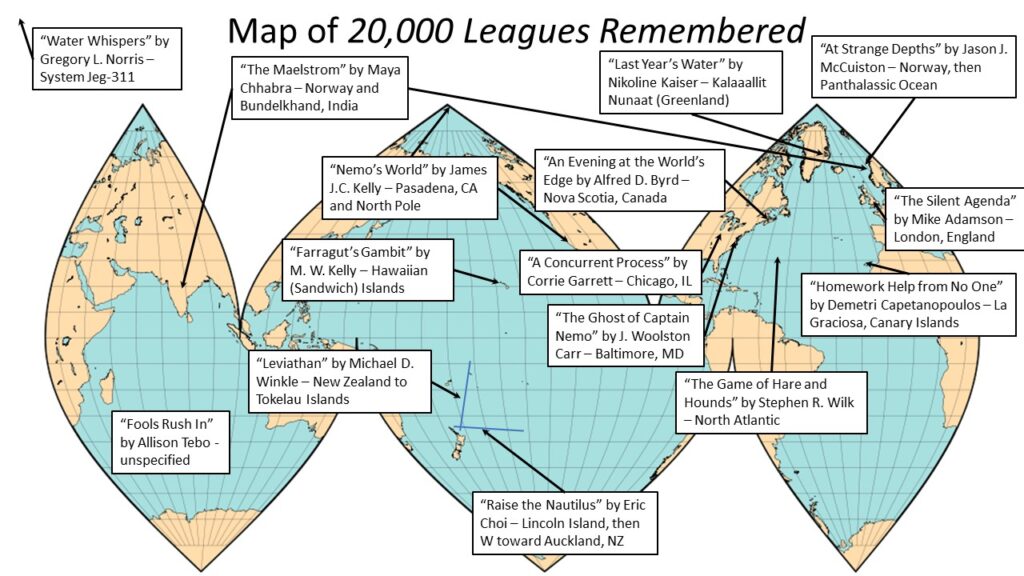
Prior to the party, I’d been thinking about the wide variety of settings for the anthology’s stories, and made a map of all of them. I posted the map during the party and people seemed to like it. One party-goer said all anthologies should make similar maps!
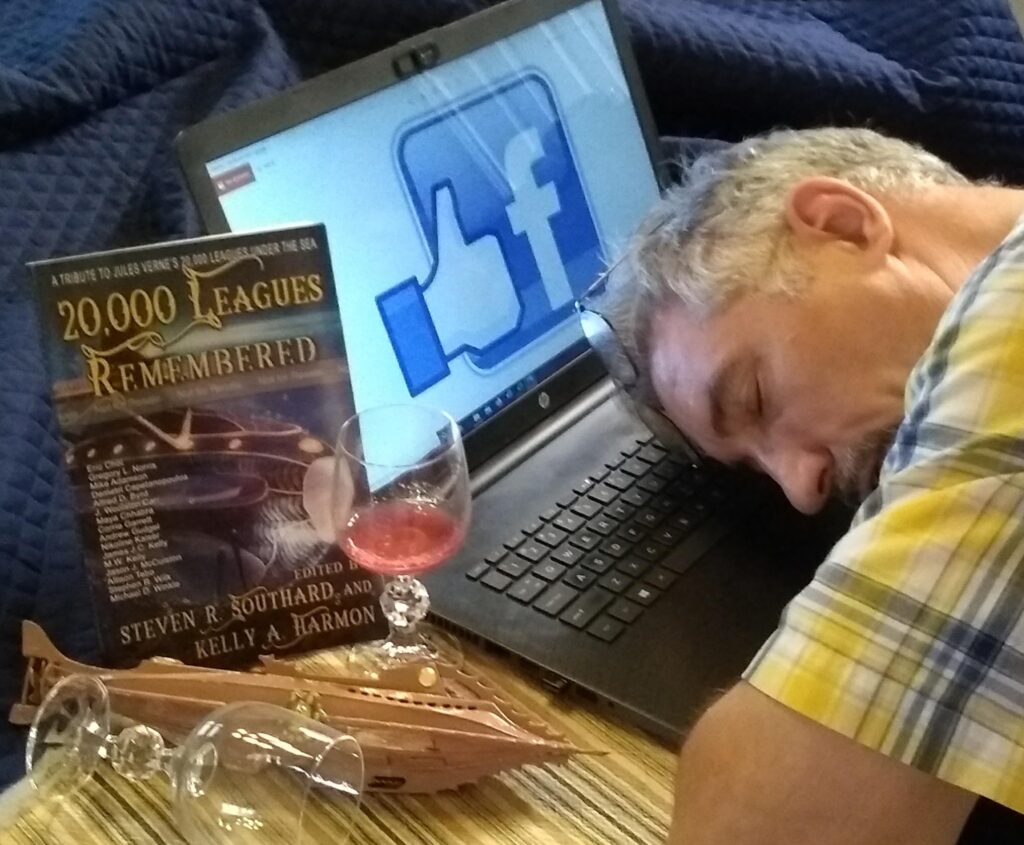
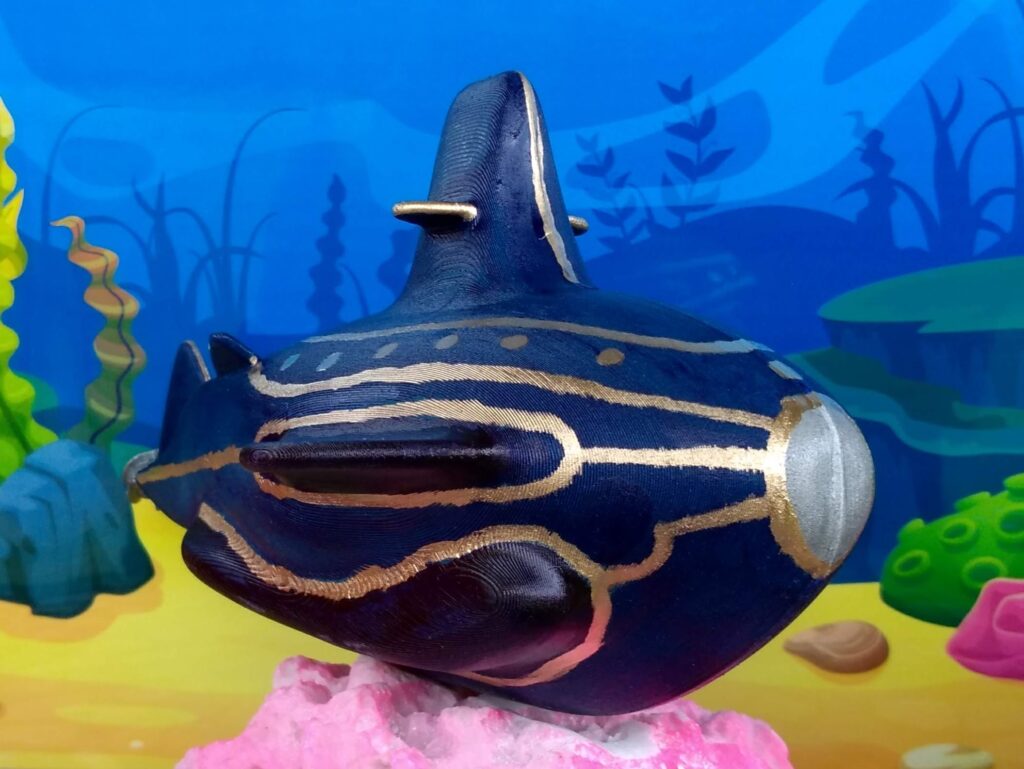
One of my daughters is particularly talented with 3D printing and has printed models from my various stories before, pictured here, here, here, here, and here. Recently, she made a near-replica of the submarine pictured on our anthology’s cover. I’m to blame for the poor paint job, but still. Kinda cool.
If you missed the party, you can still enjoy the retrospective here.
Grand Prize Still Up for Grabs!
Also, a grand prize is still available! Here’s how you can earn it, simply by posting book reviews during the month of August 2020. Post your reviews of 20,000 Leagues Remembered and any other anthology from the Pole to Pole Publishing archives on Amazon, Goodreads, Barnes & Noble, your blog, and any other online public forum. Email Pole to Pole Publishing at submissions(‘at’ symbol)poletopolepublishing.com with the URLs of your reviews. Each posted review at each public site earns you 1 point, but reviews of 20,000 Leagues Remembered earn 2 points each. (The co-editors of that anthology reserve the right to judge what constitutes a legitimate review.)
If you post the most reviews during the month of August, you’ll win…wait for it…3 (yes, three) books of your choice from Pole to Pole Publishing, in either ebook or paperback format.
I’d like to win that prize myself, but, <heavy sigh> one of the few people in the world who isn’t eligible for it is—
What traits do you need to become a successful fiction writer? Of those, which are most important?
Author Anne R. Allen wrote a blogpost some years ago that inspired this line of thinking for me. She had encountered people who thought talent was necessary, and sufficient. They’d send her their written excerpts and ask, “Do you think I’ve got the talent?”
Anne Allen argued, persuasively, that natural talent might aim you in your life’s direction, but is far less important than skill, or several other traits she cited.
I decided to carry the argument in a different direction. Given the traits she mentioned, could I come up with an ordered list from most important to least important?
Using a technique called pair-wise comparison, I used a matrix to compare each trait against each of the others and added up the scores.
First, let’s define each one in alphabetical order:
Creativity, or Imagination. This wasn’t on Anne R. Allen’s list, but I consider it important. Basically, it’s the ability to come up with new ideas, to invent characters, plots, scene descriptions, etc.
Drive. This is the inner motivation or impulse to write. It’s that determination, that self-discipline, that pushes you to create fictional worlds.
Gratitude symbol
Gratitude. By this, Anne meant the willingness to accept help in the form of negative criticism, particularly comments on your manuscript from beta readers and editors. I would have called it Toughness, or Thick Skin, but we’ll keep with Anne’s term.
Learning. This is the willingness to acquire new writing skills by educating yourself. There are numerous methods, including studying the classics, taking classes, participating in critique groups, and reading books about writing. Choose the method that works for you.
Marketing. This trait measures how well you understand what your readership wants and how well you expose potential readers to your writing. These days, you have to know the market and be willing to advertise yourself.
Observation. Anne called this trait “Listening Skills,” but I sought a one-word description. Writers must watch and listen to people, how they behave, what they say, what facial expressions and gestures they use, what verbal expressions and dialect they employ, etc. Such knowledge will make your characters seem more realistic.
Passion. This describes your love of writing. Although related to Drive, this is more about the pleasure you derive from the act of writing itself.
Tabono Symbol
Persistence. It’s a measure of your willingness and ability to overcome setbacks, to solve problems and move forward, to rise after falling.
Skill. This trait describes the quality of your writing. Anne had much to say about skill, but didn’t include it specifically in her list of traits. She defined ‘talent’ as inborn skill, but believed few people had talent, but most could develop skill. Her post suggested that ‘skill’ was an umbrella term that included all the other traits. I believe skill is independent of all of them, and merely addresses how well you write.
Solitude. Anne called this ‘The Ability to be Alone’ and made it clear that writing is not just for introverts. It’s just that extroverts must leave their comfort zone for a while, since writing is an individual effort.
Obviously, there are inter-relationships and overlaps among these traits. Still, they’re distinct enough that I was able to rate each one in importance against all the others. Below is my subjective list from most important to least:
Creativity
Drive
Passion
Observation
Learning
Skill
Persistence
Gratitude
Marketing
Solitude
As a general pattern, you can see my most important ones are traits that get you started, and the least important (with the exception of Solitude) are traits you develop as a result of having written and submitted your work.
That list may not seem right to you, but it works for—
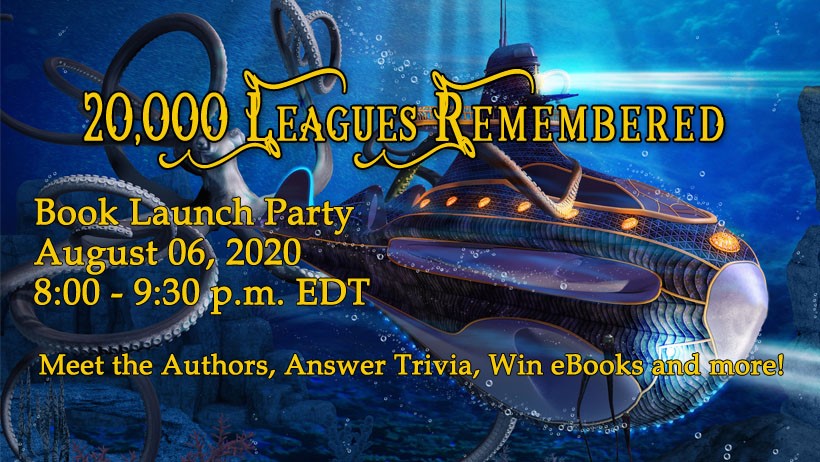
Just as Jules Verne’s Nautilus traveled all over the world, we’re throwing a world-wide party. It’s on Thursday August 6th, from 8:00 PM to 9:30 PM EDT and it’s on Facebook.
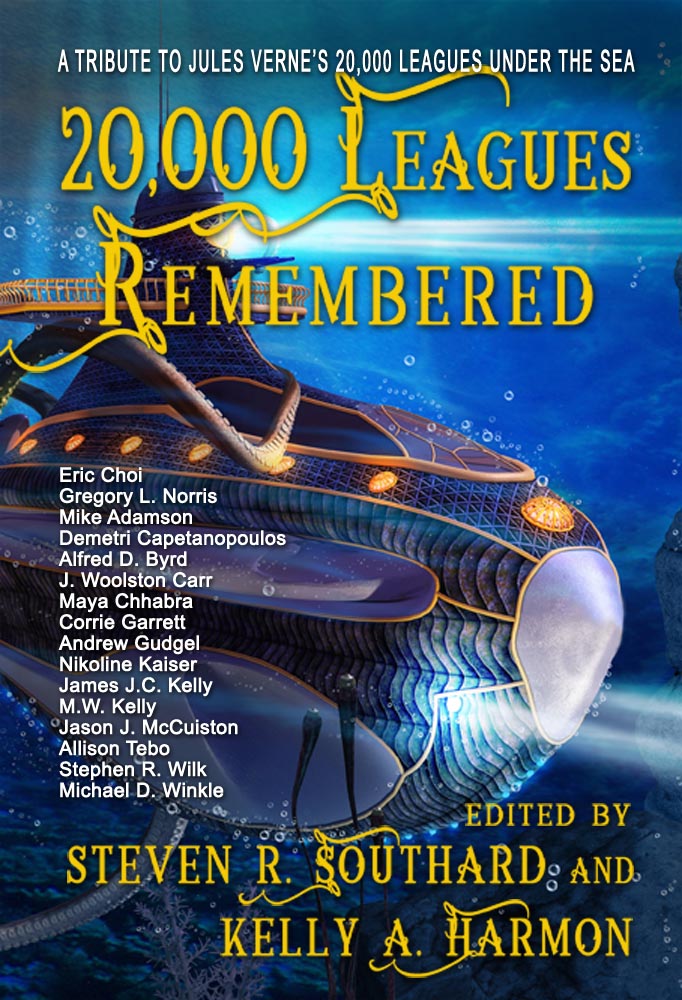
We’re doing this to celebrate the launch of the new anthology 20,000 Leagues Remembered. Published on the 150th anniversary of Jules Verne’s masterwork, this book contains new stories by 16 modern authors, all paying tribute to Twenty Thousand Leagues Under the Sea, that classic proto-steampunk novel of undersea adventure.
At the party, you can meet the editors and the authors of the stories and ask all the questions you want. Best of all, you can win prizes!
You’re invited! Everyone is. Now, of course, you’re wondering how to attend. Just follow these steps:
Create a Facebook account if you don’t already have one.
If you don’t receive a party invitation within a day or two, send me a message to prompt me.
Once you get the invitation, accept it.
Share info about the party with your friends.
Log into Facebook at the right date and time and join the fun.
(If anyone knows a simpler way to invite the whole world to a Facebook event, let me know in the comments to this blogpost.)
You’ve waited 150 years for this sesquicentennial celebration. It would be a shame to miss it. After all, the bicentennial won’t be until June 2070, and that’s a long time from now.
See you at the party! You’ve been cordially invited by—
Fluent in French, English, German, Latin, and Bundeli
Adept in using Google to translate 107 languages
Electrical experience
Used electric rails to shock Papuan natives
Electrically shocked self during home repairs
Wealth
Immensely rich from salvaging treasure
Often imagined being rich
Royalty
Born a prince
Listened to music by Prince
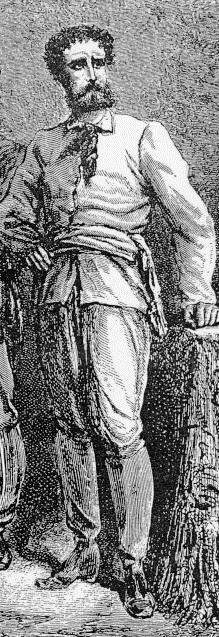
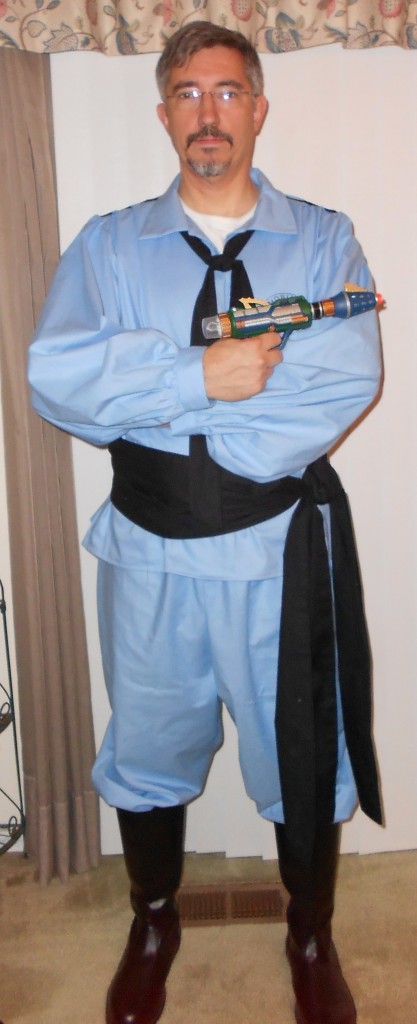
I know, it’s eerie, right? It’s not like I set out to pattern my life after Captain Nemo. I doubt very much that I’m somehow related to him, or that I’m a reincarnation of him. However, I wouldn’t dismiss those possibilities out of hand, either.
At this point, I’d like to ease the fears of any mariners reading this post. Despite my many similarities to Captain Nemo, I have no immediate plans to voyage around the world’s oceans, ramming ships along the way. Sailors of all vessels at sea are safe from any attack by me.
I promise to use my Nemo-like powers only for good, like co-editing 20,000 Leagues Remembered, an anthology recently launched by Pole to Pole Publishing.
The subject of this post might seem silly, even condescending. You already know how to read, or you wouldn’t have gotten this far into my post.
Perhaps I should have titled it ‘How to Get the Most Enjoyment Out of Reading an Anthology,’ but that’s too long and cumbersome.
I have some experience with anthologies. I’ve read many dozens of them, my stories have appeared in sixteen of them, and I’ve recently co-edited one. Allow me to share my recommended eight steps for thoroughly enjoying an anthology.
Read one of the stories. For most anthologies, the order doesn’t matter. The editors had reasons for organizing the stories as they did, but you can read them in any order.
Ponder the story you just read before going on to the next one. You might need this pondering time to ‘get’ what the author was saying, since it’s not always obvious right after reading.
Jot down some notes about the story, including its most memorable aspects and whether you liked it or not.
Repeat Steps 1 through 3 until you’ve finished the anthology.
Pick your favorite stories. Perhaps there are as many as five or as few as one, but I’m sure you’ll have favorites.
Write and post a review of the anthology online, perhaps at Goodreads or anobii or at the site of the bookseller where you got the book. In your review, don’t be afraid to mention your favorite stories by title and author name. Consider including brief comments about why you liked these stories. If you have comments about the anthology as a whole, include those too.
Look up, online, the authors of your favorite stories. See what else they’ve written that you might want to read next.
Contact those authors who are still alive and let them know how much you enjoyed their story, or ask any questions you may have. Most authors love hearing from fans.
I know this eight-step process seems much more difficult than simply reading the anthology and going on to the next book on your extensive ‘must read’ list. But the act of taking notes on the stories will help you remember them better. Writing reviews will, in time, make you a more discerning reader, able to extract more meaning and enjoyment from stories. Contacting favorite authors could result in good additions to your ‘must read’ list, books you’re sure to enjoy.
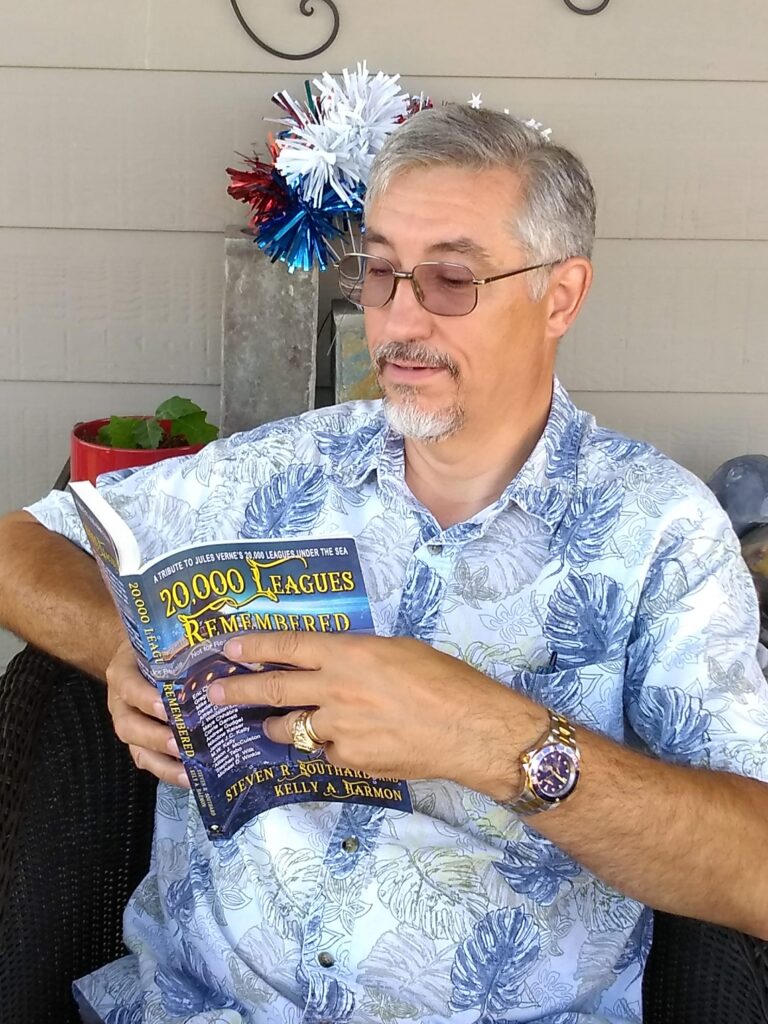
Now that you know how to read an anthology, may I recommend one? It’s 20,000 Leagues Remembered, co-edited by yours truly and just released by Pole to Pole Publishing. It’s a sesquicentennial tribute to Jules Verne’s amazing undersea masterwork, Twenty Thousand Leagues Under the Sea. You can purchase it at Amazon, Barnes & Noble, Apple iBooks, or Kobo.
You have to admit, the process I described is a fine way to read an anthology. You might even call it The Anthology-Reading Method of—
Sometimes an author belatedly tries to force-fit two or more stories into the same world timeline, but it doesn’t work well. Just ask the creators of Star Trek, Star Wars, and the writers of just about any long-running comic book series.
Jules Verne tried to tie three of his novels together, recognized the chronological errors, attempted to explain them away, and ended up confusing things even more.
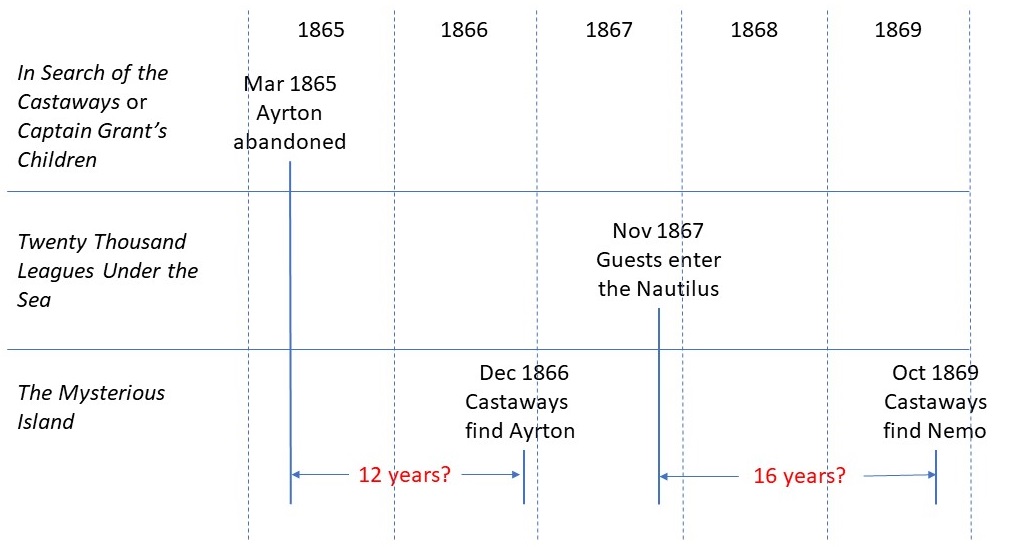
In Verne’s novel In Search of the Castaways (also called Captain Grant’s Children), the main characters abandon the traitorous Tom Ayrton on a deserted island in March 1865.
In the subsequent novel Twenty Thousand Leagues Under the Sea, three main characters are taken aboard the Nautilus in November 1867.
So far, so good. However, in The Mysterious Island, the castaways find Ayrton in December 1866. Ayrton states he was abandoned 12 years earlier, in March 1855. (Not just less than 2 years, as simple subtraction would indicate.)
Verne and his publisher included this footnote in the text:
The events which have just been briefly related are taken from a work which some of our readers have no doubt read, and which is entitled, Captain Grant’s Children. They will remark on this occasion, as well as later, some discrepancy in the dates; but later again, they will understand why the real dates were not at first given.
Thank you very much, Jules. That helps a lot.
Later in The Mysterious Island, in October 1869, the castaways come across Captain Nemo. He states it has been 16 years since the three guests came aboard the Nautilus. (It had been just shy of 2 years, but maybe time moves slower on that island.)
Again, Verne and his publisher included a footnote:
The history of Captain Nemo has, in fact, been published under the title of Twenty Thousand Leagues Under the Sea. Here, therefore, will apply the observation already made as to the adventures of Ayrton with regard to the discrepancy of dates. Readers should therefore refer to the note already published on this point.
Sooo, Jules, I think you’re saying you know you goofed up, and want your readers to know that you know. However, with two enigmatic footnotes that reference each other, you’re hoping we’ll accept that there’s some logical reason for these hopeless temporal contradictions.
It’s a strange attempt at chronological hand-waving, but we see what happened. Verne’s proclivity for including precise dates in his novels got the best of him. After publishing Captain Grant’s Children, he wished he had set that novel ten years earlier. That way, Ayrton would have been living alone for 12 years rather than 2, and more believably reduced to an uncivilized state.
Similarly, Verne needed a much older Captain Nemo in The Mysterious Island, an aged and lone survivor of his crew in 1869. Only then did Verne wish he’d not already written about a younger and energetic Nemo, and full crew, set in the years 1867-8.
He could have set The Mysterious Island further in the future, but he wanted his castaways to escape from a prison during the American Civil War, so that fixed his start date no later than 1865. He could have left his castaways on Lincoln Island a lot longer, say, 20 years rather than 4, but that’s stretching credibility.
If you had been Jules Verne and faced with these problems, how would you have solved them?
While you’re thinking about that, I can recommend a good book to read. 20,000 Leagues Remembered is a just-released anthology of 16 stories by modern authors, each tale inspired by…well, you can guess.
Verne wrote so many fine novels, he certainly can be pardoned for some botched stitch-up jobs. At least he’s forgiven by—
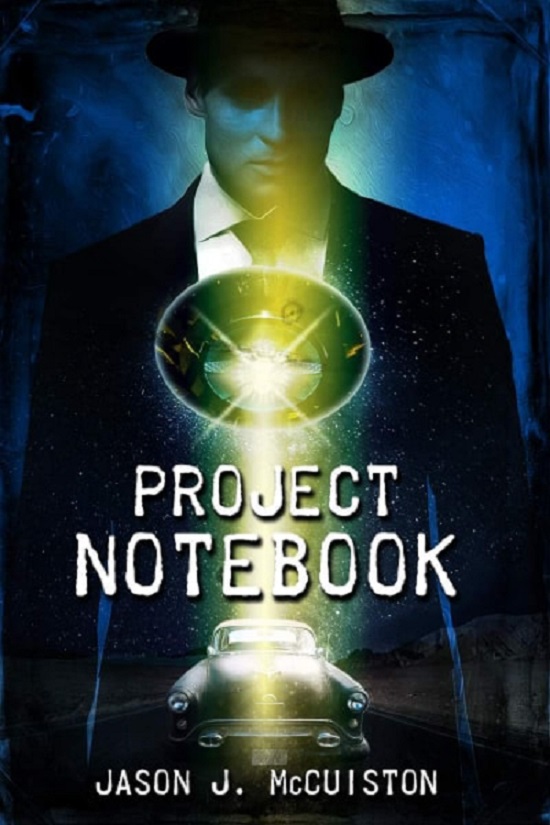
In the summer of 1947, months before something fell to Earth near Roswell, New Mexico, the skies above the Pacific Northwest were alive with strange lights and unearthly phenomena. I know this because the Travel Channel’s Mysteries at the Museum told me so. In fact, according to Don Wildman and crew, less than a week passed between the infamous Maury Island Incident and the Kenneth Arnold sighting above Mt. Rainier which introduced the phrase “flying saucer” into the American zeitgeist.
That connection or coincidence was the spark that led to my novel, Project Notebook. The spark, but not the fuel. The origins of this story may go back to 1947, but they also reach farther back into my own history than a late-night binge-watch in early 2017.
Jason J. McCuiston
Like most kids who grew up on action, sci-fi/fantasy, and horror in the 1980s, I was instantly hooked on Chris Carter’s The X-Files when it debuted on Fox in 1993. Aside from having a twenty-year-old’s crush on Gillian Anderson, I loved the conspiracy-theory/dark fantasy vibe of the show. And though I never became more than a casual interloper into the world of ufology, I’ve kept an open mind on the topic and have always found it fascinating.
A decade later, after watching the stunning HBO adaptation of Band of Brothers in 2001, I read not only Stephen E. Ambrose’s book, but also the excellent biography of Major Dick Winters, Biggest Brother by Larry Alexander. These volumes gave me an insight into the Greatest Generation, as well as a glimpse of what my own grandfather, the late Master Sergeant Darius E. McCuiston, U.S. Army, had faced in WWII. While writing Project Notebook, I soon realized that the main character, Captain El Summers is a synthesis of Winters and my Papaw.
In 2006, I found myself in a new life in Knoxville, Tennessee. Part of this new life was my weekly gaming group. We were playing the d20:Modern role-playing game at that time. Wizards of the Coast had just released the Dark Matter supplement for d20:Modern, a campaign setting that leaned heavily into the conspiracy-theory/dark fantasy/darker sci-fi atmosphere of The X-Files. That’s when it occurred to me that the first people most likely to be tapped by the U.S. Government to investigate rumors and reports of UFO’s and aliens would be battle-hardened vets of The Big Two.
So I launched a campaign based on this premise.
Sadly, the game tanked after one session, but the premise hung around in the back of my mind for over a decade. And in the summer of 2017—after two years struggling to break in as a “pro” writer and several nights watching Mysteries at the Museum—I decided to throw that premise at the page and see if it stuck. After writing the first draft of what eventually became Chapter One of Project Notebook, I posted it to a Facebook writing group for feedback. Naturally, it drew a troll quicker than a goat on a bridge. After this individual lambasted my abilities and concepts, I thanked him for his opinion, and sat down to write this story. As much out of spite as anything else.
Writing is about passion, no matter where that passion comes from. Remember that.
I’m honestly glad that troll got under my skin. Being more interested in fantasy than sci-fi and in the eleventh century than the twentieth, I may have never written this story otherwise. I may have never learned so much about the era of my grandparents. I may have never delved so deeply into the lore of ufology. I may have never created these characters for whom I have developed an amazing fondness in the ensuing years of revisions and edits.
I can only hope that you will find El, Red, Olivia, and Bill as endearing should you decide to follow their adventures in Project Notebook.
Jason J. McCuiston
Thanks, Jason. I know my readers will seek you out on Facebook and Twitter. Then they’ll buy your book on Amazon.
Mobilis in Mobili—the motto of Jules Verne’s Captain Nemo. Or should that be Mobilis in Mobile? Let’s consider it.
Why even ask the question? Well, Verne’s publishers went back and forth, using mobili in some versions and mobile in others. It seems even they were confused.
The two are Latin words. I’m no expert in that language, but as I understand it, mobili is pronounced mob´il-ee and mobile is pronounced mob´il-ay.
Here’s the text from Twenty Thousand Leagues Under the Sea, as it appears in the 1993 translation by Walter James Miller and Frederick Paul Walker:
“Each utensil, spoon, fork, knife, plate, bore a letter encircled by a motto, of which this is an exact facsimile:
Motto from Wikipedia
‘Mobile within the mobile element!’ That Latin motto was certainly appropriate for this submarine craft, so long as the preposition ‘in’ was translated as ‘within’ and not ‘upon.’ The letter N was no doubt the initial of the enigmatic person in command at the bottom of the ocean.”
Miller and Walker use their own motto image, with mobile. They state that mobili is plural and mobile is singular. Since Verne’s explanation in French (“l’element mobile”) is singular, they reason that the Latin word should be singular as well, hence mobile.
What does the motto mean? My old copy of Cassell’s New Latin Dictionary gives several meanings for mobilis including movable, easy to move, active, rapid, pliable, flexible, changeable, inconstant, with quick motion, easily, and quickly.
So we have ‘moving in a moving thing’ or ‘living free in a free world’ or ‘changing with change.’ Those first two meanings presume a singular object (moving thing or free world), so the singular mobile seems more appropriate for them.
At this point, many of you are thinking of the Monty Python Latin lesson scene in the movie Life of Brian. Now imagine John Cleese as Professor Aronnax staring at the Nautilus’ tableware and correcting Captain Nemo’s Latin!
Now that your head is spinning from that language discussion, permit me to urge you to buy and read the new anthology from Pole to Pole Publishing—20,000 Leagues Remembered. It’s available in ebook form now, and soon in paperback.
To finish up, I’ll confess to an unscholarly preference for mobili. It looks more like a Latin word than mobile, which is identical to the English word mobile.
Still, despite my preference, I guess I must be flexible and willing to change, and must therefore bow to the experts. Mobilis in Mobile it is. As you can see, there are few people more mobilis than—