Quarantine and the Writing Scene

The spread of the COVID-19 coronavirus has got us all thinking. Each of us is reacting in his own way. As a writer, my mind turns toward fiction possibilities.

Please don’t take this post as some attempt to minimize or make light of this contagious and deadly disease. The numbers of infected and dead continue to mount as this new virus spreads around the world. Nobody knows how bad this coronavirus will get. Though panic may be unwarranted, so is blind optimism.

So far, I’m not showing any symptoms and am not under quarantine, neither the imposed nor self-directed kind. To my knowledge, that’s also true of everyone I know well. I’m not blogging about quarantines due to any personal experience, but merely because the topic is timely and it interests me as an observer of society.

COVID-19 is causing some changes in our behavior. For the most part, we’re all washing our hands more often and more thoroughly. We’re travelling less, and going to fewer well-attended events. We’re practicing ‘social distancing,’ and greeting others with fist or elbow bumps. We’re staying in our homes more and connecting with each other virtually.

When TV journalists conduct video interviews of symptom-free people who’ve been quarantined out of caution, the people all say they’re binge-watching movies and playing games to pass the time. (Not reading books? Come on!) But they feel lonely and isolated. They want the two weeks to be over.

That’s understandable. We’re social animals. We gain comfort from the close presence of others. If we now must view others as potential bringers of disease, that sets up an internal conflict, a tension between self-preservation and a need for acceptance.

For most writers, a symptom-less quarantine wouldn’t be so bad. Writing is solitary anyway, and necessary social interaction represents an interruption of the writing process. To some extent, writers practice a quasi-quarantine all the time.

Perhaps because of their self-imposed isolation, authors sometimes write about disease pandemics. Early examples include The Decameron (1353) by Giovanni Boccaccio and The Last Man (1826) by Mary Shelley.

More recent novels about pandemics are The Plague by Albert Camus, The Andromeda Strain by Michael Crichton, and The Stand by Stephen King.

All these works depict horrible results after the disease has run its course. Few novels (except The Plague) show the effects of quarantine, of forced separation.

One extreme fictional example of human separateness, though not involving disease, is The Naked Sun by Isaac Asimov. In it, citizens of the planet Solaria grow up detesting the physical presence of other humans. They don’t mind robots, but can only talk to other people through holographic communication, a sort of 3-D version of Skype.

Could COVID-19 or some later, more deadly virus, force us to behave like Solarians, alone in our homes, communicating only by email and text, with drones delivering all our supplies direct from robot factories? What would that isolation do to our psyches, to our instincts for close contact?

There’s your next story idea, free of charge. You may thank me for it, but not in person. Alone (with my spouse) in quasi-quarantine, I’m—

Poseidon’s Scribe

My Muse Walks into a Blog

I haven’t invited too many guest posts on my site, and today both you and I will discover why. I invited my muse to write a post. She accepted right away. That was three years ago.

I prodded her about it recently, during one of her rare visits, and she said she hadn’t forgotten. She’d just been busy. I think she was lying. In any case, below is what she gave me, and it sure doesn’t read like three years’ worth of work. More like a last-minute, slap-dash, hodgepodge mess.

______________________________________________________________________________

Hi! I’m Steve’s muse.

Never written before—more of an idea girl myself. Talker, whisperer.

(Have you ever thought about—) No, wait. Supposed to explain, not suggest.

Just, I’m full of ideas today. Suggesting’s what I do.

(How about a driverless, autonomous car story? That’d be timely.)

They fill me, ideas do. I whisper to Steve, then move on.

Don’t know what he does with ‘em, don’t care.

(What if someone learned to talk to a dolphin, and the dolphin was the only witness to a crime—would a dolphin’s testimony be accepted?)

This language Steve uses, these punctuation marks—too constraining.

ideas are where i live          in the mind    anything is possible

i hate constraints

(What if a spaceship used a ‘gravity sail’ instead of a light sail? So fragile it couldn’t enter a solar systems’ gravity well?)

Why    cant’    I           write    like      this?

Or

            like

                        this?

(Time for someone to write about a murder on a magnetic levitation train)

Sorry, gotta go.

.

.

.

.

Back now. Don’t ask.

What’s the topic? Oh, constraints and rules…hate ‘em.

(If there are cruise ships, why aren’t there cruise submarines?)

Stupid topic, rules are. Moving on…

About me: Idea Girl. Creativity Girl. Muse.

(What about a time-travelling fish?)

A thousand ideas a second. Flitting sparks, nebulous, ethereal.

Gotta tell Steve. He’s my guy.

(A setting. Planet covered with muddy swamps and permanent, pea-soup fog.)

Steve’s slow, though.

Always wants me to tell him more…to flesh out my ideas.

(What if a character couldn’t read minds, but her mind could be read by anyone within a few feet of her?)

I don’t flesh out ideas, Steve.

Your job.

(What about the first robotic NASCAR driver?)

I just whisper and leave, that’s my job.

Wow! Shiny object over there! See ya!

______________________________________________________________________________

That’s all I got from my muse. Now you know what I have to put up with. I doubt I’ll be inviting her to guest-post again, ever. In conclu—

Ooh, ooh. Steve. Can I do the signoff?

What? No.

Pleeeeese?

Well…if it’s that imp—

Squee! Here goes. That’s it for the best-ever post on Steve’s blog by his favorite—

Now, wait a minute—

—his favorite best friend ever—

Poseidon’s Scribe’s Muse!

Prompts for Your Next Story

Got some story ideas for you!

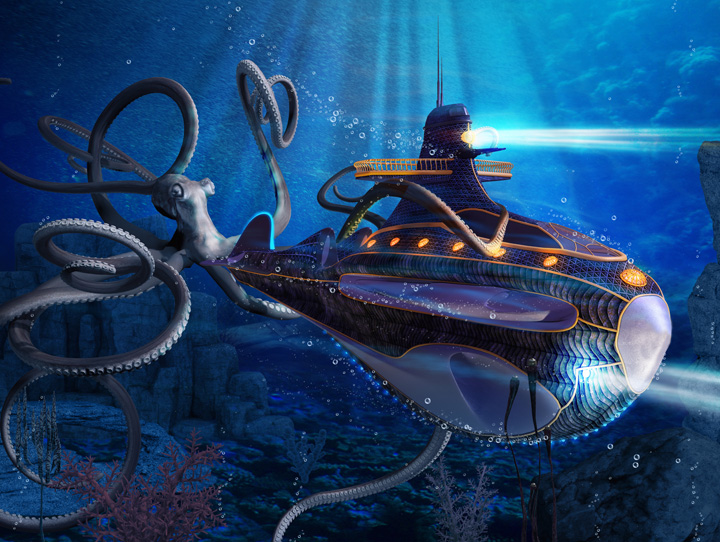
As you know, I’m co-editing an upcoming anthology called 20,000 Leagues Remembered, a collection intended to commemorate the sesquicentennial of the publication of Jules Verne’s classic submarine novel. My co-editor, Kelly A. Harmon, and I are are still accepting submissions. Click here for details. This image is what we intend to use for the cover.

We’ve received a good number of submissions, and have accepted several. There’s still room for more, though. I’ll be providing a list of prompts that might help you write a story for this anthology. Feel free to use one, or your own variation of it.

Before I do that, I’ll state the rules for the anthology. Your story:

  • must pay tribute in some way to Jules Verne’s novel;
  • may be set in any time or place;
  • may use characters from Verne’s novel or you can make up your own;
  • need not be written in Verne’s style;
  • need not be ‘dark’ (as stories in other Pole to Pole Publishing anthologies have been);
  • must capture, in your own way, the sense of wonder and adventure for which Jules Verne is famous;
  • demonstrate a significant and obvious connection with Twenty Thousand Leagues Under the Sea; and
  • must not disparage either the novel or its author.

Some of the prompts below may describe stories we’ve already accepted. That’s okay; write your story your way. Here are those promised prompts:

  • What if Captain Nemo had a time machine?
  • What was Captain Nemo’s (Prince Dakkar’s) origin story?
  • What adventures did Nemo have aboard the Nautilus before the events of Verne’s novel?
  • Did the Nautilus survive the volcanic eruption on Lincoln Island? What if it were salvaged today?
  • Did any of the Nautilus crewmen have an unusual talent, or a story worth telling?
  • What if a Nemo-like character were captain of an airship, a spaceship, a mole-machine?
  • What if a theme park (not starting with ‘D’) featured Twenty Thousand Leagues-inspired tour submarines, but one of the subs broke free of the designated ride?
  • What if Jules Verne rode a submarine before writing the novel?
  • What if a high-tech submarine manned by mysterious pirates began endangering sea travel today, how would the world’s navies react?
  • What’s the story of Captain Nemo’s wife? His children?
  • What if, in reaction to Nemo’s attacks, one or more of the world’s navies built a squadron of submarines designed to hunt down and destroy the Nautilus?
  • Did Captain Nemo have a pet? Tell its story.

Admit it. Some of those did get your creative fluids pumping around, didn’t they? Now all you have to do is write your story and submit it here. The hard part’s already been done for you by—

Poseidon’s Scribe

The Life-Cycle of Technology

On occasion, I blog about the ways society reacts to new technology. Today I’ll consider the life-cycle of a technology.

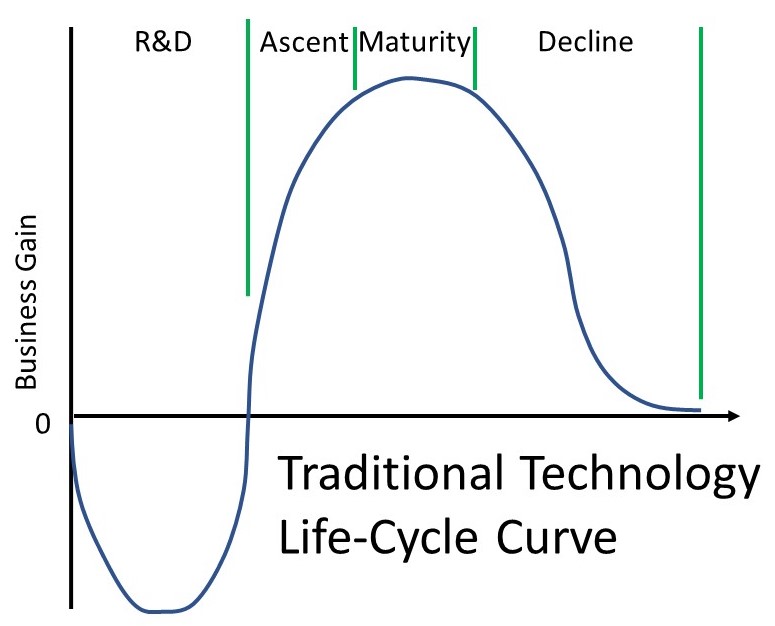
Graphing a technology’s life-cycle isn’t new. You can see this graph on Wikipedia. It’s the standard view of the profitability of a new technology over its life, including the four phases: Research and Development, Ascent, Maturity, and Decline.

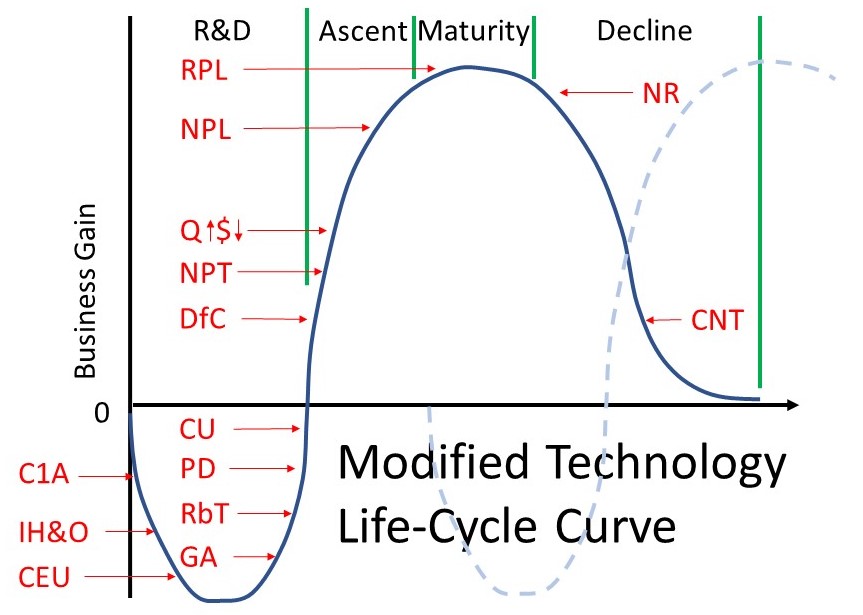
I’ve built on the standard technology life-cycle curve by adding several points of interest to it. These don’t occur with every technology, and don’t always appear in the same order. But they are common enough that I’ve seen them frequently. These points of interest fascinate me, and I explore them in my fiction.

C1A. Clumsy First Attempts. Often the first prototypes of a technology are crude, fragile, ugly things that only a laboratory scientist could love. In no way do they resemble a marketable product. On occasion, these breadboard prototypes do not work at all.

IH&O. Initial Hype and Overpromise. When dreamy-eyed advocates of the new technology get hold of a gullible press, news articles will appear about the technology, touting the marvelous future that awaits us all when the technology revolutionizes our lives. Sure.

CEU. Careful Early Use. Particularly when a new technology involves some danger or personal risk, the researchers proceed in a deliberate, methodical manner in testing it. They take safety precautions. They go step-by-step, fully aware of the hazards. This is good, but it contrasts with the CU point occurring later.

GA. Gaining Adherents. Some technologists call these people ‘early adopters.’ They can hardly wait for the technology to hit the market. They’ll stand in line to be the first to buy.

RbT. Reaction by Traditionalists. People accustomed to older technology will be quick to point out any defects in the new one, even if there are far more advantages than disadvantages. They are resistant to change, but won’t admit it. Instead, they will seek out the slightest reason to criticize as a way of rationalizing their resistance. They start with “It’ll never work,” then after it does, they’ll say, “It’ll never catch on.”

PD. Path Dependence. I’ve blogged about this phenomenon before. Developers of new technology will imitate the appearance and terminology of existing technologies. This tendency will be abandoned later at the DfC point, but it often characterizes and constrains new technology, while at the same time making it easier to relate to.

CU. Complacent Use. After a long period of successful testing, researchers will reach a comfort level with the new technology. They will abandon the care and precautions they employed at the earlier CEU point. This complacence can result in a bad outcome, a failure. If this occurs, they will refine the technology to correct flaws before marketing it to users, who will also grow complacent and not treat risky technology with respect.

DfC. Departure from Constraints. At some point, developers and imitators free themselves from the Path Dependence tendency. They start to explore the realm of possibilities of the new technology, no longer bound by past precedent.

NPT. Nostalgia for Previous Technology. This is similar to RbT, but slightly different. We expect traditionalists to object to new technology, but at this point, even some regular users—advocates of the new tech—begin to pine for the previous technology. They miss it, recalling its advantages and forgetting its quirks.

Q?$?. Quality Up, Price Down. At this point, the technology comes into its own. Original developers, as well as imitators/competitors, improve the technology and the means of producing it. Price drops and product quality improves. It’s a period of rapid growth and acceptance, a boom time.

NPL. Nearing Physical Limit. Late in the Ascent phase, producers or users begin to sense that things can’t go on. The technology is bumping up against some limitation, or has begun to cause an unanticipated problem, or is fast consuming some scarce resource. Producers try some tweaks to counter the problem, to hone the technology so as to mitigate the impending limit.

RPL. Reached Physical Limit. At the peak of the Maturity phase, when the technology is providing the most profit to producers, it can go no further. It cannot be improved sufficiently to overcome whatever limitation constrains it.

NR. Negative Reaction. Users start rejecting the technology, blaming it for the problems it caused. Engineers and researchers cast around for possible replacement technologies. Market demand and profits both plummet.

CNT. Competition with New Technology. In this period of chaos, the technology struggles against an emerging rival. The technology is fated to either die entirely or steady out at some low level, continuing to be used by die-hards who prefer it to its replacement.

There you have it, your newly-labeled technology life-cycle curve, provided by—

Poseidon’s Scribe
Jules Verne’s Impact on Undersea Fiction

The publication of Jules Verne’s Twenty Thousand Leagues Under the Sea led to a boom in books about undersea adventures. But the boom didn’t occur immediately and Verne wasn’t the sole cause.

Before explaining all that, I’ll mention an upcoming anthology of short stories titled 20,000 Leagues Remembered, scheduled for release on the 150th anniversary of Verne’s submarine novel. Until April 30, fellow editor Kelly A. Harmon and I are accepting short stories inspired by that novel. For more details and to submit your story, click here or on the cover image.

Verne wasn’t the first to venture into undersea fiction, though the predecessor works are fantasy, not science fiction. The list is brief. If I stretch the definition of undersea fiction, it includes the Biblical story of Jonah, Edgar Allan Poe’s 1831 poem “The City in the Sea,” and Theophile Gautier’s 1848 novel Les Deux Etoiles (The Two Stars). At least the latter included a submarine.

As shown by the graph, many books involving submarines appeared in the years following Verne’s undersea novel. The vast majority of these were intended for what we now call the Young Adult market, and included works by Harry Collingwood, Roy Rockwood, Luis Senarens, Victor G. Durham, Stanley R. Matthews, and Victor Appleton.

In a similar manner, Verne’s Journey to the Center of the Earth (1864) preceded an explosion of novels with subterranean settings. To a lesser extent, these also included many YA works.

But notice a curious thing about the two curves. The rise in subterranean fiction occurs earlier and starts its upward trend earlier than does the curve for undersea fiction.

I have three theories to explain this.

  1. The most obvious reason is that Journey to the Center was published six years before Twenty Thousand Leagues. That six-year gap doesn’t explain it all, however.
  2. I believe other authors, after reading Twenty Thousand Leagues, were daunted by the prospect of imitating that novel. To write credibly about submarines required knowledge most writers lacked. However, subterranean fiction required no geological expertise and no vehicle. Moreover, the writer’s underground setting could include any fantasy elements imaginable.
  3. I think the later peak in submarine novels had less to do with Verne than it did with the introduction of real submarines into the world’s navies. With actual submarines becoming familiar to readers, authors could pattern their fictional vehicles after real ones.

Neither of these mountain-shaped curves is due solely to Verne’s works. They both coincide with a boom in publishing adventure fiction of all kinds, not just undersea and subterranean. A drop in publishing costs, a rise in disposable income, a recognition that young people craved to read—all these factors attracted writers and publishers to new opportunities.

Still, I don’t want to understate Verne’s impact on undersea fiction either. Prior to Twenty Thousand Leagues, such works were fantasies. Afterward, they were either science fiction or real-life adventure stories.

After the publication of Twenty Thousand Leagues, it became the standard to which later submarine novels got compared. Even today, 150 years later, if you ask people to name a submarine novel, most likely they will either answer with The Hunt for Red October, or Verne’s book.

I just can’t help this fascination with stories of the sea. After all, I’m—

Poseidon’s Scribe

February 23, 2020Permalink

3 States of Writing Flow

Fellow author Andrew Gudgel wrote a great blogpost on December 19, 2019 regarding writing, and I’d like to expand on it.

His post is titled “Water, Molasses, Glass” and you may have to scroll down to get to it. He compares writing to the densities of three substances—water, molasses, and glass.

Sometimes writing comes easily and flows like water. Other times it’s more difficult and flows like thick molasses. What about glass? Well, that’s probably a bad example, since it’s a solid and doesn’t flow at all. The common belief that it’s a slow-moving liquid is false.

Water, Molasses, and Tar

A better third substance would be tar, or pitch. That is a slow-flowing (highly viscous) liquid. Very patient researchers at the University of Queensland (Brisbane, Australia) have been watching pitch pour from a funnel since 1930. In those ninety years, nine drops have fallen. Nine drops. Rather a slow way to resurface your driveway.

Let’s get back to the writing comparison.

Water. When writing flows like water, life is good. You know what’s coming next, and nothing’s slowing you down. Without effort, you’re churning out words in a steady stream. People have studied this state of mind and call it ‘Flow.’ I blogged about this phenomenon here. It’s great while it lasts, but it always ends at some point. While you’re in that zone, just go for it.

Molasses. Here’s where writing is harder. You’ve got to force the words out. There are long stretches where you’re just thinking and not producing prose at all. You consider doing something more fun, like, say, cleaning the garage. When in this mental state, I suggest a few strategies:

  1. First, try to recall why you started this writing project in the first place. Something made you want to write this story, and you were enthused about it then. Try to recapture that passion.
  2. Second, write an outline, or revisit the one you previously wrote. Jot down where you think the story is going. Or, since you’re stuck for words, create a mind-map of all the possible alternatives for the part you’re stuck on. It could be different plot paths, different scene descriptions, possible character types, or whatever.
  3. Third, consider writing something else for a while. Trust that your subconscious, your muse, will work on the original problem and come up with a solution.

Tar. At a drop each decade, this is truly writer’s block. I’ve written about writer’s block before, both the diagnosis and the cures. There are several things that might be causing your writer’s block, and you have to pick the right cure for your particular cause.

May your words always flow like water and your rejections and negative reviews flow like tar. That’s the writing wish for you from—

Poseidon’s Scribe

February 16, 2020Permalink

Jules Verne Found Alive!

French author Jules Gabriel Verne, born on this date in 1828, has been found alive at the age of 192. Reports of his death at age 77 in 1905, and accounts of his subsequent burial, apparently were in error.

Remarkable though it may seem, there is simply no other way to explain the large number of people, still today, who’ve undergone life-changing experiences after contact with Verne. This list includes people who became:

  • Astronauts or astronomers after reading From the Earth to the Moon;
  • Submariners, undersea explorers, or naval architects after reading Twenty Thousand Leagues Under the Sea;
  • Geologists, spelunkers, or cavers after reading Journey to the Center of the Earth;
  • World travelers or circumnavigators after reading Around the World in Eighty Days; and
  • Engineers, scientists, or fiction writers after reading any of Verne’s works.
Monument to Verne at the Jardin des Plantes in Nantes

I can see you’re not buying it. Okay, Skeptic, there’s an entire Wikipedia page devoted to the Cultural Influence of Jules Verne. It lists the following people who claim to have been inspired to pursue their profession by Verne: astronaut William Anders, undersea explorer Robert Ballard, undersea explorer William Beebe, astronaut Frank Borman, polar explorer Richard E. Byrd, speleologist Norbert Casteret, undersea explorer Jacques Cousteau, cosmonaut Yuri Gagarin, rocketry innovator Robert Goddard, cosmonaut Georgi Grechko, roboticist David Hanson, astronomer Edwin Hubble, submarine designer Simon Lake, astronaut Jim Lovell, French General Hubert Lyautey, inventor Guglielmo Marconi, speleologist Édouard-Alfred Martel, explorer Fridtjof Nansen, rocketry innovator Hermann Oberth, aviation pioneer Alberto Santos-Dumont, polar explorer Sir Ernest Shackleton, aviation pioneer Igor Sikorsky, rocketry innovator Konstantin Tsiolkovsky, and rocketry innovator Wernher von Braun.

There’s a similarly long list of authors who drew inspiration from Verne. Ray Bradbury said, “We are all, in one way or another, the children of Jules Verne.”

There exists a group known as the North American Jules Verne Society. Seriously, are you likely to have an active fan club on a different continent 192 years after your birth?

Yes, Verne is still alive, if not in body, at least in spirit. Very much in spirit.

Cover image for 20,000 Leagues Remembered

You, too, can join the list of those who’ve been influenced by Verne. You can write a short story and submit it for inclusion in the upcoming anthology 20,000 Leagues Remembered. I’m co-editing it, along with Kelly A. Harmon of Pole to Pole Publishing. It’s scheduled to be published on the 150th anniversary of the publication of 20,000 Leagues Under the Sea this coming June. Here you can see the cover image we’ve selected. For more information, and to submit your story, click here.

Happy 192nd Birthday, Jules, wherever you are. Today, in raising a toast to you with a glass of French wine, countless Verne fans around the world will be joining—

Poseidon’s Scribe

February 8, 2020Permalink

Cover Image Revealed

My co-editor, Kelly A. Harmon, and I have chosen the cover image for our upcoming anthology, 20,000 Leagues Remembered. The book will pay tribute to Jules Verne’s classic novel 20,000 Leagues Under the Sea on the June 2020 sesquicentennial of its publication.

Here is that image, with the Nautilus being menaced by a tentacled monster.

Cover image for 20,000 Leagues Remembered

Pole to Pole Publishing is still open for short story submissions to the anthology. Click here for details, and to submit your best work. Although the closing date is April 30, please note we are accepting stories as we go, so the anthology may well fill up before that date. Submit early!

We’ve received some wonderful stories so far. Still, there’s no one more anxious to read your story than—

Poseidon’s Scribe

February 3, 2020Permalink

Telling Readers All About You

How much should your readers know about you? In this age of Facebook, Twitter, and Instagram, when everything private is public, is it necessary to reveal every detail?

Before social media and even before the internet, authors were mysterious. Each one seemed like a magical wizard living in some unknown and hidden cave. A publisher would release a book, but readers wouldn’t know anything about the wizard, and publishers wouldn’t tell what they knew.

In those days, you could read the ‘About the Author’ section on the book jacket or an occasional magazine interview, but that was all you knew. The wizards stayed in their caves, typing away.

Times have changed. If you like a particular author, you can find out home town, number of cats owned, shoe size, political leanings, and a description of that writer’s most recent meal. No more wizards; no more mysteries; it turns out authors are just everyday people with an odd tendency to sling words around.

As a writer, you may still choose to remain a digital hermit, invisible to Facebook, a wizard in your cave. But you’d be going against the trend, and against the current guidance.

The web is filled with advice blogs for new authors. You must have a social media presence. Your readers are curious about you, so you must connect with them. Be authentic; show your audience you’re a real person. A few hours spent on social media will help grow your book sales.

Not all authors follow this advice. One of them, Tom Corson-Knowles, recommends writers shun social media entirely. He argues you’ll achieve better sales by writing better books; staying off Twitter will give you more free time to write; and social media is cramping your creativity.  

Each writer must take the path that seems right, and be willing to change if that’s not working. As for me, I write these weekly blogposts, post on Twitter and Facebook once a week or so, and sometimes post book reviews on Goodreads. I rarely talk about personal stuff on those platforms.  

Although I’d be more comfortable as a mysterious, cave-dwelling wizard, I’m willing to admit things are changing. Almost everyone shares personal details these days, and if I knew I could increase sales by posting a few things, I’d do it.

For now, I’ll reveal one spicy secret. Though I like dogs and (sometimes) cats, there are currently no pets in the home of—

Poseidon’s Scribe

February 2, 2020Permalink

Character Analysis — Captain Nemo

Now we’ve come to the last major character in Jules Verne’s Twenty Thousand Leagues Under the Sea. Let’s study Captain Nemo.

Before we do, I’ll remind you to submit a short story to 20,000 Leagues Remembered, a tribute anthology scheduled for publication on the 150th anniversary of Verne’s marvelous novel. Along with unparalleled word-master, Kelly A. Harmon, I’m co-editing this anthology for Pole to Pole Publishing. The official closing date is April 30, but you should submit early. We’re accepting stories as we go, and this publisher has filled each of its anthologies before the closing date. For more details, and to submit your story, click here.

Regarding Captain Nemo, I’ll restrict this analysis to what we know from the 20,000 Leagues novel and disregard information provided later in The Mysterious Island as well as later adaptations.

When readers first encounter Nemo, they learn he appears self-confident, energetic, and courageous. He is tall, of indeterminate age, and has wide-set eyes. He says, “To you, I’m simply Captain Nemo,” adding a rank to the name “no one” by which Odysseus (another sea captain) fooled the Cyclops.

In subsequent chapters, Pierre Aronnax learns Nemo is a highly intelligent scientist and engineer, has divorced entirely from the land and all nations, and is immensely wealthy. Later, Aronnax discovers Nemo cares deeply for a dying crewman and buries him on the seafloor. He assists a stricken pearl diver off the coast of India, saying he “lives in the land of the oppressed, and I am to this day, and will be until my last breath, a native of that same land!”

Nemo provides a huge sum of gold to a Grecian diver, apparently to aid in the uprising of Crete against Ottoman rule. Aronnax sees a set of paintings in Nemo’s cabin, all portraits of historical revolutionaries. Using the Nautilus’ ram, Nemo slaughters a pod of sperm whales to save some baleen whales. He then attacks and sinks a ship whose nationality is unknown to Aronnax. Following this act of destruction, Aronnax spies Nemo kneeling and weeping before a portrait of a woman and two children.

The Captain combines several opposing characteristics and sentiments:

  • He claims to support the downtrodden, yet he designed the Nautilus with a distinct two-class system, and treats Aronnax as an upper-class gentleman, in contrast to the way he treats Conseil, Land, and his own crew.
  • He financially supports freedom-seeking revolutionaries, and his Mobilis in Mobili motto implies a love of freedom, yet all who enter his Nautilus are confined aboard forever.
  • At the outset, Nemo declares, “I’m not what you term a civilized man! I’ve severed all ties with society, for reasons that I alone have the right to appreciate. Therefore I obey none of its regulations…” yet he plants a flag at the South Pole just as any imperialistic conqueror from a land nation might.

It’s well-known that Verne initially gave Nemo a detailed back-story with a former nationality and a traumatic past to explain his motivations, but his publisher urged him to delete all that. We’re left with an unexplained mystery, a Byronic Leonardo da Vinci, a marauding scientist, a sea hermit, a gentleman savage.

Like Captain Ahab, Nemo suffers from a troubled past that leads him on an obsessive oceanic quest, resulting in madness. Unlike Ahab, the cause is not as evident as a bitten-off leg, but resides only in his mind. His motives remain as invisibly submerged as his submarine.  

I hope you’ve enjoyed reading these recent blogposts about the four main figures in 20,000 Leagues Under the Sea. This one completes the quartet of character analyses by—

Poseidon’s Scribe

January 26, 2020Permalink