Bringing My Seastead Pyramid into the 3rd Dimension

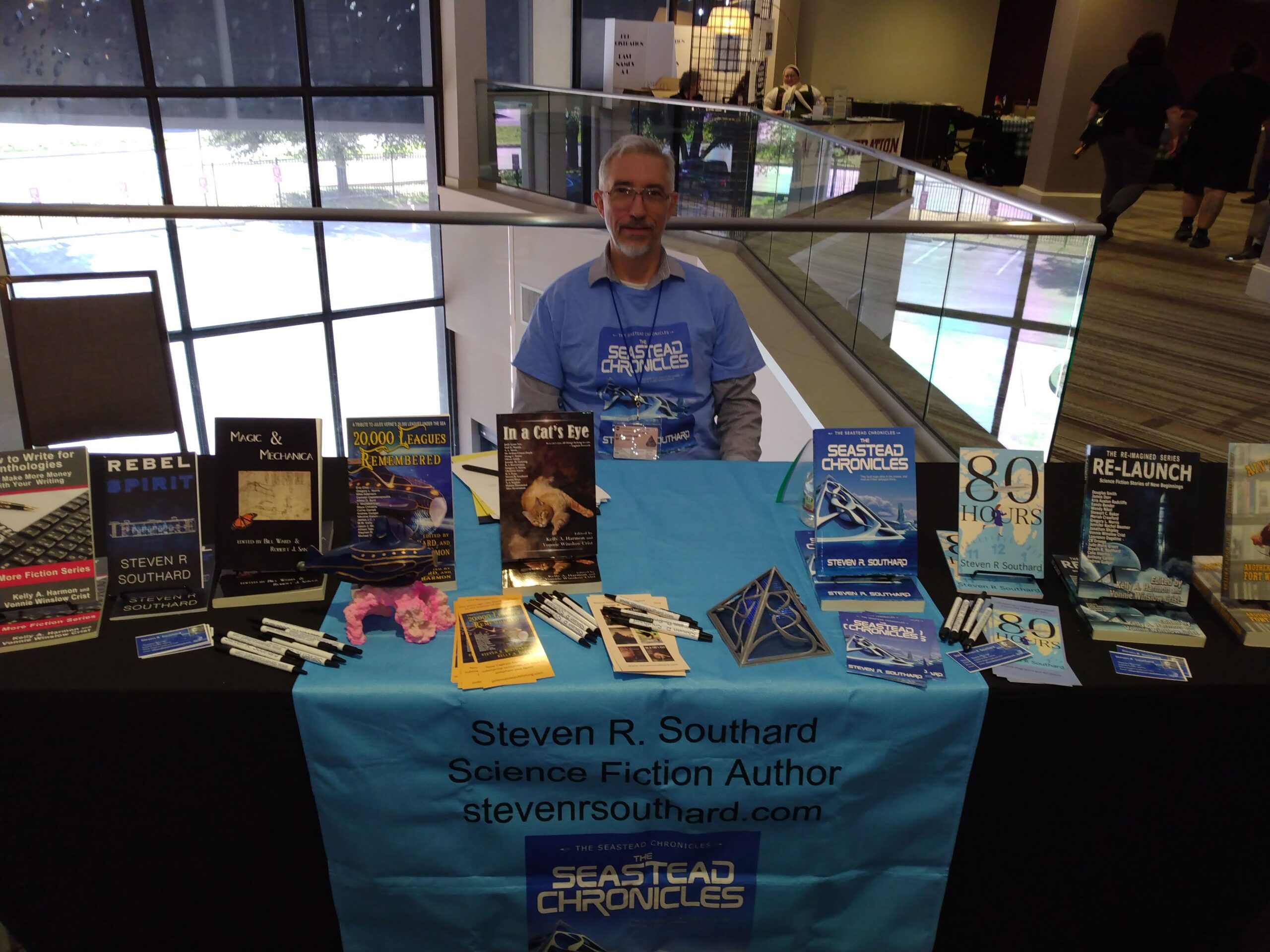
When I appear at conventions or other events, I like to display 3D printed models depicting vehicles or other objects from my stories. These help, I hope, attract potential readers’ eyes.

I’m pleased to announce the addition of a new item to my collection.

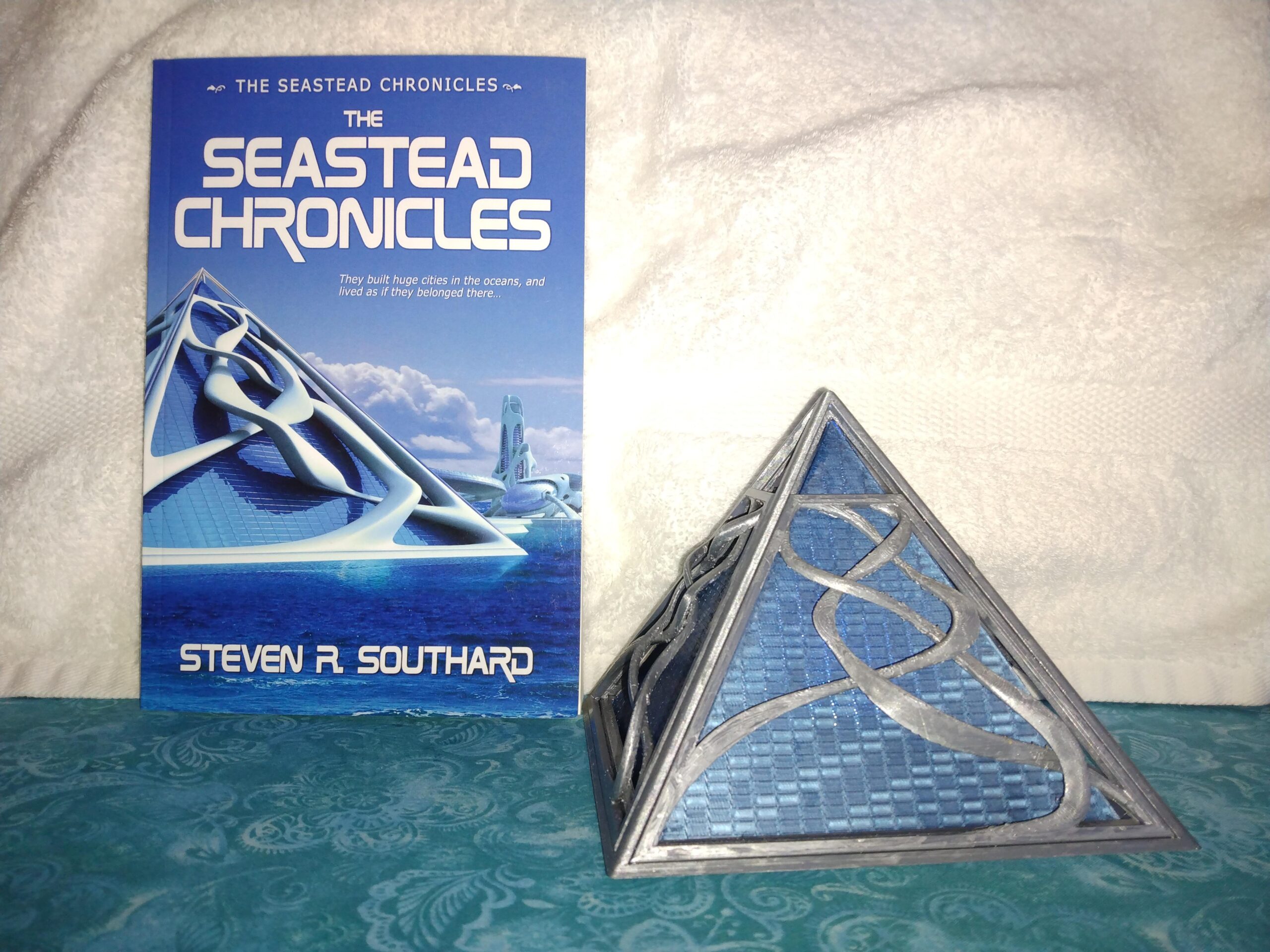
Behold the pyramidal seastead from the cover of The Seastead Chronicles! My publisher, Pole to Pole Publishing, used a cover image designed by an artist known as 3000ad.

I engaged the services of a 3D-printing designer named Duane Corpe to create a 3D version of that pyramid. Not only did he produce a wonderful model, but he made it big enough that I can put a puck light inside and make the pyramid glow.

The odd shapes on the outside of the pyramid proved a difficult challenge. Much of 3D printing design involves combining existing shapes first developed by others. For the sinuous, over- and under-lapping features you see on the pyramid’s outer surface, no previous models existed. I don’t know how Duane did it, but he created a fantastic display piece!

In previous blogposts, I’ve shown off the other models in my collection. See this submarine, this Martian tripod fighting machine, this replica of Plato’s Ring of Gyges, this Ottoman spacecraft, this clockwork lion, and this airship.

Almost forgot. When you’re done gawking at the 3D pyramid, consider buying and reading the book The Seastead Chronicles, written by—

Poseidon’s Scribe

162 Years After the First Successful Submarine Attack

Today I’m updating and reposting an entry first published on February 17, 2025.

On this anniversary, let’s observe a moment of silent reading while we visualize the events of the day some brave submariners made history.

Aboard the Submarine

You’re sitting on a bench, crammed in beside six other sweaty men. Your hands grip a crankshaft, and you turn it under the command of a lieutenant sitting at the bow, to your left. You face the boat’s starboard side three feet away, a blank, curved bulkhead of iron, dripping with condensation. Stale air fills your lungs with each breath. The odors of sweat, urine, oil, and pipe tobacco assault your nostrils.

“Got ’er now,” the lieutenant says. “Dead ahead. For the South, men! Full speed!”

Though exhausted and out of breath, you rotate the crankshaft with all your strength. You’re determined to strike a blow for your side’s cause, and you’re confident of success.

You feel a powerful impact and hear a loud explosion.

CSS Hunley

By late 1863, the Confederacy searched for any advantage that might reverse the currents of the Civil War. The Union blockade of Charleston hindered vital supply lines and had proved impenetrable. If the Grey could not defeat the Blue on the surface, what about underwater?

People had tried submarines in battle before, but never met success. Inventor Horace Hunley believed his boat stood a good chance to break the blockade. Forty feet long and four feet in diameter, CSS Hunley introduced the cigar shape common to all later military submarines. Armed with a keg of explosives mounted on a spar projecting from her bow, the craft aimed to ram its prey, blast a hole in its hull, and sink it.

Poor Performance Record

An innovative boat requires a well-trained crew, and they made frequent practice runs. Just as the men began to gain proficiency, tragedy struck. On August 29, 1863, a mishap occurred, killing five crewmembers, who sank with the craft.

Still, the Confederacy needed a victory, so they recovered the Hunley and obtained a fresh crew. This time, Horace Hunley himself, the craft’s inventor, manned the boat. They completed many test runs until, on October 15, the submarine flooded again, killing all eight men aboard.

After a boat kills two crews, most of us would abandon further tries. The desperation of the South, though, had reached a point beyond rational calculation of odds. They raised the boat once more, removed its dead, and somehow obtained a third crew.

Attack and Aftermath

On the night of February 17, 1864, that crew rammed the Hunley into the side of USS Housatonic. The spar-mounted keg exploded, crippling the Union ship and sinking her with the loss of five sailors. The Hunley’s crew had performed the first successful submarine attack in history.

People waited on shore for the submarine, but the little craft never returned. Some thought the craft got sucked into the hole it created, but that proved untrue. Searchers found the Hunley in 1995, and salvagers raised her in 2000. Today, she rests on display at a museum in Charleston.

Rebel Spirit

Yes, the Confederacy fought to preserve the vile institution of slavery and lost the war. Even so, we can still admire the bravery of those men in the Hunley. They volunteered to serve aboard an experimental craft that had already killed two crews. They endured horrendous conditions in a cramped iron tube, hoping to free their countrymen from a blockade when no other recourse seemed possible.

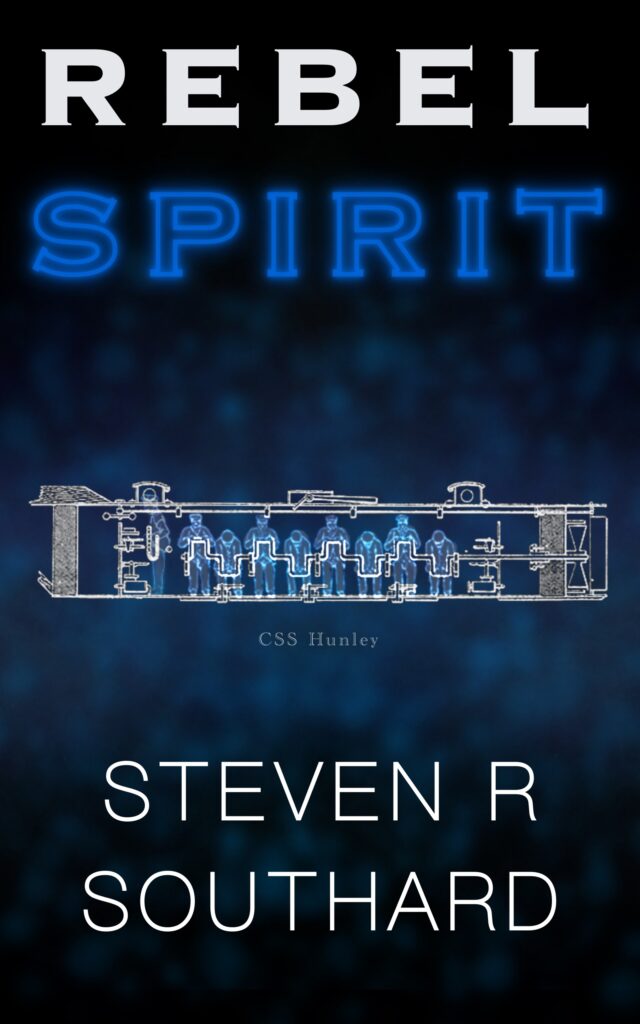
Having served on a submarine, I feel a kinship with the Hunley crews. I’ve written a ghost story called Rebel Spirit about one of the crewman. You can purchase it in ebook or paperback format.

Thank you for sharing, on this anniversary, a somber moment of remembrance of the CSS Hunley crew along with—

Poseidon’s Scribe
A Book Palooza? That’s READiculous

Consider coming to the first-ever READiculous Book Palooza on Saturday, February 28. It will be at the Oak Street Drafthouse at 308 East Oak Street in Denton, TX.

Though the Palooza starts at 1:00pm, you might wish to plan on being there at 6:00pm, when I’ll be reading from one or more of my books.

Hope to see you there! Several other authors will participate as well, not just—

Poseidon’s Scribe

Hold Infinity in the Palm of Your Hand

Billionaires get to think bigger. Some spend their money on grand projects, pushing technology to new limits. The rest of us play amusing parlor games, imagining what we would do with billions of dollars.

Raúl Jianyu Mason

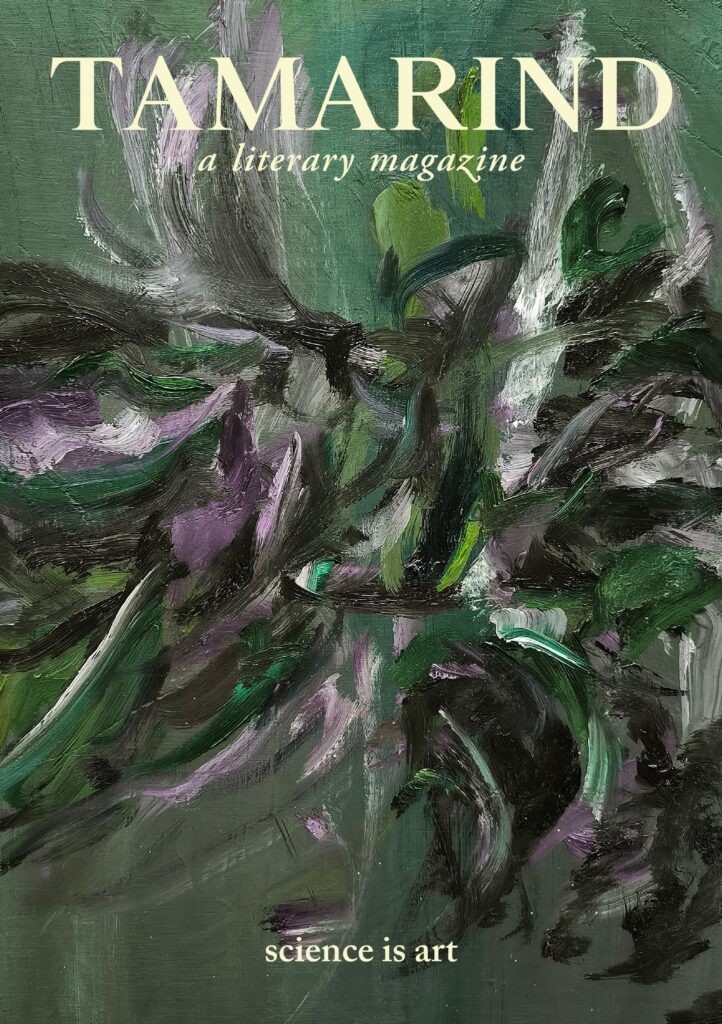
My imagining led me to create a fictional future trillionaire, Raúl Jianyu Mason, who’s featured in my short story, “Infinity in Your Hand,” published in Tamarind Literary Magazine, Issue 9. Bold and determined, Raúl lives by this credo: big accomplishments require only two things—money and will. The first human to marry an android, he’s famous for building and operating the largest space habitat.

Wormholes, Black Holes, White Holes

Raúl has set his sights on reducing the time required for interstellar travel by constructing stable wormholes in space. If he can do it, he’ll open the universe for humanity to go anywhere, thus bending space itself to his indomitable will.

Theories tell us anything can enter a black hole and nothing comes out. But for a white hole—the counterpart to a black hole—everything comes out, and nothing can enter. Raúl believes these could serve as an entrance and exit, with a wormhole between. But black holes and white holes attract each other, so he develops a design using two white holes and two black holes positioned to maintain stability. To sum up, he proposes a shortcut portal through a wormhole to a distant spot in the universe.

Poetry

The story got its title from the poem “Auguries of Innocence” by William Blake, which begins with these lines:

    To see a World in a Grain of sand
    And a Heaven in a Wild Flower
    Hold Infinity in the palm of your hand
    And Eternity in an hour

Money and Will

You’ll have to read the story to find out how things work out for Raúl, and for his android wife. Perhaps he’s right—all it takes are money and will. Raúl’s got plenty of both. Or maybe it takes something else to hold “Infinity in Your Hand.”

My Story in Your Hand

Pick up a copy of Tamarind to read this story by—

Poseidon’s Scribe

The Ballad of Joan Henry

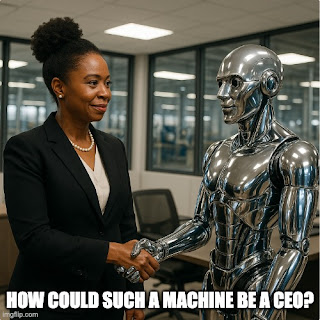
You can read my short story, “The Ballad of Joan Henry” for free. It’s featured at Fiction on the Web, along with a great accompanying image. First, though, I’ll give you some background.

John Henry

Before Joan, there was John. The legend of John Henry depicts him as a former slave, now a free man, working at steel driving. That job involved hammering a steel chisel into rock to create holes for dynamite. They used explosives to build railway tunnels through mountains. No man could outdo John Henry in this task. He accepted a challenge to see if he could work faster than a steam-powered drilling machine. In the end, he won the race, only to die from exhaustion.

Joan Henry

My story, set in the near future, involves Joan Henry, a female CEO of an auto parts manufacturing company in West Virginia. To keep her firm profitable, she’s fired most of the human workers and replaced them with robots. Now, the board of directors is considering a robotic CEO. They set up a challenge where she must compete with this robot for her own job. After that, the story deviates from its John Henry roots.

Setting

“The Ballad of Joan Henry” takes place in a future a few years from now, when robots perform most of the work and all humans receive Universal Basic Income. People respond to this in various ways, and many resent the takeover of jobs.

Comments

The story has already garnered two favorable comments and I thank those two readers for their kind words.

Fantasy or Prophesy?

Today, corporations are replacing human workers with robots and AI. Will things get as bad as I portray in my story? Or will things settle to a new equilibrium state, one acceptable to humans? If my story proves prophetic, well, you heard it first from—

Poseidon’s Scribe

Printed Tribute Books, So You Never Forget

After someone dies, people often hold a funeral or memorial service or celebration of life. Each of these honor the dead but, as one-time events, they lack permanence. Would you consider a printed book as a tribute to a departed loved one?

Advantages

As mentioned above, a book lasts longer than a one-off event. Convenience counts as an advantage, too—you may pick up the book at any time and page through it to remember your loved one. Also, the volume of facts in a book can far exceed the number of anecdotes and memories glossed over at an event, and you need not read the book in one sitting. In addition, you may enjoy a book in solitude, at a time when you may not welcome the presence of others.

Description

Like funerals, tribute books benefit the living. Therefore, if you choose to create one, think of the book’s audience. What would they most want to know about the person being honored? You needn’t approach the task like a biographer—reporting a life story, citing sources, verifying facts, conveying the bad along with the good. Instead, make it your purpose to honor, not just inform.

Did your departed family member write a lot—even letters, recipes, poems, emails, texts? Consider including some of these as appropriate, if they help convey the essence of the person’s life.

These days, we take and save pictures, each worth (as the saying goes) a thousand words. Include the best of these in your tribute book. Explanatory captions should accompany the pictures, with dates and descriptions of each image.

Videos represent a difficulty—how do you include them in a printed book? You could upload videos to a website, assign QR (Quick Response) codes to them, and include the QR codes in your book. Or you can attach, to each copy of the book, a thumb drive with the valued videos saved on it.

Creation

How do you make a tribute book? Various options exist, and your choice may depend on the energy, time, and money you can devote to the effort. You can pay a service to help you by doing the parts of the work you might find difficult. Such services include ModernHeirloomBooks.com, SimplyCelebrate.com, TributeStoryBook.com, ALifeUntold.com, NewlyWords.com, MyStoryFlow.com, and ModernMemoirs.com.

Personal Example

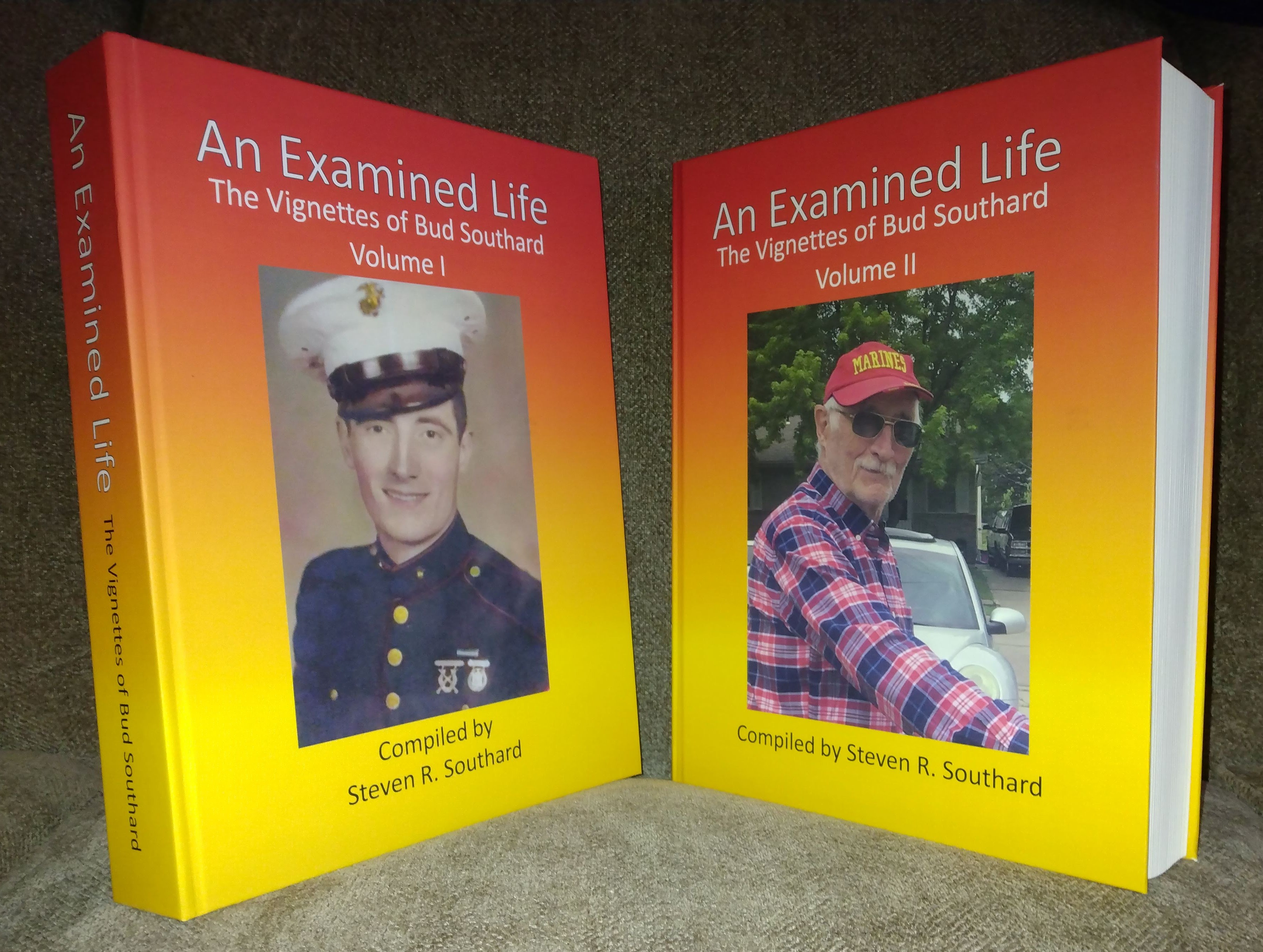
My father died in 2022 at the age of 91. I knew nothing about tribute books then. However, as mentioned in a previous post, he left behind over 800 written vignettes describing his life and thoughts about everything along the way. Rather than having these vignettes wither away in password-protected oblivion inside obscure internet servers, forgotten and unread, I had them printed in book form.

Easy, huh? After all, my dad had written everything. All I had to do was copy, paste, format, and send to the printer.

Not so easy. It took almost two years. I’m proud of the result—a tribute book in two volumes totaling 1410 pages. Rather long for a tribute book—or any book—but Dad wrote all of it except the Foreword. That being the case, the book resembles an autobiography as much as a tribute book. I didn’t hire a service, just formatted the manuscript and had a few copies printed by Lulu.com for my family. I used that site, but you may choose from a variety of others.

Your Tribute Book

Could you create a book as a tribute to a lost loved one? Books endure, and family members, even those yet unborn, could learn about their ancestors. I offer the notion as a suggestion to consider. In deepest sympathy for you on the loss of someone you love, I’m—

Poseidon’s Scribe