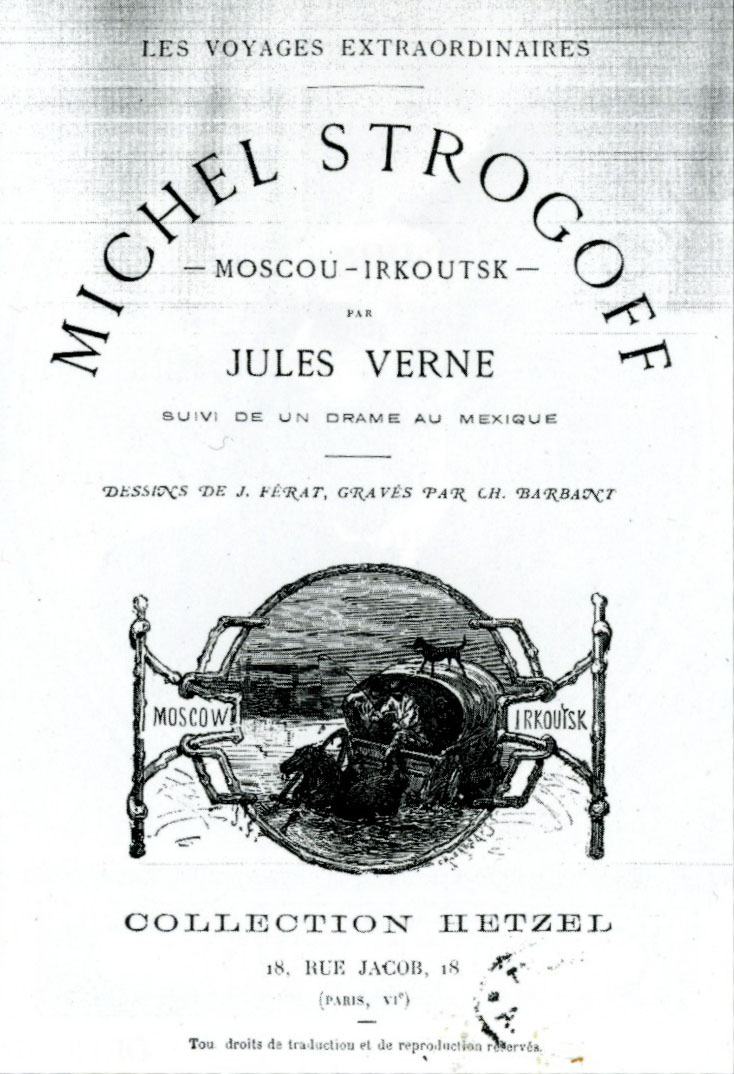
150 years ago this month, Jules Verne’s novel Michael Strogoff: The Courier of the Czar was published. If that news didn’t pique your interest, I’ll bet you’ll be more intrigued after reading this post.
Few people outside Russia count this novel among Verne’s best. Most people haven’t heard of it. Even so, it ranks seventh best of Verne’s fifty-four novels on Books That Slay, and sixth best on Ranker.
In my edition of the book, the introduction contains this quote by Leonard S. Davidow: “Jules Verne has written no better book than this, in fact it is deservedly ranked as one of the most thrilling tales ever written.”
In his book An Amputee’s Guide to Jules Verne, Nick DiMartino says, “It’s pure, unadulterated storytelling, a thrilling, expertly written novel…impressive and passionate and satisfying in so many ways.”
Michael Strogoff Synopsis
If you’re expecting submarines, giant cannons, or balloons, forget it. No science fiction here. However, a key plot point involves a scientific phenomenon called the Leidenfrost effect.
Verne wrote at the time of the Russian czars, and the real-life Czar Alexander II plays a significant part in the book. An uprising of rebel tartars has cut off eastern Siberia from the rest of Russia. In far-off Irkutsk, the czar’s brother is holding off against the rebels. The czar learns a renegade Russian colonel plans to turn the czar’s brother over to the invaders. Alexander must warn his brother about the traitor, but the tartars have cut the telegraph lines, so he must send a courier.
That courier, Michael Strogoff, must travel 3400 miles from Moscow across the endless steppes and icy tundra to Irkutsk. He travels well at first, by carriage (called a tarantass) on land and by boat on rivers. In time he loses the carriage, then his horses, and must walk on foot. Michael encounters fierce storms and a savage bear attack.
Oops. I forgot to mention how Michael gets captured early on by tartar rebels. They suspect him of being a spy and punish him with a technique that causes blindness. Luckily, he joins up with a young woman who is able to guide him.
I haven’t mentioned all the perils and predicaments, but it would seem unlikely Strogoff will reach Irkutsk in time to deliver the message that could save Russia. And Verne gives us a surprise twist involving that Leidenfrost effect I mentioned. Oh, yeah, and it’s kind of a love story.
In Other Media
The novel got adapted into two plays and a musical. It’s enjoyed fifteen screen versions made in ten different countries. Also, it inspired a board game.
In Russia
Russians love the book. It conveys the spirit of the times of the czars. More than that, it evokes the vast expanse and icy wilderness of the Russian land. Most of all, Russians delight in the heroic character of Michael Strogoff himself. He embodies the virtues of bravery, loyalty, and dedication they admire.
Is it Verne?
You may be wondering if Verne really wrote Michael Strogoff. It seems a story of pure adventure, not science fiction. Nobody explores the unknown. Nobody drives a strange, new vehicle. No scientists or engineers appear as characters.
Yet, Jules Verne did write it, and it fits with the other novels in his Extraordinary Voyages series. Verne didn’t set out to invent science fiction. Fascinated by adventure and far-off places, he wrote dramatic travel escapades. Of his own writing purpose, he said, “It is my intention to complete, before my working days are done, a series which shall conclude in story form my whole survey of the world’s surface and the heavens; there are still left corners of the world to which my thoughts have not yet penetrated.”
Relevance
In the 150 years since the novel’s publication, Russia remains a huge, often inhospitable place to travel through. The thought of crossing that country on foot astounds me. In our modern world of instantaneous communication, we consider the idea of human couriers obsolete. Yet, the story of enduring a continental trek, full of perils and requiring indomitable courage, still enthralls readers.
See? You didn’t think you’d care about the topic, but now, to honor the sesquicentennial, you’ve just added Michael Strogoff to your To Be Read list, on the recommendation of—
Poseidon’s Scribe