Read What Happened When I Interviewed the Hero’s Sidekick

During my years of blogging, I’ve interviewed plenty of writers and a few editors. However, I’ve never interviewed a sidekick. Today, I did just that.
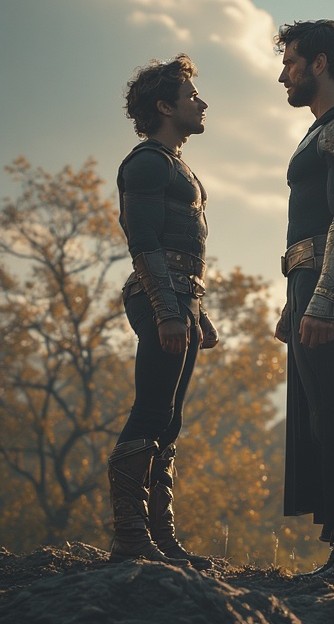
Image created at Perchance.org

Interview

Poseidon’s Scribe: Welcome to my blog.

Sidekick: Thanks, but you’ve got the wrong person. I’m not a sidekick.

P.S.: Really? I thought you were. What are you?

S: I’m the main character, the protagonist, the hero.

P.S.: Ah, so you’re the one driving the plot forward.

S: I guess, sort of.

P.S.: You’re standing in someone’s shadow. Who’s that?

S: That’s my sidekick.

P.S.: I see. But you’re the one who seems to be assisting that person a lot.

S: Yeah. My sidekick really needs help.

P.S.: I’ve heard, of the two of you, you’ve got the better sense of humor. Is that true?

S: Yes. Authors always give the hero the best lines.

P.S.: Ah. From what I’ve seen, that person confides in you, trusts you. You act like the person’s conscience.

S: Yup. My sidekick bounces ideas off of me, usually bad ones, and I have to be the one coming up with the right plan. My sidekick probably couldn’t survive without me.

P.S.: You two seem to complement each other, with many opposite personality traits.

S: Well, they say opposites attract.

P.S.: True. Tell me, at the end of the story, which of you will get the most credit for resolving the major conflict—you, or the person in whose shadow you’re standing?

S: Um…well…I guess…Is it possible that I’m not the hero? That I’m really just a sidekick?

P.S.: Never say just a sidekick. You’re vital to the story. As you said, the hero would be lost without you. I’d say that hero is lucky to have a pal, a sounding board, a loyal ally like you.

S: Yeah. Lucky to have me. That’s right.

Poseidon’s Scribe: Thank you for stopping by today. I know you have to get back to supporting and looking after the hero.

Sidekick: Believe me, it’s a full-time job. That is one flawed character.

Further Reading

For more on sidekick characters and how to create them, see this post by Author’s Pathway, this one by Victoria Grossack, this one by WriTribe, and this one by Lorenz Carst at Springhole.net.

Nobody Thinks They’re the Sidekick

In the 2005 movie Sahara, Al Giordino is Dirk Pitt’s sidekick. When another character asks Al how long he and Dirk have been together, he says, “Kindergarten, college, Navy, NUMA. Poor guy’s always been in my shadow…Always the Al’s maid, never the Al.”

All along I thought I was the hero of my life’s story, but now I wonder if someone else’s sidekick is—

Poseidon’s Scribe
Has It Been 10 Years Already?

I started this Poseidon’s Scribe blog in January 2011, so it seems I’ve been doing this for a decade now. I’m closing in on 600 blog posts (this is my 587th). Hard to believe Poseidon’s Scribe is ten years old.

It was very kind of author Todd Sullivan to interview me on the subject of blogging discipline. You can watch the interview on YouTube.

In fact, I’ve included a new Interviews tab on my website, so you can read or view all the interviews of your favorite blogger and author.

Back to Todd Sullivan’s interview of me. In that video, I provided the following overall advice about blogs:

  • Valuable content. Provide useful information to readers.
  • Quality writing. Keep posts brief, interesting, and well written.
  • Clean appearance. Make your site uncluttered and easy to navigate.
  • Periodic posts. Establish a rhythm of posting and stick to it.

Here’s what I advised about starting a blog:

  • Write down why you want to blog. What’s your niche?
  • Identify your intended audience. Whom are you writing to?
  • What might your audience want to know, that you can provide?
  • Write down 20 topics for your first 20 blogposts
  • Add to that list as you come across other ideas
  • Commit to posting on a regular schedule (helps you, readers, and site popularity)
  • Don’t expect instant followers, comments, or notice, let alone fame.

This was what I said about writing individual blogposts:

  • Craft an interesting and useful subject line. Numbers catch readers’ eyes, as do the words you, your, and you’re.
  • Include an image or video with your posts
  • Start with a rough outline before writing, but be willing to deviate from it.
  • Edit by imagining you’re a reader just surfing to that post. Cut boring stuff. No long paragraphs. Keep the overall post short.
  • Proofread before publishing

To supplement the advice I gave in the interview, I’d add this—it’s best not to dedicate your blog to the craft of writing. The net is saturated with writers writing about writing. Consider blogging about the subjects you write about instead. If your fiction focuses on certain settings, or characters, or themes, write about them.

I’ll go further than that. Consider not blogging at all. Set up a website, sure. It can be a fairly static one, with your bio, your bibliography, your scheduled appearances, etc. But think about this before you start blogging: time spent blogging is time you could be spending on your fiction.

Back in 2011, experts advised all beginning writers to blog. It was, and remains, a good way to increase your online footprint and to raise your site ranking in searches for the topics you blog about.

However, I’m not sure it increases sales of your fiction, or improves the quality of your stories. Think about that before you start a blog.

If your goal is better fiction, or more sales, work on your fiction and your marketing.

For me, though, a decade-old habit is hard to break. You can look forward to more years of steady blogging from—

Poseidon’s Scribe

February 14, 2021Permalink