Read What Happened When I Interviewed the Hero’s Sidekick

During my years of blogging, I’ve interviewed plenty of writers and a few editors. However, I’ve never interviewed a sidekick. Today, I did just that.
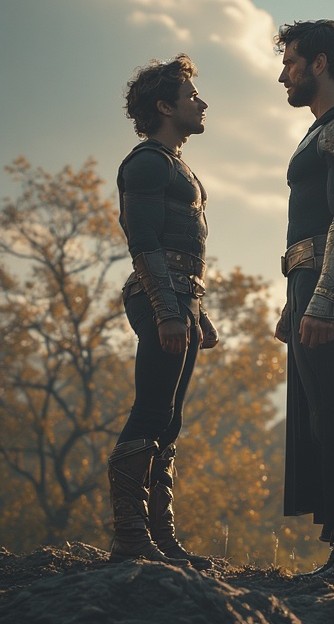
Image created at Perchance.org

Interview

Poseidon’s Scribe: Welcome to my blog.

Sidekick: Thanks, but you’ve got the wrong person. I’m not a sidekick.

P.S.: Really? I thought you were. What are you?

S: I’m the main character, the protagonist, the hero.

P.S.: Ah, so you’re the one driving the plot forward.

S: I guess, sort of.

P.S.: You’re standing in someone’s shadow. Who’s that?

S: That’s my sidekick.

P.S.: I see. But you’re the one who seems to be assisting that person a lot.

S: Yeah. My sidekick really needs help.

P.S.: I’ve heard, of the two of you, you’ve got the better sense of humor. Is that true?

S: Yes. Authors always give the hero the best lines.

P.S.: Ah. From what I’ve seen, that person confides in you, trusts you. You act like the person’s conscience.

S: Yup. My sidekick bounces ideas off of me, usually bad ones, and I have to be the one coming up with the right plan. My sidekick probably couldn’t survive without me.

P.S.: You two seem to complement each other, with many opposite personality traits.

S: Well, they say opposites attract.

P.S.: True. Tell me, at the end of the story, which of you will get the most credit for resolving the major conflict—you, or the person in whose shadow you’re standing?

S: Um…well…I guess…Is it possible that I’m not the hero? That I’m really just a sidekick?

P.S.: Never say just a sidekick. You’re vital to the story. As you said, the hero would be lost without you. I’d say that hero is lucky to have a pal, a sounding board, a loyal ally like you.

S: Yeah. Lucky to have me. That’s right.

Poseidon’s Scribe: Thank you for stopping by today. I know you have to get back to supporting and looking after the hero.

Sidekick: Believe me, it’s a full-time job. That is one flawed character.

Further Reading

For more on sidekick characters and how to create them, see this post by Author’s Pathway, this one by Victoria Grossack, this one by WriTribe, and this one by Lorenz Carst at Springhole.net.

Nobody Thinks They’re the Sidekick

In the 2005 movie Sahara, Al Giordino is Dirk Pitt’s sidekick. When another character asks Al how long he and Dirk have been together, he says, “Kindergarten, college, Navy, NUMA. Poor guy’s always been in my shadow…Always the Al’s maid, never the Al.”

All along I thought I was the hero of my life’s story, but now I wonder if someone else’s sidekick is—

Poseidon’s Scribe
Your Antifragile Hero

Is the protagonist of your story antifragile? Should she be?

I wrote an earlier post on ‘antifragility,’ but there I applied the term to stories themselves. Today we apply it to heroes/protagonists/main characters.

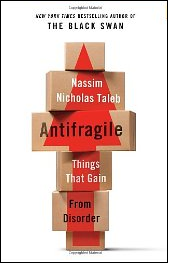
Here’s a brief introduction to antifragility. In his book Antifragile, Things That Gain From Disorder, Nassim Nicholas Taleb sought an antonym of the word “fragile.” He didn’t mean words like ‘resilient,’ ‘tough,’ or ‘robust,’ which refer to sustaining shocks without damage. He wanted to describe things that improve their resistance to stress by being stressed. There being no such word, he coined the term ‘antifragile.’

What does this have to do with literary heroes? Remember, all stories involve conflict.The writer must subject the protagonist to a significant conflict. Stories are about the hero contending with the problems arising from this conflict.

Conflict needn’t involve bombs or guns, swords or knives. The conflict can be verbal jousting with another character. It can be internal, as the hero wrestles some inner demon.

Note the mention of ‘disorder’ in the subtitle to Taleb’s book. Often, a story begins with an orderly, logical world for the hero, a world soon thrown into chaos, subjecting the hero to confusion and unfamiliar surroundings. The story then becomes the hero’s struggle to contend with this new and disorderly world.

The best stories take some weakness in the protagonist’s psychological character or some aspect of the hero that deviates from the norm, and exploit it. That is, the author designs the conflict to attack that weakness or stress that deviating aspect. In this manner, the author fits the specific conflict to the specific hero.

Moreover, a good writer will show no mercy, and will ramp up the conflict throughout the story to the point where it seems the protagonist can stand it no longer. Authors do this, not because they’re sadistic, but to get the reader to care about the character, to want to read the story to the end.

The story ends soon after the resolution of the conflict. In a few stories, the resolution involves the death of the main character. Most of the time, though, the protagonist prevails in the struggle and wins the day. This occurs when the hero faces her fears, defeats her inner demons, beats the bad guy, etc. In the best stories, the main character learns something in the process, changes for the better, improves herself in some way.

In this manner, the protagonist exhibits antifragility. She encounters several stressful situations and emerges stronger from the ordeal. She changes and learns from the experience. She is antifragile.

Maybe this idea extends beyond the hero herself. In stories where the protagonist prevails in the conflict, we could say the protagonist is teaching us, the readers, about antifragility. To be more specific, as we read such tales, we learn how to become antifragile ourselves.

Maybe you disagree. Go ahead and submit comments disputing my statements. Such slings and arrows only serve to make me stronger. Antifragility is the middle name of—

Poseidon’s Scribe