How to Train Your AI, Legally

Though I don’t often comment on court cases, this one, as reported in the L.A. Times and in TechSpot, involved fiction authors and artificial intelligence (AI), so I couldn’t resist.

Image generated using ChatGPT

The Prosecution

More than 500,000 authors—not including me—sued the AI company Anthropic, contending the company illegally obtained the authors’ books and used them without permission.

The authors claimed the company downloaded the books from pirate websites, then fed the electronic text into the company’s AI to train it. However, the authors wrote the books to be read by humans, not to be used as training for AI.

The Defense

I’m not sure what Anthropic said about how they obtained the books. However, they contended that feeding text into an AI to train it is “fair use,” a term used in copyright law.

In the U.S., you can’t copy someone’s work and use large chunks of it without citing the source. However, if what you do is “transformative,” and adds value to the original work, then it’s fair use. Anthropic claimed the training of its AI was transformative.

The Settlement

From what I can gather, the case involved two issues. Was the company guilty of:  

1. Obtaining the books illegally? and

2. Using the books illegally?

If I understand correctly, this case never went to trial. The two sides agreed to a settlement, but the court had to approve it, and did so.

For the first issue, the court ordered Anthropic to pay $1.5 Billion to the authors, who will receive about $3000 per pirated book.

Regarding the second issue, the court found no guilt. Anthropic may use digital copies of books to train their AI.

The Impact

Get set for more related cases. About 350 authors opted out of this settlement, so they may seek compensation via an alternate path. This settlement only affects Anthropic, not the many other companies with AI, who are also training theirs in similar ways. Further, a major newspaper is suing some AI developers with regard to news articles. Movie studios are suing AI developers for training AI using copyrighted movie characters.

My Take

As a science fiction enthusiast, I’m fascinated by AI I’m curious what the real-world future holds. I’ve read enough fiction about AI to know things can turn out well, or lead to our demise.

For most human-invented tools, people can use them for good or evil purposes. At present, AI does what a human tells it to do. It doesn’t initiate actions on its own. When it becomes sentient and takes action of its own accord, it will start to seem less tool-like and more human. At that point, we’ll have to re-think things. We may have to start regarding AI as a fellow sapient species, with legal rights, susceptible to punishment for illegal acts.

In this particular Anthropic case, I don’t know if the monetary payout is reasonable, but the overall judgements in the settlement strike me as fair. My books have appeared on pirate websites at cut-rate prices, with no money going to the publisher. That’s not fair or legal. As fly-by-night operations, these websites disappear when challenged and spring up under other names, so they’re tough to prosecute. Anthropic shouldn’t have purchased training materials from pirate sites.

AI companies wishing to provide optimal training to their AIs are free to do so after paying full price to purchase books by—

Poseidon’s Scribe
Shouldn’t Fiction Writers Get Paid More?

As the old saying goes, if you want to make a small fortune by writing fiction, start with a large fortune. Spoiler alert—the answer to this post’s title question is ‘yes.’

The Problem

Fiction writers should get paid more than most of them do. Consider the loneliness of writing, the struggle to gather the right words—out of many thousands—and to arrange them in just the right order, the trepidation of submitting a manuscript, the anxious anticipation of awaiting a response, the crushing despair of rejection.

Mere doctors and lawyers, accustomed to their lives of ease, could never stand the strain. Yet, by the most paradoxical injustice of our universe, members of these professions earn much more money than most fiction writers.

The Plea

As mentioned in an article in The Guardian, author Philip Pullman wrote an open letter to British publishers, imploring them to pay writers more. He made his case on the basis of fairness, stating that it’s in everyone’s interest to ensure authors can make a living.

Plan A

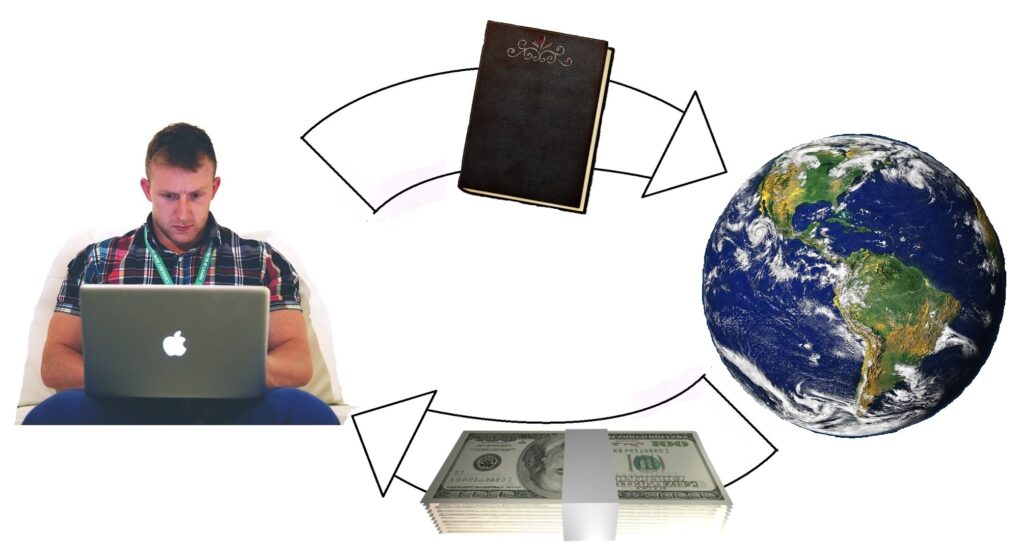
The uncaring and indifferent among you might ask where the money (these additional funds for deserving authors) should come from. The letter doesn’t cover that matter in detail because the answer is obvious. After all, publishers spend most of their time luxuriating in their vaults, counting and recounting their excess money. They use bills as scrap paper. They use gold coins to shim the legs of wobbly desks. They’re awash in cash, drowning in it.

The letter doesn’t ask publishers to part with all their money, just enough so starving writers can eat. It’s not too much to ask. Publishers will still retain plenty of scrap paper and desk-propping coins.

Plan B

On the off chance those skinflint publishers decline to cough up the necessary funding, the letter hints at another source. Pullman states it’s in ‘everyone’s interest’ to get writers paid appropriately.

Therefore, if publishers prove too stingy, we can turn to Plan B—take money from everyone and spread that sum among writers. However, Plan B may prove more difficult than it sounds. Going door to door with a tin cup strikes me as time-consuming. Also, a few citizens may hold differing opinions of fairness and disagree about what constitutes ‘everyone’s interest.’ Some might even refuse to contribute to the tin cup.

Let’s forget that method and select a far more efficient way of collecting money from ‘everyone’—taxation. We can simply persuade politicians (well known for their powers of logical reason and their sense of fairness) to raise sufficient taxes to pay writers what we’re worth. If they balk at a tax hike, they can feel free to add to the rather minuscule national debt, for payment later, by someone else.

What a grand project! Who’s with me?

The Consequences

Before we march on Washington, there’s one more thing. Failure in this endeavor is not an option. Mr. Pullman’s letter warns that if writers don’t get paid more, they will become an endangered species.

Writers, you may be aware, have almost split off from Homo sapiens to constitute a separate species—Homo scriptor. Failure to pay writers a living wage, Mr. Pullman believes, will cause that species’ population to decline.

What higher purpose does government serve, I ask you, than to protect all the species of the Earth? The endangerment of a beloved species, the possibility of its extinction, should prompt all non-writers to beg their governments to do something to ‘Save the Writers.‘ (Not a bad slogan. I should write that down.)

Rethinking the Problem

As I ponder this, a countervailing thought occurs. As the population of Homo scriptor dwindles, they will produce fewer new books. In a free market, when supply shrinks and demand stays steady or increases, the price goes up. As the price rises, more money should flow to the remaining writers, thus solving their income problem.

In fact, it’s possible this has already happened, and that the world has already reached an equilibrium, with the right number of writers all earning their fair share in a competitive market.

Well, isn’t that a buzz kill? I had my bags packed to march on D.C. Maybe, contrary to Mr. Pullman’s contention, things are as fair as they’re going to be for writers.

And if they’re not, the words of my father keep coming back. He used to ask me, “Who told you the world was fair?” That was a long time ago, before I became—

Poseidon’s Scribe

February 25, 2024Permalink

Writing and the 1st Amendment

Today is Constitution Day in the U.S., the 234th anniversary of the signing of the Constitution. Since that document includes a 1st Amendment, and since that amendment is important to writers, I thought I’d mark this anniversary.

The text is straightforward: “Congress shall make no law…abridging the freedom of speech…” Sounds simple, but over the centuries, lawyers and scholars have debated every word of that amendment, including ‘the.’

In theory, the 1st Amendment frees fiction writers to write about anything they want. That’s a good thing. Writers need not fear the government jailing or fining them for what they write.

In practice, the Supreme Court has imposed limits applicable to fiction writers:

  1. You may engage in political writing, unless it poses a “clear and present danger” of bringing about an evil that the Congress has a right to prevent. Over the years, the prohibitions have narrowed in favor of more freedom for the writer.
  2. If you’re a student in school, you’re subject to some limitations on what you can write about in a school-sponsored publication.
  3. You’re limited in the types of obscenity and pornography you can write about, but again, the prohibitions have narrowed in favor of the writer.
  4. You can’t defame, slander, or libel someone. The definitions of those have narrowed as well.
  5. You may not copy someone else’s writing and claim it as your own.

Some of the founders, including James Madison, at first objected to the inclusion of the 1st Amendment and the rest of the Bill of Rights, arguing that the Constitution already implied and contained these individual rights, that they required no separate enumeration.

In retrospect, it’s probably a good thing they ratified the Bill of Rights. Governments, by their very nature, grow and seek to restrict the freedom of individuals. Without a written and obvious restriction on governmental growth, the Supreme Court might have had a harder time digging ‘freedom of speech’ out of the basic Constitution’s text. 

For now, you’re free to write just about anything, and that’s something to celebrate. Happy Anniversary, 1st Amendment! Though you’re old, a bit tattered, and under constant assault, you’re looking pretty good to—

Poseidon’s Scribe

September 17, 2021Permalink
