Writers, it’s difficult, but we have to talk about this. The recent celebrity suicides of Anthony Bourdain and Kate Spade have raised awareness of the general suicide problem. However, writers may be particularly at risk.
A study released in March 2017 by the UK’s Office for National Statistics reported a higher risk of suicide “among those working in artistic, literary and media occupations.” [My emphasis added.]
It didn’t take long for me to compile my own partial list of fiction authors who have committed suicide (in order of birth date):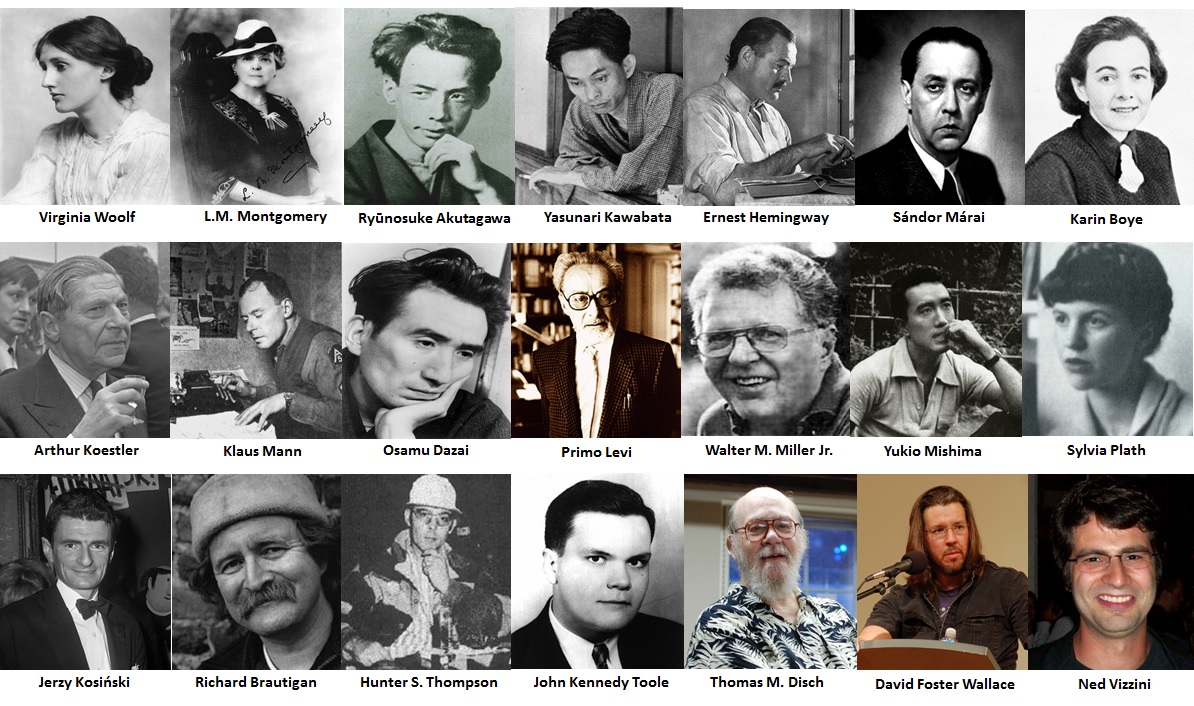
- Virginia Woolf – (1882-1941, age 59)
- L.M. Montgomery – (1884-1942, age 67)
- Ryunosuke Akutagawa – (1892-1927, age 35)
- Yasunari Kawabata – (1899-1972, age 72)
- Ernest Hemingway – (1899-1961, age 61)
- Sándor Márai – (1900-1989, age 88)
- Karin Boye – (1900 – 1941, age 40)
- Arthur Koestler – (1905-1983, age 77)
- Klaus Mann – (1906-1949, age 42)
- Osamu Dazai (1909-1948, age 38)
- Primo Levi – (1919-1987, age 67)
- Walter M. Miller Jr.– (1923-1996, age 72)
- Yukio Mishima – (1925-1970, age 45)
- Sylvia Plath – (1932-1963, age 30)
- Jerzy Kosinski – (1933-1991, age 57)
- Richard Brautigan (1935-1984, age 49)
- Hunter S. Thompson – (1937-2005, age 67)
- John Kennedy Toole – (1937-1969, age 31)
- Thomas Disch – (1940-2008, age 68)
- David Foster Wallace – (1962-2008, age 46)
- Ned Vizzini – (1981-2013, age 32)
For three of these (Kawabata, Mann, and Levi), the suicide explanation remains in doubt. I feel compelled to point out that three other authors on this list (Boye, Miller, and Disch) wrote Science Fiction, my chosen genre.
In reading articles about these authors, it’s significant how many articles mention the word “depression.”
Following any suicide, we naturally seek a reason, an explanation, an answer to “why?” Some authors left notes attempting to rationalize their choice, but often these only leave us with more questions.
It’s probably unfair to generalize about such a personal choice, an option chosen based on necessarily specific reasons. Still, it’s natural to wonder if there are aspects of writing fiction that increase suicide risk. Here are my (unscientific and unsupported) speculations on that:
- Writing is solitary. Writers tend to be less social and have fewer contacts with friends who might talk them out of suicide.
- Writers explore their inner feelings, and those of their characters. Such deep introspection can lead to depression and suicide.
- Writers think more about death and suffering than most people do. All fiction involves conflict, and writers must put their characters through pain, and, in some cases, death.
- Feedback can depress writers. Authors offer their cherished work to the entre world, and hope for a positive reaction. If the public ignores their stories or reviewers lambast them, authors often take it personally.
 If you’re a writer (or anyone) contemplating suicide, please, please, please call the Suicide Prevention Lifeline at 1-800-273-TALK (8255), or go to their website.
Perhaps you know a writer (or, again, anyone) who may be at risk of suicide. There’s a Twitter hashtag devoted to this: #BeThe1To. Here are the 5 Action Steps you can take to help your friend:
- Ask your friend in a caring way if they feel suicidal;
- Do what you can to keep your friend safe;
- Listen without judgement and be there for your friend;
- Connect your friend to a network of resources and helpful people; and
- Follow up with your friend, even after treatment.
Let’s have a world without suicides. That’s the dream of—
Poseidon’s Scribe
 According to a