Giving and Receiving…Critiques

‘Tis the season for giving and receiving, so I thought I’d discuss critiques of fiction manuscripts.  Last time I did so, I said I’d let you know how to give and receive critiques.  My critique group meeting 2experience is based solely on twenty years of being in small, amateur, face-to-face critique groups; not writing workshops, classes, or online critique groups; so the following advice is tuned to that sort of critique.
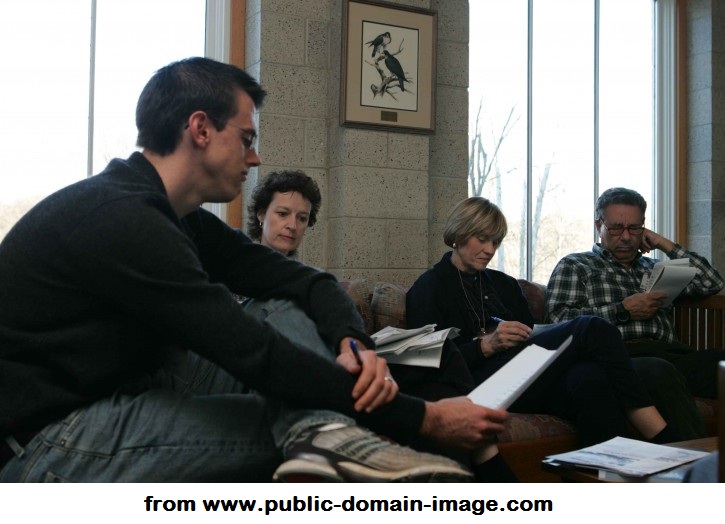
First of all, to give the critique, keep the following points in mind:

  • Read the submitted manuscript straight through once, and just note where you were “thrown out of the story” for some reason.  Jot down why and come back to those points later.
  • Re-read the manuscript again. You could mark some of the grammar or spelling problems, but don’t concentrate on those.  The author wants you to find the bigger stuff.
  • Where there are stand-out positives (“Eyeball kicks” in TCL parlance) note those and praise the author.  The word critique should not have solely negative connotations.  A positive comment from you could keep the author from later deleting a really good description, metaphor, or turn of phrase.
  • Be clear and specific in the comments you write; avoid ambiguity.
  • Look for the following story elements and comment if they’re not present or they’re weak:

1.  Strong opening or hook

2.  Compelling, multi-dimensional, non-stereotypical protagonist with human flaws

3.  A problem or conflict for the protagonist to resolve

4.  Worthy secondary characters, different from the protagonist, who do not steal the show

5.  Vivid settings, not overly described

6.  Consistent and appropriate point of view

7.  Appropriate dialogue that moves the plot and breaks up narration

8.  Narration that shows and doesn’t tell.

9.  A plot that builds in a logical way, events stemming from actions that stem from understandable motivations

10.  A story structure complete with Aristotle’s Prostasis, Epitasis, and Catastrophe (beginning, middle, and end)

11.  Appeals to all five senses

12.  Active sentence structure, using passive only when appropriate

13.  Appropriate symbolism, metaphors, similes

14.  A building of tension as the protagonist’s situation worsens, followed by brief relaxing of tension before building again

15.  An appropriate resolution of the conflict, without deus ex machina, resulting from the striving of the protagonist, and indicative of a change in the protagonist

  • If your group shares comments verbally, do so in a helpful, humble way.

You think all that sounds pretty difficult?  Ha!  It’s much harder to receive a critique.  When doing so, here are the considerations:

  • Submit your work early enough to allow sufficient time for thorough critiques.  Be considerate of your group members’ time.
  • While being critiqued, sit there and take it.  No comments.  No defensiveness.  Just listen to the honest comments of a person who not only represents many potential readers, but who wants you to get published.

So, when it comes to critiques, is it better to give than to receive?  In contrast to most gifts, it’s harder to receive them, but it’s still a toss-up which is better overall.  But perhaps both are just a bit easier for you to deal with now, thanks to this post by—

                                                      Poseidon’s Scribe
December 30, 2012Permalink

Sorry, New Rule. You Can’t Do That!

In the original Star Trek TV series, there’s an episode where Captain Kirk invents a card game called Fizzbin in which he makes up the rules as he goes along.  The comic strip Calvin and Hobbes featured a game called Calvinball which may never be played by the same rules twice.

If you’re a writer of fiction, you might consider yourself to be playing such a game, too.  According to W. Somerset Maugham, “There are three rules for writing the novel. Unfortunately, no one knows what they are.”  With apologies to the famous novelist, I’d say the game has too many rules to memorize and they change with time, according to the tastes of readers.  Only by playing the game well can you can make money selling books.

You might try to emulate great writers of the past and imitate their writing styles, in an effort to achieve success.  Bad idea.  The rules were different in their time.  Let’s cover some of those former rules.

1.  Take all the time you need to create a vivid description, to ‘paint’  with words.  Writers of the 19th Century and earlier used extensive portrayals to convey the appearance of a scene or character, multi-paragraph descriptions abounding in adjectives.  That worked well in an era without movies or TV, but readers won’t wade through such long-winded descriptions today.

2.  Adverbs exist for a reason; use them.  Authors once used adverbs with abandon. Adverbs modify adjectives or verbs and often end in ‘ly’ like ‘crazily.’  These days it’s considered lazy to use too many adverbs, a sign you didn’t take time to select a powerful enough verb.

3.  Demonstrate your skill as an author in your narrative paragraphs; dialogue only interferes with that.  At one time, fiction was mostly narration, with occasional dialogue.  We’re now in an age of character-driven stories, and readers want characters to talk more.  No long, boring narrative paragraphs, and less narration overall.

4.  Incorporate a rather dull character who needs everything explained to him (even things he already knows); that’s a clever way to explain things to the reader. There was an era when authors could use this technique even if it strained the conversation a bit.  These days, that’s no longer tolerated and there’s even a term for it–As You Know, Bob or AYKB.  AYKB’s are tempting, an easy trap to fall into even if you make every effort to avoid them.

5.  Bring the narrator in as an entity the reader can trust, as one who helps foreshadow future events.  In a bygone past, writers could have the narrator speak directly to the reader.  And now, Gentle Reader, let us discover what Annabel must be thinking about this latest development.  That voice could be used to foreshadow future events in an ominous tone.  Little did Frank know, but his secure life would soon be altered forever.  Understand, it’s still okay to use foreshadowing, but do it with subtlety, and not with the narrator speaking to the reader.  Today that’s referred to as narrative intrusion.

6.  Find clever new ways to express your ideas.  As centuries of writers did this, many of the word combinations they used were so good the first time, they got used again, and re-used many times over.  And became clichés.  Now you don’t get to use those clichés, unless you add some twist on them.  Go think of your own clever word combo that might become a future cliché.  This rule didn’t change, but sorry, you can’t use the same tired clichés.

7.  Ease into your story by introducing the reader to the setting, time period, and major characters before any action occurs.  Readers in those times had nothing to compete with books for entertainment, and had the time to curl up near the fire and read a cozy story by its light.  Times are different.  You must grab your reader by the throat with a first sentence or paragraph that demands attention.  It’s called a hook, and stories without a good one stay un-bought.

So, are you up for a game like Fizzbin or Calvinball?  May the best writer win!  Unfortunately, the game’s rules aren’t known by you or—

                                                                    Poseidon’s Scribe


November 25, 2012Permalink

Conveying a Sense of Wonder

One of the things that drew me into fiction as a child was the sense of wonder I experienced when reading certain fiction, notably that of Jules Verne, Arthur C. Clarke and later science fiction writers.  The question is, how does a writer evoke that in readers?

First, let’s try to define it.  The book Brave New Words: The Oxford Dictionary of Science Fiction defines it this way:  “a feeling of awakening or awe triggered by an expansion of one’s awareness of what is possible or by confrontation with the vastness of space and time, as brought on by reading science fiction.”

Although often associated with science fiction, that emotion needn’t be.  Rachel Carson’s book The Sense of Wonder was about sharing a love of nature with a child.

I like the associate with childhood.  To children the natural world is new, and they experience that sense of wonder more often.  Then it fades as we age and it takes more than mere nature to astonish us.  Here’s an example of that fading-with-adulthood phenomenon.  How many times have you heard the finale of the William Tell Overture (the Lone Ranger theme) by Gioachino Rossini?  Ho hum, right?  But do you remember the thrill of that first time you heard it?  Can you image what audiences of 1829 felt the first time that finale ever played, anywhere?

Up until Jules Verne and authors who followed him, adults most often experienced the sense of wonder in religious contexts, or in fantasy literature.  Through his writing Verne showed the world what engineers and scientists of the time were bringing about—a better understanding of the natural world, and the amazing things man might do to achieve his ends.  Verne showed readers something new and vast, and it had nothing to do with God or dragons, but with people.

Arthur C. Clarke was another science fiction author who captured the sense of wonder better than most.  He carried the science far beyond Verne did, and showed a future humanity achieving, through engineering, the capabilities of gods or wizards.  It was Clarke who said, “Any sufficiently advanced technology is indistinguishable from magic.”

For writers seeking to induce the sense of wonder in their readers, then, how do you do it?  I think there are four elements involved:

  • A “thing” that is new in some way, or an old thing in a new context
  • A powerful description of that thing, emphasizing its newness
  • One or more characters confronting the thing
  • A depiction of the awe felt by one or more of the characters.  How does the thing make the character feel?  Again, you’re striving to recreate in words the amazement a child feels for something new.

If you do this well, if your characters are compelling, if the thing is truly worthy of awe and you’ve described it and your characters’ impressions well, then your readers will feel the wonder of it right along with the characters.

In my fiction, I strive to create this sense of wonder, most often in association with technology.  Many of my stories are historical, so the characters see something outside their experience, but not necessarily beyond that of modern readers.  I confront my characters with such things as a flying trireme, a clockwork lion, a giant mechanical elephant, a steam-powered oared galley in the 1st Century, and steam-powered human limbs (coming soon).

Is there anything to this “sense of wonder” stuff, in your opinion?  Have you experienced that feeling from reading fiction?  Have you tried writing it into your fiction?  Leave a comment and let me know.  Wondering about the answer to these and other questions, I’m—

                                                           Poseidon’s Scribe

November 18, 2012Permalink

The Modular Author

I’ve written before about the conflict between the way readers want authors to be, and the way authors’ muses want them to be.  Now I’ll carry those thoughts forward to conclusion.

As a reminder, readers want you (as an author) to be consistent in genre and style so when they pick up one of your books, they know what they’re getting and aren’t surprised.  On the other hand, writers’ muses are creative and get bored with sameness; they’re always seeking something new and different; it’s always possible for an author’s ideas to run dry, and that’s another reason for writing in several genres.

There’s a conflict, a disconnect, between the desires of the people in each camp.  I think it’s a little much to expect readers to change.  They’re the customer, after all, and the customer is always right.

One possible answer is the use of pen names, also called nom de plumes or pseudonyms.  There are many other reasons you might use one, but we’ll just discuss one today.  The idea is to create a persona, an alter ego, another version of yourself.   The author going by that fictitious name is a specialist in a particular genre, a specific type of story.  That’s that persona’s brand.

A downside of pen names these days results from (1) our lives being recorded on the Internet to a great degree, and (2) readers’ desire to know their favorite authors in as personal a way as possible.  Those facts make it difficult to prevent people from finding out the real author behind the pen name.  Authors these days are expected to have their own websites, with their picture and a list of future appearances; some of those things might be difficult for a nom de plume to pull off.  Further, curious and persistent readers even go to the extent of analyzing writing to determine if two apparently different authors are really one person.

But to dismiss these disadvantages for a moment, are we headed for an end state where most authors actually have multiple names, several personas, each cranking out stories according to his or her particular brand?  That would seem to please both authors and readers.  This was foreseen, in a way, by Alvin Toffler in his 1970 book Future Shock.  After observing the increasing number and amount of temporary, throw-away material products, Toffler introduced the concept of the “Modular Man,” a disposable person.  In the future, all people would form several personas, try them out, and discard them as they please.

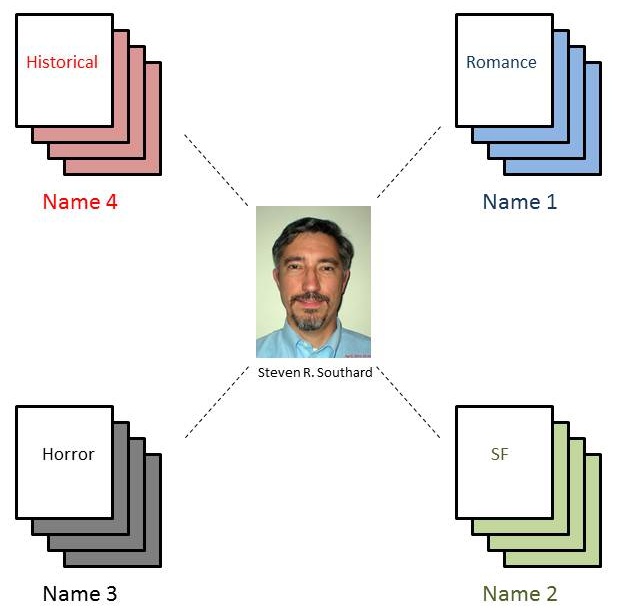
Is the literary world now reaching Toffler’s future?  What if you created a separate name under which you wrote romances, another name for horror, and one more for science fiction.  For each name, there would be a website for which you wrote blogs and connected with curious readers by e-mail.  Perhaps with some photo manipulation you could get away with posting pictures of these ‘virtual authors.’  Some of them might be male, others female–in fact all of them might be the opposite gender from your real one.  Each one could write stories and blog entries in a different style according to their various personalities.

Difficult?  As a fiction author, you’re used to creating multiple and varied people.  The only difference here is you’re not creating characters in stories; you’re creating other versions of yourself, where each version is an author.  One or more of those versions could be quite outrageous, edgy, and controversial.  Why not?

As of today (so far as you know) I have not plunged into that future/present to any significant extent.  I’m sure others already have.  As for the one who signs my blog entries, that’s really a job title, not a name.  It is my attempt at an alternate persona, my nod at creating a modular author.  Leave a comment and let me know if you would like to have a portfolio of alternate writing personas, if you do it already, and how many such modular authors you maintain.  Though it’s not really me, but kind of is, I’m—

                                                     Poseidon’s Scribe


October 21, 2012Permalink

Is Fiction Dialogue Different from Plain Old Yakking?

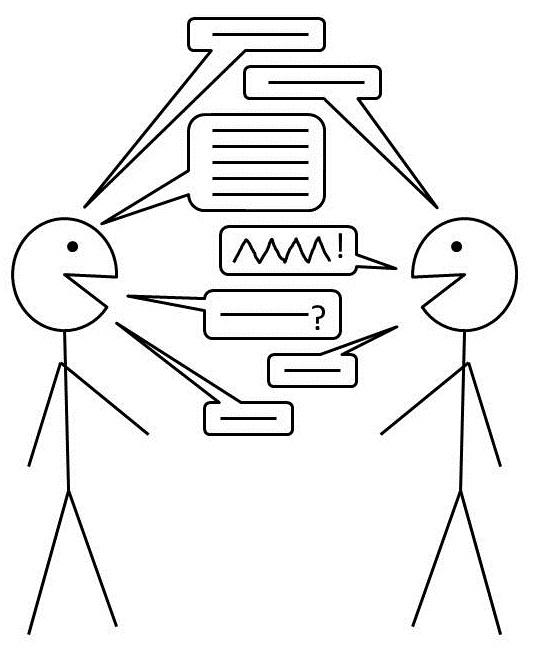
Dialogue through verbal speech is as important to your fictional characters as it is to us flesh-and-blood folks, though for somewhat different reasons.  For both fictional and real people, speaking is the most common form of communication, and communication is, of course, not only vital but is something we humans do a lot.

However, real people engage in spoken dialogue for only a few reasons, and among them are:

  • to inform
  • to persuade
  • to establish a relationship
  • to argue
  • to direct or command

When our fictional characters talk, it is for these reasons, too, but also several more.  This is due to the difference in their situation.  For example, we often speak ‘off the cuff’ without much preparation or forethought; characters never do that, though they seem to.  Characters only exist due to the efforts of an entity called a ‘writer,’ of whom they are unaware.  They exist solely for the benefit and enjoyment of another entity called a ‘reader,’ of whom they are also unaware.  So dialogue between characters also serves these purposes:

  • to set the scene; that is, help the reader ‘see’ the scene
  • to establish a character’s personality
  • to advance the plot by introducing or heightening the conflict
  • to create suspense or add tension
  • to remind the reader of previous events or characters
  • to foreshadow future events
  • to provide easy-to-read ‘white space’ in between narration paragraphs

Most of the time, fictional dialogue is accomplishing many of these functions at once.  That might seem a daunting task for the beginning writer, and you may be wondering how you’ll ever write dialogue that does so much.  As an author not too far removed from beginner status, all I can say is, I’m told the task gets easier with practice, like any good habit.

Now that we’ve covered the differences in purpose, let’s cover the differences in form between real and fictional dialogue.

  • In the first place, fictional dialogue is less dull.  As much as we try not to be dull in real life, much of our conversation is, frankly, boring.  Fiction can’t afford to be dull, so leave out all the ‘ums’ and ‘ahs’ of real speech.  Cast out all the little pleasantries like ‘how are you doing?’ ‘fine,’ etc.  Ever notice fictional characters rarely say ‘hello’ or ‘goodbye?’ Now you know why.
  • Fictional characters shouldn’t have as strong an accent as real people, at least as it’s depicted in written dialogue.  Whether your character is from the deep South, New England, or speaks English with a strong foreign accent, don’t attempt to replicate every word by spelling it as your character would pronounce it.  Just do that with a couple of words per sentence at most.  Your readers’ imaginations will do the rest, and you don’t want to make it difficult for them to decipher your prose.

And that’s it.  In other words, fictional dialogue isn’t too different from everyday speaking, at least on the surface.  If it were significantly different, readers wouldn’t find it believable.  It’s only beneath the surface where fictional dialogue serves purposes beyond what’s going on in real conversation.   Here are three links to great articles giving helpful guidance about fictional dialogue:  here, here, and here.

“Hope you enjoyed my blog entry on how dialogue is different from plain old yakking.  Feel free to leave a comment whether you agree or disagree,” said—

                                                  Poseidon’s Scribe


What the Web Wrought on Writing

We still live near the dawn of the Internet Age, of course, so it’s perhaps a bit early to assess the web’s impact on writing.  But here goes, anyway…

First, it’s instructive to recall the past technological developments that aided fiction writers, or allowed them to better connect with paying readers.  Here’s a partial list:  libraries, bookbinding, printing presses, mass production of paper, mail delivery, bookstores, dictionaries, typewriters, computer word processors, and eBooks.  Each of these innovations aided storytellers in significant ways.

(By the way, I’m aware of the difference between the ‘Internet’ and the ‘World Wide Web.’  Even so, they’re intertwined enough that I’ll use the terms interchangeably.)

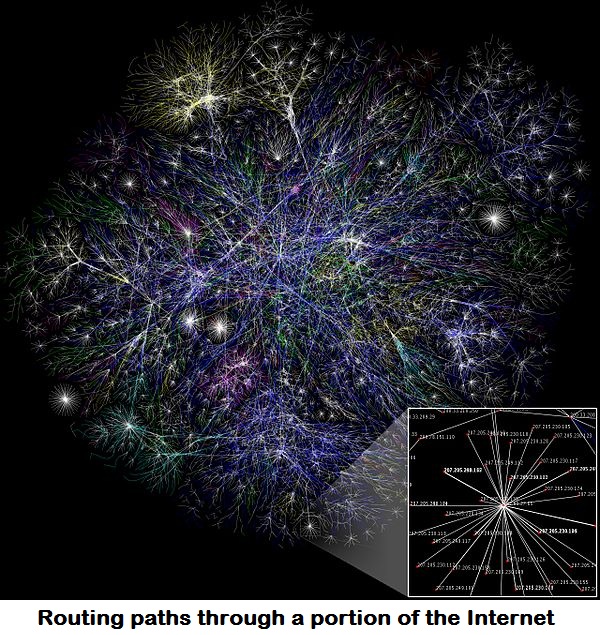
I would argue the Internet’s impact on writing is (and will be) as great as any of those previous technologies.  It’s true, those who created the Internet did not have authors specifically in mind.  But some of the Internet’s attributes have eased the processes involved in the writing business:

  • Span.  The Internet covers the world; and to a greater extent every day, it is spanning all of human history; and encompassing a larger fraction of all human knowledge.
  • Search and Retrieval.  Internet search engines provide a way to sift through the vastness and find desired, specific information, no matter how obscure.
  • Permanence.  To some extent, the Internet represents a permanent record.  I believe the way data is stored and backed up renders far less likely a tragedy such as the destruction of the ancient Alexandrian Library.
  • Speed.  Everything you can do on the Internet, you can do fast, much faster than using the mail, or hunting through a library.
  • Availability.  The Internet is within reach of nearly everyone, and at very low cost.

In short, the web eases the way people connect to information and to other people.  The sudden ease of those connections has been a boon to writers.

Here are some ways the web has improved several steps of the writing process:

  • Research.  It is far easier for writers to research specific topics using the Internet.  There are gaps in the web, of course, and problems with accuracy of information, so trips to the library remain necessary on occasion.
  • Co-authorship.  E-mail makes it easier to collaborate with another writer when both are contributing to a book.
  • Critiquing.  It’s no longer necessary to find other writers in your local area to get your manuscripts critiqued.
  • Market searches.  Websites like Duotrope, Ralan, and Doug Smith’s Foreign Market List make it much easier to compile a prioritized list of ideal markets for each of your stories.
  • Submitting.  Most markets take online submissions, either through e-mail or their own online form.  Much faster and less costly than mailing.
  • Publishing.  As with many other businesses, the Internet has allowed people to quickly form small businesses operating out of their homes.  This has resulted in a proliferation of publishers.
  • Advertising.  The advent of websites, blogging, and social networking has opened up new ways for authors to reach readers.
  • Book-shopping.  For readers, the Internet’s search features and various online booksellers have eased the process of browsing for the next book to read, no matter how obscure the reader’s interests.
  • Reviewing.  Online bookselling sites have made it easy for anyone to post a book review.  These reviews help other readers make their purchasing decisions.

The Internet has helped writers in every way except one.  It won’t write your book for you!  And maybe that’s a good thing.  Still writing my own stories, I’m—

                                                          Poseidon’s Scribe


September 30, 2012Permalink

Writin’ for Nuttin’

Should you always write to be paid, or should you (at least sometimes) write for free?  Here I’m talking about complete fictional stories, not blog articles or story excerpts.

The answer for you will depend on your situation.  I’ll offer some guidance, some basis on which you can make your decision.

There are those who say you should never write for free, and their reasons are compelling.

  • Writing is effort, and you deserve to get paid for it.  In one sense it does look like writers are producing something from nothing, but the product is something, after all.  Considerable effort went into the product, and work should have its compensations.  Of course, payment is more related to value as perceived by the purchaser than to the effort expended by the author.
  • You have to eat.  How much of your life’s precious time do you really have to expend on doing stuff that has no return?
  • Other authors get paid; why shouldn’t you?  Let’s face it—all else being equal, getting paid for your work beats not getting paid.  Since there are readers willing to pay for well-written stories, why shouldn’t you be one to meet that need, and reap the benefits?
  • Readers perceive free fiction must be inferior.  You get what you pay for, the old saying goes.  If you give away your stuff, they’ll think it can’t be any good.  No matter your personal reasons for writing for free, you can’t directly control this aspect, since it’s a reader perception issue.  Perhaps slowly over time you’ll build an audience as readers realize your stories are high quality despite being free, and tell their friends.

Still, there are valid reasons for giving away your stories, and some of these may apply in your case.

  • Name recognition.  Given that today’s readers rarely choose stories from authors they don’t know, you need to give an incentive for them to know you.  From there you can build an audience willing to pay for your work.
  • Writing as a hobby.  Some folks associate income with work, and work with drudgery.  They associate the word ‘hobby’ with fun, and don’t want to contaminate their fun hobby by turning it into a chore.
  • Less chance of rejection.  I think the so-called “for the love” markets are easier to break into.  However, this reason for giving away fiction is starting to become obsolete in an age when writers can skip the editor/publisher route entirely and publish eBooks directly, and charge for them.
  • Writing as a favor.  Perhaps you’ve become friends with an editor or publisher, and perhaps you owe them a favor for some kindness they’ve shown you.  Nothing wrong with sending them a story for which you ask no payment.
  • For charity.  Here the reader still pays to read your stuff but proceeds go to some deserving assistance organization rather than to you.  Nothing wrong with that.

You’ll have to weigh the pros and cons depending on your particular situation.  In my own case, I have written a couple of stories and submitted them to a “for the love” market.  I hope to include them in an anthology that I’ll charge for, so maybe I’ll make some money from them.  I wrote a story intended to go into a different anthology for which proceeds would go to charity.  That anthology fell through, though, so I will attempt to market that one and get paid for it.  Generally, now, I write for money.

Please let me know what you think about writing for free, and what your experiences have been.  Of course, you can always read—for free—the blog entries of—

                                               Poseidon’s Scribe

September 23, 2012Permalink

How Well Do You Really Know Your Characters?

In a previous blog post, I wrote about creating characters.  One bullet point I made was that you, as author, should get to know your major characters.  Let me expand on that today.

To review, your goal is to create believable, interesting, and memorable characters.  Also, to some degree, your characters should be representative, or recognizable; readers should be able to identify with at least some aspect of the characters, having that aspect themselves or having witnessed it in other real people.

With that as your goal, you understand why you shouldn’t use stereotypes as your main characters.  You want to convey a degree of complexity or depth, mimicking the complexity of real people.  To achieve that, try to create characters that aren’t entirely consistent; they can’t be described in one word or phrase.  They may be mostly consistent, but they have a quirk or two.

So, why must you, as the author, spend time getting to know your main characters?  Think about it this way—your readers can’t know your characters before you do, or any better than you do.  Phrased positively, after you start loving your characters, and to the degree you do, your readers have a good chance of loving them too.

Every author employs a technique of choice to gain an understanding of his or her characters.  Mine is to use a character chart.  The chart takes me through the following aspects of a character:

  • Biographical.  This includes such things as name, date of birth, back-story, talents or skills, nationality, race, finances, religion, employer and occupation, marital status, etc.
  • Physical.  This category asks questions about age, weight, height, health, body type, eye color, hair color and style, disabilities, illnesses, self-image, etc.
  • Psychological.  In this section I specify the Myers-Briggs personality category, the character’s main motivation, worst fear, biggest regret, etc.

If you send me an e-mail at steven-at-stevenrsouthard-dot-com, I’ll send you the character chart I use.  However, I urge you to modify it so it suits you.

Here’s the interesting and non-intuitive part about using these character charts.  You won’t end up using all that filled-out chart information in your story.  In fact, after filling out the chart, you may never look at it again.  And that’s okay.  The point of filling out the chart wasn’t only (or even mainly) to generate a ready reference.  The point was for you to get introduced to your character, to really understand your character well.

After completing the chart, you should still think of it as dynamic and changeable.  It’s on paper or electronic form, after all, not chiseled on a stone tablet.  If you find some aspect of the character not really working in the story, feel free to change the character.  You’re aiming to have the story and characters intertwined so that only these characters could experience these events and behave in ways that advance that particular plot.

Aside from the chart method, here are two other ways to get to know your characters:

  • You could take some scene or event from your own life (not something in your story), and describe it as your character would.  That helps keep your characters from getting too autobiographical and forces you to see through their eyes.
  • You could write down (or speak aloud) an imaginary dialogue between yourself and your character.  Again, this separates the character from you, highlights how distinct and unique the character is, and helps bring the character “alive” in a way.

Did this blog entry help you, or not?  Either way, feel free to leave a comment and let me know.  Meanwhile, there are several characters waiting to become better known by—

                                                 Poseidon’s Scribe


September 9, 2012Permalink

Novels-in-Verse

If writing prose is getting boring,

If each new tale keeps getting worse,

To send your reader’s thoughts a’soaring,

Just try a novel writ in verse.

Verse novel it is called quite often.

Your muse’s heart you’ll have to soften,

For writing thus will take more time,

To work in meters, feet, and rhyme.

Free verse or Onegin-type stanza,

(Much like the blog you’re reading now.)

Done right, your readers will say “Wow!”

Your novel’s sales, a big bonanza.

Do other authors do it? Yes!

Like Margaret Wild and Karen Hesse.


When is Verse Novel form most useful?

When characters are more than few,

And besides—to be quite truthful—

When tale’s got many points of view.

When characters stir up commotion,

And in their heads is much emotion,

When using prose would seem far worst,

Each scene a momentary burst.

It’s quite in style for younger readers;

Verse Novels now are catching on;

For poetry, another dawn?

So, you might join this movement’s leaders,

Craft verse among that happy tribe!

Rhythmically Yours—

                                                 Poseidon’s Scribe


September 2, 2012Permalink

When Authors Speak

When you’ve had a few stories published, you may be asked to speak at a conference.  It may be a chance to speak alone about a topic, to speak on a panel, or to read some samples of your writing.

I’ve had that honor twice.  In February 2010, I read a portion of my story “Within Victorian Mists” to an audience at the Crossroads Writing Conference in Macon, GA.  I was with a group of other steampunk writers (Emilie P. Bush, Kathryn Hinds, Alexander White, Lainey Welsch, Dwayne DeBardelaben, and Austin Sirkin), and here’s a picture from that event.  In November 2011, I served on a panel with some steampunk experts (Mark P. Donnelly, Elektra Hammond, and Kevin Houghton) at the DarkoverCon in Timonium, MD.

For both conference speaker and conference attender, there are likely to be some unmet expectations.  I fear that conference attenders who hope to be authors someday think they will learn the hidden secrets of great writing and be handed the golden keys to fortune and fame.  In some cases, conference speakers may expect to earn flocks of new fans, all captivated by the speaker’s charm or wit and eager to part with their cash in exchange for the author’s books.

So if you’re the writer who’s given a chance to speak, what should you expect?  Perhaps one or more audience members will feel moved to purchase something on the spot.  Others may think about it and investigate your presence online later, before deciding to buy and read one of your books.

Those attending your panel, or lecture, or reading, must lower their expectations as well.  After all, it’s not like you have surplus fortune-and-fame keys to hand out.  The most they’ll receive are a few nuggets of wisdom about becoming an author, or reminders and reinforcements of previously learned knowledge.

As the speaker, then, your purposes are clear.  (1) Present yourself as an engaging, interesting personality.  (2) Convey some useable advice or recommendations about getting published. (3) Inform the audience about your books without being pushy.  In this way both speaker and audience can leave knowing they’ve received something of value.

Trouble is, the skills you developed while becoming a published author differ from those needed for speaking at a conference.  Public speaking scares most people at first, and only practice and experience lessen that fear.

If you’re the sole speaker during your session, I suggest you come prepared with an outline, so your talk doesn’t ramble.  Remember too, even a lecture is an interactive event, never the same twice.  Watch your audience members for their body language and facial reactions; you’ll know when you’ve said something controversial or provocative, etc.  Be gracious and attentive during the question-and-answer period.

When serving on a discussion panel, now group dynamics enter the picture.  Don’t monopolize the panel; that turns audiences off.  Don’t sit there saying little; you won’t entice future readers that way either.  If you must disagree with another panelist, do so with respect and consideration.  Never get drawn into an argument; that runs counter to your purposes.

If reading from one of your stories, select an engaging passage.  Project your voice.  Enunciate your words.  Modulate as you speak, stressing for emphasis and altering your timbre or accent for different characters in dialogue.

Was this advice helpful?  Let me know with a comment.  Remember, readers love to meet and engage with authors, especially those they find intriguing.  So get out there and be intriguing.  Soon you’ll be winning fans, including–

                                                         Poseidon’s Scribe