Writercore—the Easy Way to Become a Writer

Everyone turns to me for news on the latest trends, the hottest aesthetics, and the current fashions. Never one to disappoint my many fans, I’ll delve into writercore today.

What is Writercore?

Image created at Perchance.org

It’s a vibe, a style meant to announce you’re a writer. To achieve it, wear a vest and long coat (leather or tweed) with a wide belt. When you go out, wear a flat cap. Select colors in the brown and sepia range. Carry a fancy fountain pen and a leatherbound journal.

To complete the look and feel, sit at a desk with your typewriter (yes, typewriter) and your coffee mug (or teacup and saucer). Nearby stands your bookshelf weighed down with books and inspirational knickknacks.

For a better description of writercore, see this post by Kara Race-Moore.

Walmart even offers a writercore mug.

Why -core?

Because everything’s -core these days. Add the suffix -core and you’ve got an aesthetic. It derives from the Latin cor, meaning heart. Writercore = the heart (or core) of being a writer.

Are there other -cores?

More than I wish to mention, but I’ll cite four examples. Cluttercore allows you to crowd your living space with things you love. Those into Gorpcore wear outdoor recreation clothes as urban streetwear. Normcore seems a reaction against the -core trends, since its adherents wear unassuming, average clothes. Yes, even that requires its own special name.

Poetcore deserves its own paragraph. At the moment, it seems a more defined and widespread fashion trend, with writercore as a minor offshoot. Though related, the two differ a little. For more information about poetcore, see this New York Post article and this article in Culture Mosaic.

Will writercore really make me a writer?

Maybe. Who am I to say? Perhaps you need the vibe to get in the mood to write.

To be honest, I think the odds stack up against it. Seems to me you’re better off actually writing and getting published first, and then inventing your own version of writercore style later. Perhaps writing style exceeds clothing and furniture style in importance.

With nary a typewriter, fountain pen, or leatherbound journal in sight, I’m—

Poseidon’s Scribe

Get Yourself Ready for National Imagination Day

Tomorrow, the Martin Luther King Jr. Birthday holiday coincides with National Imagination Day. Appropriate, huh?

What is National Imagination Day?

Picture a day set aside to celebrate the unlimited power of your mind to think whatever it wants to, to dream impossible dreams, to imagine a better world (or a worse one). That’s National Imagination Day.

Who Started It?

The folks at NationalDayCalendar.com started National Imagination Day in 2024, just two years ago.

Image created at Perchance.org

What, Exactly, Is Imagination?

Imagination—the ability to form mental images of things not detected by the senses or not considered real.

From out of nothing at all, we can form something in our mind—something new to the world. Or, from raw materials at hand (or those we can think of) we can picture a new formation, a new construct, a new use.

We think of it as a trait exclusive to humans, but animals imagine too. What might they be imagining?

How Do I Celebrate National Imagination Day?

Glad you asked. Here are a few suggestions:

  1. First, if you haven’t used your imagination in a while, you might need to prime your imagination pump. Let your mind return to a time when you imagined things with ease—as a young child. What did you imagine then? What did you pretend to be or do? Recall that time and remember the fun.
  2. Another priming technique—watch a movie or TV show, or (better) read a fiction book. (If you’re not sure which books to read, I can recommend some.) Imagine yourself in the settings of that story. Or think how you would direct the show or write the book in a different and better way.
  3. Consider a problem you face in your life, or one someone else faces. Write twenty solutions to the problem. Don’t limit yourself to practical, feasible solutions. Go crazy, but don’t stop until you reach twenty of them.
  4. Take a walk in nature, maybe somewhere you haven’t walked before. Imagine an adventure there, with talking trees and animals, castles, wood sprites, or whatever.
  5. Compose a song, with or without lyrics. Sing or hum it. Dance to it. They say music is the language of the soul.
  6. Draw or paint a picture of whatever your mind imagines.
  7. Build an imaginative physical creation using whatever materials you have at hand.
  8. Write a story or poem about whatever your mind imagines.
  9. Imagine your ideal video game. Write the premise of the game and its major characteristics.
  10. Since we celebrate Martin Luther King Jr’s birthday on the same day, read his famous “I Have Dream” speech. Imagine the country of that dream. What would that nation be like? Imagine yourself there.

What’s the Point?

Whichever suggestion you chose, did you have fun? If so, why not do a little imagining every day? No need to wait a year.

Look back at what you did. Did your imaginative activity spark something bigger? Did you brainstorm a workable solution to the problem? Could you write that story, or screenplay, or poem, and could you submit it? Might that song be something you could record? Is the picture you made or the structure you built sharable with others? How about that video game—would someone in the industry be interested? What might it take to get our country to resemble the one in Martin Luther King’s dream?

Don’t be disappointed if you imagined something silly or stupid or too private to share with others. Some imaginative ideas lead to profitable outcomes, but most don’t. National Imagination Day isn’t about making money.

However, consider this—every profitable innovative idea, every new song or story or painting or video game started out in someone’s imagination. They imagined them on a day like today.

You have an imagination. Use it! Don’t let that powerful ability go to waste. Every day can be National Imagination Day for people like you, and for writers like—

Poseidon’s Scribe

A New, and Aquatic, Newsletter

I’m starting a newsletter, and would love it if you’d subscribe.

Called “Steven R. Southard’s Log,” it will take the form of a ship’s log chronicling my voyage through the literary seas. You’ll get a fresh log entry in your email inbox around the middle of each month, (when the Romans called the Ides).

Through the newsletter I’ll keep you up to date on what’s happening with my writing, my upcoming stories and books, information on stories I’ve published before, links to my blog entries for the month, and whatever else I can dream up.

As with any newsletter, you may unsubscribe at any time. I’ll do my best to keep the log entries short and interesting, so you’ll be inclined to stick with me.

To subscribe:

After you click the box, you should see a form asking for your name and email address. After providing those and clicking Subscribe, you should receive a Welcome Aboard email.

You’ll find the newsletter a more personal way to keep in touch with—

Poseidon’s Scribe

Keyboards Now Untouched – American Scifi Authors Lost in 2025

As we start 2026, let’s begin by remembering the many authors we lost in 2025. To reduce the list to a readable blogpost, I’ll just honor the prominent American science fiction authors who died last year. I used the Encyclopedia of Science Fiction as a source.

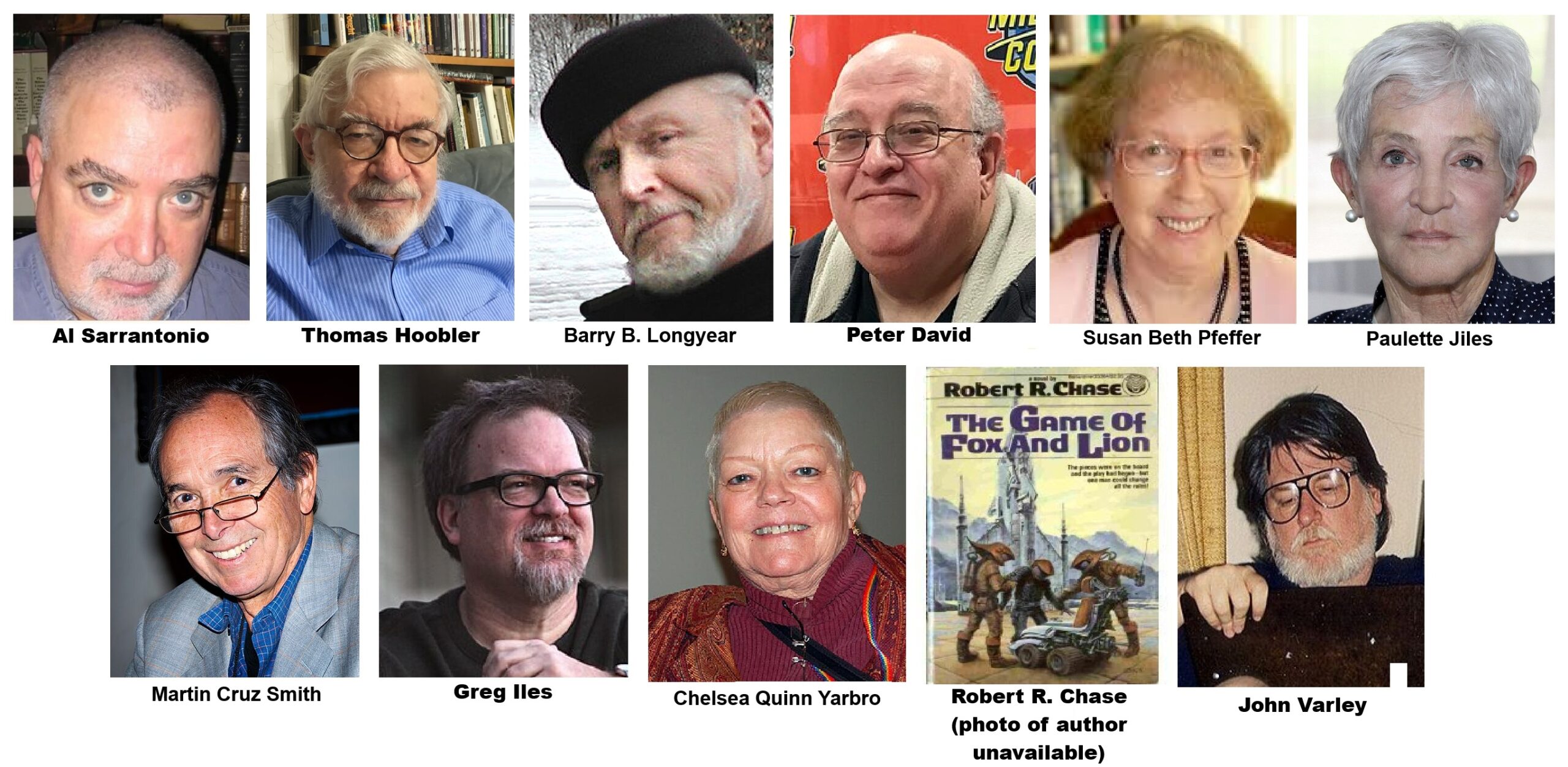
Al Sarrantonio (1952-2025)

A horror writer, editor, publisher, he authored more than fifty books and ninety short stories, and edited several anthologies. He authored the Five Worlds science fiction trilogy and the Master of Mars scifi trilogy.

Thomas Hoobler (1942-2025)

Along with his surviving wife, Dorothy, he co-authored more than 100 books. In science fiction, they wrote The Hunters, Treasure Hunters, and Dr. Chill’s Project.

Barry B. Longyear (1942-2025)

He wrote numerous scifi novels, including the Hugo and Nebula winning novella Enemy Mine, later made into a movie. He was the first writer to win the Hugo, Nebula, and Campbell awards in the same year.

Peter David (1956-2025)

Though primarily a comic-book writer, he also wrote the novel several popular Star Trek novels, Babylon 5 novels, and novel adaptations of films, among others.

Susan Beth Pfeffer (1948-2025)

She wrote over seventy science fiction and young adult novels, including the popular Moon Crash series.

Paulette Jiles (1943-2025)

Though mainly a poet and memoirist, Jiles also wrote science fiction, notably The Late Great Human Road Show (set in a future dystopic Toronto), and Lighthouse Island (set in an overpopulated future with a worldwide city).

Martin Cruz Smith (1942-2025)

He wrote scifi and mystery. The Indians Won was alternate history. His Gypsy series featured a detective with ESP. He also wrote scifi thrillers The Inca Death Squad, Code Name: Werewolf, and The Devil’s Dozen.

Greg Iles (1960-2025)

Though he wrote novels in many genres, The Footprints of God features the blending of a human mind with a computer to run the government.

Chelsea Quinn Yarbro (1942-2025)

More known for occult and mystery novels, she also wrote Cautionary Tales and the dystopian future novels Time of the Fourth Horseman, False Dawn, and Hyacinth.

Robert R. Chase (1948-2025)

His scifi short stories appeared in Analog, and Asimov’s Science Fiction magazine. He also published three scifi novels.

John Varley (1947-2025)

A Hugo and Nebula award winner, he wrote fourteen novels and numerous short stories. Notable series include the Eight Worlds series and the Thunder and Lightning series. In style, he compared to Robert A. Heinlein.

Requiescant in pace

May these authors rest in peace. In a way, they live forever, since their writings endure. They’re remembered today by—

Poseidon’s Scribe